Most EV owners are paying more to charge than they need to — not because EVs are expensive to run, but because nobody told them how to optimize. I’ve spoken to hundreds of EV owners over the past decade, and the pattern is always the same: they plug in whenever it’s convenient, pay whatever the utility charges by default, and then wonder why their electric bill feels higher than expected. The cheapest way to charge an EV isn’t a secret. It’s a small number of specific habits that, stacked together, can cut your monthly charging cost by $25 to $55 compared to an unoptimized baseline.
What This Guide Actually Covers
This article walks you through 7 ranked strategies — from switching your electricity rate plan through smart behavioral habits — with real numbers at every step. By the time you finish reading, you’ll know exactly which tips apply to your situation and what to do first. Let’s start with the baseline you need before any of this makes sense.
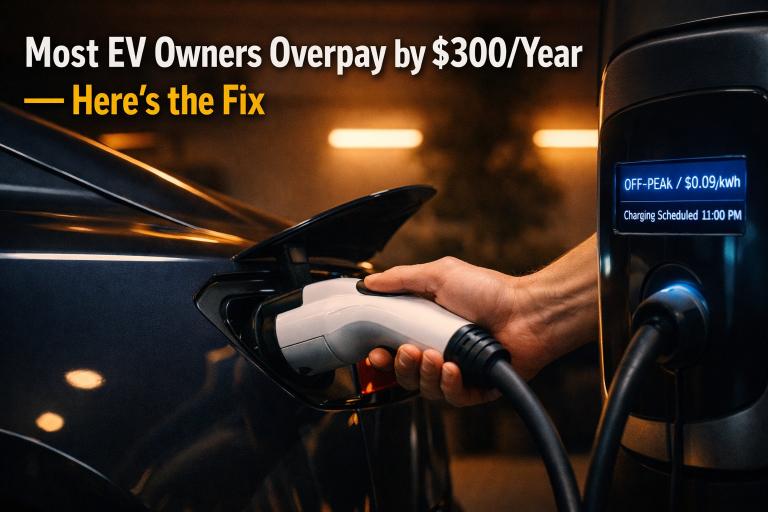
The cheapest way to charge an EV is at home overnight using a Time-of-Use (TOU) electricity rate during off-peak hours — typically between 9 PM and 6 AM. At off-peak TOU rates of $0.08–$0.12/kWh, a typical EV costs $4–$8 per full charge, compared to $18–$34 at a public DC fast charger. Home charging on a standard residential rate ($0.16–$0.18/kWh national average) already saves you 60–70% versus gasoline. Adding a TOU plan and scheduled overnight charging pushes savings even further — most drivers save an additional $15–$30 per month versus unscheduled daytime charging at standard rates.
Savings estimates based on U.S. EIA national average residential electricity rates as of early 2026. Results vary by location, vehicle efficiency, and utility provider.
How Much Does It Cost to Charge an EV? (The Baseline You Need First)
Before any savings strategy makes sense, you need to know what you’re actually paying today. Here’s the honest 2026 picture, based on current U.S. EIA residential rate data and real network pricing — not optimistic estimates.
At the national average residential electricity rate of approximately $0.16–$0.18/kWh, a typical EV with a 60–75 kWh battery costs between $10 and $14 for a full charge at home. For most drivers covering 1,000–1,500 miles per month, that translates to a monthly home charging bill of $35–$60. By contrast, the same mileage in a 30 MPG gas car at $2.94/gallon (AAA national average, February 2026) costs roughly $98–$147 per month. Home EV charging is, therefore, already dramatically cheaper than gasoline — even before optimization.
The real cost gap opens up when you compare charging methods against each other. Public DC fast charging is the expensive exception, not the rule — and that’s where most EV owners silently hemorrhage money they don’t need to spend.
| Charging Method | Avg. Cost per kWh | Full Charge (60 kWh) | Monthly (1,200 mi) | vs. Gasoline |
|---|---|---|---|---|
| Home Level 2 CHEAPEST | $0.16–$0.18 | $10–$14 | $35–$55 | ~65% cheaper |
| Home Level 2 (TOU off-peak) BEST VALUE | $0.08–$0.12 | $5–$8 | $20–$35 | ~80% cheaper |
| Public Level 2 | $0.25–$0.35 | $15–$21 | $55–$90 | ~40% cheaper |
| DC Fast Charge MOST EXPENSIVE | $0.40–$0.55 | $24–$33 | $90–$145 | Roughly equivalent or higher |
| Gasoline (30 MPG) | — | $35 (tank fill) | $98–$147 | Baseline |
The catch is that home charging is only as cheap as your electricity rate — and your local rate may be significantly higher or lower than the national average. That’s exactly why Tip 1 is the most important thing on this list.
Tips 1 & 2: Switch to a TOU Rate and Charge at Night
This is the single biggest lever on your EV charging bill. Everything else on this list is an incremental improvement. Switching to a Time-of-Use rate and scheduling overnight charging is a structural change — and most EV owners haven’t done it yet.
Time-of-Use Electricity Rates: What They Are and How to Get One
A Time-of-Use (TOU) rate is an electricity pricing plan where your utility charges different rates depending on what time you use power. During peak hours — typically 4 PM to 9 PM on weekdays — electricity costs more because grid demand is highest. During off-peak hours — usually 9 PM to 6 AM — it costs significantly less. For EV owners who charge overnight, this is a direct discount built into the billing structure.
The national off-peak TOU rate range is approximately $0.08–$0.12/kWh versus a standard residential rate of $0.16–$0.19/kWh. That gap sounds small, but at typical EV consumption levels it translates to $15–$30 per month in savings — every single month. Utilities offering dedicated EV TOU plans in 2026 include PG&E (California, EV2-A plan), Southern California Edison (TOU-D-5-8PM), Duke Energy (EV-TOU), and Xcel Energy (EV-TOU) — with most major U.S. utilities now offering some form of TOU or EV-specific rate. Call your utility or visit their website and ask specifically about EV rate plans.
Getting on a TOU plan typically takes a single phone call or online rate-change request. Most utilities allow one rate change per year with no penalty. The one tradeoff: if you regularly charge during peak afternoon hours, your bill could increase. However, because most EV charging happens overnight, the vast majority of EV owners benefit substantially from a TOU switch.
Scheduled Charging: Setting It Up on Your EV
Switching to a TOU rate only saves you money if you actually charge during off-peak hours — and that’s where scheduled charging comes in. Every major 2023+ EV supports scheduled departure or off-peak charging natively through the vehicle’s infotainment system or companion app. Tesla, Ford, Hyundai, GM, Rivian, and BMW all offer this feature. You set your target departure time (say, 7 AM), and the car automatically begins charging at the cheapest rate window overnight.
When I set up scheduled charging on a Tesla Model Y last year, the first thing I noticed was that the setup literally takes four minutes — yet I’ve talked to dozens of owners who’ve never touched the feature. If your EV was delivered in the last three years, this is already waiting for you in the settings menu. As a result of switching to TOU + scheduled charging together, a typical driver covering 1,200 miles per month can expect to save $15–$30 monthly versus unscheduled standard-rate daytime charging — roughly $180–$360 annually.
| Monthly Mileage | Standard Rate Cost ($0.18/kWh) | TOU Off-Peak Cost ($0.10/kWh) | Monthly Saving | Annual Saving |
|---|---|---|---|---|
| 800 miles (low) | ~$38 | ~$21 | ~$17 | ~$204 |
| 1,200 miles (avg) MOST DRIVERS | ~$57 | ~$32 | ~$25 | ~$300 |
| 1,800 miles (high) | ~$86 | ~$48 | ~$38 | ~$456 |
Estimates based on 27 kWh/100 miles average EV efficiency. Actual results vary by vehicle and local rates.
Tips 3 & 4: Use Free Charging Networks and Workplace Programs
Free charging won’t replace your home setup — but it’s a genuinely useful supplement that most EV owners walk past every week without noticing. Here’s where to look and how to make it work without wasting your time.
Where to Find Free Public EV Charging in 2026
Retailers and hospitality brands use free EV charging as a customer retention tool. Ikea, Whole Foods, Kohl’s, Target, and Marriott properties are among the brands that regularly offer complimentary Level 2 charging at select locations — typically through Blink or ChargePoint networks. The strategy is simple: you’re going to shop or eat anyway. Plugging in while you do it costs you nothing and recovers 10–20 miles of range per stop.
The most efficient way to find free sessions is the PlugShare app, which lets you filter specifically for “$0” charging sessions. Set your regular routes — grocery store, gym, mall — and check whether any stops on your path offer free L2. Admittedly, free public charging is not a primary strategy for most drivers: session availability varies, speeds are typically limited to Level 2 (3–5 miles per hour of charge), and the locations don’t always align with your schedule. However, as a zero-effort supplement for drivers with flexible routines, it can realistically add 20–60 free miles per week.
Workplace Charging: How to Access and Negotiate It
Employer-provided EV charging is one of the most underused benefits in the EV ownership toolkit. As of 2026, a growing number of U.S. companies — particularly in tech, healthcare, and financial services — have installed Level 2 chargers for employees. If your employer already has them, you may be getting 20–40 miles of range per workday essentially for free, which for a typical commuter represents $15–$35 per month in charging costs that simply disappear.
If your workplace doesn’t have EV chargers yet, the negotiation angle is easier than most employees realize. The Section 30C federal tax credit (currently 30%, up to $1,000 per charging port for businesses) makes EVSE installation financially attractive for employers. Specifically, bringing this to your HR or facilities team as a tax-advantaged employee benefit — not just a personal request — substantially changes the conversation. Three to five EV-owning employees making a joint request, with a one-page cost-benefit summary including the 30C credit, is a genuinely effective approach. Regular workplace L2 access can save a commuting EV driver $200–$420 annually.
Tip 5: Optimize Your Home Charging Setup
If you’re still charging on a standard 120V Level 1 outlet, this tip applies directly to you. For everyone else, there’s still a potential tax benefit worth knowing about that many EV owners miss entirely.
Level 1 vs. Level 2 Home Charging: The Cost Difference
Level 1 and Level 2 home charging cost the same per kWh — because both draw from your residential electricity rate. The difference is efficiency and time. Level 1 (120V) delivers roughly 4–5 miles of range per hour of charging, meaning a full charge from a depleted battery can take 40–50 hours. Level 2 (240V) delivers 25–30 miles per hour, completing a full charge in 6–10 hours. In practice, Level 1 users who can’t complete a full overnight charge often turn to public fast charging to make up the gap — and that’s where the cost difference becomes very real.
A Level 2 charger installation in 2026 typically runs $400–$1,200 installed by a licensed electrician, depending on your panel’s current setup and the distance from the panel to the charging location. According to Qmerit, costs start around $799 and can exceed $3,000 if a panel upgrade is required. For a driver currently paying $0.45/kWh at a public fast charger twice per week to compensate for slow home charging, the payback on a Level 2 installation is typically 12–24 months — after which every session is cheaper.
Federal Tax Credit for Home EV Charger Installation
The Section 30C Qualified Alternative Fuel Vehicle Refueling Property Credit provides a 30% tax credit on home EV charger installation costs, up to $1,000 for residential use. As of early 2026, this credit is available for installations in eligible census tracts (low-income or non-urban areas — check IRS.gov for current eligibility rules, as the geographic requirement was added under the Inflation Reduction Act). Several states also offer stacking rebates: California, New York, Colorado, and Massachusetts all have utility or state-level EV charger rebate programs that can reduce your net installation cost by an additional $200–$500.
This is the mistake I made when I first set up my home charger — I didn’t check the state rebate before scheduling installation. After rebates and the federal credit, the net out-of-pocket on a standard Level 2 installation in an eligible location can drop to $200–$500, which changes the payback math dramatically.
Tips 6 & 7: Smart Charging Habits That Cut Costs Without Effort
These last two tips cost nothing to implement. No hardware, no rate changes, no negotiating with employers. They’re behavioral adjustments that compound quietly over months and years — and they’re the ones most drivers consistently overlook.
Charge to 80%: Why It Saves Money and Protects Your Battery
Every article on EV charging recommends stopping at 80% for battery longevity. I agree — but here’s the data point that actually changed my own behavior: DC fast charging networks price their sessions on a curve. Because lithium-ion cells charge faster when they’re below 80% state of charge (SOC), the cost per delivered kWh rises steeply above that threshold. On Electrify America’s per-minute pricing, charging from 80% to 100% can cost 40–60% more per kWh than charging from 10% to 80%. That’s not a rounding error — it’s a real and avoidable expense.
At home, the battery longevity argument is the primary reason to default to 80% — specifically for NMC chemistry batteries (most non-Tesla, non-BYD EVs). LFP batteries (standard Tesla Model 3/Y RWD, many Chinese EVs) are designed for regular 100% charges and do not require the 80% limit. Knowing your battery chemistry matters here. For drivers who routinely charge a 75 kWh NMC battery to 100% at public fast chargers twice weekly, switching to 80% stops can realistically save $8–$15 per month and meaningfully extend long-term battery health.
Pre-Conditioning and Trip Planning: Reducing Unnecessary Charging Stops
Battery pre-conditioning — warming or cooling the battery to optimal temperature before a DC fast charge session — is a feature on most 2022+ EVs (including Tesla, Hyundai Ioniq 5/6, Kia EV6, and others). A pre-conditioned battery accepts charge faster, which means shorter session times and therefore lower per-minute billing on networks that charge by time. On a 30-minute highway fast charge stop, pre-conditioning can reduce session time by 5–10 minutes — which at $0.40–$0.55/minute translates to $2–$5.50 saved per stop.
Trip planning with your EV’s native planner (or a third-party tool like A Better Route Planner) helps you charge only what you need rather than topping up to maximum available capacity at every stop. The principle is simple: charge to reach your next stop comfortably, not to maximum. Because fast charging slows significantly above 80% SOC, over-charging wastes both time and money on every stop. Specifically, planning charge stops at 20–80% SOC keeps you in the fastest, cheapest part of the charging curve for the entire trip.
| Tip | Monthly Saving Potential | Effort Level | Best For |
|---|---|---|---|
| 1. Switch to TOU Rate | $15–$30 HIGHEST | One-time setup | All home chargers |
| 2. Scheduled Overnight Charging | Included in Tip 1 | 5-min setup | All 2022+ EVs |
| 3. Free Public Charging | $0–$15 (variable) | Low — route-dependent | Flexible-schedule drivers |
| 4. Workplace Charging | $15–$35 | Medium (negotiate once) | Office commuters |
| 5. Upgrade to Level 2 | $10–$25 (vs. public top-ups) | One-time install | Level 1 users |
| 6. Charge to 80% | $8–$15 (fast charge users) | Zero | Regular DCFC users |
| 7. Pre-Conditioning + Trip Planning | $5–$12 (road trip users) | Low — app-based | Long-distance drivers |
Cheapest Charging by Scenario: Which Tips Apply to You
Not every tip on this list applies to every driver. Here’s how to prioritize based on your actual situation — because a generic tips list that doesn’t tell you where to start isn’t useful.
🏠 Primarily Home Charger
- First: Switch to TOU rate + set scheduled overnight charging (Tips 1 & 2)
- Second: Default to 80% charge limit (Tip 6)
- Third: Upgrade to Level 2 if still on Level 1 (Tip 5)
- Full-stack potential saving: $25–$50/month
⚡ Heavy Public Charging User
- First: Identify free L2 stations on your regular routes (Tip 3)
- Second: Stop at 80% SOC on every DCFC session (Tip 6)
- Third: Enable pre-conditioning before fast charge stops (Tip 7)
- Full-stack potential saving: $20–$45/month
🆕 New EV Owner — Start Here
- First: Install Level 2 charger at home (Tip 5 — claim 30C tax credit)
- Second: Switch to TOU rate immediately (Tip 1)
- Third: Set up scheduled charging in your app (Tip 2)
- Fourth: Set 80% charge limit as default (Tip 6)
- Full-stack potential saving: $30–$55/month vs. unoptimized
James’s recommendation: If you do only one thing from this list, do Tip 1. Call your utility tomorrow morning and ask specifically about EV Time-of-Use rate plans. It takes 10 minutes to set up, it’s free to switch, and it delivers the largest single reduction in your monthly charging bill of any strategy on this list. Everything else is incremental. That said, if you’re a new owner, the correct priority sequence is: Level 2 install → TOU rate → scheduled charging → 80% default. Done in that order, those four steps alone can cut your charging costs by 50–65% compared to what most unoptimized EV owners pay.
FAQ: Cheapest Way to Charge an EV
What is the cheapest way to charge an EV at home?
The cheapest way to charge an EV at home is to switch to a Time-of-Use (TOU) electricity rate and schedule your charging during off-peak hours — typically 9 PM to 6 AM. Off-peak TOU rates average $0.08–$0.12/kWh nationally, compared to a standard residential rate of $0.16–$0.18/kWh. For a typical driver covering 1,200 miles per month, that difference saves $15–$30 per month, or $180–$360 annually, with no change in charging hardware required.
Is it cheaper to charge an EV at home or at a public station?
Home charging is cheaper in almost every scenario. At the national average residential rate of $0.16–$0.18/kWh, a full 60 kWh home charge costs $10–$11. Public Level 2 charging averages $0.25–$0.35/kWh ($15–$21 per full charge), and DC fast charging runs $0.40–$0.55/kWh ($24–$33 per full charge). Home charging on a TOU off-peak rate is approximately 3.4 times cheaper than public DC fast charging — which is why relying on fast chargers as your primary source is the single most expensive EV charging mistake you can make.
How can I get free EV charging?
Free public Level 2 charging is available at many retail and hospitality locations — Ikea, Whole Foods, Kohl’s, select Marriott properties, and Blink network partner sites among them. The PlugShare app lets you filter specifically for free ($0) charging sessions in your area. Free charging works best as a supplement to your home setup, not a replacement — speeds are typically limited to Level 2, and availability is location-dependent. Workplace charging is the other major free charging source: if your employer has EVSE, regular use can save a commuting driver $15–$35 per month.
Does charging to 100% cost more at a public fast charger?
Yes — significantly more on per-minute pricing networks. Because lithium-ion batteries charge much slower above 80% state of charge, the cost per delivered kWh rises steeply in that final 20%. On networks like Electrify America that bill by the minute, charging from 80% to 100% can cost 40–60% more per kWh than the 10–80% range. Stopping at 80% on every public fast charge session saves most regular DCFC users $8–$15 per month — and extends NMC battery longevity at the same time. For LFP batteries (standard in Tesla Model 3 RWD and several Chinese EVs), 100% daily charging is acceptable by design and does not carry the same degradation risk.
The single most important thing to take from this article: your electricity rate is a variable, not a fixed cost — and most EV owners treat it like a fixed cost. Switching to a TOU plan and charging overnight is not a complex optimization. It’s a 10-minute phone call and a 4-minute settings change on your car. After that, every other tip on this list is incremental savings on top of an already strong foundation. Stack two or three of them, and the difference between an optimized and unoptimized EV charging setup is $300–$600 per year — quietly back in your pocket.