
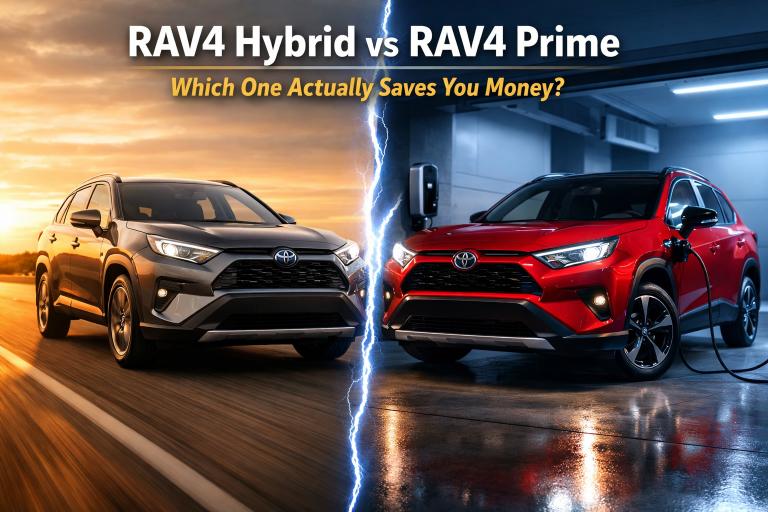
Last Updated: May 2026 — US and Canadian pricing, EPA fuel economy data (fueleconomy.gov), IRS Clean Vehicle Credit rules, Natural Resources Canada
The RAV4 Hybrid vs RAV4 Prime question comes down to one variable most comparison articles skip: how often you will actually plug the Prime in. Both Toyota’s hybrid and its plug-in hybrid share the same body, the same interior, and broadly the same DNA — but the financial case for the Prime rests entirely on whether it regularly runs on electricity rather than petrol. Charge it daily and the maths shifts in the Prime’s favour. Never charge it and you have paid a $9,500 premium for a car that delivers roughly the same fuel economy as the Hybrid, weighs more, tows less, and carries slightly less cargo.
This article runs the actual numbers — US and Canadian — at three charging frequencies, across three tax credit scenarios, to give you a break-even figure that reflects your situation rather than a dealer’s best case.

RAV4 Hybrid vs RAV4 Prime — Which Saves More Money? Summary:
The RAV4 Hybrid saves more money for most buyers in most situations. At US average fuel and electricity prices, the Prime’s $8,500–10,000 price premium takes 10–17 years to recover through fuel savings even if you charge it daily — and never recovers if you charge infrequently. The Prime becomes the financially correct choice only when three conditions align: you charge at home at least 4–5 times per week, your commute is under 68 km (42 mi) so most daily miles run on electricity, AND you qualify for and receive a meaningful tax credit ($3,750+). In Canada with active provincial rebates, the Prime can break even in under 5 years for daily chargers. One often-overlooked dealbreaker for the Prime: its towing capacity is 2,500 lbs versus the Hybrid’s 3,500 lbs — 1,000 lbs less.
The Price Gap: What You’re Paying Extra For
The RAV4 Prime costs more than the RAV4 Hybrid at every comparable trim level. The premium is not small — it sits around $8,500 to $10,000 at the trims most buyers actually purchase:
| Trim (US MSRP, 2026) | RAV4 Hybrid | RAV4 Prime | Prime Premium |
|---|---|---|---|
| Entry / SE | $31,250 (LE) | $42,100 (SE) | +$10,850 |
| Mid / XSE | $36,875 (XLE Premium) | $45,000 (XSE) | +$8,125 |
| Upper / XSE Premium | $42,325 (Limited) | $49,900 (XSE Premium) | +$7,575 |
What does that premium buy? Mechanically: a larger battery (18.1 kWh total, ~14.4 kWh usable), a more powerful electric motor that gives the Prime combined system output of 302 hp versus the Hybrid’s 219 hp, and the ability to plug into a household outlet or Level 2 charger to replenish that battery. The Prime’s EPA-rated all-electric range is 42 miles (68 km) — enough to cover a daily commute in one charge for most North American drivers whose average round-trip sits around 30 to 50 km.
What the premium does not buy: more cargo space (the Prime has less — the battery pack claims floor space under the rear cargo area), a higher towing rating (lower, by 1,000 lbs), or better fuel economy when running on petrol (essentially identical to the Hybrid at 36 vs 35 mpg combined). The Prime’s advantages are EV range and power. Everything else is a trade-off, not an upgrade.
Running Costs: The Three Charging Scenarios
The RAV4 Prime’s financial case is not fixed — it shifts dramatically based on how often you charge it. The following calculations use US average assumptions: $3.50/gallon for petrol and $0.15/kWh for electricity, at 15,000 miles (24,140 km) annual mileage. Three realistic charging patterns:
Scenario A — Daily charger: charges at home every night, commute under 42 miles each way. The Prime runs approximately 80 percent of its annual miles on electricity.
Scenario B — Occasional charger: plugs in roughly 3 to 4 times per week. Roughly 50 percent of annual miles on electricity. The pattern for someone with home charging but irregular habits, or workplace charging only.
Scenario C — Rarely charges: plugs in once a week or less. Around 20 percent of annual miles on electricity. Common for Prime owners without home charging who depend on public charging they do not seek out consistently.
| Vehicle / Scenario | Annual Gas Cost | Annual Electricity Cost | Total Annual Energy | Saving vs Hybrid |
|---|---|---|---|---|
| RAV4 Hybrid (35 mpg, no plugging in) |
$1,500 | — | $1,500/yr | — |
| RAV4 Prime — Scenario A Daily charger (80% EV miles) |
$292 | $644 | $936/yr | $564/yr |
| RAV4 Prime — Scenario B Occasional charger (50% EV miles) |
$729 | $403 | $1,132/yr | $368/yr |
| RAV4 Prime — Scenario C Rarely charges (20% EV miles) |
$1,167 | $161 | $1,328/yr | $172/yr |
The range of annual savings — $172 to $564 — is striking. A Prime owner who charges daily saves nearly five times as much per year as one who rarely plugs in. The fuel economy difference between a Hybrid running on petrol and a Prime running mostly on petrol is modest: the Prime’s extra battery weight slightly reduces its thermal-engine efficiency, so the “rarely charges” Prime is marginally more expensive to run than the Hybrid.
Tax Credits and Rebates: The Variable That Changes Everything
The tax credit is the single variable that most dramatically changes the Prime’s financial case. The RAV4 Hybrid qualifies for no federal clean vehicle credit in the US or Canada. The RAV4 Prime, as a plug-in hybrid, does — subject to conditions that vary by year, jurisdiction, and buyer income.
United States: IRS Clean Vehicle Credit
Under current IRS rules (post-Inflation Reduction Act), the RAV4 Prime qualifies as a new clean vehicle credit vehicle. The available credit for PHEVs is based on battery capacity: vehicles with 7 to 14.9 kWh of battery receive $3,750; vehicles with 15 kWh or more receive $7,500. The RAV4 Prime has a 14.4 kWh usable battery (18.1 kWh total). Toyota’s North American assembly and battery sourcing determines whether the full $7,500 or partial $3,750 applies in any given model year — this has varied between $3,750 and $7,500 for different RAV4 Prime production runs. Check the current eligibility at fueleconomy.gov for the specific VIN before purchase.
The credit also has income caps: $150,000 for single filers, $300,000 for joint filers. Buyers above those thresholds do not qualify. The RAV4 Prime’s MSRP ($42,100–$49,900) falls under the $80,000 MSRP cap for SUVs and trucks, so the vehicle itself qualifies when sourcing requirements are met.
Canada: iZEV and Provincial Rebates
The RAV4 Prime has a 68 km all-electric range, which exceeds the 50 km threshold for PHEVs under Canada’s iZEV incentive program. When the iZEV program is active, the RAV4 Prime qualifies for C$2,500 (PHEVs receive the reduced PHEV rate, not the full EV rate). The iZEV program has been paused as of early 2025 — verify current status at tc.gc.ca before purchase.
Provincial rebates add significantly to the Canadian case, particularly in Quebec and British Columbia:
| Province | RAV4 Prime Provincial Rebate | Federal iZEV (when active) | Total Potential Rebate | Effective Premium After Rebates |
|---|---|---|---|---|
| Quebec | C$4,000 (PHEV ≥50 km) | C$2,500 | C$6,500 | ~C$2,500 |
| British Columbia | C$4,000 (CleanBC) | C$2,500 | C$6,500 | ~C$2,500 |
| Prince Edward Island | C$5,000 | C$2,500 | C$7,500 | ~C$1,500 |
| Nova Scotia | C$3,000 | C$2,500 | C$5,500 | ~C$3,500 |
| Ontario | C$0 | C$2,500 | C$2,500 | ~C$6,500 |
| Alberta / Saskatchewan / Manitoba | C$0 | C$2,500 | C$2,500 | ~C$6,500 |
Break-Even Analysis: When (If Ever) the Prime Pays Off
Break-even is the number of years of ownership required before the Prime’s fuel savings fully repay its price premium. The calculation is: price premium ÷ annual fuel saving. If the answer is longer than you plan to own the car, the Prime does not save you money — it costs you money.
| Scenario | Effective Premium | Annual Saving | Break-Even (Years) | Verdict |
|---|---|---|---|---|
| US — Daily charger, no credit $3.50/gal, $0.15/kWh |
$9,500 | $564/yr | 16.8 years | Hybrid wins for most owners |
| US — Daily charger, $3,750 credit $3.50/gal, $0.15/kWh |
$5,750 | $564/yr | 10.2 years | Borderline — depends on ownership horizon |
| US — Daily charger, $7,500 credit $3.50/gal, $0.15/kWh |
$2,000 | $564/yr | 3.5 years | Prime wins — clear financial case |
| US — Occasional charger, $3,750 credit $3.50/gal, $0.15/kWh |
$5,750 | $368/yr | 15.6 years | Hybrid wins |
| US — Rarely charges, any credit $3.50/gal, $0.15/kWh |
$9,500–$2,000 | $172/yr | 11.6–55 years | Hybrid wins — no scenario works |
| Canada — Daily charger, Quebec/BC rebates C$1.70/L, C$0.12/kWh |
C$2,500 | C$1,322/yr | 1.9 years | Prime wins decisively |
| Canada — Daily charger, no rebate (Alberta/SK) C$1.70/L, C$0.12/kWh |
C$9,000 | C$1,322/yr | 6.8 years | Prime wins — if you keep it 7+ years |
| Canada — Occasional charger, no rebate C$1.70/L, C$0.12/kWh |
C$9,000 | C$861/yr | 10.5 years | Borderline |
The conclusion the table forces: without a meaningful tax credit (US) or provincial rebate (Canada), the Prime only makes financial sense for daily chargers who plan to own the vehicle for at least 7 to 10 years. In Canada with active provincial rebates — Quebec’s C$4,000 or BC’s C$4,000 stacked on a federal C$2,500 — the Prime’s break-even drops below 2 years. That is a genuinely compelling case. In Ontario with no provincial rebate and an iZEV program that has been paused, the same daily charger is looking at 6.8 years just to break even — reasonable but not a slam dunk.
For a broader framework on how to model 5-year vehicle ownership costs across hybrid, PHEV, and EV options, our gas vs hybrid vs EV SUV 5-year cost comparison runs the same rigour across more powertrain types.
The Prime Trap: What Happens If You Don’t Charge It
The RAV4 Prime is one of the best-selling PHEVs in North America. It is also, based on usage telemetry from multiple markets, one of the most-bought PHEVs that owners then undercharge. Studies from the International Council on Clean Transportation found that a significant proportion of PHEV owners in the US charge less than once a week. At that frequency, the Scenario C numbers above apply — $172/year in savings against a $9,500 premium. You will own that car for 55 years before the fuel savings repay the premium.
The pattern is predictable: buyers purchase the Prime for the EV range, discover their apartment building has no charging, their workplace parking is not equipped, and public Level 2 chargers require apps and payment that add friction. Within 6 months, the Prime is running on its petrol engine almost exclusively. It weighs about 300 lbs more than the Hybrid (4,515 lbs vs 4,235 lbs) because of the battery, and its petrol fuel economy — 36 mpg combined — is marginally worse than the Hybrid’s 35 mpg at a similar price point before discounts.
Beyond Fuel Costs: Performance, Cargo, and the Towing Gap

The financial analysis above only captures fuel costs. Four other specifications separate the two RAV4 variants in ways that may matter more than the fuel bill depending on how you use the car.
Power: The Prime Wins by a Significant Margin
The RAV4 Prime produces 302 hp combined from its petrol engine and electric motors. The RAV4 Hybrid produces 219 hp. That 83 hp difference is felt: the Prime reaches 100 km/h in approximately 5.7 seconds; the Hybrid in approximately 7.8 seconds. For most family SUV buyers these numbers are academic, but the Prime genuinely drives like a performance vehicle in a way the Hybrid does not. If driving character matters to you, the Prime’s extra cost buys real performance, not just economy.
Towing Capacity: The Hybrid Wins — and This Often Decides the Purchase
The RAV4 Hybrid is rated for 3,500 lbs (1,587 kg) towing. The RAV4 Prime is rated for 2,500 lbs (1,134 kg). The 1,000 lb gap is not a rounding difference — it is the difference between towing a small boat (typically 1,500 to 2,500 lbs), a small camper trailer, or a loaded utility trailer and not being able to tow those things within the rated capacity. Any RAV4 buyer who tows regularly should consider the Hybrid unless their load is consistently under 2,500 lbs.
Toyota has not publicly explained the Prime’s lower tow rating, but it relates to the different rear suspension and axle load distribution caused by the battery placement. The result is a practical limitation that most comparison articles mention in a footnote rather than a headline. It belongs in a headline.
Cargo Space: The Hybrid Has More
The RAV4 Hybrid offers 37.6 cubic feet of cargo space behind the rear seats and 69.8 cubic feet with the seats folded. The RAV4 Prime offers 33.5 cubic feet and 65.7 cubic feet respectively. The difference — 4.1 cubic feet behind the rear seats — is real, caused by the high-voltage battery pack mounted under the rear cargo floor. For buyers who regularly load the full boot, this is a meaningful daily trade-off.
Full Specification Comparison
| Specification | RAV4 Hybrid | RAV4 Prime | Advantage |
|---|---|---|---|
| Combined system power | 219 hp | 302 hp | Prime |
| 0–100 km/h | ~7.8 sec | ~5.7 sec | Prime |
| EPA fuel economy (petrol mode) | 35 mpg combined | 36 mpg combined | Roughly equal |
| All-electric range | None (~1–2 km crawl) | 42 miles / 68 km | Prime |
| Towing capacity | 3,500 lbs (1,587 kg) | 2,500 lbs (1,134 kg) | Hybrid |
| Cargo (behind rear seats) | 37.6 cu ft / 1,065 L | 33.5 cu ft / 949 L | Hybrid |
| Kerb weight | ~4,235 lbs (1,921 kg) | ~4,515 lbs (2,048 kg) | Hybrid (lighter) |
| AWD | Standard (all trims) | Standard (all trims) | Equal |
| Battery warranty | 8 yr / 100,000 mi | 8 yr / 100,000 mi | Equal |
| Base MSRP (US) | $31,250 | $42,100 | Hybrid |
Who Should Buy Which
Buy the RAV4 Hybrid If…
- You do not have reliable home charging — without it, the Prime’s fuel savings drop to $172/year and the $9,500 premium never recovers in a reasonable ownership window
- You regularly tow a trailer, boat, or camper — the Hybrid’s 3,500 lb rating vs the Prime’s 2,500 lb rating is a concrete capability difference, not a footnote
- You need maximum cargo flexibility — 4.1 cubic feet more behind the rear seats matters for regular long-load use
- You do not qualify for the US federal credit (income limits, sourcing rules) and live in Ontario, Alberta, or another province with no PHEV rebate — the Hybrid’s financial case improves significantly without the rebate to offset the Prime’s premium
- Your ownership horizon is 3 to 5 years — even best-case, the Prime needs 7+ years to break even without a substantial credit
- You want the most proven, simpler drivetrain — the Hybrid’s technology has been refined across multiple generations since 2005; the Prime’s larger battery and plug-in system adds complexity
Buy the RAV4 Prime If…
- You have or will install Level 2 home charging before taking delivery — this is the non-negotiable condition; the Prime’s financial case is built on daily home charging
- Your daily commute is under 68 km round trip at least 4 days per week — most of your daily miles will run on electricity rather than petrol
- You are in Quebec or British Columbia — C$6,500 in combined rebates brings the effective premium down to ~C$2,500, and break-even for a daily charger falls under 2 years
- You qualify for the US federal clean vehicle credit ($3,750 or $7,500) — this changes a 17-year break-even into a 3.5 to 10-year one
- The 302 hp matters to you — the Prime drives meaningfully better than the Hybrid and that performance difference has value independent of the fuel savings calculation
- You want HOV lane access in eligible US states (California, Virginia, others) — the Prime qualifies for clean vehicle HOV access where available
FAQ: RAV4 Hybrid vs RAV4 Prime
Is the RAV4 Prime worth the extra money over the Hybrid?
It depends on three things: whether you have home charging, your daily commute length, and whether you qualify for a tax credit or rebate. At US average fuel and electricity prices with no federal credit, a daily-charging Prime takes approximately 17 years to break even on its $9,500 premium over a comparable Hybrid — and most buyers do not own cars for 17 years. With a $3,750 credit, break-even falls to about 10 years. With the full $7,500 credit and daily charging, it falls to 3.5 years — a clear financial win. In Canada with Quebec or BC rebates bringing the effective premium to C$2,500, a daily charger breaks even in under 2 years. Without home charging, or if you charge infrequently, the Hybrid is the financially rational choice in almost every scenario.
What is the real-world fuel economy of the RAV4 Prime?
The RAV4 Prime’s real-world fuel economy depends almost entirely on charging behaviour. A daily charger who keeps most miles on electricity can achieve effective fuel economy of 80 to 150 MPGe when electricity cost is factored in — dramatically better than the Hybrid’s 35 mpg. The same Prime owner who charges infrequently will see real-world fuel economy of approximately 34 to 36 mpg on petrol — marginally worse than the Hybrid’s 35 mpg because the battery adds about 300 lbs of mass. The EPA’s 94 MPGe combined rating assumes the mix of electric and petrol driving typical of average US usage patterns; your actual figure will vary significantly based on commute length and charging frequency.
Can the RAV4 Prime drive on electricity only?
Yes. The RAV4 Prime has a dedicated EV mode that runs on electricity only up to the EPA-rated 42 miles (68 km) of all-electric range. In EV mode, the petrol engine remains off as long as battery charge is available and driving conditions do not demand peak power beyond what the electric motor alone can deliver. Above approximately 105 mph or during very hard acceleration, the petrol engine will engage regardless of battery state. For typical daily driving — city streets, residential roads, light highway — EV mode operates as advertised for the rated range.
Why does the RAV4 Prime tow less than the Hybrid?
The RAV4 Prime is rated for 2,500 lbs of towing compared to the Hybrid’s 3,500 lbs. Toyota has not published a detailed technical explanation, but the likely cause is a combination of factors: the battery pack’s placement alters rear axle load distribution, the Prime is approximately 280 lbs heavier which reduces the available gross combined vehicle weight for towing, and the Prime’s rear suspension is tuned differently to accommodate the battery weight. The 1,000 lb difference is meaningful in practice. A small aluminium fishing boat with trailer typically weighs 1,200 to 2,500 lbs; a jet ski with trailer runs 1,000 to 2,000 lbs. Buyers who need to tow anything regularly should check their specific load against the 2,500 lb rating before choosing the Prime over the Hybrid.
Does the RAV4 Prime qualify for federal tax credits?
In the US, the RAV4 Prime qualifies as a clean vehicle under the Inflation Reduction Act’s clean vehicle credit program. The available credit — $3,750 or $7,500 — depends on whether the vehicle’s battery components and critical minerals meet North American sourcing requirements, which has varied by production year. Verify the specific VIN against current IRS and fueleconomy.gov eligibility lists before purchase, as sourcing compliance can change within a model year. Income caps apply: $150,000 for single filers, $300,000 for joint filers. The RAV4 Prime’s MSRP falls under the $80,000 cap for SUVs. In Canada, the iZEV program covers PHEVs with ≥50 km EV range (which the Prime’s 68 km meets) at C$2,500 when active — verify current status at tc.gc.ca.