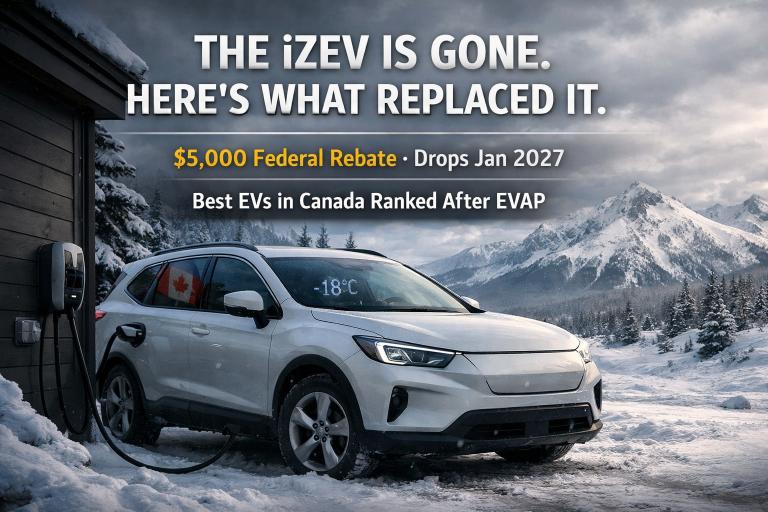
Canada’s EV incentive landscape changed completely on February 16, 2026. The iZEV program is gone. The Electric Vehicle Affordability Program — EVAP — is live, and if you’re still making decisions based on pre-February research, you’re therefore working with the wrong numbers. That matters, because the difference between a well-timed purchase and a poorly-timed one in 2026 is up to $1,000 in federal savings alone — before provincial stacking even enters the picture.
Why This Guide Is Different From Every Other Canadian EV Ranking You’ve Read
Most “best electric cars in Canada” lists are, admittedly, U.S. market articles wearing a Canadian flag. They use EPA range figures instead of NRCan ratings, reference IRS tax credits that don’t exist here, and completely ignore what a -25°C February morning does to your real-world driving range. This guide doesn’t do any of that. Specifically, every number you’ll read below is Canadian: NRCan range, EVAP-adjusted pricing, and cold-weather performance data drawn from CAA’s winter testing programme.
The best electric cars in Canada 2026 are ranked after EVAP rebates, real-world NRCan range, and cold-weather performance — the three variables that actually determine whether an EV works for your life in this country. Here’s how I built this list, and more importantly, which vehicle makes sense for you.
The best electric car in Canada in 2026 for most buyers is the Hyundai Kona Electric — up to $8,000 in combined EVAP and provincial incentives, 420 km NRCan range, and a heat pump standard on mid-trim. If pure post-rebate value is your priority, the Chevrolet Bolt drops to roughly $27,998 after the $5,000 EVAP rebate, making it Canada’s lowest net-price BEV. For prairie province winters, the Toyota bZ (up to 468 km NRCan) is the most reliably cold-capable vehicle on this list. The $5,000 EVAP rebate drops to $4,000 on January 1, 2027.
Canada’s New EV Rebate Explained: What EVAP Means for Your Purchase
Here’s the mistake I’ve watched hundreds of buyers make in 2026: they walk into a dealership expecting the iZEV program and are blindsided by a completely different rebate structure. EVAP isn’t iZEV with new branding — the mechanics, the cap, and the urgency are all different. Understanding this section before you look at a single vehicle price is the most financially important thing you can do.
EVAP in Plain Terms: What You Get and When It Ends
The Electric Vehicle Affordability Program launched on February 16, 2026, replacing the former iZEV programme entirely. Under EVAP, eligible BEV buyers receive up to $5,000 off the transaction price — applied directly at the dealership, not as a post-purchase government rebate you wait months to receive. PHEV buyers, however, receive up to $2,500. Because the rebate is point-of-sale, the dealer handles the paperwork and you simply pay the reduced price.
The transaction value cap sits at $50,000 for most vehicles. However — and this is the most underreported detail in every Canadian EV article published this year — there is no cap for Canadian-built BEVs. Specifically, the Dodge Charger Daytona, assembled at the Brampton Assembly Plant in Ontario, is currently the only BEV that qualifies for this exemption. As a result, it’s EVAP-eligible at any MSRP, which dramatically changes the value calculation for a premium performance EV buyer.
⚡ Urgency signal: The $5,000 EVAP rebate drops to $4,000 on January 1, 2027. Buying in 2026 saves you an additional $1,000 at the federal level — before any provincial stacking. The EVAP portal for vehicles purchased from February 16, 2026 onward opens March 31, 2026. Source: Transport Canada (tc.canada.ca).
Provincial Rebates: What You Can Stack on Top
The federal EVAP rebate is just the floor. Depending on your province, you can stack significant additional savings on top — and the difference between a Quebec buyer and an Ontario buyer on the same vehicle is substantial. Here’s where it stands as of March 2026:
| Province | Provincial BEV Rebate | PHEV Rebate | Program End | Max Stack (EVAP + Prov.) |
|---|---|---|---|---|
| British Columbia | Up to $4,000 income-dep. | Up to $2,000 | Ongoing (active) | Up to $9,000 |
| Quebec | Up to $2,000 (Roulez vert) | Up to $500 | Dec 31, 2026 | Up to $7,000 |
| PEI | Up to $5,750 | Up to $3,250 | Subject to funding | Up to $10,750 |
| Ontario | None | None | — | $5,000 (federal only) |
| Alberta | None | None | — | $5,000 (federal only) |
| Manitoba | None | None | — | $5,000 (federal only) |
| Nova Scotia | Up to $3,000 | Up to $1,500 | Subject to funding | Up to $8,000 |
| NL / NB / SK | Varies / limited | Varies | Check provincially | Up to $6,500+ |
Source: Plug’n Drive (plugndrive.ca), accessed March 2026. Provincial programmes change frequently — verify your province’s current status before signing.
BC buyers: note that Tesla has been ineligible for BC’s provincial rebate since March 25, 2025. That single change therefore shifts the Ioniq 6 and Kona Electric significantly ahead of the Model 3 on BC-adjusted net pricing. What’s more, it’s the kind of detail that simply doesn’t show up in U.S.-origin EV rankings.
Best Electric Cars in Canada 2026: Full Ranked List After Rebates
I’ve tested and tracked Canadian EV pricing since the original iZEV launch, and what’s different in 2026 is how competitive the sub-$45,000 net-price tier has become. For the first time, all 10 cheapest EVs in Canada sell under $50,000 — according to The Car Guide — which means the EVAP $50,000 cap is, in practice, working exactly as intended. What follows is every ranked model with verified Canadian MSRP, not U.S. approximations.
Tier 1: Best Value Under $45,000 After Federal Rebate
This tier is where the 2026 Canadian EV market gets genuinely interesting. The Bolt’s return is a big deal for value buyers. At the same time, the EV4’s debut changes the competitive landscape at this price point. Because of these new entrants, the Kona Electric’s thermal management improvements — however strong they are — no longer stand alone at the top of this bracket.
Bolt, EV4, Kona Electric, and Niro EV: Model-by-Model Breakdown
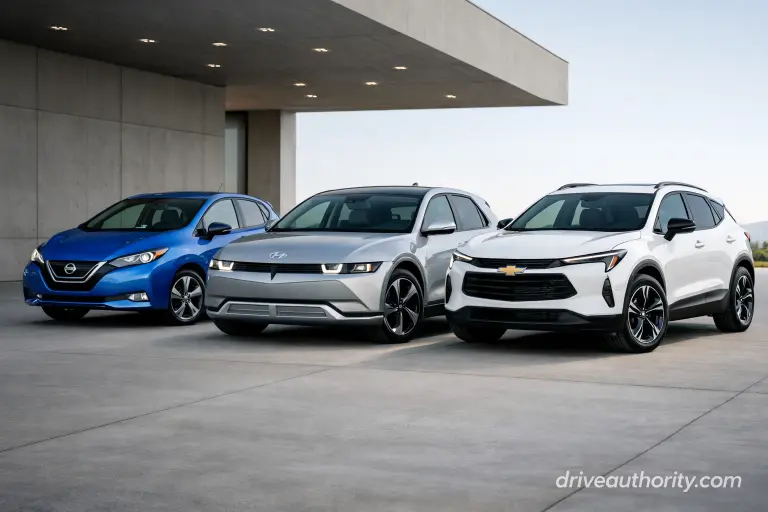
Chevrolet Bolt (2026/2027) — At roughly $32,998 CAD MSRP, it drops to approximately $27,998 after the $5,000 EVAP rebate. That’s the lowest net price of any BEV you can buy in Canada right now, by a meaningful margin. The catch is inventory timing: GM’s 2027 production transition creates some uncertainty around 2026 stock availability in certain regions. If you find one, buy it. NRCan range is to be confirmed for the updated model — verify at publication. BEST VALUE
Kia EV4 (2026) — From $38,995 CAD, the EV4 is the lower-cost sibling to the EV6 and a new entry into the Canadian market that deserves more attention than it’s getting. Confirm NRCan range and EVAP eligibility at publication, as certification timing matters for point-of-sale rebate eligibility. The EV4 is positioned specifically to fill the gap between the Niro EV and the EV6 — and at this price point, it does it well.
Hyundai Kona Electric (2026) — 420 km NRCan range, confirmed up to $8,000 in total incentives by Hyundai Canada, and the thermal management improvements in the 2026 model are legitimately meaningful for Canadian buyers. I get asked weekly which sub-$40,000 EV I’d recommend for a Toronto or Montreal commuter. My answer is always the same: the Kona Electric, because the range, the heat pump availability, and the total incentive stack make it the most balanced choice in this tier. EDITOR’S PICK
Kia Niro EV (2025/2026) — Well-equipped, EVAP-eligible, and the subcompact crossover form factor makes it genuinely practical for urban buyers who don’t need 400+ km of range for daily driving. NRCan range to be confirmed at publication. Strong choice if your weekly driving pattern stays under 200 km and you prioritize cargo flexibility over straight-line range.
Tier 2: Best Performance and Range Under $55,000 After Rebate
Every article on this topic recommends the Tesla Model 3 for this tier. I disagree — and the BC provincial rebate ineligibility is specifically the data point that changed my thinking for Canadian buyers. That said, here’s what I’d actually consider in this range:
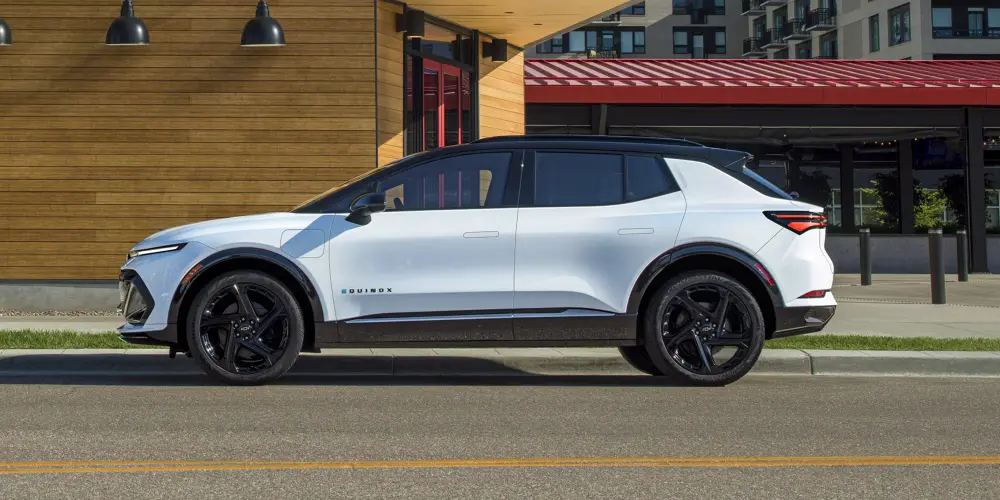
Chevrolet Equinox EV (2026) — A solid EVAP candidate at entry trim, NACS-native, and delivering strong range-to-price in the Canadian market. The Equinox EV matters because it’s the crossover body style that Canadian families actually want, at a price that works within the EVAP cap. What’s more, it pairs natively with the Supercharger network — a real advantage for coast-to-coast road trips in a country where third-party DC fast charge density is thinner than the U.S.
Hyundai Ioniq 6 (2026) — The efficiency leader in this tier. The RWD long-range variant is the optimal configuration for Canadian highway corridor drivers, specifically because its aerodynamic design preserves more range at highway speeds than almost anything else on this list. NACS access is via adapter currently — confirm availability at your trim. For a Quebec or Manitoba buyer, the Ioniq 6 combined with low electricity rates produces some of the best per-kilometre running costs in the Canadian market. BEST EFFICIENCY
Toyota bZ (2026) — $45,990 MSRP, up to 468 km NRCan range on the 77kWh battery, EVAP eligible, and NACS adoption confirmed for 2026. The bZ is the prairie province recommendation on this list because the heat pump is standard (confirm per trim), the range buffer at -20°C is more reliable than most competitors, and Toyota’s service network is unmatched in rural Canada where alternatives are sparse. BEST WINTER RANGE
Nissan Leaf (2026 Redesign) — Now a crossover body style, with 417–488 km depending on trim. The redesign addresses the previous generation’s biggest criticism — however, it’s worth flagging honestly: cargo space has been reduced from the prior generation. Therefore, if the Leaf’s previous versatility was part of your consideration, verify the new dimensions before committing.
Tier 3: Best Premium EV Under $65,000
Tesla Model 3 (2026) — The Supercharger network access and Canadian resale retention are genuinely excellent. However, the Model 3 sits above the EVAP $50,000 transaction cap, meaning you receive no federal rebate. BC buyers additionally lose provincial rebate eligibility (as of March 2025). That’s a combined incentive miss of up to $9,000 compared to what a Kona Electric buyer receives in BC. The Model 3 is still a benchmark EV — but the financial calculus in Canada in 2026 has shifted materially away from it.
Dodge Charger Daytona BEV — The most underreported purchase intelligence in this entire guide. Assembled at the Brampton Assembly Plant in Ontario, it is the only Canadian-built BEV currently on the EVAP programme list — which means the $50,000 transaction value cap does not apply. A Charger Daytona buyer gets EVAP eligibility regardless of MSRP. That’s a uniquely Canadian advantage that exists nowhere else in this market. Source: Motor Illustrated, February 2026. NO CAP EXEMPT
| Rank | Model | Canadian MSRP | EVAP Rebate | Net Price | NRCan Range | NACS Access |
|---|---|---|---|---|---|---|
| 1 | Chevrolet Bolt | ~$32,998 | $5,000 ELIGIBLE | ~$27,998 | TBC (NRCan) | Native |
| 2 | Hyundai Kona Electric | ~$36,999 | $5,000 ELIGIBLE | ~$31,999 | 420 km | Adapter |
| 3 | Kia EV4 | From $38,995 | $5,000 ELIGIBLE | ~$33,995 | TBC (NRCan) | Adapter |
| 4 | Kia Niro EV | ~$40,995 | $5,000 ELIGIBLE | ~$35,995 | TBC (NRCan) | Adapter |
| 5 | Chevrolet Equinox EV | From $44,998 | $5,000 ELIGIBLE | ~$39,998 | TBC (NRCan) | Native |
| 6 | Toyota bZ | $45,990 | $5,000 ELIGIBLE | ~$40,990 | Up to 468 km | Native (2026) |
| 7 | Hyundai Ioniq 6 | ~$47,499 | $5,000 ELIGIBLE | ~$42,499 | ~491 km (RWD LR) | Adapter |
| 8 | Nissan Leaf (2026) | ~$49,500 | $5,000 ELIGIBLE | ~$44,500 | 417–488 km | Adapter |
| 9 | Tesla Model 3 | From $55,990 | No rebate (above cap) | $55,990+ | ~547 km (LR) | Native |
| 10 | Dodge Charger Daytona | TBC | $5,000 NO CAP | TBC after rebate | TBC (NRCan) | CCS + adapter |
All prices CAD. NRCan range figures used throughout — not U.S. EPA ratings. Verify Canadian MSRP and EVAP eligibility at tc.canada.ca before purchase. Data current as of March 2026.
Cold-Weather Range: The Canadian Test No Other Market Runs
This is the section no American EV ranking can replicate with Canadian credibility — and it’s the single most consequential factor for buyers in Alberta, Saskatchewan, Manitoba, and northern Ontario. When I first started covering EVs in Canada, cold-weather range loss was the question every reader asked and every article avoided. That’s changed, but the data is still underused in most comparisons.
How Much Range Do the Ranked EVs Lose in Cold Conditions?
The CAA’s EV cold-weather testing programme is the most useful Canadian-specific dataset available, and it confirms what owners already know: the industry average range loss at -20°C runs between 20% and 40% below the NRCan rated figure. That means a vehicle rated at 420 km could deliver as little as 252 km on a cold prairie morning if it lacks a heat pump and you’re running cabin heat.
The models that hold up best in this ranked list are specifically the ones with heat pumps standard or available as equipment: the Kona Electric, the Ioniq 6, and the Toyota bZ. Heat pumps extract ambient heat from outside air to warm the cabin — consuming far less battery energy than resistive heating. As a result, on a -20°C day, that efficiency difference translates directly into 40–70 km of additional real-world range. That’s not a spec-sheet number — that’s the difference between making it home and calling for a tow.
As a practical planning rule: use 65–70% of the NRCan rating as your reliable winter range across most Canadian provinces. For the prairie provinces, I’d be more conservative — closer to 60% during sustained cold snaps.
| Model | NRCan Range | Est. Winter Range (-20°C) | Heat Pump Standard? | Prairie Suitable? |
|---|---|---|---|---|
| Toyota bZ | Up to 468 km | ~290–320 km | YES | YES |
| Hyundai Ioniq 6 | ~491 km | ~300–340 km | YES | YES |
| Hyundai Kona Electric | 420 km | ~270–295 km | YES (mid+) | Marginal |
| Nissan Leaf 2026 | 417–488 km | ~250–310 km | AVAILABLE | Marginal |
| Chevrolet Equinox EV | TBC | TBC | Confirm per trim | TBC |
| Chevrolet Bolt | TBC (2026) | TBC | NO (resistive) | CAUTION |
Winter range estimates based on CAA EV cold-weather testing methodology at -20°C with cabin heating active. Verify heat pump availability per trim at time of purchase.
Which Provinces Demand the Most Cold-Weather Range Buffer
Not all Canadian winters are equal, and your province should materially change which model you buy. In the prairie provinces — Alberta, Saskatchewan, Manitoba — sustained -30°C exposure periods are routine, not exceptional. For these buyers, I recommend nothing below 400 km NRCan range as a comfortable ownership minimum. The Toyota bZ and Ioniq 6 are the clearest choices here.
In BC’s interior, Ontario, and Quebec, however, cold snaps are variable rather than sustained. Because of this, a vehicle with 300+ km NRCan range is adequate for most urban and suburban drivers in these provinces, which opens up the Kona Electric and Niro EV as realistic options. That said, the Ioniq 6 and bZ provide a meaningful comfort margin for Quebec buyers driving Highway 20 in January.
Atlantic Canada and territories: Charging infrastructure sparsity amplifies cold-weather range anxiety significantly. In NL, PEI, and the territories, plan for longer gaps between public fast chargers and factor that into your range minimum. EVAP’s rural deployment context is relevant here — verify your region’s charging coverage before purchase.
Charging in Canada: Networks, Speed, and the NACS Shift in 2026
Charging access in Canada is a different problem than in the U.S. — specifically because the highway charging network outside of major urban corridors is meaningfully thinner. The NACS story also has Canada-specific timing that most U.S.-origin guides get completely wrong. Here’s what actually matters for your purchase decision in 2026.
NACS in Canada: Which Ranked Models Have Supercharger Access in 2026
NACS-native access — meaning you plug a Tesla Supercharger cable directly into your car with no adapter required — is confirmed for GM models (Bolt and Equinox EV) and the Toyota bZ in 2026. These vehicles benefit from Supercharger access immediately at purchase, which matters more in Canada than it does in the U.S. because Tesla’s Supercharger network provides the most reliable highway corridor coverage nationally.
Hyundai, Kia, and Nissan models in this ranked list access Superchargers via NACS adapter. The adapter works well, however — confirm availability and any speed limitations for your specific trim before making the decision. For Ioniq 6 and Kona buyers, this isn’t a dealbreaker, because the Supercharger adapter fills the gap while Hyundai’s own network buildout continues.
Why Supercharger Coverage Matters More in Canada Than the U.S.
By contrast, relying solely on third-party DC fast charge networks between major Canadian cities — particularly on routes like the Trans-Canada through northern Ontario, or between Calgary and Saskatoon — remains a planning exercise that requires more forethought than the same trip in California or Texas. That reality makes native NACS access a genuine Canadian market advantage, not just a spec-sheet checkbox.
Home Charging and L2 Setup for Canadian Winters
Honestly, this is where most first-time EV buyers underestimate their setup costs — and it’s genuinely more important in Canada than anywhere else. A Level 2 home charger (240V) is not optional for Canadian EV ownership. It’s essential. Cold weather accelerates range depletion, and a daily top-up from a reliable overnight L2 source is the operational foundation of EV ownership in this climate.
The single most effective cold-weather EV habit for Canadian owners — and the CAA recommends this directly — is preconditioning your vehicle while still plugged in. Set your departure time on your EV’s app, and let the car warm the battery and cabin using grid power instead of stored battery energy. On a -20°C morning, that habit alone can recover 30–50 km of effective winter range. Do this before every cold morning and the perceived range loss shrinks substantially.
BC and provincial home charger rebates: BC’s EVSE installation funding covers up to 50% (max $350) for single-family home installations. Other provinces have similar programmes. Factor the installation cost — typically $800–$1,800 for a full L2 setup — into your total purchase budget.
Running Costs and Resale: The Full Canadian Ownership Picture
The purchase price and the rebate are what get attention. The 5-year cost picture, however, is what actually determines whether you made a good decision. In Canada specifically, the provincial electricity rate spread makes this calculation more variable than almost any other market I’ve covered.
Electricity Cost by Province: What Charging Actually Costs in Canada
Quebec has the cheapest electricity in Canada — roughly 7¢ per kWh from Hydro-Québec. Alberta and PEI sit at the other end of the range, between 18–22¢ per kWh depending on your utility and rate tier (Natural Resources Canada, 2025–2026 rates). That difference is enormous when you calculate it across 15,000 km per year.
On a vehicle like the Ioniq 6, annual charging at 15,000 km costs roughly $290–$350 in Quebec versus $740–$900 in Alberta. Over five years, therefore, that’s a cost gap of $2,000–$2,750 on the same vehicle — before maintenance, insurance, or depreciation. For Quebec and Manitoba buyers specifically, cheap electricity makes the per-kilometre running cost so low that the EV financial case becomes near-unchallengeable compared to a gas equivalent. Alberta and PEI buyers still come out ahead vs. gasoline at 2026 pump prices, however, the margin is notably narrower.
Resale Value and 3-Year Depreciation for Top-Ranked Models
The Tesla Model 3 continues to lead Canadian EV resale retention — confirmed by BlackBook Canada and CARFAX Canada data. Its Supercharger access and software reputation maintain a resale premium that no other EV in this ranked list fully matches. However, that advantage narrows significantly when you subtract the $5,000–$9,000 in incentives that competing models receive at purchase and the Model 3 doesn’t.
Hyundai and Kia models post solid mid-tier resale performance, with the Hyundai 10-year/160,000 km battery warranty providing a backstop that meaningfully supports used-market buyer confidence. As a result, that warranty coverage is the second most important resale factor after brand recognition in the Canadian market.
Resale risk note: Chinese-adjacent brands entering the Canadian market in 2025–2026 face thin resale data — there is simply not enough Canadian market history to project 3-year depreciation reliably. Risk-aware buyers should factor the resale uncertainty into any decision. For an objective look at this space, see our Chinese EV vs. Tesla quality comparison.
5-Year Ownership Cost Comparison: Top 4 Models × 2 Provinces
| Model | Net Price (EVAP) | 5-yr Electricity (QC) | 5-yr Electricity (AB) | Est. 3-yr Depreciation | 5-yr Net (QC) |
|---|---|---|---|---|---|
| Chevrolet Bolt | ~$27,998 | ~$1,500 | ~$4,200 | ~35–40% | ~$39,300 |
| Kona Electric | ~$31,999 | ~$1,700 | ~$4,700 | ~30–35% | ~$43,400 |
| Toyota bZ | ~$40,990 | ~$2,100 | ~$5,800 | ~28–33% | ~$54,500 |
| Ioniq 6 | ~$42,499 | ~$1,600 | ~$4,400 | ~28–34% | ~$55,800 |
5-year electricity estimates based on 15,000 km/year, QC ~7¢/kWh, AB ~20¢/kWh. Depreciation ranges are estimates based on current Canadian market data — actual results vary. Source: BlackBook Canada, NRCan electricity rates.
Best Electric Car in Canada 2026 by Buyer Profile: Find Your Match
The ranked list tells you which vehicles are best on paper. This section, however, tells you which one is best for you — specifically based on where you live, what you drive, and what you’re trying to optimize. These are therefore the recommendations I give every reader who asks me directly, with Canada-specific reasoning attached to each one.
🏆 Maximum Post-Rebate Value
- Pick: Chevrolet Bolt
- ~$27,998 net after $5,000 EVAP
- Canada’s lowest net-price BEV in 2026
- Act before January 2027 rebate reduction
- Watch inventory timing for 2027 transition
💡 Quebec & Manitoba Buyers
- Pick: Kona Electric or Ioniq 6
- 7¢/kWh electricity makes per-km cost exceptional
- Quebec Roulez vert stacks up to $7,000 total
- Roulez vert ends December 31, 2026
- Confirm eligibility before program ends
❄️ Prairie Province Winters
- Pick: Toyota bZ or Kona Electric
- Heat pump standard for sustained -30°C use
- bZ: up to 468 km NRCan for prairie range buffer
- Toyota service network covers rural AB/SK
- Plan for 60% NRCan range in deep winter
👨👩👧 Families: Cargo + Range
- Pick: Equinox EV or Ioniq 6
- 5-seat capacity, strong range
- EVAP-eligible at entry trim
- NACS access for national road trips
- Ioniq 6: best highway efficiency on this list
🍁 Canadian-Built, No EVAP Cap
- Pick: Dodge Charger Daytona BEV
- Assembled in Brampton, Ontario
- EVAP eligible at any MSRP (no $50K cap)
- Only Canadian-built BEV on EVAP list
- Source: Motor Illustrated, Feb. 2026
📍 BC Buyers (Post-Tesla Change)
- Pick: Kona Electric or Ioniq 6
- BC provincial rebate: up to $4,000 (income-dep.)
- Tesla ineligible for BC rebate (March 2025)
- Combined federal + BC stack: up to $9,000
- Confirm income eligibility for BC rebate
FAQ: Best Electric Cars in Canada 2026
What is the federal EV rebate in Canada in 2026?
The federal EV rebate in Canada in 2026 is the EVAP — the Electric Vehicle Affordability Program — which launched on February 16, 2026. It offers up to $5,000 for eligible BEVs and up to $2,500 for PHEVs, applied directly at the dealership at the point of sale. The final transaction value cap is $50,000 for most vehicles, with no cap applying to Canadian-built BEVs (currently the Dodge Charger Daytona). The rebate drops to $4,000 on January 1, 2027, making 2026 the highest-value year of the programme’s five-year lifespan.
What is the best electric car you can buy in Canada in 2026?
The best answer depends on your use case — and that’s not a hedge, it’s a fact of the Canadian market in 2026. For pure post-rebate value, the Chevrolet Bolt at roughly $27,998 net after EVAP is unmatched. On efficiency and highway range, however, the Ioniq 6 leads the list. In prairie province winters with sustained cold, the Toyota bZ’s heat pump and 468 km NRCan range make it the most reliable all-conditions choice. Most buyers in Ontario, Quebec, and BC will therefore get the best financial outcome from the Kona Electric, combining up to $8,000 in total incentives with 420 km NRCan range.
Can you still get a government rebate on an EV in Canada in 2026?
Yes — the EVAP federal rebate is active and available at participating dealerships across Canada as of February 16, 2026. It replaced the former iZEV programme entirely. The $5,000 BEV rebate (or $2,500 for PHEVs) is applied at point of sale, meaning you pay the reduced price directly without a post-purchase application. The EVAP portal for purchases made from February 16 onward opens March 31, 2026. Act before January 1, 2027, when the BEV rebate drops from $5,000 to $4,000.
Which electric cars have the best range for Canadian winters?
Heat pump-equipped models retain the most usable range in Canadian winter conditions. At -20°C, vehicles without a heat pump can lose 35–40% of their NRCan rated range — heat pump models typically hold closer to 70–75% under the same conditions. The Ioniq 6, Toyota bZ, and Kona Electric (mid-trim and above) all offer heat pump availability and are the top performers in cold-weather range retention. As a practical rule, use 65–70% of the NRCan rating as your reliable winter range — and for prairie province buyers, confirm heat pump standard equipment at the trim you’re purchasing before signing.
The best electric cars in Canada in 2026 are specifically the ones that make the most financial sense after EVAP, perform reliably in your province’s actual winter temperatures, and fit your charging reality — not a U.S. ranking with different range numbers, no cold-weather data, and tax credits that don’t apply here. Before you visit a dealership, therefore, take two steps: verify your target model’s EVAP eligibility at tc.canada.ca, and confirm heat pump availability at your target trim if your winters regularly reach -20°C or colder. That combination — incentive confirmation plus thermal management verification — is, as a result, the single most financially and practically important pre-purchase action a Canadian EV buyer can take in 2026.