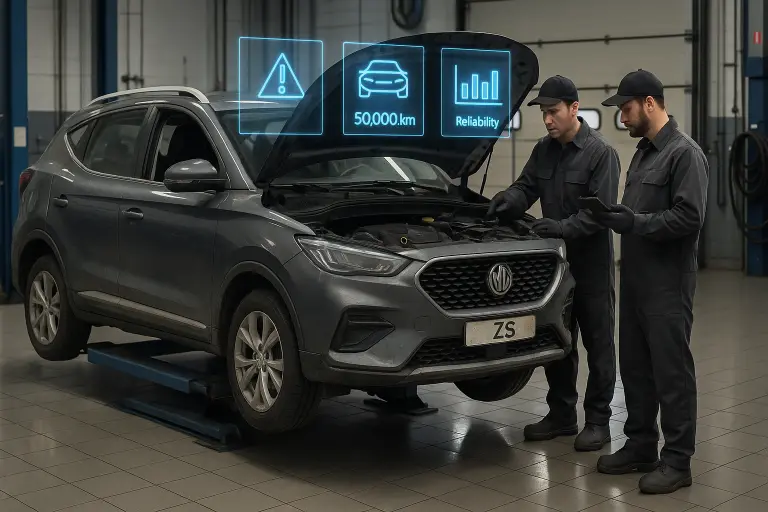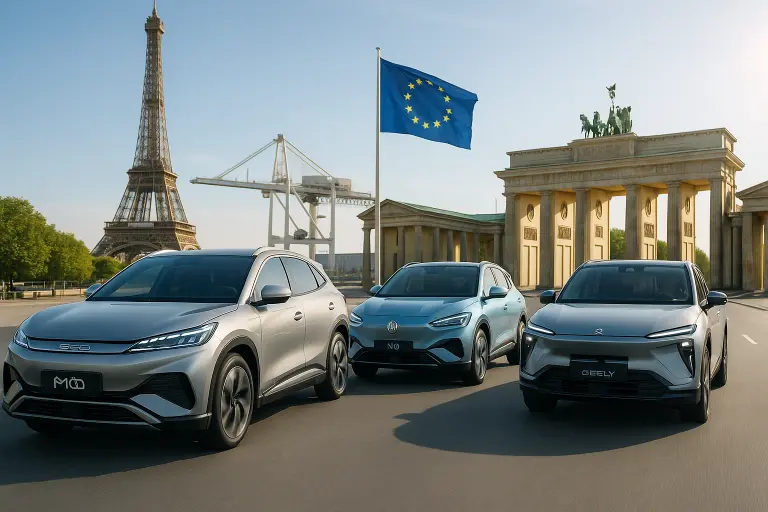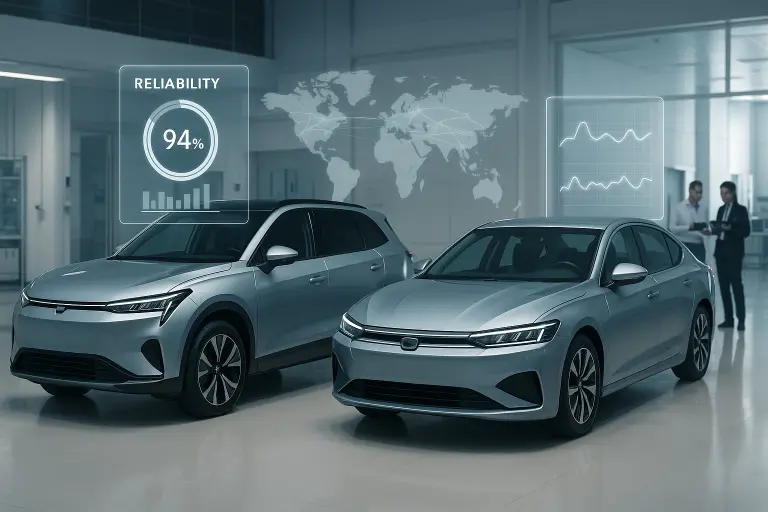
In 2025, one question keeps showing up in Google searches, car forums, and dealership conversations worldwide: Are Chinese Cars Reliable in 2025?
It’s a fair question — and an increasingly urgent one. Chinese brands are no longer niche. They now dominate the global EV market, expand into Europe at speed, and compete against Toyota, Hyundai, and Volkswagen on price and features. But reliability? That’s where the debate heats up.
To give readers clarity, we examined recall data, long-term tests, warranty policies, owner surveys, and regional performance across global markets. Here’s the short version:
- Overall reliability improved significantly from 2020–2025, especially for EVs, but consistency remains uneven across brands.
- Top-tier Chinese automakers now match (or beat) mainstream global brands in battery tech, software stability, and drivetrain durability.
- Weak spots remain: aftersales networks, spare-parts delays, and quality control in fast-growing budget brands.
- Some Chinese cars are excellent long-term buys, while others are high-risk early-adopter bets — so brand selection matters more than ever.
Why This Question Matters in 2025
Chinese automakers aren’t just expanding — they’re reshaping the global automotive hierarchy. With EV exports exceeding several million units per year, new factories in Europe and South America, and aggressive pricing strategies, their presence is impossible to ignore.
Stakeholders affected include:
- Car buyers wondering if low prices hide long-term risks
- Fleet managers measuring TCO against established brands
- Regulators concerned about software, emissions, and safety compliance
- Dealers deciding whether to carry new Chinese franchises
Given this shift, reliability isn’t just a technical metric — it’s a market-defining factor. That’s why this analysis uses a structured, data-first approach to assess build quality, long-term durability, and user experience across regions.
Methodology: How We Define and Measure “Reliable”
To answer the reliability question objectively, we used industry benchmarks across five dimensions:
- Real-world failure rates (per 10,000 vehicles)
- Recall volume and severity (2018–2025)
- Owner satisfaction surveys from respected agencies (J.D. Power, Consumer Reports-like organizations in China, ANCAP reports, regional studies)
- Warranty claim frequency and repair lead times
- Long-term total cost of ownership (TCO) — depreciation, maintenance, battery performance, software stability
Because 70–80% of Chinese global exports are EVs, we also evaluated:
- Battery degradation rates
- BMS & OTA software reliability
- Charging compatibility issues
This review covers regions including China, Europe, North America, Africa, Southeast Asia, Latin America, and the Middle East, using data available through 2025.
Limitations: Not all markets publish detailed failure-rate data, and some new entrants lack long-term testing records.
Global Reliability Snapshot — Headline Findings
Across global markets, the reliability picture is neither universally excellent nor problematic. It’s diverse and brand-dependent.
Strengths
- Rapid tech improvements: EV drivetrains are simple, and Chinese OEMs iterate faster than almost any competitor.
- Battery innovation leadership: LFP batteries (dominant in Chinese EVs) show excellent durability with low degradation.
- Highly competitive warranties: 5–8 years on major components is common; some brands offer 10-year battery guarantees.
Weaknesses
- Uneven build quality: Especially among newer or budget-focused brands.
- Aftersales support varies dramatically by region.
- Software glitches remain a recurring theme for fast-scaling brands.
Data trends (2018–2025) highlight real progress:
- Recall volume is decreasing per 10k vehicles even as export numbers rise.
- Owner satisfaction is strong in EV-dominant markets but weaker in areas with limited dealer coverage.
- Warranty claims dropped significantly for major brands after 2022 model-year improvements.
Regional Breakdown
1. China (Domestic Market)
China’s home market shows the highest reliability scores for its own brands. Buyers benefit from:
- Dense service networks
- Mature supply chains
- Fast OTA support
Established leaders such as BYD, GAC, and Changan show Toyota-like reliability metrics in many segments. Fast-growing startups vary widely — some excellent, others inconsistent.
2. Europe
European entry has forced Chinese brands to meet strict EU safety, cybersecurity, and emissions regulations.
Strengths:
- Strong safety ratings (Euro NCAP tests in 2022–2025 show multiple 5-star performers).
- Improved cabin quality through local tuning.
Challenges:
- Dealer networks still in early development stages.
- Parts availability can cause weeks-long repair delays.
- Residual values remain uncertain — a major concern for buyers.
3. North America
North America remains the hardest market for Chinese brands due to regulatory hurdles and political pressures.
Reliability notes:
- Few models are on sale, but the ones tested independently show solid EV drivetrain performance.
- The challenge isn’t quality — it’s logistics, compliance, and brand perception.
- Warranty support will need massive investment before mass adoption is possible.
4. Emerging Markets (Africa, SE Asia, Middle East, Latin America)
This is where Chinese cars are most successful — and for good reason.
Pros:
- Strong value-for-money proposition
- Durable performance in hot climates (thanks to LFP batteries and optimized cooling systems)
- Lower purchase and maintenance costs
Cons:
- Reliability depends heavily on local distributors and their ability to stock parts.
- Some budget brands struggle with suspension durability on rough roads.
5. Fleet & Commercial Buyers
Fleet managers focus on:
- Uptime
- Predictable maintenance
- Battery lifespan
Chinese EV vans, buses, and delivery vehicles score well here due to:
- Simple drivetrains
- Low energy costs
- Competitive warranties
However, fleets must verify tech support and parts pipelines before large-scale adoption.
BEVs vs ICE: Which Are More Reliable?
Chinese automakers are strongest in EV reliability, largely because:
- EVs have fewer moving parts
- LFP chemistry is stable and long-lasting
- OTA updates fix issues quickly
Key reliability considerations:
- Battery degradation: LFP packs show 5–7% loss after 3–4 years — excellent.
- BMS & software: Some brands push updates too aggressively, causing temporary glitches.
- Thermal management: Improving yearly; newer models show stable performance in harsh climates.
ICE vehicles vary more widely. Some Chinese ICE engines match Korean reliability; others feel like unfinished work. EVs are the safer bet.
Which Chinese Brands Score Well in 2025?
Top Performers (High Reliability)
- BYD — Benchmark LFP batteries, low warranty claim rates, fleet-proven durability
- GAC (Aion) — Strong QA processes, stable software
- Geely / Volvo-associated models — Mature platforms, consistent build quality
- Changan — Good reliability across ICE and EV segments
Mid-Tier (Good value, some consistency gaps)
- MG (SAIC Group)
- Haval (Great Wall Motors)
High Risk / Inconsistent
- New, fast-scaling brands without mature QA
- Budget EV startups with limited service networks
“Reliable Chinese cars” absolutely exist — but the brand matters as much as the model year.
Aftersales, Service Network, and Parts Availability
Reliability isn’t only about manufacturing quality. It’s also:
- How fast repairs happen
- How easy it is to get spare parts
- Whether technicians are properly trained
Key challenges:
- Rapid global expansion outpacing service infrastructure
- Some markets face delays in body panels, electronics, and infotainment modules
Buyer checklist for aftersales support:
- Confirm the number of service centers within 50–100 km
- Check battery warranty terms and whether diagnostics require factory approval
- Ask whether software updates are OTA or dealer-only
- Verify parts availability for common wear items
Cost of Ownership & Warranty Comparison
| Brand Category | Bumper-to-Bumper Years | Battery Warranty Years | Battery Mileage Limit |
|---|---|---|---|
| Top-tier Chinese | 5–6 | 8–10 | 150,000–200,000 |
| Mid-tier Chinese | 4–5 | 7–8 | 120,000–150,000 |
| Low-tier/Startup Chinese | 3 | 5–6 | 100,000 |
| Mainstream Global (Avg) | 3–4 | 8 | 160,000 |
Chinese cars typically offer:
- Lower upfront price
- Competitive insurance rates
- Excellent EV efficiency
But depreciation remains uncertain in new markets, affecting long-term TCO.
Warranties vary but often include:
- 5–6 years bumper-to-bumper
- 8–10 years battery cover
- Free roadside assistance (varies by region)
High-end brands mirror Korean and Japanese warranty standards; lower-end brands vary significantly.
Risk Matrix: When to Buy, When to Wait
A simple guide:
| Buyer Type | Recommendation |
|---|---|
| Early adopter | Go for top-tier brands; avoid Gen-1 models from startups |
| Budget buyer | Excellent value for city EVs and compact SUVs |
| Fleet manager | Strong option for EV fleets with confirmed local support |
| Risk-averse buyer | Stick to proven brands with existing dealer networks |
General rule: If aftersales support is weak in your region, wait. If strong, the value is hard to beat.
Actionable Buyer Checklist
Before buying, verify:
- Local service center availability
- Battery warranty (years + mileage)
- Real-world range vs. rated range
- Infotainment update policy
- Known recalls for your model
- Parts availability timeline
- Long-term reviews for your exact trim
- Dealer credibility and certification
- Resale value trends in your region
- Test drive noise, suspension, and software responsiveness
Conclusion
So — Are Chinese Cars Reliable in 2025?
The answer is yes, many are, but reliability varies more dramatically than in older, slow-moving automotive markets. Top-tier Chinese brands now compete with global leaders, especially in EV reliability, battery durability, and value. Yet gaps remain in aftersales support, long-term data for newer brands, and regional consistency.
For buyers, the smartest move is not simply choosing “a Chinese car,” but choosing the right Chinese brand with the right support network — and keeping an eye on fast-moving developments after 2025.
FAQ
1. Are Chinese cars safe in 2025?
Yes. Many score 5 stars in Euro NCAP and ANCAP tests, though results vary by brand. Always check the exact model’s crash-test rating.
2. Do Chinese EVs lose battery capacity faster?
No — LFP batteries used by Chinese EV makers show excellent durability, often outperforming NMC packs in long-term stability.
3. How do recalls compare to mainstream brands?
Major Chinese brands now show similar recall volumes to Korean and some European manufacturers. Newer brands have more variability.
4. Are warranties for Chinese cars better or worse?
Usually better. Five-year bumper-to-bumper and 8–10-year battery warranties are common, especially for EVs.
5. Is resale value poor for Chinese cars?
Resale value is still developing in many markets. Stronger in regions with established dealer networks; weaker in new markets.
6. Should I buy a Chinese car for fleet use?
If aftersales support is strong, Chinese EVs can be excellent fleet choices due to low running costs and reliable batteries.
7. Are software issues common?
Some brands push frequent OTA updates, which can cause short-term bugs, but reliability generally improves over time.
8. Are Chinese ICE cars reliable?
Mid-to-high-tier ICE models are solid, but EVs are the stronger category overall.