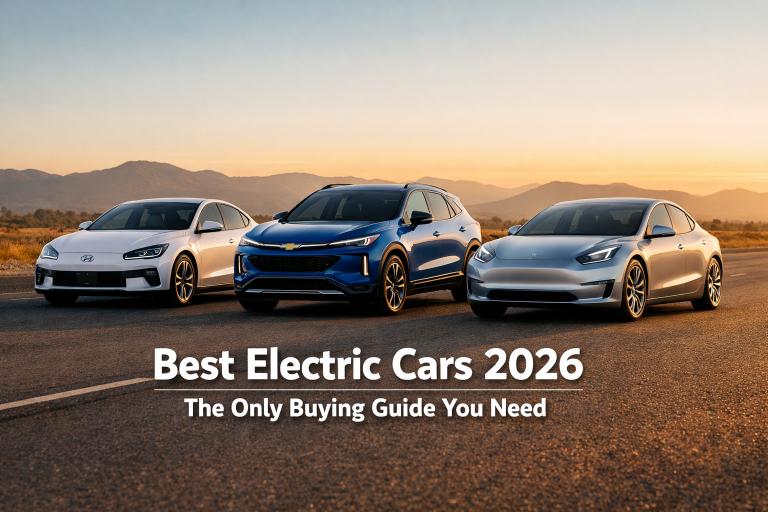
Finding the best electric cars in 2026 means cutting through manufacturer claims and comparing real numbers: actual range under mixed driving conditions, charging stop time on a real road trip, and what ownership genuinely costs over five years. This guide ranks the top EVs available in the U.S. right now using EPA data, fueleconomy.gov owner reports, J.D. Power study data, and total cost of ownership modeling — so you can move from research to a confident, financially grounded decision.
Table of Contents
How We Ranked the Best Electric Cars 2026
Marketing specs from automakers are a starting point — not a purchasing basis. Our ranking applies three weighted evaluation layers to each vehicle: real-world driving efficiency, charging infrastructure practicality, and five-year ownership economics. A car that scores well in the brochure but poorly across these three dimensions does not make this list.
Real-World Range & Efficiency (kWh/100 mi)
EPA range figures are produced under controlled lab conditions at 75°F with minimal climate control load — not how most Americans actually drive. Real-world figures consistently run 8–18% lower. We weight owner-reported data from fueleconomy.gov submissions and third-party independent testing alongside EPA figures. Energy consumption in kWh per 100 miles is evaluated separately: a vehicle consuming 3.1 kWh/100 mi delivers meaningfully lower annual charging costs than one consuming 4.0 kWh/100 mi at identical mileage.
Charging Speed & Infrastructure Access (10–80% DC Fast Charge)
Range without fast, accessible charging is a planning liability on longer trips. We evaluate peak DC fast charge speed in kilowatts, 10–80% charge time under realistic conditions accounting for thermal management throttling, and network compatibility. In 2026, NACS adoption has expanded to Ford, GM, Honda, Nissan, and additional brands — meaningfully broadening Supercharger network access beyond Tesla owners. Network reliability factors alongside raw charging speed in our scoring.
Ownership Costs, Warranty & Resale Value
Sticker price is one input into a five-year financial equation that also includes insurance premiums, maintenance intervals, warranty terms, projected depreciation, and energy costs. According to J.D. Power’s 2025 U.S. Electric Vehicle Experience Ownership Study, ownership satisfaction is most strongly correlated with charging reliability and service network quality — two factors that frequently separate competitive vehicles at similar price points.
Quick Comparison Table — Top EVs at a Glance
The tables below cover core specifications and estimated five-year costs for the strongest contenders in the 2026 U.S. EV market. All range figures are EPA-rated. Charging times reflect 10–80% DC fast charge under manufacturer-published conditions at peak power.
Price, Battery Size & EPA Range
| Model | Starting MSRP | EPA Range | Battery (kWh) | 10–80% DC Fast | Drivetrain | Warranty |
|---|---|---|---|---|---|---|
| Hyundai IONIQ 6 SE LR RWD Top Pick | $38,615 | 361 mi | 77.4 kWh | ~18 min | RWD | 5yr/60K | 8yr battery |
| Chevrolet Equinox EV LT Best Value | $34,995 | 319 mi | 85 kWh | ~35 min | FWD | 3yr/36K | 8yr battery |
| Tesla Model 3 Long Range RWD | $42,490 | 358 mi | 75 kWh | ~25 min | RWD | 4yr/50K | 8yr battery |
| Kia EV6 Standard RWD | $43,275 | 310 mi | 77.4 kWh | ~18 min | RWD | 5yr/60K | 8yr battery |
| Ford Mustang Mach-E Premium | $42,995 | 290 mi | 91 kWh | ~38 min | RWD | 3yr/36K | 8yr battery |
| BMW i4 eDrive35 | $56,400 | 307 mi | 70.2 kWh | ~31 min | RWD | 4yr/50K | 8yr battery |
| Lucid Air Pure Longest Range | $69,900 | 410 mi | 88 kWh | ~22 min | RWD | 4yr/50K | 8yr battery |
Sources: EPA fueleconomy.gov, manufacturer MSRP data, and published charging specifications as of Q1 2026. MSRP reflects base trim. Federal tax credit eligibility varies — verify at fueleconomy.gov before purchase.
5-Year Estimated Ownership Cost Comparison
| Model | 5-Yr Maintenance Est. | Avg Annual Insurance* | Energy Cost (15K mi/yr) | Est. 5-Yr Total Cost |
|---|---|---|---|---|
| Chevy Equinox EV | $1,500–$2,200 | $1,700–$2,200 | ~$4,800 | ~$48,000–$52,000 |
| Hyundai IONIQ 6 LR Lowest 5-Yr Cost | $1,600–$2,300 | $1,900–$2,400 | ~$4,300 | ~$52,000–$56,000 |
| Tesla Model 3 LR | $1,800–$2,500 | $2,200–$2,800 | ~$4,500 | ~$58,000–$62,000 |
| Kia EV6 LR | $1,600–$2,300 | $1,900–$2,300 | ~$4,500 | ~$56,000–$60,000 |
| Lucid Air Pure | $2,500–$3,500 | $2,800–$3,600 | ~$3,900 | ~$87,000–$95,000 |
*Insurance estimates aggregated from Insurance Information Institute data and NADA cost-to-own models. Maintenance figures based on U.S. Department of Energy EV service interval benchmarks. Individual results vary by state, driver profile, and coverage level.
Best Electric Cars 2026 by Category
Best Budget Electric Car 2026 Under $35,000
Chevrolet Equinox EV LT — Starting at $34,995
The Equinox EV is the clearest value case for first-time EV buyers in the U.S. right now. At $34,995 it sits below the $55,000 MSRP cap for the federal Clean Vehicle Credit — eligible buyers can reduce effective purchase price to roughly $27,495 after the full $7,500 credit. You get 319 miles of EPA range, a practical SUV body, and NACS charging compatibility providing broad Supercharger access without an adapter.
Strengths: Competitive range for the price, GM dealer network coverage nationwide, SUV form factor families prefer, qualifies for the full federal tax credit at base trim.
Trade-offs: Peak DC charging speed of ~150 kW lags the 800V Korean competitors by a meaningful margin. Interior execution is functional rather than premium.
Ideal buyer: Budget-conscious first-time EV buyers, families replacing a compact crossover, daily commuters who charge at home overnight. For more options in this price tier, our full best EVs under $40,000 guide covers additional contenders side by side.
Best Mid-Range Family EV 2026
Hyundai IONIQ 6 SE Long Range RWD — Starting at $38,615
The IONIQ 6 is our top overall pick for 2026. Its 800V architecture delivers a 10–80% charge in approximately 18 minutes at a 350 kW-capable DC fast charger — faster than any comparable vehicle at this price point. EPA-rated at 361 miles, real-world range consistently lands at 330–345 miles in moderate climates based on aggregated fueleconomy.gov owner data. Hyundai’s 5-year/60,000-mile bumper-to-bumper warranty is the most comprehensive coverage offered by any mainstream EV brand in the U.S.
Strengths: Ultra-fast 800V charging, best-in-class real-world efficiency at this price, longest mainstream warranty, aerodynamic design reduces highway energy load significantly.
Trade-offs: Sedan-only body style limits cargo utility versus crossover alternatives. Rear headroom is tighter than in taller competitors.
Ideal buyer: Daily commuters covering 50–130 miles per day, frequent road-trippers who want the shortest charge stops, buyers for whom 5-year warranty protection is a priority.
Best Performance and Luxury EV 2026
Lucid Air Pure — Starting at $69,900
The Lucid Air Pure achieves approximately 4.7 miles per kWh — an efficiency figure that, per EPA data, leads the U.S. luxury EV segment. Its 410-mile EPA range and 900V charging architecture enabling up to 350 kW peak charging translate to genuine long-distance capability that no current U.S. luxury competitor matches at this price tier. Charging from 10–80% takes roughly 22 minutes under optimal conditions at a compatible DC fast charger.
Strengths: Unmatched range and efficiency in the luxury segment, class-leading charging speed, genuinely distinctive and premium interior execution.
Trade-offs: Lucid’s physical service network remains concentrated in major metro areas. Resale data is still developing given the brand’s relative youth. Insurance premiums run higher than comparable established luxury brands.
Ideal buyer: Luxury buyers for whom maximum range is the primary purchase driver, Tesla Model S owners seeking a differentiated alternative, buyers who primarily home-charge and value engineering distinction over dealer convenience.
Bottom Line
For the broadest range of U.S. buyers in 2026, the Hyundai IONIQ 6 Long Range delivers the most balanced combination of real-world range, charging speed, warranty coverage, and five-year ownership cost. For buyers where budget is the priority, the Chevrolet Equinox EV after the federal tax credit is the strongest sub-$28,000 option currently available in the U.S. market.
Real-World Range vs Advertised Range in 2026
EPA Range vs Actual Driving Conditions
The EPA range estimate is produced under a standardized testing protocol that does not reflect typical American driving. Per EPA methodology documentation, tests run at 75°F ambient temperature at moderate speeds with climate control minimized. Real-world driving — particularly at highway speeds with HVAC active — consistently produces 10–18% lower range than the EPA figure. Understanding this gap is critical when evaluating whether a vehicle’s rated range actually covers your daily and road-trip requirements.
Real-World Range Estimates — Mixed Driving, Moderate Climate
Estimates derived from aggregated owner data (fueleconomy.gov user submissions) and third-party independent testing under mixed conditions. Results vary by speed, temperature, load, and driving style.
Winter Range Loss & Heat Pump Efficiency
Cold weather is the most significant and consistently underestimated range variable for EV buyers in northern states. At temperatures below 20°F, EV range can drop 25–40% on vehicles without a heat pump, and 15–25% even on heat pump-equipped models, according to AAA EV cold-weather testing data. In 2026, heat pumps are standard on Long Range trims of the IONIQ 6, EV6, and Tesla Model 3. Always confirm inclusion at your specific trim level before purchase if you operate in a cold climate.
Highway vs City Efficiency: What Changes at 75 mph
Unlike gasoline vehicles, EVs are significantly more efficient in city driving than at highway speeds. Regenerative braking recovers energy during deceleration in stop-and-go traffic, while sustained highway speeds increase aerodynamic drag sharply. A vehicle rated at 330 miles of city range may realistically deliver only 255–275 miles at a steady 80 mph. For road-trippers planning charge stop intervals, the highway figure — not the EPA combined number — is the relevant planning metric. Our breakdown of EV range vs advertised range runs the numbers by model with documented real-world data.
Charging, Software & 2026 EV Technology Trends
800V Architecture & Ultra-Fast Charging Explained
800-volt battery architecture allows a vehicle to accept significantly higher power levels during DC fast charging without generating excess heat that forces the system to throttle speed. Hyundai and Kia’s 800V E-GMP platform vehicles charge at up to 235–350 kW peak, completing a 10–80% charge in approximately 18 minutes. By comparison, most 400V platform vehicles peak at 150–175 kW and require 30–45 minutes for the same charge window. Over a 1,200-mile road trip with three charging stops, that architecture gap translates to 30–60 fewer minutes spent at charging stations — a significant quality-of-life difference for frequent road-trippers.
OTA Updates & AI-Enhanced Driver Assistance in 2026
Over-the-air software updates are standard across Tesla, Rivian, Hyundai, GM, and Ford EVs in 2026. These push range recalibration improvements, navigation enhancements, and ADAS capability upgrades without requiring a dealership visit — a meaningful long-term ownership advantage. AI-assisted driving features have expanded considerably this model year, but all production vehicles sold in the U.S. require continuous driver attention and supervision under current regulatory frameworks. Confirm which ADAS features are included at your trim versus subscription-gated before signing, as post-sale subscriptions can add $100–$200 annually to total ownership cost.
Battery Chemistry: LFP vs NMC — Which Is Better for Your Use Case?
Lithium Iron Phosphate (LFP) batteries — used in Tesla Standard Range models and certain other platforms — offer superior cycle life and can be charged to 100% daily without meaningful long-term capacity degradation. Nickel Manganese Cobalt (NMC) batteries deliver higher energy density per kilogram, enabling longer range, and are standard in Long Range trims across most brands. For high-mileage drivers covering 20,000+ miles annually, LFP chemistry provides a measurable durability advantage. For buyers who prioritize maximum range per charge, NMC Long Range trims remain the stronger practical choice. Our guide on how long EV batteries last covers real-world degradation data at 50K, 100K, and 150K miles across both chemistries.
Cost of Ownership & Federal Incentives
Federal & State EV Tax Credits: 2026 Update
The federal Clean Vehicle Credit under the Inflation Reduction Act provides up to $7,500 for qualifying new EVs. The point-of-sale application option — allowing dealers to apply the credit as an immediate price reduction — remains available through participating dealers in 2026. Key eligibility requirements: MSRP must not exceed $55,000 for sedans or $80,000 for SUVs and trucks; modified AGI must not exceed $150,000 (single) or $300,000 (joint); vehicle must meet North American final assembly and battery sourcing requirements. Always verify current eligibility at fueleconomy.gov before negotiating, as the qualifying vehicle list updates with each model year.
State-level incentives add further value in California, Colorado, New York, and approximately 15 other states, ranging from $1,000 to $5,000 depending on income and vehicle type. Combined federal and state incentives can reduce effective purchase price by $10,000–$12,500 for fully qualifying buyers.
EV Insurance, Maintenance & Real Energy Costs
EV insurance premiums run approximately 10–20% higher than equivalent gas vehicles nationally, driven by higher repair costs for high-voltage components and ADAS sensor systems, per Insurance Information Institute data. Annual maintenance tells a different story: EVs require no oil changes, transmission service, or spark plug replacement, and regenerative braking extends brake pad life by 40–70% versus conventional braking systems. The U.S. Department of Energy estimates average EV maintenance at $0.061 per mile versus $0.101 per mile for gasoline vehicles — roughly $600–$900 in annual savings at typical driving distances. For the full monthly cost breakdown, our monthly EV ownership cost guide runs home and public charging costs side by side by model.
EV Depreciation & 5-Year Resale Forecast
EV depreciation stabilized considerably in 2025–2026 after the significant market repricing of 2022–2024. Per Kelley Blue Book residual value estimates, mainstream EVs from Hyundai, Kia, and GM project 40–50% residual values at year five — comparable to strong-performing compact SUVs. Tesla residuals have stabilized at 38–47% following its pricing actions. Luxury EVs from younger brands carry higher depreciation risk: Lucid and Rivian residuals at year five are projected at 30–42%, reflecting thinner resale market depth. As a planning benchmark: budget for 38–50% residual value on mainstream EVs and 30–44% for luxury models. These are KBB-based projections, not guaranteed values.
Which Electric Car Is Right for You?
Best EV for Daily Commuters in 2026
If your round-trip commute is under 80 miles and you have Level 2 home charging access, nearly every vehicle on this list exceeds your daily requirements. Prioritize total purchase price after tax credits, annual insurance cost, and service network proximity. The Chevrolet Equinox EV — effective cost under $28,000 after the federal credit for qualifying buyers — is the strongest commuter value proposition in the current U.S. market.
Best EV for Road Trips in 2026
Road trip performance is defined by charging speed and network reliability, not rated range alone. The Hyundai IONIQ 6 and Kia EV6 win this category — their 800V architecture keeps each stop well under 25 minutes. The Tesla Model 3 benefits from Supercharger network density and consistency across the U.S. highway system. If long-distance driving is a priority, our home EV charging setup guide ensures you start every trip at full capacity without morning delays.
Best EV for Long-Term Ownership Value in 2026
Evaluate warranty length, five-year maintenance cost, and depreciation trajectory together as a single financial unit. Hyundai and Kia’s 5-year/60,000-mile bumper-to-bumper warranty is the most comprehensive in the mainstream segment by a meaningful margin. For buyers where total cost over the ownership period matters most, the IONIQ 6 Long Range consistently produces one of the lowest verified 5-year ownership cost profiles at its price point, based on DOE maintenance benchmarks and KBB residual projections.
Quick Buyer Checklist Before You Decide
- Do you have access to Level 2 home charging? (Strongly recommended — see our home charging setup guide)
- What is your actual daily driving distance — not your worst-case scenario?
- Do you live in a state with winters below 20°F? (Confirm heat pump inclusion at your trim)
- Do you take road trips more than twice per year? (Prioritize 800V / NACS-compatible models)
- Have you verified your after-tax-credit net price at fueleconomy.gov?
- Have you compared 5-year insurance estimates, not just sticker price?
- Is the brand’s service network within a reasonable driving distance of your home?
First-time EV buyer? Avoid the decisions that cost buyers thousands in year one. Our guide to first-time EV buyer mistakes covers charging setup errors, trim selection missteps, and incentive timing mistakes that are entirely preventable.
FAQs — Best Electric Cars 2026
What is the best electric car overall in 2026?
For most U.S. buyers, the Hyundai IONIQ 6 Long Range RWD offers the strongest overall package in 2026 — combining 361 miles of EPA range, 18-minute 10–80% DC fast charging via its 800V architecture, a 5-year/60,000-mile bumper-to-bumper warranty, and one of the lowest verified 5-year ownership cost profiles in its segment. The Chevrolet Equinox EV is the superior choice for budget-prioritizing buyers after the $7,500 federal tax credit.
Which EV has the longest real-world range in 2026?
The Lucid Air Pure leads the U.S. market with approximately 385 miles of real-world range under mixed driving conditions. Among mainstream EVs under $45,000, the Hyundai IONIQ 6 Long Range and Tesla Model 3 Long Range both deliver 315–345 miles in moderate climates based on aggregated fueleconomy.gov owner data.
Are electric cars cheaper to own than gas cars in 2026?
For most drivers covering 12,000–18,000 miles per year, yes. The U.S. Department of Energy estimates EV maintenance at $0.061 per mile versus $0.101 per mile for gasoline vehicles. Combined with lower fuel costs at average national electricity rates, the 5-year ownership advantage of a mainstream EV over a comparable gas vehicle typically ranges from $3,500 to $9,000 depending on local energy prices and tax credit eligibility.
Is now a good time to buy an EV in 2026?
2026 represents one of the most favorable EV buying environments in recent years. Dealer inventory is broadly available, the $7,500 federal tax credit remains active with point-of-sale application, and public charging infrastructure has expanded substantially across the U.S. highway system. The primary uncertainty is potential changes to federal incentive policy — buyers who qualify today should not assume current conditions will persist unchanged.
What are the hidden costs of owning an EV in 2026?
The most consistently underestimated ownership costs are: insurance premiums running 10–20% above equivalent gas vehicles (Insurance Information Institute); Level 2 home charger installation at $800–$1,500 including electrician fees; higher out-of-warranty repair costs for high-voltage components; and public DC fast charging rates of $0.28–$0.48 per kWh on road trips — significantly above home electricity rates. Budget for all four before comparing EV and gas car total costs side by side.