Last Updated: March 2026 — Reflects IRA rules, 2026 income limits, and current qualifying vehicle list
The best EV tax credits in 2026 can knock up to $7,500 off a new electric vehicle — but most buyers discover too late that they don’t qualify due to income limits, vehicle MSRP caps, or battery sourcing rules that disqualify more models than people expect. Federal incentives have been reshaped again this year, and stacking them correctly with state rebates and utility programs can push total savings past $10,000 on the right vehicle. This guide cuts through the confusion and shows you exactly what you qualify for before you sign anything.
Best EV Tax Credits 2026 — Quick Summary:
The federal Clean Vehicle Credit offers up to $7,500 for new EVs and up to $4,000 for used EVs in 2026, subject to income limits ($150,000 single / $300,000 joint for new) and vehicle MSRP caps ($55,000 for cars, $80,000 for SUVs/trucks). The credit can now be applied at the point of sale — no waiting for tax season. State rebates and utility incentives can stack on top for additional savings.
Federal EV Tax Credits in 2026 — What’s Changed?
The federal Clean Vehicle Credit established under the Inflation Reduction Act (IRA) remains in effect for 2026, but its practical reach has narrowed compared to initial projections. Tighter battery sourcing rules, unchanged MSRP caps, and income thresholds that have not adjusted for inflation mean a smaller pool of buyers and vehicles qualify compared to 2024. Here’s what matters before you step into a dealership.

Clean Vehicle Credit Requirements (Income, MSRP, Assembly Rules)
To claim the federal EV tax credit in 2026, three conditions must be met simultaneously — fail any one of them and the credit drops to zero:
1. Income limits (AGI-based): For new EVs, the modified adjusted gross income (MAGI) cap is $150,000 for single filers, $225,000 for heads of household, and $300,000 for married filing jointly. For used EVs, the limit is lower: $75,000 single, $112,500 head of household, $150,000 joint. These are based on the lower of your current or prior year income.
2. Vehicle MSRP caps: Sedans and hatchbacks must be priced at or below $55,000. SUVs, pickup trucks, and vans have a higher cap of $80,000. Several popular EV trims — including base Model 3 and Model Y variants — fall within these limits, but higher-spec versions do not.
3. North America assembly requirement: The vehicle must be assembled in North America. Additionally, battery sourcing rules require a growing percentage of critical minerals and battery components to come from U.S. free-trade partners — rules that disqualify several models from Asian manufacturers that were previously eligible.
Point-of-Sale Credit vs Tax Filing Credit in 2026
One of the most buyer-friendly changes still in effect in 2026 is the point-of-sale credit transfer. Instead of waiting to file your taxes to receive the $7,500 benefit, eligible buyers can transfer the credit directly to a participating dealer — who applies it as a reduction to the purchase price or down payment at signing. This makes the savings immediate and concrete rather than a deferred tax calculation.
| Credit Method | When You Get the Savings | Who Benefits Most | Key Requirement |
|---|---|---|---|
| Point-of-Sale Transfer | At dealership signing | All eligible buyers | Dealer must be registered with IRS |
| Tax Filing Credit | When you file taxes (spring 2027) | Buyers who didn’t use POS transfer | Must owe sufficient federal tax |
State-Level EV Incentives You May Qualify For in 2026
The federal credit is the largest single incentive, but it’s rarely the only one available. Many states have maintained or expanded their own EV rebate programs in 2026, and several utility companies offer separate charging equipment rebates that stack independently. The combined value of federal + state + utility incentives can significantly exceed the $7,500 federal cap alone.
States Offering Additional EV Rebates in 2026
State programs vary widely in structure — some are income-based rebates, others are point-of-purchase reductions, and a few are tax credits at the state level. The most active state programs in 2026 include California’s Clean Vehicle Rebate Project (CVRP) offering up to $2,000–$4,500 depending on income tier, Colorado’s tax credit of $5,000 for new EVs (stackable with the federal credit), and New York’s Drive Clean Rebate of up to $2,000 for qualifying purchases. Texas, Illinois, Massachusetts, and Oregon each maintain active incentive structures as well, though program caps and availability change frequently — always verify at your state’s energy or DMV website before purchasing.
Stackable Incentives — Utility Rebates & Local Programs
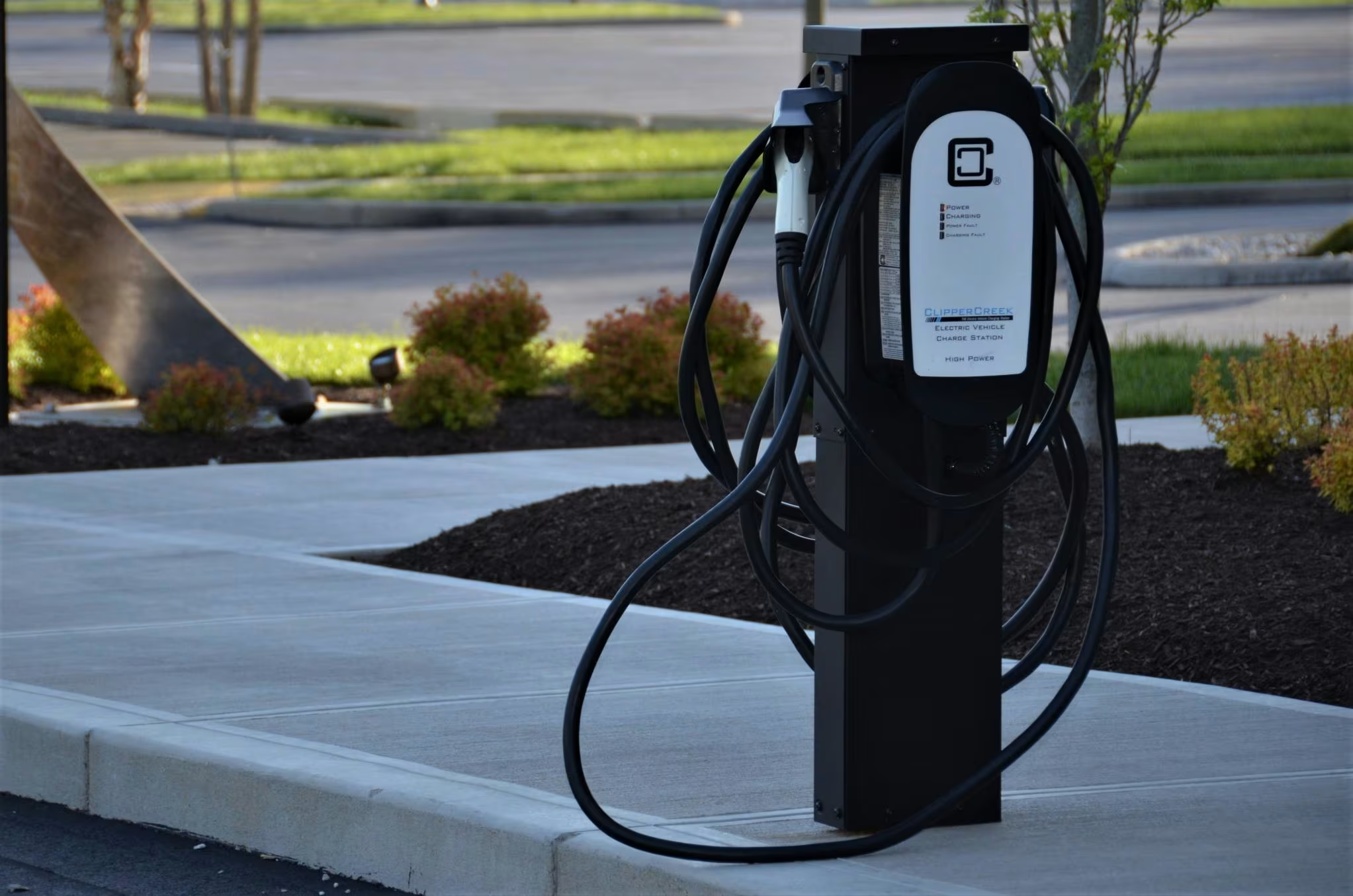
Beyond state programs, many U.S. utility companies offer separate EV incentives that apply independently of both federal and state credits. These typically fall into two categories: vehicle purchase rebates ($250–$1,000 from utilities like PG&E, Xcel Energy, and Duke Energy) and home charging equipment rebates covering partial or full cost of Level 2 charger installation ($200–$800 in most active programs). Some utilities in California, Colorado, and the Pacific Northwest also offer reduced overnight EV electricity rates that compound savings over the life of the vehicle.
Best EV Tax Credits 2026 by Buyer Profile
The credit you qualify for isn’t just about the car — it’s heavily shaped by your income, how you’re financing, and whether you’re buying new or used. These three buyer profiles cover the most common scenarios and the best credit strategy for each.
Middle-Income Household Buyers
Buyers with household income between $80,000 and $250,000 are in the sweet spot for the full federal credit on new vehicles — comfortably below the $300,000 joint filing cap while having sufficient tax liability to benefit from the full $7,500. For this group, the point-of-sale transfer is the recommended approach — it removes the tax liability calculation entirely and delivers the full credit at signing regardless of what you owe at year end.
The key variable for middle-income buyers is vehicle selection: choose a model priced under $55,000 (or $80,000 for an SUV/truck) that meets the North America assembly and battery sourcing requirements. Not all popular EVs clear this bar — verify the specific trim level before committing.
High-Income Buyers & the Lease Strategy
Buyers above the income thresholds — $150,000 single, $300,000 joint — are locked out of the consumer Clean Vehicle Credit. However, there’s a legitimate workaround: leasing an EV. Leased vehicles qualify under the Commercial Clean Vehicle Credit, which has no consumer income limits because the lessor (the financing company) claims the credit rather than the buyer. Dealers typically pass a portion of this value into the lease through reduced monthly payments or a capitalized cost reduction — effectively giving high-income buyers an indirect path to EV incentives.
The pass-through isn’t guaranteed or standardized — negotiate explicitly for it and compare lease deals across manufacturers. Some OEMs pass through the full $7,500; others absorb part of it as margin.
Used EV Buyers — The $4,000 Credit
The Used Clean Vehicle Credit offers up to $4,000 or 30% of the sale price (whichever is less) for qualifying pre-owned EVs in 2026. The vehicle must be at least two model years old, priced at or below $25,000, and sold by a licensed dealer — private party sales don’t qualify. Income limits are stricter: $75,000 AGI for single filers, $150,000 for joint filers.
| Buyer Scenario | Max Credit | Income Limit (Joint) | MSRP / Price Cap | POS Transfer? |
|---|---|---|---|---|
| New EV — Purchase | $7,500 | $300,000 | $55K cars / $80K SUVs | ✅ Yes |
| New EV — Lease | Varies (dealer pass-through) | No limit | No cap | Built into lease terms |
| Used EV — Purchase | $4,000 | $150,000 | $25,000 | ✅ Yes |
Which Electric Vehicles Qualify for the 2026 EV Tax Credit?
Vehicle eligibility is the most frequently misunderstood part of the credit. Not every EV qualifies — and eligibility can differ between trim levels of the same model. The IRS maintains a live list of qualifying vehicles at fueleconomy.gov, which is updated as manufacturers report battery sourcing data. Always check this list against the specific VIN of the car you intend to purchase.
Battery & Manufacturing Requirements in 2026
To qualify, a vehicle must clear two manufacturing hurdles. First, final assembly must occur in North America. Second, critical mineral sourcing and battery component rules require a rising percentage of materials to come from the U.S. or free-trade agreement partner countries. In 2026, the battery component threshold has increased to 60% and the critical mineral threshold to 50% — requirements that disqualify several previously eligible models, particularly those from South Korean and Japanese manufacturers whose battery supply chains don’t fully meet the U.S. sourcing targets.
Popular EV Models That Qualify in 2026 — and Why Some Don’t
Based on available manufacturer certifications as of early 2026, the following models are among those qualifying for the full or partial federal EV tax credit for most buyers meeting income and MSRP requirements:
| Vehicle | Type | Starting MSRP | Federal Credit | Eligibility Note |
|---|---|---|---|---|
| Chevrolet Equinox EV | SUV | ~$35,000 | $7,500 | U.S. assembled, strong battery sourcing |
| Tesla Model 3 (Standard) | Sedan | ~$40,240 | $7,500 | Under $55K cap; sourcing meets 2026 rules |
| Tesla Model Y (RWD) | SUV | ~$44,990 | $7,500 | Under $80K cap; verify trim at purchase |
| Ford F-150 Lightning (Pro) | Truck | ~$49,995 | $7,500 | Under $80K; U.S. assembled |
| Rivian R1T (Standard) | Truck | ~$69,900 | $3,750 | Partial credit — battery sourcing partial compliance |
| Hyundai Ioniq 6 | Sedan | ~$38,615 | $0 (purchase) / credit via lease | Korean assembly disqualifies purchase credit |
How to Verify Your EV Tax Credit Eligibility Before Buying
The single biggest mistake EV buyers make is assuming they qualify without verifying first. A dealer who wants to close a sale may not flag disqualifying factors proactively — particularly income limits or battery sourcing issues. Here’s the exact verification process to run before signing.
Income & Filing Status Checklist
Pull your most recent two years of tax returns and identify your Modified Adjusted Gross Income (MAGI) for both years. The IRS uses the lower of your current or prior year income — so a buyer who earned $280,000 last year but expects $200,000 this year can still qualify using current year income. Confirm your filing status: single, married filing jointly, or head of household — each has a different threshold. If you’re close to any limit, consult a tax professional before committing to a purchase, as excess income by even $1 eliminates the entire credit.
Dealer Verification & IRS Resources
At the dealership, ask three specific questions before agreeing to terms:
① Is this vehicle currently on the IRS qualifying vehicle list at fueleconomy.gov?
② Is your dealership registered with the IRS to facilitate point-of-sale credit transfers?
③ What is the exact VIN, and has the manufacturer confirmed it meets 2026 battery sourcing requirements?
The IRS maintains the authoritative list at fueleconomy.gov/feg/tax/taxevb.shtml — updated in real time as manufacturers certify vehicles. A vehicle may appear eligible based on model name but fail at VIN level if the specific build uses a non-qualifying battery source. Always cross-reference the VIN, not just the model.
Real Savings Breakdown — How Much Can You Actually Save in 2026?
Credits look impressive in isolation — the real question is how they affect total cost of ownership over the period you’ll actually own the vehicle. Here’s how the math works across three realistic buyer scenarios.
Combined Federal + State Savings Scenarios
5-Year Total Cost of Ownership Impact
Credits reduce your effective purchase price — but they compound with EV fuel savings over time. The table below models three realistic 2026 scenarios at 15,000 miles per year, home charging at $0.17/kWh, versus a gas car at 30 MPG and $3.50/gallon.
| Scenario | Vehicle Price | Credits Applied | Net Purchase Cost | 5-Yr Fuel Savings vs Gas | 5-Yr Net Advantage |
|---|---|---|---|---|---|
| Chevy Equinox EV — Middle income, Colorado | $35,000 | $12,500 | $22,500 | ~$5,015 | ~$17,515 effective cost |
| Tesla Model Y RWD — Middle income, Texas | $44,990 | $7,500 | $37,490 | ~$5,015 | ~$32,475 effective cost |
| Used EV ($22,000) — Income-eligible buyer | $22,000 | $4,000 | $18,000 | ~$5,015 | ~$12,985 effective cost |
FAQ — EV Tax Credit Qualification (2026)
Do I qualify for the full $7,500 EV tax credit in 2026?
You qualify for the full $7,500 federal Clean Vehicle Credit if three conditions are met simultaneously: your MAGI is at or below $150,000 (single) or $300,000 (married filing jointly), the vehicle MSRP is at or below $55,000 for cars or $80,000 for SUVs and trucks, and the vehicle meets North America assembly and battery sourcing requirements. Failing any one condition reduces the credit to zero — there is no partial credit for exceeding income limits, only for battery sourcing shortfalls.
Can high-income earners still benefit from EV incentives in 2026?
Yes — through leasing. When you lease an EV, the financing company (lessor) claims the Commercial Clean Vehicle Credit rather than the consumer, and there are no income limits on that commercial credit. Many lessors pass part of this value into the lease as lower monthly payments or a reduced capitalized cost. Negotiating explicitly for this pass-through is essential — it is not automatically reflected in advertised lease rates.
Are leased EVs eligible for federal credits in 2026?
Yes, but through a different mechanism. Leased vehicles qualify under the Commercial Clean Vehicle Credit, claimed by the lessor. The consumer benefit depends entirely on how much of that credit the dealer or financing company passes through into the lease terms. Unlike the consumer credit, there is no MSRP cap or income limit on the commercial credit — meaning leasing can be advantageous for both high-income buyers and those interested in vehicles that don’t meet assembly requirements for purchase credits.
Do used electric cars qualify for tax credits in 2026?
Yes — the Used Clean Vehicle Credit offers up to $4,000 or 30% of the sale price (whichever is lower) for qualifying pre-owned EVs. The vehicle must be at least two model years old, purchased from a licensed dealer (not a private seller), and priced at or below $25,000. Income limits are stricter than for new vehicles: $75,000 AGI for single filers and $150,000 for married filing jointly. The credit can also be transferred at the point of sale starting in 2024, and this continues in 2026.
⚖️ This article is for informational purposes only and does not constitute tax or legal advice. Tax credit eligibility rules are subject to change. Consult a qualified tax professional to confirm your specific eligibility before purchasing a vehicle.