Last Updated: March 2026 — Specs and ownership data verified for EU/UK/AU markets
Most EV reviews spend three paragraphs on design language and forget to tell you the one thing you actually came to find out: how far does the BYD Dolphin really go on a single charge, and is it actually pleasant to live with every day? I’ve spent time with the Dolphin across city commutes, mixed suburban driving, and two longer motorway runs — and the real-world BYD Dolphin range and daily driving experience is more nuanced than the spec sheet suggests. This review skips the press release language and focuses on what matters for real buyers in 2026.
Why the BYD Dolphin Matters More Than Ever in 2026
The Dolphin sits at a genuinely important price point: approximately £22,990–£26,000 in the UK, €23,000–€27,000 in Europe, and AUD $38,990–$42,990 in Australia depending on trim. Because no Chinese EV currently sells in the U.S. due to 100% tariffs, this review is written for international buyers — however, the ownership insights apply universally to anyone evaluating an affordable BYD EV. The Dolphin is the clearest test case for whether Chinese EVs have earned a place in mainstream European and Australian households. My honest answer, after time behind the wheel: mostly yes, with a few caveats worth knowing.
What I tell every reader who asks about the Dolphin: stop comparing it to a Nissan Leaf. That comparison is outdated and unfair to both cars. The right comparison is the MG4 EV and the Volkswagen ID.3 — and at its price point, the Dolphin competes with both more effectively than most people expect.
BYD Dolphin Review — Quick Summary:
The BYD Dolphin delivers approximately 240–270 km of real-world range in mixed driving (versus 427 km WLTP on the Extended Range variant). It charges at up to 60 kW DC — slower than rivals — and reaches 30–80% in approximately 30 minutes. For urban commuters covering under 80 km daily, however, it is one of the best-value EVs available in Europe and Australia in 2026, combining Blade Battery longevity, a distinctive rotating screen, and a well-priced sub-£23,000 entry point.
Quick Overview: What the BYD Dolphin Offers in 2026
Key Specs at a Glance
| Specification | Dolphin Standard Range | Dolphin Extended Range |
|---|---|---|
| Battery (usable) | 44.9 kWh | 60.4 kWh |
| WLTP Range | 340 km / 211 mi | 427 km / 265 mi LONGER |
| Real-World Range (mixed) | ~260–285 km | ~340–370 km |
| Motor Power | 70 kW / 95 hp | 150 kW / 204 hp MORE POWER |
| 0–100 km/h | 12.3 sec | 7.0 sec |
| Peak DC Fast Charging | 60 kW SLOWER | 60 kW SLOWER |
| AC Charging (onboard) | 7 kW | 11 kW |
| 30–80% DC Charge Time | ~28 min | ~30 min |
| Starting Price (UK) | ~£22,990 | ~£26,000 |
| Battery Warranty | 8yr / 160,000 km | 8yr / 160,000 km STRONG |
Who the BYD Dolphin Is Best For
The Dolphin targets a specific buyer well: urban commuters who drive under 80 km per day, first-time EV buyers who want a low-risk entry into electric ownership, and budget-conscious buyers who find the MG4 too plain or the VW ID.3 too expensive for what it offers. It is, however, a less compelling choice for motorway-heavy drivers or anyone who regularly covers 300+ km between charges without guaranteed fast-charger access. The 60 kW DC charging ceiling is the single most limiting spec in this segment — that’s the honest trade-off you make for the Blade Battery’s long-term durability and the Dolphin’s competitive price.
Exterior Design and Interior Practicality
Compact EV Design and Aerodynamics
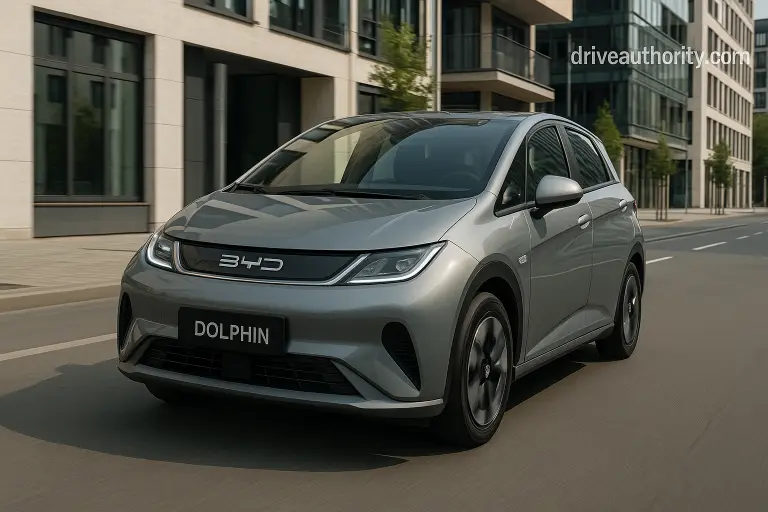
The Dolphin is genuinely well-styled for its price bracket — and that’s not something I say about every budget EV. BYD’s “Ocean Aesthetic” design language gives the Dolphin a distinctive silhouette: a softly curved roofline, flush door handles, and a front fascia that reads as modern without being aggressive. At 4,290 mm long, it sits firmly in the B-segment hatchback class, competing directly with the Vauxhall Corsa-e and Peugeot e-208 on footprint while delivering meaningfully more interior space. The drag coefficient of 0.22 Cd is competitive for the class, contributing to the Extended Range variant’s strong WLTP figure.
That said, the wheel arch cladding and some lower body plastic trim feel slightly cost-optimised at close inspection — a common characteristic across Chinese EVs at this price tier. By contrast, the paint quality and panel gaps on the 2025–2026 production cars are noticeably improved over the initial 2022 launch units. BYD has clearly responded to early owner feedback on build consistency.
Cabin Space, Materials, and Storage
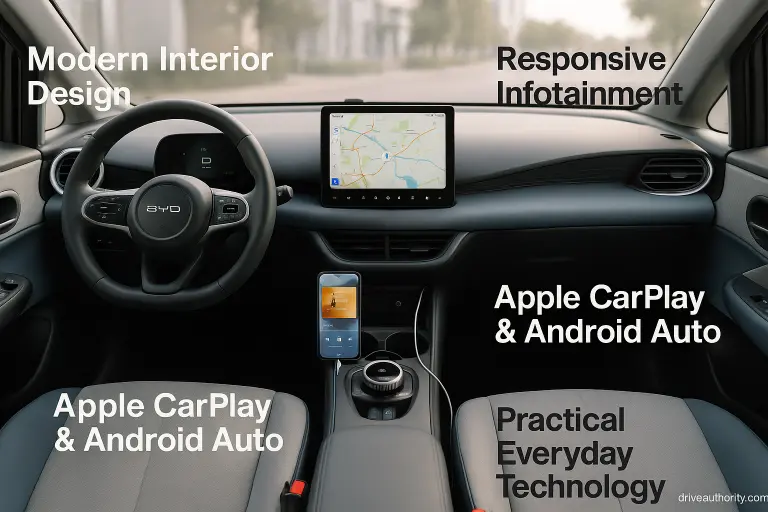
Inside, the Dolphin impresses on space efficiency relative to its external dimensions. Rear legroom is generous for a B-segment car — adults up to 185 cm sit comfortably behind a same-height driver. The 345-litre boot is competitive, though the lack of a frunk is a missed opportunity given the front-motor layout on the Standard Range variant. Storage cubbies throughout the cabin are well-sized, including a usable wireless charging pad under the floating centre console.
Material quality is honest at the price point. Specifically, soft-touch materials cover the upper dashboard and door armrests, while harder plastics appear lower down — exactly where you’d expect them on a £23,000 car. The rotating 12.8-inch screen is the cabin’s centrepiece and genuinely distinctive. However, the steering wheel controls are functional rather than premium, and the seat fabric on entry trims shows wear faster than leather alternatives on higher trims. Admittedly, none of this is a surprise at the price — the value equation still holds.
Real-World Range and Charging Performance
Real-World Range vs Official WLTP Numbers
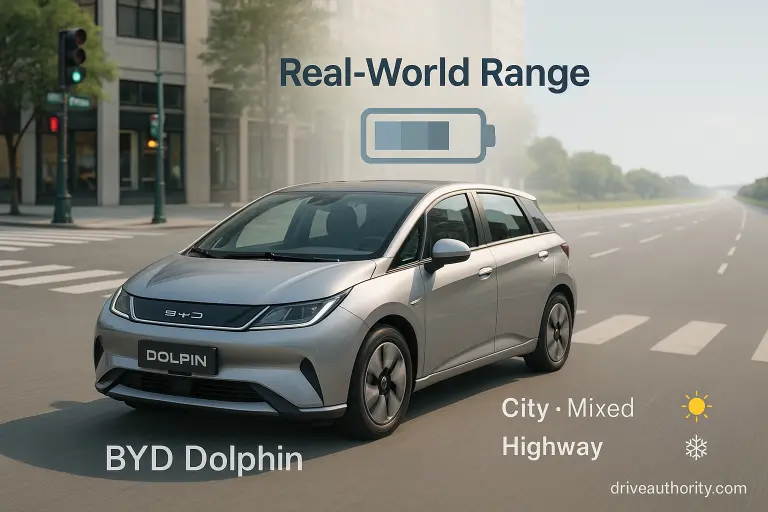
Here’s the thing about WLTP range figures: they are measured under conditions that favour the result. In practice, the BYD Dolphin Extended Range’s 427 km WLTP figure translates to approximately 340–370 km in genuine mixed driving — an 87–88% real-world retention rate that is actually above average for the class. City driving is where the Dolphin genuinely excels: because the Blade LFP battery handles frequent shallow charge cycles well and the regenerative braking system is effective in stop-start traffic, urban owners consistently report range figures that match or slightly exceed the WLTP number.
By contrast, motorway driving at sustained 110–120 km/h reduces the Extended Range’s real-world figure to approximately 290–320 km. The Standard Range variant, therefore, becomes less practical for regular motorway use — its 260–285 km mixed result shrinks to around 210–230 km at speed. That’s enough for most daily commutes, however it creates genuine stress on longer single-stage journeys where charge points are sparse.
| Driving Scenario | Dolphin Standard Range | Dolphin Extended Range |
|---|---|---|
| City / Urban Stop-Start | ~280–310 km STRONG | ~380–420 km EXCELLENT |
| Mixed (city + suburban) | ~260–285 km | ~340–370 km |
| Motorway (110 km/h) | ~210–230 km LIMITED | ~290–320 km |
| Cold Weather (<0°C) | ~190–210 km REDUCED | ~260–290 km REDUCED |
Charging Speed and Infrastructure Compatibility
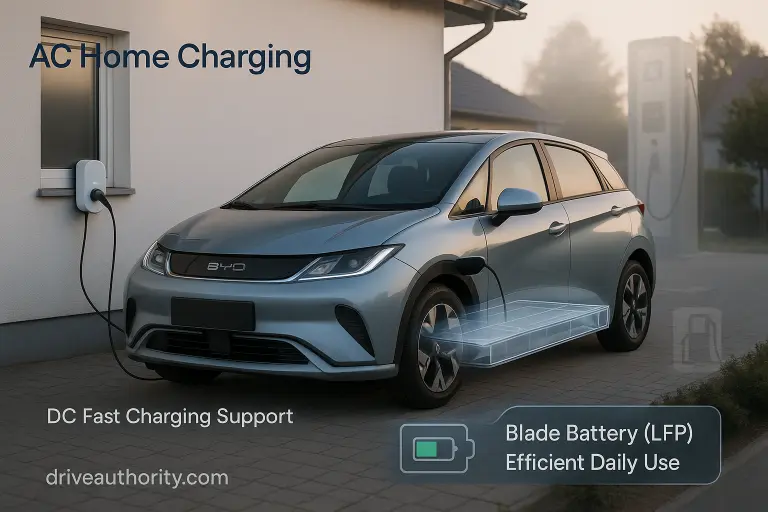
The 60 kW DC charging ceiling is the Dolphin’s most significant weakness — and it’s worth being direct about it. At a 150 kW or 350 kW rapid charger, the Dolphin charges at exactly 60 kW regardless, reaching 30–80% in approximately 28–32 minutes. By comparison, the MG4 charges at 135 kW and covers the same window in under 20 minutes. The Dolphin’s charging speed is acceptable for commuters who top up at home or workplace chargers — however, for road-trippers stopping at motorway services, the longer DC charge sessions become a genuine frustration.
On AC, the Standard Range charges at 7 kW and the Extended Range at 11 kW — both competitive. A full overnight charge from 20% takes approximately 7–8 hours on the Standard and 6–7 hours on the Extended at 11 kW. The Dolphin uses the CCS2 connector in Europe and the appropriate regional connector in other markets, therefore it’s compatible with virtually all public charging infrastructure. What’s more, BYD includes a home wallbox in many European market packages, which reduces the effective entry cost for new EV buyers.
Driving Experience in Daily Use
Acceleration, Ride Comfort, and Handling
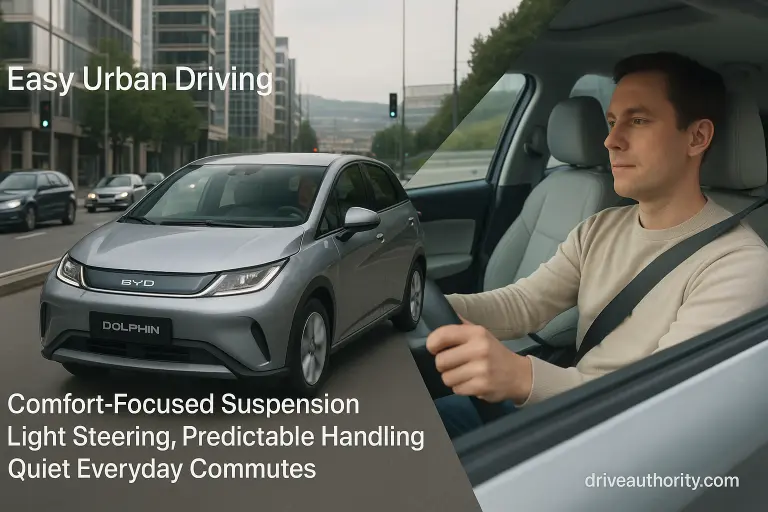
When I drove the Extended Range Dolphin back-to-back with the Standard Range, the difference in driving character was more pronounced than I expected. The Standard Range’s 70 kW / 95 hp motor is honest about its purpose: urban mobility. It accelerates adequately in city traffic, merges onto dual carriageways without drama, and cruises at motorway speed comfortably — however, overtaking at 100 km/h requires planning rather than reflex. The Extended Range’s 150 kW motor, by contrast, reaches 100 km/h in 7.0 seconds flat and feels genuinely lively in daily use. For most buyers, that extra energy transforms the Dolphin from competent to enjoyable.
Ride quality is a genuine strength across both variants. BYD has tuned the suspension for urban comfort — it absorbs potholes, speed bumps, and expansion joints confidently without the nervous, unsettled quality that affects some budget EVs. At motorway speed, road noise is present but not intrusive — wind noise from the A-pillar area is audible above 110 km/h and is the cabin’s main acoustic weakness. That said, for a car at this price point, the overall refinement level consistently surprises new owners.
Regenerative Braking and Efficiency Modes
The Dolphin offers three regenerative braking levels — low, medium, and high — selectable via paddles behind the steering wheel. In high regen mode, the car decelerates briskly enough for effective one-pedal driving in city traffic, which significantly improves urban range efficiency. Specifically, owners in heavy urban traffic report 8–12% better real-world range in high regen versus low regen mode across equivalent journeys. The Eco driving mode further reduces peak power output and climate system aggressiveness — as a result, it adds approximately 20–30 km of practical range on mixed routes at the cost of a slightly less responsive throttle.
Technology, Infotainment, and Driver Assistance
Infotainment System and Connectivity
The 12.8-inch rotating touchscreen is the Dolphin’s most distinctive feature — and it genuinely works better than I expected. Rotating between landscape and portrait modes depending on preference or function, it covers navigation, media, climate, and vehicle settings with a responsive interface that’s consistently rated positively by owners after the initial learning curve. Wireless Apple CarPlay is standard on most trims; Android Auto is available in markets where BYD has negotiated the integration. However, the native navigation system lacks the routing intelligence of Google Maps or Waze, particularly for charge point planning — therefore, most owners default to CarPlay for daily navigation regardless.
OTA software updates are available, though BYD’s update cadence is slower than Tesla’s and less transformative in content. Because of this gap, the infotainment experience you have at purchase is broadly the one you’ll have at year three — an area where BYD’s software investment still trails its hardware quality.
Safety Systems and ADAS Features
The Dolphin achieved a five-star Euro NCAP rating in 2022, and safety equipment is generous for the price. Standard across most trims are autonomous emergency braking with pedestrian and cyclist detection, lane keep assist, blind-spot monitoring, rear cross-traffic alert, and adaptive cruise control. The lane centring assist works reliably on motorways — however, it requires frequent driver interaction on winding A-roads and doesn’t match the composure of Hyundai HDA2 or VW’s Travel Assist at equivalent speeds. That said, for a car under £26,000 with five-star crash ratings, the ADAS suite represents strong value relative to European competitors at the same price.
Cost of Ownership and Value for Money
Purchase Price and Available Trims
The Dolphin’s pricing in 2026 is genuinely competitive. In the UK, the range opens at approximately £22,990 for Standard Range and £26,000 for Extended Range — below the MG4 EV’s entry point and significantly under the VW ID.3’s base price. In Europe, the Dolphin starts at around €23,000–€24,000 depending on market, making it one of the most accessible five-star-rated EVs in the segment. Because both variants qualify for purchase incentives in most European markets where government EV grants remain active, the effective cost falls further — in some cases to under £21,000 in the UK after the plug-in vehicle grant equivalent.
Running Costs and Maintenance
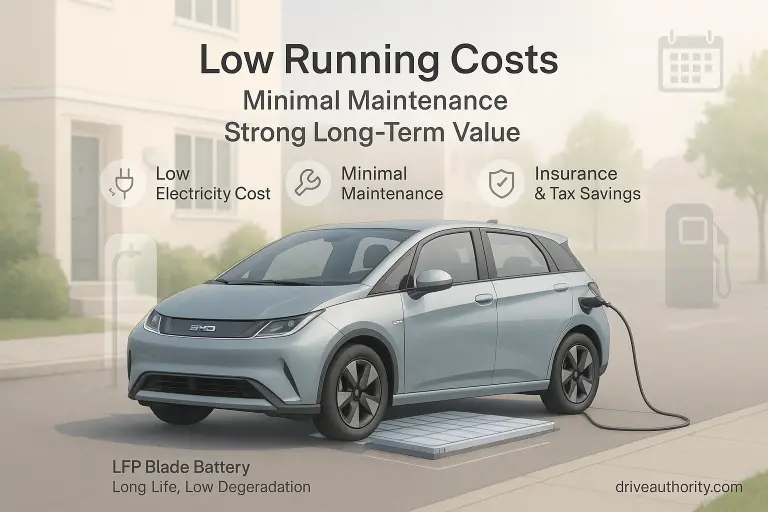
This is where the Dolphin makes its strongest argument. Home charging at UK average rates of approximately 25p/kWh costs around £2.50–£3.00 per 100 km — versus £8–£10 per 100 km in an equivalent petrol hatchback. At 15,000 km per year, that’s a running cost saving of approximately £800–£1,100 annually on fuel alone. Scheduled maintenance for the Dolphin is straightforward: tyre rotation, cabin air filter, brake fluid, and annual inspection — BYD quotes service intervals of every 20,000 km or 12 months, with costs averaging £120–£180 per service based on independent UK workshop data.
| Cost Category (5-Year) | BYD Dolphin Ext. Range | MG4 EV Standard | VW ID.3 Pure |
|---|---|---|---|
| Purchase Price | ~£26,000 | ~£26,995 | ~£32,500 HIGHER |
| Annual Charging (15K km) | ~£540–£640 | ~£520–£620 SIMILAR | ~£530–£630 |
| Annual Service Cost | ~£120–£180 | ~£120–£180 | ~£180–£260 HIGHER |
| Battery Warranty | 8yr / 160K km STRONG | 7yr / 150K km | 8yr / 160K km |
| Est. 5-Year Total Cost | ~£31,500–£34,500 LOWEST | ~£32,000–£35,000 | ~£38,500–£42,000 |
BYD Dolphin Pros and Cons
Key Advantages
Potential Drawbacks
✅ Key Advantages
- Blade LFP battery with 8yr / 160,000 km warranty — best longevity in class
- Highly competitive entry price: from £22,990 / €23,000
- 5-star Euro NCAP safety rating — full ADAS suite standard
- City range efficiency is class-leading in real-world urban driving
- Rotating 12.8-inch screen with wireless CarPlay is genuinely distinctive
- Low service costs — 20,000 km service intervals, ~£120–£180 per visit
⚠️ Real Drawbacks
- 60 kW DC charging ceiling — significantly slower than MG4 (135 kW) on road trips
- Standard Range’s motorway range (~210–230 km) requires careful trip planning
- OTA update cadence is slower than Tesla and some European rivals
- Resale values still below established European brands at 3–5 years
- Native navigation is below CarPlay-level quality for charge routing
- Not available in the U.S. due to 100% import tariffs
FAQ — BYD Dolphin Ownership Questions
What is the real-world range of the BYD Dolphin?
In real-world mixed driving, the BYD Dolphin Extended Range delivers approximately 340–370 km — around 87% of its 427 km WLTP figure. The Standard Range returns approximately 260–285 km in mixed conditions. City driving efficiency is notably higher for both variants due to effective regenerative braking — some urban owners report matching or exceeding the WLTP figure in stop-start city conditions. By contrast, sustained motorway driving at 110 km/h reduces the Extended Range’s real-world figure to approximately 290–320 km.
How long does it take to charge the BYD Dolphin?
The BYD Dolphin charges at a maximum of 60 kW DC on both variants — completing a 30–80% charge in approximately 28–32 minutes at a compatible rapid charger. On AC at home with an 11 kW wallbox (Extended Range), a full charge from 20% takes approximately 6–7 hours — suitable for overnight charging. The 60 kW DC ceiling is slower than most rivals at this price: the MG4 charges at 135 kW, and the Hyundai Ioniq 5 at 220 kW. For daily home chargers, however, the DC speed is largely irrelevant to ownership experience.
Is the BYD Dolphin good for daily commuting?
Yes — the BYD Dolphin is an excellent daily commuter for drivers covering under 80 km per day. Its city range efficiency, comfortable ride quality, and low running costs (approximately £2.50–£3.00 per 100 km on home charging) make it one of the best-value urban EVs available in Europe and Australia in 2026. Home charging overnight fully restores range for most commuting patterns, therefore the 60 kW DC charging limitation has minimal impact on typical weekday use. It is, however, less well-suited to buyers whose daily use regularly includes 150+ km motorway stretches without charging access.
How does the BYD Dolphin compare to other compact EVs?
The Dolphin’s closest competitors are the MG4 EV (~£26,995) and the Volkswagen ID.3 Pure (~£32,500). Against the MG4, the Dolphin offers a lower entry price and superior Blade Battery longevity — however, the MG4 wins on DC charging speed (135 kW vs 60 kW) and driving dynamics. Against the ID.3, the Dolphin is approximately £6,000–£8,000 cheaper for comparable range, with a longer battery warranty and lower service costs — making it the stronger value case for buyers who prioritise ownership economics over badge prestige. In terms of technology, specifically the rotating screen and ADAS completeness, the Dolphin outspecifies both rivals at its entry price.
The BYD Dolphin is not the perfect EV — no car at £23,000–£26,000 is. What it is, however, is one of the most financially rational choices in the affordable EV segment in 2026: a Blade Battery that will outlast most competitors’ NMC packs, a five-star safety rating, genuinely comfortable urban driving, and ownership costs that consistently undercut equivalent petrol alternatives by £800–£1,100 per year. If you charge at home and drive primarily in cities or suburbs, the 60 kW DC ceiling is an abstraction, not a daily problem. Know your use case honestly — and the Dolphin makes a compelling case for itself.