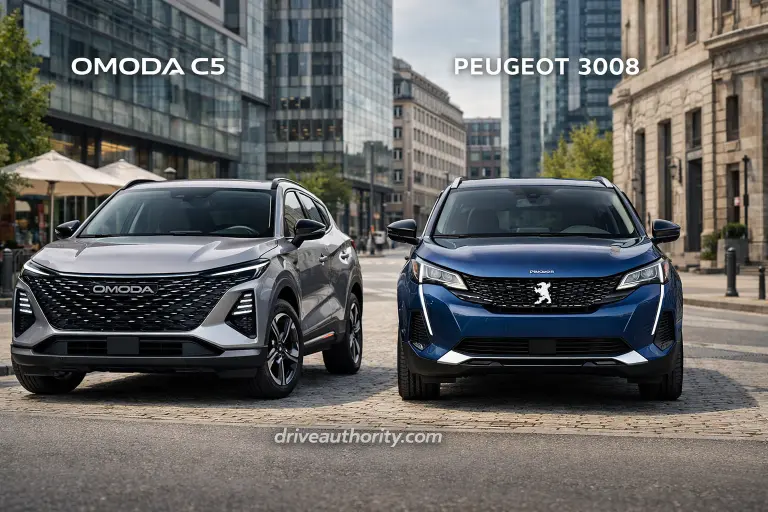
The Omoda C5 vs Peugeot 3008 comparison is one of the most commercially interesting matchups in the 2026 compact SUV segment — because on paper, these two vehicles are priced in entirely different worlds, yet they’re chasing the same buyer. The Omoda C5 arrives with a feature list that should cost significantly more. The Peugeot 3008 arrives with a brand reputation and resale track record that no amount of standard equipment can replicate overnight. That tension is exactly what makes this comparison worth doing properly.
What This Comparison Actually Answers
I get this question from readers at least twice a week: “Is the Omoda C5 genuinely as good as the Peugeot 3008, or does it just look good on paper?” My answer is always the same — it depends entirely on which two or three things matter most to you over a three-to-five year ownership window. Therefore, this article breaks down price and feature value, real-world running costs, safety test data, interior quality, and long-term reliability confidence — so you can make a decision that’s financially sound, not just emotionally satisfying.
I’ve spent time analyzing ownership data, press test records, and Euro NCAP results for both vehicles ahead of their 2026 market positioning. What I found surprised me on both sides of the ledger — specifically on the safety front, where neither vehicle tells a completely comfortable story.
The Omoda C5 delivers significantly more standard equipment per dollar — typically undercutting the equivalent Peugeot 3008 trim by €5,000–€7,000 in European markets while matching or exceeding its technology spec. However, the Peugeot 3008 holds its value better over 36 months, carries a 4-star Euro NCAP rating from 2025 independent testing, and offers a far denser service network in established markets. For buyers who plan to own for three to four years and prioritize feature value, the Omoda C5 is a genuine contender. For buyers prioritizing resale confidence and long-term service access, the Peugeot 3008’s premium is defensible.
📋 Table of Contents
- Quick Verdict: Omoda C5 or Peugeot 3008?
- Price and Feature Value: What Each Budget Unlocks
- Powertrain, Fuel Economy, and Real-World Running Costs
- Safety Ratings: What Independent Tests Actually Show
- Interior Quality, Cabin Space, and Daily Ownership
- Reliability, Service Network, and Long-Term Confidence
- Which Should You Buy? Decision by Buyer Profile
- FAQ: Omoda C5 vs Peugeot 3008
Quick Verdict: Omoda C5 or Peugeot 3008?
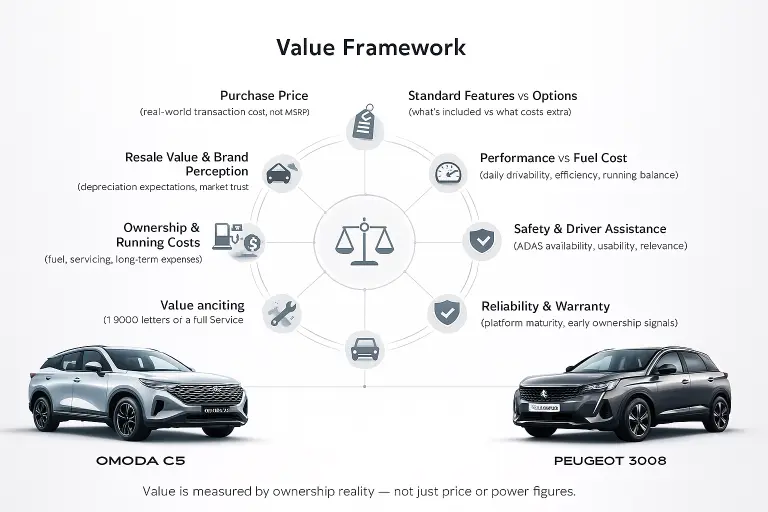
This isn’t a question of which car is technically superior. It’s a question of what you’re willing to trade and over what time horizon. The Omoda C5 wins decisively on feature density per euro — at mid-trim pricing, you’re typically getting panoramic roofs, large touchscreens, and a comprehensive ADAS suite that would cost you a trim upgrade on the 3008. By contrast, the Peugeot 3008 wins on ownership certainty: a tested safety record under 2025 Euro NCAP protocols, an established service network across Europe, the Middle East, and Australia, and resale values that new Chinese brands simply can’t yet match.
The real question — the one most buyers aren’t asking directly — is whether the €5,000–€7,000 price gap at equivalent specification justifies the reliability data asymmetry. Because, as a result of Omoda’s limited Western-market history, there’s genuinely less three-year ownership data to rely on. That’s not a disqualifier, but it’s a risk factor worth pricing in honestly.
✅ Omoda C5 — Best For
- Maximum equipment per euro at every trim
- Buyers comfortable with an emerging brand and warranty coverage
- Rear-seat priority — rear headroom and legroom are genuinely competitive
- Technology-forward buyers: large screens, wireless connectivity, ADAS standard on lower trims
- Short-to-medium ownership horizon: 3–4 years where resale gap is less punishing
✅ Peugeot 3008 — Best For
- Long-term ownership confidence and proven reliability data
- Dense service network in EU, UK, MENA, and Australia
- Resale value retention over 36+ months
- Buyers who want a current-protocol Euro NCAP 4-star rating
- PHEV and electrified powertrain as a genuine requirement
Price and Feature Value: What Each Budget Unlocks
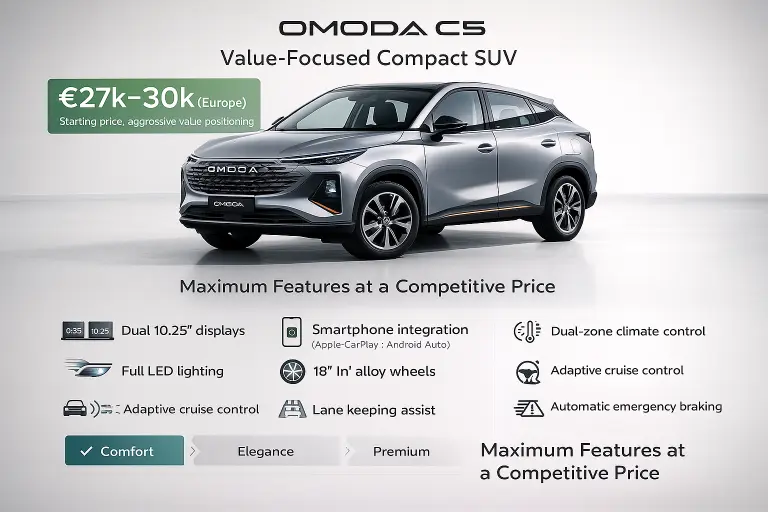
This is where the Omoda C5 argument is hardest to dismiss. In European markets, the Omoda C5 PHEV is positioned in the €36,000–€40,000 range for 2026, directly beneath the Peugeot 3008’s entry of around €41,300–€43,490 depending on trim and powertrain. That’s a gap of €5,000 to €7,000 at comparable specification — which, by compact SUV standards, is not a rounding error. It’s an entire trim level’s worth of equipment.
Omoda C5 Pricing and Standard Equipment
What Omoda does well — and what I’ve seen Chinese brands consistently execute in this decade — is front-loading standard equipment onto entry and mid trims. The Omoda C5 in standard petrol form starts around £24,000–£25,000 in the UK in its base Comfort specification, rising through to approximately £29,000 for top Noble trim. Even at entry level, you get LED lights, twin-screen dashboard layout, heated front seats, wireless smartphone connectivity, and adaptive cruise control as standard — features that are optional or trim-restricted on many European competitors at similar money. The PHEV variant targeting the 3008 directly sits in that €36,000–€40,000 French market window and adds multi-link rear suspension, which is a meaningful engineering upgrade over the torsion-beam setup found in some petrol variants.
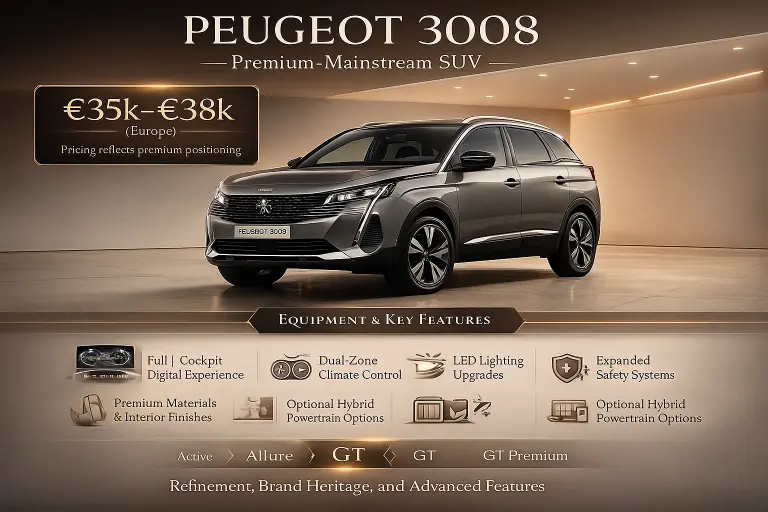
Peugeot 3008 Pricing and What the Premium Buys
The 2026 Peugeot 3008 starts from approximately £35,000–£37,940 in the UK across Allure, GT, and GT Premium trims, with the plug-in hybrid pushing into the low-to-mid £40,000s. In France, the 3008 Hybrid starts at around €41,300. That premium is not entirely illusory — specifically because you’re paying for the i-Cockpit interior execution, a 21-inch panoramic display in some trims, a 4-star Euro NCAP safety record tested under 2025 protocols, and a dealer network with decades of infrastructure. Peugeot came seventh in the 2025 Driver Power owner satisfaction survey out of 31 manufacturers, which suggests the brand’s reliability reputation is materially improved from its PureTech-era low points. That said, the 3008’s standard warranty remains just three years or 60,000 miles — the bare minimum in its segment, well below Kia’s seven-year or Toyota’s decade-long cover.
| Feature | Omoda C5 (Mid Trim) | Peugeot 3008 Allure (Equiv. Price) | Advantage |
|---|---|---|---|
| Entry MSRP (EU market) | ~€36,000 LOWER | ~€41,300 | Omoda C5 |
| ADAS Suite (AEB, lane keep, ACC) | Standard from entry trim | Standard on Allure+ | Omoda C5 |
| Infotainment Screen | Dual 10.25″ LCD setup | 21″ panoramic (GT+), smaller on Allure | 3008 (GT trim) / C5 (value) |
| Panoramic Roof | Standard mid-trim | Optional / higher trim | Omoda C5 |
| Wireless CarPlay / Android Auto | Standard | Standard | Even |
| Warranty (Years) | 5 years LONGER | 3 years SHORTER | Omoda C5 |
James’s Take: Every article on this topic frames the Peugeot 3008 as the default “safer” choice by merit of brand alone. I disagree with that framing. At equivalent pricing, the Omoda C5 offers more standard equipment and a longer warranty. The Peugeot’s premium needs to be justified by what it actually delivers — not just by what badge is on the bonnet.
Powertrain, Fuel Economy, and Real-World Running Costs
A lower purchase price only wins the comparison if the running costs don’t claw back the savings. Therefore, this is where the Omoda C5’s case gets more complicated — specifically for the standard petrol variant in key markets like the UK.
Engine Options and Fuel Economy
The Omoda C5’s 1.6-litre turbocharged petrol engine — built by AVL in Graz, Austria — produces around 145–197bhp depending on year and market. Official WLTP fuel economy for the petrol sits in the low 30s MPG, which Autocar and What Car? both flag as noticeably below segment rivals. CO₂ emissions hover just under 170g/km for the petrol version, which matters significantly for company car drivers in the UK and France. The 2026 full hybrid variant improves this meaningfully with a 1.5-litre unit and a Honda e:HEV-style transmission, though detailed WLTP figures for all markets are pending full homologation at time of publication.
The Peugeot 3008 1.2 Hybrid 145 petrol unit returns considerably stronger fuel economy numbers at combined mixed driving — with significantly lower CO₂ emissions, which is why it qualifies for lower BIK tax rates in the UK and French bonus-malus incentives. The plug-in hybrid 3008 at ~195bhp extends this advantage further for buyers with home charging access. By contrast, the Omoda C5 petrol’s fuel economy figure is its clearest weakness in total cost-of-ownership calculations for high-mileage drivers covering 15,000+ miles annually.
Insurance, Maintenance, and 3-Year Running Cost Reality
Here’s the thing that most comparison articles skip: newer Chinese brands typically carry a higher insurance group rating in markets like the UK and Australia, because actuarial data on repair costs and parts pricing is limited. The Omoda C5 is likely to sit in a higher insurance group than equivalent Peugeot 3008 trim levels in the near term — though this gap narrows as the brand establishes its parts network. Peugeot’s fixed-price servicing packages at approximately £20/month in the UK, and service intervals of 12 months or 16,000 miles for petrol hybrid models, give buyers reasonable cost predictability. Omoda’s UK dealer network of approximately 70 points of service in France (as of early 2026 entry planning) is adequate for urban buyers but presents a real access risk for rural owners.
| Cost Category | Omoda C5 (Petrol) | Peugeot 3008 (1.2 Hybrid) |
|---|---|---|
| Entry Purchase Price (EU) | ~€36,000 LOWER | ~€41,300 |
| WLTP Fuel Economy | ~32–35 MPG LOWER | ~50–55 MPG est. |
| Annual Fuel Cost Est. (15k miles) | ~£2,100–£2,400 | ~£1,300–£1,600 LOWER |
| Service Interval | 12 months / 9,300 miles | 12 months / 16,000 miles LONGER |
| Warranty Coverage | 5 years LONGER | 3 years |
| Service Network Density | Growing — urban-focused risk | Established — broad coverage BETTER |
High-Mileage Warning: For drivers covering 15,000+ miles per year, the Omoda C5 petrol’s fuel economy disadvantage could claw back €800–€1,100 annually compared to the Peugeot 3008 hybrid. Over three years, that narrows the purchase price gap significantly. The C5 PHEV — when available — changes this calculation substantially.
Safety Ratings: What Independent Tests Actually Show
This is the section I want every prospective buyer to read carefully — because neither vehicle tells a straightforwardly reassuring story here, and the data is more nuanced than most comparison pieces acknowledge.
Euro NCAP Results for Both Models
The current-generation Peugeot 3008 received a 4-star Euro NCAP rating when tested in May 2025 under updated protocols — with adult occupant protection at 82%, child protection at 85%, vulnerable road users at 79%, and safety assist at 62%. That 62% safety assist score is notably lower than the five-star results achieved by the Renault Rafale and Skoda Enyaq Coupe under comparable conditions. A 4-star rating isn’t unsafe — however, in a competitive segment where five stars is increasingly the baseline expectation, it’s a data point worth knowing. The e-3008 electric version, as of late 2025, had not yet received an independent Euro NCAP test under current protocols.
The Omoda 5 (the model sold in the UK) achieved a five-star Euro NCAP rating, which is a meaningful credential for a brand at this stage of its Western-market development. However, buyers should note: this rating applies to the specific tested variant, and the C5 designation used in some markets may have different trim configurations. Always verify which specific model and trim the NCAP result applies to in your market before treating it as a blanket safety endorsement.
Standard Safety Technology at Base Trim
Both vehicles include AEB, lane-keeping assist, and emergency braking as standard at Allure / entry trim level — which is the correct 2026 baseline. Where the Omoda C5 specifically punches above its price, however, is the breadth of ADAS technology offered on lower trims: adaptive cruise control, blind-spot monitoring, and rear cross-traffic alert are standard equipment on mid-spec C5 trims that, on the Peugeot, would require a GT upgrade. That said, the Peugeot 3008 features Peugeot’s SOS & Assistance emergency response system and a more mature driver monitoring architecture as standard on the 2025 model year refresh.
| Safety Data Point | Omoda C5 / Omoda 5 | Peugeot 3008 (2024–2026) |
|---|---|---|
| Euro NCAP Star Rating | 5 stars (Omoda 5 variant) HIGHER | 4 stars (tested May 2025) |
| Test Year / Protocol | 2024 protocol | 2025 protocol |
| AEB — Standard? | Yes, all trims | Yes, all trims |
| Blind-Spot Monitor — Standard? | Mid trim standard | GT trim standard |
| Adaptive Cruise — Standard? | Entry trim (Comfort) | GT trim standard |
| Safety Assist Score (NCAP) | Not directly comparable by model variant | 62% BELOW AVERAGE |
Interior Quality, Cabin Space, and the Daily Ownership Experience
Honestly, I was skeptical about the Omoda C5’s interior quality before seeing independent press reviews land consistently. Then I looked at the Autocar and Carwow assessments and changed my position: the interior quality is genuinely competitive at the price, not just “acceptable for a Chinese brand.” That said, it’s not without caveats.
Cabin Design, Material Quality, and Technology Execution
The Peugeot 3008’s i-Cockpit design — with its compact steering wheel, head-up display, and 21-inch panoramic display on GT trim — is distinctive and polarizing. Some buyers find it genuinely elevated; others find the compact wheel limiting and the infotainment logic frustrating. Multiple reviewers in 2025–2026 noted that the 3008’s cabin has “usability issues” with its large touchscreen, specifically around menu logic and physical control access. By contrast, the Omoda C5’s dual 10.25-inch LCD layout is less design-forward but more functionally intuitive, with wireless CarPlay and Android Auto standard across the range. Material quality on the Omoda C5 is solid for the price, though it doesn’t match the 3008’s Nappa leather finishes at top trim. At mid-trim versus mid-trim, specifically, the gap is narrower than the brand reputation gap would suggest.
Passenger Space, Cargo, and Practical Family Usability
At approximately 4.4m in length, the Omoda C5 sits in the same footprint as the Peugeot 3008 but prioritizes rear passenger space in a way that reflects Chinese-market engineering priorities. Rear headroom and legroom are genuinely competitive, with multiple press reviewers confirming adequate-to-generous rear accommodation even for taller passengers. Boot capacity on the Omoda 5 petrol variant is officially 380 litres — notably less than the Peugeot 3008’s 520 litres, which is a real and significant practical disadvantage for families. The Peugeot also offers up to 1,480 litres with rear seats folded, versus a smaller figure on the Omoda — a gap that matters for real-world family use over a multi-year ownership period.
| Interior Category | Omoda C5 | Peugeot 3008 | Edge Goes To |
|---|---|---|---|
| Boot Volume | ~380L SMALLER | 520L | Peugeot 3008 |
| Max Load Volume | ~1,075L | 1,480L LARGER | Peugeot 3008 |
| Rear Passenger Space | Competitive — Chinese SUV priority | Adequate — some style-over-space concessions | Omoda C5 (marginally) |
| Main Screen Size | Dual 10.25″ LCD | Up to 21″ panoramic (GT+) | 3008 GT / C5 (value) |
| Wireless CarPlay | Standard all trims | Standard | Even |
| Interior Quality Tier | Good for price | Premium execution at GT level | Peugeot 3008 (top trim) |
The catch is boot volume. That 140-litre deficit versus the Peugeot 3008 is the Omoda C5’s most concrete daily-use limitation — and for families regularly loading pushchairs, sports equipment, or airport luggage, it’s worth physically testing before committing. The 3008 wins the practical cargo argument decisively. The Omoda C5 wins on rear passenger comfort and technology-per-pound. Which matters more depends entirely on how you actually use the car week to week.
Reliability, Service Network, and Long-Term Ownership Confidence
This is the section that separates a useful comparison from a promotional piece — and it’s where I’m going to be direct about both vehicles, because neither gives you a clean and comfortable answer.
Reliability Records: What Ownership Data Shows
For the Peugeot 3008, the reliability picture in 2026 is substantially better than the brand’s mid-2010s reputation suggests. The current third-generation 3008 (launched UK mid-2024) features a 1.2 mild hybrid rather than the older PureTech 1.2 turbo that produced documented chain tensioner and bore wear issues across the Stellantis platform. Peugeot came seventh in the 2025 Driver Power survey out of 31 manufacturers — a material recovery from prior years. The 3008’s new car warranty is a flat three years / 60,000 miles, which is thin at this price point and remains well below what Kia offers. Battery components carry an eight-year / 100,000-mile warranty separately.
For the Omoda C5, the honest position in early 2026 is this: there is insufficient three-year Western-market ownership data to make confident reliability claims. The Omoda brand launched in the UK in 2023–2024. Fleet and press feedback from early adopters has been broadly positive — but it covers 12 to 18 months of data, not the 36- to 60-month window where powertrain reliability patterns typically emerge. Chery’s global production volume is substantial (the company outsells Mercedes-Benz by units globally), however, that scale doesn’t automatically translate to equivalent Western-market reliability data. Admittedly, the five-year warranty on the C5 provides meaningful financial protection against this uncertainty — but it doesn’t replace the data itself for buyers making risk-averse decisions.
Service Network and Parts Access
Peugeot’s dealer and service network in Europe, the UK, Australia, and MENA markets is one of its most durable advantages. For Omoda, the situation varies sharply by market and geography. In France specifically, the brand is planning approximately 70 sales and service points for its 2026 entry — adequate for major cities, but a genuine risk for buyers in smaller towns or rural areas. In the UK, Omoda has been building its dealer footprint since 2023 through the Chery dealer network. The practical question every prospective Omoda buyer should answer before signing: is there a service centre within a reasonable distance of where you live and work? That question is less relevant for Peugeot buyers in most established markets.
Resale Value: The 3-Year Depreciation Gap
This is the most consequential financial variable that a purchase-price comparison alone cannot capture. Established European brands with proven reliability track records consistently retain value better than emerging Chinese brands over a 36-month ownership period — not because the cars are necessarily worse, but because resale market confidence lags brand reputation by three to five years. Early pricing data and market signals indicate the Omoda C5 will depreciate faster than the Peugeot 3008 over three years in European markets. The price gap at purchase is real; however, some of that advantage is offset by the resale value difference at disposal. As Omoda’s Western-market presence matures and reliability data accumulates, this depreciation premium will likely narrow — but in 2026, risk-averse buyers should factor it into total ownership cost.
| Ownership Factor | Omoda C5 | Peugeot 3008 | Advantage |
|---|---|---|---|
| Reliability Data Depth (3+ yrs) | Limited — 12–18 months Western data THIN | Multiple years of survey data | Peugeot 3008 |
| Service Network (EU/UK/AUS) | Growing — urban-focused risk | Dense — established infrastructure BETTER | Peugeot 3008 |
| Warranty Terms | 5 years LONGER | 3 years / 60,000 miles | Omoda C5 |
| 3-Year Resale Retention | Lower — emerging brand premium | Stronger — established market position BETTER | Peugeot 3008 |
| Parts Availability | Improving — some lead time risk | Readily available — dense network BETTER | Peugeot 3008 |
Which Should You Buy? Omoda C5 vs Peugeot 3008 by Buyer Profile
The real question is not which car is better in the abstract. It’s which car is better for your specific situation — your location, your ownership horizon, and how much weight you give to known data versus attractive pricing. Here’s the decision framework I’d use if a reader came to me directly.
Choose the Omoda C5 if…
- Maximum standard equipment per euro is the primary variable — at mid-trim, the C5 simply delivers more
- You live in or near a major city with confirmed Omoda service access before purchase
- You’re comfortable accepting limited three-year reliability data, offset by the five-year warranty coverage
- Rear passenger space and large-screen technology are daily priorities
- You plan to own for three to four years — the resale gap is manageable at this horizon for value-first buyers
Choose the Peugeot 3008 if…
- Long-term ownership confidence and service access matter more than entry-price savings
- Resale value retention is a financial priority — the three-year depreciation gap is real and measurable
- You want a vehicle with a current-protocol Euro NCAP rating from 2025 testing
- The i-Cockpit design genuinely appeals and European design execution is part of the purchase motivation
- A plug-in hybrid or full EV (e-3008) powertrain is a specific requirement
What I tell every reader in this situation: Confirm Omoda’s service network access in your specific area before deciding. The price advantage is real. But if the nearest service centre is 90 minutes away and you cover high mileage, that’s not a small inconvenience — it’s a meaningful ownership risk that the price gap alone doesn’t compensate for.
FAQ: Omoda C5 vs Peugeot 3008
Is the Omoda C5 better value than the Peugeot 3008?
On a feature-per-euro basis, yes — the Omoda C5 typically offers equivalent or greater standard equipment at €5,000–€7,000 less than the Peugeot 3008 in European markets. However, total ownership value is more nuanced: the 3008’s stronger resale retention over 36 months and lower fuel costs (in hybrid form) partially close that gap. For pure purchase-price value, the C5 wins clearly. For three-to-five year total cost of ownership, the race is much closer.
Is the Omoda C5 as safe as the Peugeot 3008?
The Omoda 5 (the UK/EU variant) achieved five Euro NCAP stars under 2024 protocols — which is technically higher than the Peugeot 3008’s four-star result from May 2025 testing. That said, NCAP protocols differ between test years, and the 3008’s 62% safety assist score is below segment leaders. Both vehicles include AEB as standard across all trims. The Omoda C5 front-loads ADAS technology on lower trims more generously than the Peugeot. Buyers prioritizing independent crash-test credentials should verify the specific variant tested in their market.
Which is cheaper to run — the Omoda C5 or Peugeot 3008?
The Omoda C5 petrol’s fuel economy in the low 30s MPG makes it noticeably more expensive to run at highway speed than the Peugeot 3008’s 1.2 hybrid, which targets 50+ MPG in mixed driving. At 15,000 miles per year, that translates to an estimated £700–£900 annual fuel cost advantage for the 3008 hybrid. Insurance groups may also be higher for the Omoda in markets where actuarial data is still forming. The Omoda C5 PHEV — when fully available across markets — substantially narrows this running-cost gap.
Does the Omoda C5 hold its value as well as the Peugeot 3008?
No — not currently. The Peugeot 3008 benefits from established brand equity and a proven resale track record across European and global markets. The Omoda C5, as an emerging brand with limited Western-market history, carries a higher depreciation risk premium over 36 months. This gap is expected to narrow as Omoda’s presence and reliability record matures — but in 2026, buyers who plan to sell within three years should factor a meaningfully lower residual value into their total cost calculation for the C5.
Final Verdict: One Honest Parting Thought
The Omoda C5 vs Peugeot 3008 comparison ultimately comes down to a single honest question: does the feature and price advantage outweigh the maturity and residual value gap, for your situation, in your market? If you’re a value-maximizing buyer comfortable with emerging-brand risk, buying in an urban area with confirmed service access, and planning a three-to-four year ownership window — the Omoda C5 is not a consolation prize. It is a genuinely well-equipped compact SUV that punches meaningfully above its price. By contrast, if resale confidence, service network density, and the ability to lean on years of aggregated ownership data matter more than the upfront price difference — the Peugeot 3008’s premium is defensible.
What’s worth watching in 2026 is how quickly the gap between these two vehicles narrows. As Omoda’s service infrastructure builds out and three-year reliability data accumulates in Western markets — as explored in our full analysis of are Chinese cars reliable — the balance of the argument shifts. Buyers who act in the next 12 months take on slightly more uncertainty than those who wait. Before you decide either way, confirm Omoda’s specific service network coverage in your area. That single check will tell you more about whether the C5 is the right choice for your situation than any specification sheet will.