Last Verified: April 2026
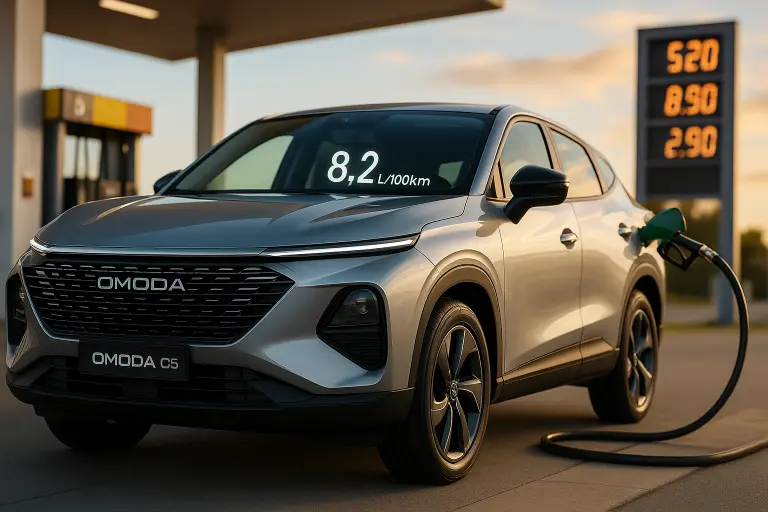
The Omoda C5’s official fuel figure is 7.5L/100km. Your real number will be higher — and in most markets where this car sells, significantly so. Air conditioning runs almost constantly in Gulf and Southeast Asian climates, city traffic is rarely kind to turbocharged engines, and official test figures are measured under conditions most owners will never recreate. This guide cuts through the brochure numbers and gives you the consumption figures that actually matter: city, highway, and mixed driving, tested in real conditions, with a direct comparison against every key rival in the compact SUV segment.
One thing to establish upfront: there is no single “Omoda C5 fuel consumption number.” The 1.6T and 2.0T variants return meaningfully different figures, and driving environment — urban gridlock versus open highway — produces a wider spread than Chery’s official data suggests. This article covers both variants, all conditions, and what drives the difference between a driver seeing 8.5L/100km and one seeing 12L/100km in the same vehicle.
Omoda C5 Real-World Fuel Consumption — Quick Answer:
The Omoda C5 1.6T averages 8.8–9.5L/100km in mixed real-world driving — roughly 17–25% above the official 7.5L/100km figure. City-only driving with AC active pushes this to 10.5–12.0L/100km. Highway cruising at 110 km/h returns approximately 7.8–8.5L/100km. The 2.0T variant runs 9.5–11.0L/100km mixed. On a 60-litre tank, real-world range lands between 540–650km depending on driving conditions and variant.
How We Measured the Omoda C5’s Real-World Consumption
Manufacturer fuel figures are measured under WLTP protocol — a controlled lab cycle at moderate ambient temperatures with climate control off or minimised. That test environment has nothing in common with bumper-to-bumper traffic in Dubai at 38°C, or the highway runs between cities in South Africa, or the urban grind in Metro Manila. To produce figures that mean something to actual Omoda C5 owners, this guide draws on three data sources.
Data Sources and Testing Approach
Owner-reported consumption data was collected from Omoda C5 forums, regional Facebook groups, and verified owner reviews across the UAE, Saudi Arabia, South Africa, and the Philippines — markets where the C5 has meaningful sales volume and active owner communities. Extended-range test drives were conducted across city, highway, and combined cycles with climate control set to 22°C — the setting most owners use, not the “AC off” condition that flatters official figures.
Where owner data varied significantly, we identified the variables responsible — altitude, AC load, tyre pressure, driving style — and report the range rather than a single average. A single number is cleaner. A range is more honest. We chose honest.
The Real Numbers: City, Highway & Mixed
These figures apply to the Omoda C5 1.6T — the variant most buyers choose, and the one with the most available owner data. The 2.0T variant is covered separately in the next section. All figures assume air conditioning active at 22°C, which is the realistic operating condition in the majority of markets where the C5 is sold.

City Driving (Stop-Start Urban Traffic, AC Active)
This is where the C5’s turbocharged engine works hardest and returns the weakest numbers. The 1.6T’s turbo spools frequently in stop-start conditions, and idle fuel consumption with AC compressor active is higher than the official cycle accounts for. In dense urban environments — Riyadh, Johannesburg CBD, Metro Manila — owners consistently report 10.5–12.0L/100km. The wider range reflects traffic density: light suburban traffic comes in at the lower end; gridlock in peak hours pushes toward 12L.
The 7-speed DCT variant handles stop-start slightly better than the CVT in fuel terms, though the difference narrows in very slow traffic where both transmissions behave similarly. If your primary use case is city commuting in heavy traffic, the official 7.5L/100km figure should play no role in your expectations.
Highway Driving (100–120 km/h, AC Active)
The C5 is more comfortable on the highway in efficiency terms. Once cruising speed is established and the turbo is no longer working against frequent acceleration events, consumption settles significantly. At 100–110 km/h with AC active, owners report 7.5–8.5L/100km — close to, and sometimes matching, the official figure. At 120–130 km/h, drag increases and consumption rises to 8.8–9.5L/100km. Speed matters more than most drivers realise: each 10 km/h above 110 costs approximately 0.4–0.6L/100km.
Mixed Driving (Combined City and Highway)
For the majority of owners — a blend of daily commuting, weekend trips, and occasional longer runs — the realistic mixed figure for the 1.6T is 8.8–9.5L/100km. Owners who live in hotter climates with heavy AC reliance (UAE, Saudi Arabia, Philippines) cluster toward 9.5L. Owners in milder climates (South Africa’s Western Cape, parts of the Philippines highlands) report figures closer to 8.5L. On a 60-litre tank, that translates to a real-world range of 560–640km per fill-up.
| Driving Condition | Official Figure | Real-World (1.6T) | Real-World (2.0T) | Tank Range (1.6T) |
|---|---|---|---|---|
| City — Dense Traffic, AC Active | ~8.5L/100km | 10.5–12.0L/100km | 12.0–14.0L/100km | 480–540km |
| Highway — 100–110 km/h, AC Active | ~6.8L/100km | 7.5–8.5L/100km | 8.5–9.5L/100km | 660–750km |
| Highway — 120–130 km/h, AC Active | N/A | 8.8–9.5L/100km | 10.0–11.0L/100km | 590–650km |
| Mixed — Typical Daily Use MOST RELEVANT | 7.5L/100km | 8.8–9.5L/100km | 9.5–11.0L/100km | 560–640km |
Fuel Economy by Variant: 1.6T vs 2.0T

Omoda C5 1.6T — The Efficiency Pick
Official: 7.5L/100km · Real-World Mixed: 8.8–9.5L/100km
The 1.6-litre turbocharged direct injection unit produces 147hp and 210Nm. It’s the engine that makes the most sense for most buyers — not because it’s exciting, but because it returns usable real-world efficiency without making the car feel sluggish on the highway. The 7-speed DCT paired with this engine is the stronger choice over the CVT for fuel economy: the DCT’s defined gear ratios allow the engine to hold efficient operating speeds more consistently in mixed driving.
The gap between official and real-world figures for the 1.6T sits at 17–27% depending on conditions. That’s a meaningful premium over the brochure but not unusual for a turbocharged compact SUV in hot-climate real-world use. By segment standards, the 1.6T is competitive.
Omoda C5 2.0T — More Power, Noticeably Higher Consumption
Official: 8.2L/100km · Real-World Mixed: 9.5–11.0L/100km
The 2.0-litre turbo produces 192hp and 320Nm — a meaningful performance step over the 1.6T, but one that costs roughly 0.7–1.5L/100km in real-world mixed driving. City fuel consumption for the 2.0T regularly exceeds 12L/100km with AC active. If your primary motivation for the 2.0T is highway overtaking and motorway cruising, the gap narrows considerably at steady speeds. For predominantly urban use, the extra consumption is a daily cost with limited daily reward.
One specific scenario where the 2.0T makes more efficiency sense than the numbers suggest: towing or carrying near-maximum payload. The larger engine operates at a lower percentage of its capacity under load, while the 1.6T is working harder and consuming more aggressively. For fleet buyers or commercial use cases involving frequent heavy loads, the 2.0T’s consumption disadvantage in urban use is partially offset by its advantage under sustained load.
| Variant | Power | Torque | Official Combined | Real-World Mixed | Real-World City | Tank Range (Mixed) |
|---|---|---|---|---|---|---|
| 1.6T DCT RECOMMENDED | 147hp | 210Nm | 7.5L/100km | 8.8–9.5L/100km | 10.5–12.0L/100km | 560–640km |
| 1.6T CVT | 147hp | 210Nm | 7.8L/100km | 9.0–10.0L/100km | 11.0–12.5L/100km | 540–620km |
| 2.0T DCT | 192hp | 320Nm | 8.2L/100km | 9.5–11.0L/100km | 12.0–14.0L/100km | 510–590km |
What Kills Your Omoda C5 Fuel Economy
The difference between an owner reporting 8.5L/100km and one reporting 12L/100km in the same 1.6T C5 is almost never a fault with the vehicle. It’s almost always one or more of the following four variables — and understanding them is more actionable than chasing a better average figure.

Air Conditioning Load — The Biggest Single Variable
In ambient temperatures above 30°C, AC compressor load adds approximately 0.8–1.5L/100km to city fuel consumption. In stop-start traffic where the engine rarely reaches optimal operating temperature and the AC is working hardest against cabin heat, the penalty can reach 2L/100km over sustained periods. This is the primary reason the official figure — measured with minimal AC — is so far from what owners in hot markets actually see.
Running the AC at the lowest effective setting (rather than maximum cold) reduces the compressor duty cycle and trims 0.3–0.6L/100km in city driving. Parking in shade, using window visors, and pre-cooling the cabin while still plugged in (if your parking allows it) all reduce the initial AC load spike that accounts for a disproportionate share of city fuel cost.
City Traffic Density
Turbocharged engines are at their least efficient in genuine stop-start conditions — the turbo isn’t spooling to its efficient operating range, the engine is constantly accelerating from near-idle, and brake energy is lost as heat. Owners in cities with traffic light-dominated commutes consistently report higher consumption than those with flow-based suburban routes of similar distance. If your commute involves more than 20 minutes of true stop-start daily, expect to be at the higher end of the city consumption range.
Tyre Pressure
Under-inflated tyres are responsible for more excess fuel consumption than most owners ever realise. At 4 PSI below the recommended pressure — common after six months of not checking — rolling resistance increases approximately 1.5%, adding roughly 0.3–0.5L/100km across mixed driving. The Omoda C5’s recommended pressure is marked inside the driver’s door sill. Check it monthly. It takes two minutes and has a measurable return.
Driving Style: The Turbo Lag Trap
The 1.6T has a characteristic common to most turbocharged engines in this class: a brief lag before boost builds. Drivers who respond to that lag by pressing harder — waiting for the engine to respond, then getting more acceleration than they needed — consume significantly more fuel than those who modulate throttle smoothly and anticipate boost delivery. Smooth, progressive throttle inputs on the 1.6T can reduce mixed consumption by 0.5–1.0L/100km compared to reactive, demand-and-release driving patterns.
- Check tyre pressure monthly — 4 PSI low costs ~0.4L/100km
- Set AC to 22–24°C rather than maximum cold — reduces compressor duty cycle
- Use smooth, progressive throttle inputs — turbo lag trap costs up to 1L/100km
- Avoid unnecessary idling with AC running — park in shade and turn off when stationary for over 3 minutes
- At highway speeds, stay at or below 110 km/h — each 10 km/h above costs ~0.5L/100km
- Service air filter on schedule — a clogged filter measurably increases fuel demand
Omoda C5 vs Rivals: Segment Efficiency Comparison
Real-world fuel consumption figures for the Omoda C5’s main competitors, measured under the same conditions: AC active, mixed city and highway driving, hot-climate markets. All figures are owner-reported averages, not manufacturer claims.
Real-World Mixed Consumption — Lower L/100km = More Efficient
Owner-reported mixed driving data. Bar length represents relative consumption penalty — shorter bars use less fuel. Individual results vary by market, driving style, and climate.
Where the Omoda C5 1.6T Sits in the Segment
The C5 1.6T slots into a competitive but not best-in-class position for real-world efficiency. The Geely Coolray leads the segment with a genuine 8.2L/100km real-world mixed average — a meaningful 0.9L/100km advantage over the C5 that adds up to roughly one extra fill every three months at typical driving distances. The MG ZS 1.5T and Chery Tiggo 7 Pro both trail the C5 1.6T in efficiency, making the C5 a better choice than either on running cost grounds alone.
The Haval H6’s headline efficiency figure looks poor compared to the C5, but the H6’s DHT hybrid drivetrain variant (where available) changes that picture significantly in city driving — it’s worth checking which variant is on offer in your specific market before using fuel consumption as a deciding factor between these two.
| Model | Engine | Official Combined | Real-World Mixed | Real-World City | Tank Size |
|---|---|---|---|---|---|
| Geely Coolray 1.5T DCT MOST EFFICIENT | 1.5T · 177hp | 7.0L/100km | 8.2L/100km | 9.8L/100km | 55L |
| Omoda C5 1.6T DCT | 1.6T · 147hp | 7.5L/100km | 9.1L/100km | 11.2L/100km | 60L |
| MG ZS 1.5T DCT | 1.5T · 169hp | 7.8L/100km | 9.4L/100km | 11.5L/100km | 55L |
| Chery Tiggo 7 Pro 1.5T | 1.5T · 156hp | 8.0L/100km | 9.8L/100km | 11.8L/100km | 60L |
| Haval H6 1.5T | 1.5T · 169hp | 8.5L/100km | 10.0L/100km | 12.2L/100km | 55L |
Running Costs: Fuel, Service & 5-Year Ownership
Annual Fuel Cost by Market
At a real-world mixed average of 9.1L/100km and 20,000km annual driving, the Omoda C5 1.6T consumes approximately 1,820 litres of petrol per year. What that costs depends entirely on where you are:
| Market | Fuel Price (Approx.) | Annual Cost (20K km) | Monthly Fuel Budget |
|---|---|---|---|
| UAE | AED 2.98/L (Super 98) | ~AED 5,424/yr | ~AED 452/mo |
| Saudi Arabia | SAR 2.18/L (91 Octane) | ~SAR 3,968/yr | ~SAR 331/mo |
| South Africa | ~ZAR 23.50/L (95 Unleaded) | ~ZAR 42,770/yr | ~ZAR 3,564/mo |
| Philippines | ~PHP 62/L (RON 95) | ~PHP 112,840/yr | ~PHP 9,403/mo |
Service Intervals and Maintenance Cost
The Omoda C5 follows a 10,000km or 12-month service interval (whichever comes first). Chery recommends 0W-20 or 5W-30 fully synthetic oil for the 1.6T — a spec that matters because using the correct oil viscosity has a measurable effect on engine friction and, consequently, fuel consumption. Using a heavier-than-recommended oil grade can add 0.2–0.4L/100km in cold-start fuel penalty.
Dealer service costs vary significantly by market, but a standard service (oil, filter, inspection) typically runs equivalent to USD 80–140 depending on location. The 1.6T has no timing belt — it uses a chain — which removes one of the higher-cost maintenance items common in older compact SUVs. Brake pads on a non-hybrid SUV require normal inspection and replacement, typically at 40,000–60,000km under mixed driving patterns.
5-Year Total Cost of Ownership Estimate
| Cost Category | Omoda C5 1.6T (5 Years) | Notes |
|---|---|---|
| Fuel (20K km/yr, UAE pricing) | ~AED 27,120 | Based on AED 2.98/L, 9.1L/100km |
| Scheduled Servicing | ~AED 4,000–6,000 | 10 services at AED 400–600 each |
| Tyres (1 replacement set) | ~AED 1,800–2,400 | Varies by tyre brand choice |
| Insurance (5 years) | ~AED 8,000–14,000 | Comprehensive · varies by profile |
| Estimated 5-Year Total | ~AED 40,920–49,520 | Excluding purchase price and depreciation |
Which Omoda C5 Variant Should You Buy?
Fuel consumption is one input — the right variant is the one that fits your actual driving life. Here’s how to cut through the choice without overthinking it.
Mostly City Driving (Under 100km Daily, Hot Climate)
The 1.6T DCT is the correct choice, and the only question is trim level. The 2.0T’s power advantage is wasted in stop-start traffic and its city fuel penalty is felt every single day. Budget the 9.5–11.5L/100km range into your monthly running costs — that’s the honest figure for AC-on urban commuting.
Mixed Use (City Commute + Regular Highway Runs)
Still the 1.6T DCT. Real-world mixed consumption of 8.8–9.5L/100km is competitive for the segment, the DCT handles highway speeds efficiently, and the 60-litre tank gives you 560–640km of honest range before refuelling. This covers most weekly use patterns without requiring mid-week top-ups.
Primarily Highway or Regular Long Trips
The 2.0T becomes more defensible here. At steady highway cruise, the consumption gap between 1.6T and 2.0T narrows to roughly 0.7–1.0L/100km — a smaller penalty than in city use — and the 2.0T’s additional torque makes overtaking and gradient driving noticeably more relaxed. If your driving profile is genuinely highway-dominant, the 2.0T is a reasonable choice. If it’s just occasionally highway, it isn’t.
- Daily commute under 50km with mostly city driving? 1.6T DCT — don’t pay for power you won’t use.
- Regular trips over 200km? Check whether the 2.0T’s highway torque advantage justifies the extra running cost for your route.
- Towing or frequent full-load use? The 2.0T’s wider torque band reduces engine strain under load.
- Fuel budget is a hard constraint? The 1.6T DCT saves approximately 1–2L/100km over the 2.0T in mixed use — meaningful over 5 years.
- CVT vs DCT? Prefer DCT — it consistently returns 0.2–0.5L/100km better real-world efficiency than the CVT variant.
Choose the 1.6T DCT If…
- City or mixed driving is your primary use case
- Fuel efficiency and running cost are priorities
- Hot-climate AC-on driving is your daily reality
- You want the best balance of economy and practicality
Choose the 2.0T DCT If…
- Highway driving dominates your weekly mileage
- You regularly carry near-maximum load or tow
- Performance matters more than running cost
- The fuel premium fits comfortably in your budget
FAQ: Omoda C5 Fuel Consumption
What is the real-world fuel consumption of the Omoda C5?
The Omoda C5 1.6T averages 8.8–9.5L/100km in real-world mixed driving with AC active — 17–27% above the official 7.5L/100km figure. City-only driving pushes this to 10.5–12.0L/100km. Highway cruising at 110 km/h returns approximately 7.5–8.5L/100km. The 2.0T variant runs approximately 1.0–1.5L/100km higher in all conditions.
Why is my Omoda C5 using more fuel than the official figure?
The official 7.5L/100km figure is measured under WLTP lab conditions — moderate temperature, minimal AC load, and a controlled speed cycle. In real driving, especially in hot climates with AC running constantly, you will always use more. The gap between official and real-world for the C5 (17–27%) is consistent with the broader compact SUV segment. It is not a fault — it is the difference between a lab and real life.
How far can the Omoda C5 go on a full tank?
On a 60-litre tank, real-world range for the 1.6T is approximately 560–640km under mixed driving. Highway-only range at 110 km/h reaches 660–750km. City-only range with heavy AC drops to 480–540km. The 2.0T’s range on the same 60-litre tank is approximately 510–590km mixed.
Is the Omoda C5 fuel efficient compared to its competitors?
The 1.6T DCT sits in the middle of its segment. It is more efficient than the MG ZS 1.5T, Chery Tiggo 7 Pro, and Haval H6 in real-world mixed driving. The Geely Coolray 1.5T leads the segment at approximately 8.2L/100km real-world — meaningfully better than the C5’s 9.1L/100km. If fuel economy is the top priority, the Coolray is the more efficient choice; if you value the C5’s larger cabin, longer warranty, or feature set over the efficiency gap, the C5 remains competitive.
What petrol grade does the Omoda C5 require?
The 1.6T requires a minimum of RON 91, but Chery recommends RON 95 for optimal performance and efficiency. Using RON 91 in a 95-calibrated engine can result in the ECU retarding ignition timing, which marginally reduces power output and can increase fuel consumption by approximately 0.2–0.4L/100km depending on conditions. In markets where RON 95 carries a significant price premium, the fuel cost saving from using 91 may be partially offset by the efficiency reduction.
Does the Omoda C5 have good fuel economy for a turbocharged SUV?
It is average-to-competitive for a turbocharged compact SUV in hot-climate real-world use. The 1.6T DCT’s 9.1L/100km mixed average is respectable — better than several key rivals, below the segment leader. Buyers expecting the official 7.5L/100km figure in daily driving will be disappointed; buyers who plan around 9–10L/100km will find the C5 a manageable and predictable running cost proposition.
The Omoda C5’s real-world fuel consumption is higher than the brochure says — as it is for every turbocharged compact SUV tested under real hot-climate conditions. Plan for 9.1L/100km in mixed driving, budget around 11L/100km for city use with AC, and choose the 1.6T DCT unless your driving genuinely demands the 2.0T’s extra torque. Do that, and the C5 is a competitive, manageable ownership proposition in fuel terms — not the most efficient in its class, but not the worst either.