
How long do EV batteries last? It’s one of the first questions most people ask when considering an electric vehicle — and for good reason. The battery isn’t just another component; it’s the heart of an EV, determining not only how far you can drive but also how long your investment will hold its value.
As electric vehicles rapidly move from niche to mainstream, understanding battery lifespan has become essential. (International Energy Agency’s Global EV Outlook 2024) Drivers want to know: Will my EV still perform well after years of daily use? How much range loss should I expect over time? And what can I do to extend the life of my battery?
In reality, several key factors influence how long EV batteries last — from driving habits and charging frequency to temperature conditions and battery management systems.
To understand how long EV batteries really last, we first need to look at how they work and what truly affects their longevity.
2. What Does “Battery Lifespan” Really Mean?
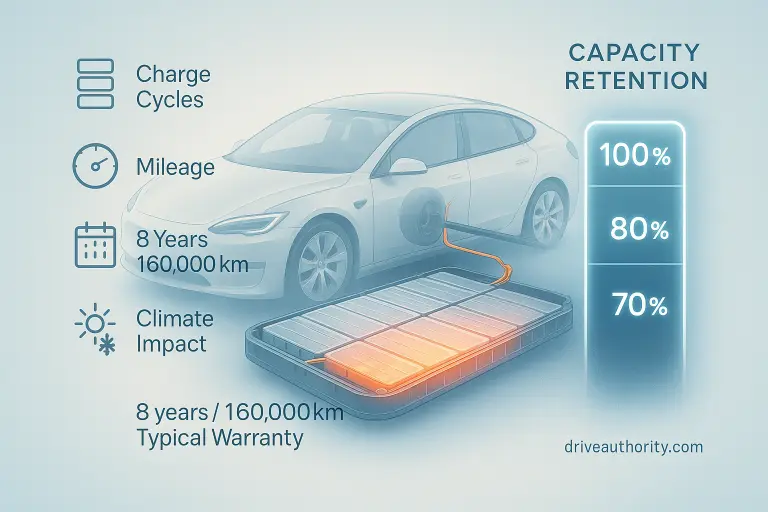
When people ask, “How long do EV batteries last?”, they often think in years. But in electric vehicles, lifespan is about more than time — it’s about capacity retention.
Capacity Retention vs. Total Lifespan
Battery lifespan measures how much of its original capacity the battery can still store after years of use. It doesn’t mean the battery stops working one day; instead, it gradually holds less energy.
Most EV owners notice this drop when capacity falls below 70–80% of the original level. That’s when range and performance begin to decline.
Expected Lifespan vs. Real-World Use
Manufacturers provide an expected lifespan, often expressed in years, mileage, or charge cycles — for example, 8 years or 160,000 km.
However, real-world performance often varies. It depends on how the driver charges the car, local climate, and daily driving habits. An EV driven gently and charged properly may outperform the manufacturer’s estimate.
How Manufacturers Measure Battery Life
Carmakers usually rate batteries based on charge cycles — the number of full charges and discharges they can handle before losing significant capacity.
Modern EV batteries can survive 1,000 to 3,000 cycles, which typically equals 10 years or more of normal driving.
3. How Long Do EV Batteries Actually Last?
So, how long do EV batteries last in real life? On average, most electric vehicle batteries last between 8 and 15 years — or roughly 100,000 to 300,000 miles — before their capacity drops noticeably. The exact lifespan depends on the battery type, driving habits, climate, and charging routine.
Real-World Lifespan by Brand
Different manufacturers report slightly different results:
- Tesla batteries often retain about 80–90% capacity after 200,000 miles, thanks to advanced thermal management and efficient battery chemistry (Tesla Impact Report 2023).
- Nissan Leaf batteries, especially older models without active cooling, may show faster degradation — often after 8–10 years in hot climates.
- Hyundai and Kia EVs use modern lithium-ion polymer batteries that typically last 10–15 years under normal conditions.
- .
The Role of Warranty Coverage
Most carmakers offer strong warranty protection to reassure buyers. In fact, almost all major EV brands provide an 8-year or 100,000-mile battery warranty — whichever comes first. Tesla’s warranty, for instance, guarantees at least 70% battery capacity during that period. Hyundai extends this confidence with lifetime coverage for some of its EV models.
In short, while EV batteries naturally lose capacity over time, most are engineered to last well beyond a typical car ownership cycle. With proper care, your EV’s battery can easily outlive your desire for an upgrade.
4. Key Factors That Affect EV Battery Life
While EV batteries are built to last for many years, several real-world factors can either extend or shorten their lifespan. Understanding these influences helps drivers get the most out of their investment.
4.1 Charging Habits
How you charge your EV plays a major role in battery health. Frequent fast charging generates more heat, which can stress the cells and accelerate degradation over time. In contrast, slow overnight charging (Level 2) is gentler and helps preserve battery capacity.
It’s also best to avoid charging to 100% or draining to 0% too often. Keeping the battery between 20% and 80% is ideal for long-term health.
4.2 Driving Patterns
Your driving style affects how hard the battery works. Rapid acceleration, high-speed driving, and heavy loads all increase energy demand — which raises battery temperature and wear.
Short, consistent trips are easier on the system than long, high-speed commutes. Smooth acceleration and regenerative braking can make a big difference in extending battery life.
4.3 Climate and Temperature
Temperature is one of the most significant environmental factors. Extreme heat accelerates chemical reactions that degrade battery cells, while extreme cold reduces performance and efficiency.
Drivers in hot regions like Arizona or the Middle East may notice faster degradation compared to those in cooler climates. Parking in the shade and using preconditioning features can help regulate temperature and protect the battery.
4.4 Battery Management Systems (BMS)
Modern electric vehicles include a Battery Management System, or BMS, designed to protect and balance the battery pack.
The BMS monitors temperature, voltage, and charge levels to prevent overcharging or deep discharging. This technology ensures each cell performs optimally, extending overall battery life and maintaining consistent performance over time.
5. Signs Your EV Battery Is Wearing Out
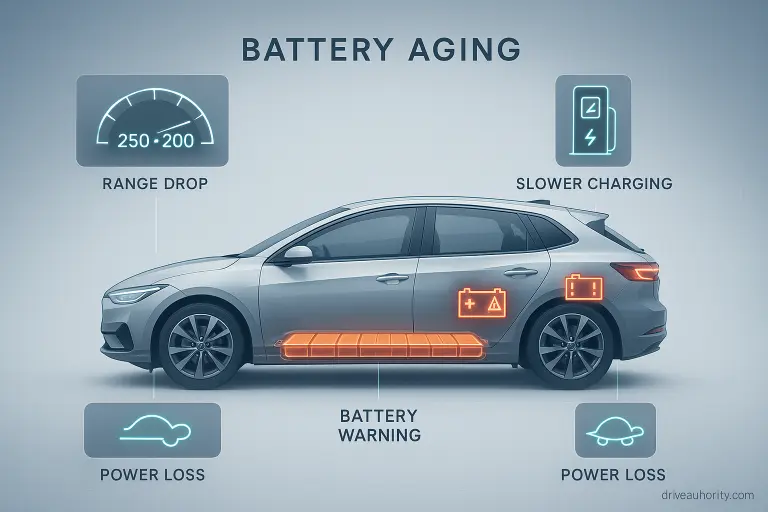
Even though EV batteries are engineered for durability, every battery eventually shows signs of aging. Recognizing these early can help you take corrective action — or plan ahead for maintenance or replacement. Here are the most common indicators your EV battery may be wearing out:
🔋 5.1 Reduced Driving Range
If you notice your car’s range shrinking over time — for example, a full charge that once delivered 250 miles now provides only 200 — it’s a clear sign the battery’s capacity is decreasing. Gradual range loss is normal, but a sudden drop may indicate a deeper issue within the battery cells or management system.
⚡ 5.2 Longer Charging Times
As batteries age, internal resistance increases, causing slower charging speeds. If your EV now takes noticeably longer to reach a full charge — even on the same charger — it could signal reduced efficiency or minor degradation within the battery pack.
🚨 5.3 Warning Lights or Diagnostic Alerts
Modern EVs include advanced monitoring systems that track battery health. If your dashboard displays a “battery health” or “service battery” warning, don’t ignore it. These alerts often indicate the system has detected capacity loss, imbalanced cells, or abnormal temperature fluctuations.
🐢 5.4 Slower Performance or Inconsistent Charge Levels
Aging batteries can affect overall performance. You might experience reduced acceleration, less responsive regenerative braking, or charge levels that fluctuate unexpectedly. These symptoms usually mean the battery is struggling to deliver consistent power output.
6. Can EV Batteries Be Repaired or Replaced?
When EV batteries begin to lose performance, many drivers wonder: Do I have to replace the entire battery pack, or can it be repaired? The good news is that today’s electric vehicles offer several options — from minor repairs to full replacements — depending on the severity of the issue.
🔧 6.1 Battery Repair and Module Replacement
EV batteries are made up of many smaller modules or cells. In some cases, only a few of these cells degrade or fail, rather than the whole pack. Skilled technicians can diagnose the faulty modules using advanced diagnostic tools and replace only the affected parts.
This targeted repair is far less expensive than a full replacement and can restore performance and range for several more years. However, not all EV models currently support modular repairs — some manufacturers still require full-pack replacement when significant issues arise.
💰 6.2 Full Battery Pack Replacement and Cost
When degradation reaches a point where repairs are no longer effective, a full battery replacement may be necessary. Costs vary widely depending on battery size and brand:
- Typical range: $4,000–$20,000
- Average for popular models: Around $10,000–$12,000
Fortunately, most electric vehicles come with long-term battery warranties — usually 8 years or 100,000 miles, whichever comes first. Some brands even cover replacement if capacity drops below a set threshold (often 70%). Always check your manufacturer’s warranty terms before considering any major repair.
🔄 6.3 Recycling and Second-Life Applications
Even after an EV battery can no longer power a vehicle efficiently, it doesn’t have to end up as waste. Many used batteries are being repurposed for second-life applications such as home energy storage, solar backup systems, or grid stabilization.
The recycling industry is also rapidly evolving, with companies recovering valuable materials like lithium, cobalt, and nickel to produce new batteries. This circular approach reduces waste and environmental impact — making EV ownership even more sustainable.
7. How to Extend Your EV Battery’s Lifespan
The question “How long do EV batteries last?” doesn’t have a single answer — because much depends on how you treat your battery day-to-day. By following a few smart habits, you can significantly slow down battery degradation and keep your EV performing like new for years.
⚙️ 7.1 Avoid Frequent 100% Charges
While it’s tempting to top up your EV to 100% for maximum range, doing so too often puts extra stress on the cells. Lithium-ion batteries prefer to stay within a moderate charge window — ideally between 20% and 80%. Save the full charge for long road trips, and for daily driving, aim for a balanced routine that avoids constant full capacity.
🌡️ 7.2 Keep Your Vehicle in Moderate Temperatures
Extreme heat and cold are two of the biggest threats to battery health. Whenever possible, park in shaded or climate-controlled areas, and use your vehicle’s preconditioning features to regulate temperature before driving. If you live in a hot or freezing region, maintaining thermal stability will have a major impact on long-term battery life.
⏰ 7.3 Use Scheduled Charging
Many modern EVs let you schedule charging times, so the car finishes charging right before you start driving. This keeps the battery from sitting at a high state of charge for long periods — a simple but effective way to preserve its chemical integrity. Nighttime charging is especially beneficial when grid demand (and often electricity cost) is lower.
🚗 7.4 Drive Smoothly and Maintain Consistent Speeds
Aggressive driving — like rapid acceleration or frequent hard braking — generates excess heat and puts stress on the battery. Instead, drive smoothly, use regenerative braking efficiently, and maintain steady speeds whenever possible. Not only does this conserve battery health, but it also improves overall range and efficiency.
8. The Future of EV Battery Technology
As electric vehicles evolve, so do the batteries that power them. The next generation of innovations promises not only longer lifespans but also greater safety, faster charging, and lower environmental impact. Understanding where EV battery technology is headed helps answer a crucial question: How long will EV batteries last in the future?
🔬 8.1 Solid-State Batteries: The Next Big Leap
One of the most anticipated breakthroughs in the EV world is solid-state battery technology. Unlike traditional lithium-ion batteries that use liquid electrolytes, solid-state cells rely on solid electrolytes — making them safer, lighter, and more energy-dense.
Early prototypes suggest that these batteries could last up to 20–30 years, offering double the lifespan of current lithium-ion packs. While still in development, major automakers like Toyota, BMW, and QuantumScape are investing heavily in commercializing this game-changing technology.
🌡️ 8.2 Smarter Thermal Management Systems
Heat remains one of the main enemies of battery longevity. The next generation of EVs will feature advanced thermal management systems capable of precisely regulating battery temperature during charging and driving.
Innovations such as liquid cooling loops, phase-change materials, and AI-driven heat control will minimize thermal stress and significantly reduce degradation — particularly in extreme climates.
🧠 8.3 Advanced Battery Management Systems (BMS)
Modern Battery Management Systems already monitor voltage, temperature, and charge balance, but the future brings even smarter integration.
AI-enhanced BMS technology will be able to predict cell wear, optimize charge cycles in real time, and even perform self-healing routines to extend life expectancy. These systems will ensure that each battery cell performs at peak efficiency throughout its lifecycle.
💡 8.4 What It Means for Drivers: Lower Costs and Higher Resale Value
With these advancements, future EVs could easily surpass 20 years of reliable battery life — drastically improving total cost of ownership. Longer-lasting batteries also mean stronger resale values, as used EVs will retain more of their range and reliability.
In essence, the next wave of innovation won’t just make electric vehicles greener — it will make them financially smarter investments too.
9. Conclusion
So, how long do EV batteries last? On average, most electric vehicle batteries are designed to perform reliably for 8 to 15 years, depending on driving habits, climate, and charging behavior. Thanks to advanced engineering, modern EVs retain 70–90% of their battery capacity even after hundreds of thousands of miles.
While factors like charging patterns, temperature, and driving style influence longevity, the good news is that drivers have real control over how long their EV batteries last. By following best practices — such as avoiding frequent 100% charges, maintaining moderate temperatures, and driving smoothly — you can keep your battery healthy for well beyond its warranty period.
Today’s EV batteries are remarkably durable and technologically advanced, far exceeding early expectations. And with innovations like solid-state batteries, smart thermal systems, and AI-driven battery management, the next generation of electric vehicles may see lifespans stretching past 20 years or more.
The future of EVs isn’t just electric — it’s efficient, sustainable, and built to last.
Pingback: Best Electric Cars 2025: The Ultimate Buyer’s Guide
Pingback: Is BYD Really Better Than Tesla? Full 2026 Comparison