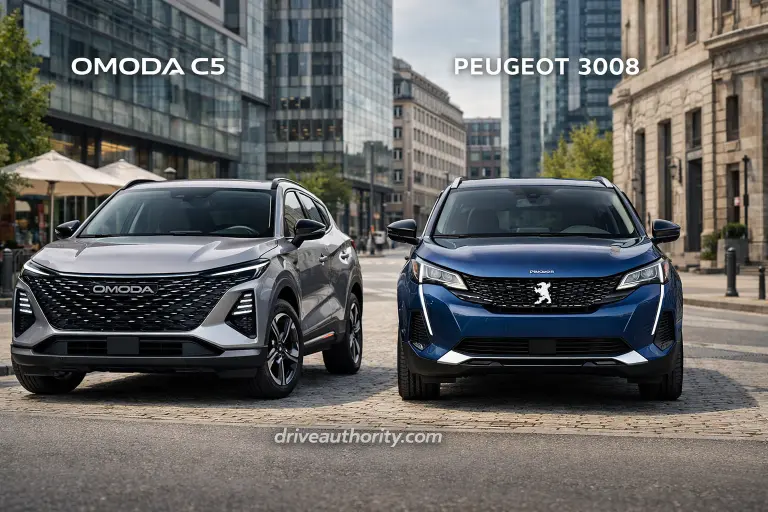
1. Introduction: The Real Value Question Buyers Face — Omoda C5 vs Peugeot 3008
The compact crossover segment has grown at a remarkable pace in recent years. Today, buyers are flooded with options that promise SUV style, modern technology, and reasonable running costs. As a result, the real challenge is no longer choosing a body type. Instead, it is deciding which model truly delivers value in daily life. This is exactly where the Omoda C5 vs Peugeot 3008 comparison becomes critical.
At the heart of this choice lies an emotional tension. On one hand, there is a proven European name with a long history and established reputation. On the other hand, there is a feature-rich new challenger that looks ambitious, modern, and aggressively priced. Therefore, the decision feels less like a calculation and more like a leap of trust.
The Omoda C5 enters this debate as a disruptive value contender. It targets buyers who want maximum features for their money and are willing to consider a newer brand. Meanwhile, the Peugeot 3008 stands as a well-known benchmark in the segment. It offers refinement, brand confidence, and years of real-world feedback.
However, value is not defined by specifications alone. Numbers on paper rarely reflect ownership reality. For that reason, this Omoda C5 vs Peugeot 3008 comparison focuses on what truly matters: real costs, everyday usability, and long-term confidence. Ultimately, the goal is simple — to deliver a clear, honest value verdict without spec-sheet noise or marketing hype.
2. What “Value” Really Means in the Omoda C5 vs Peugeot 3008 Comparison
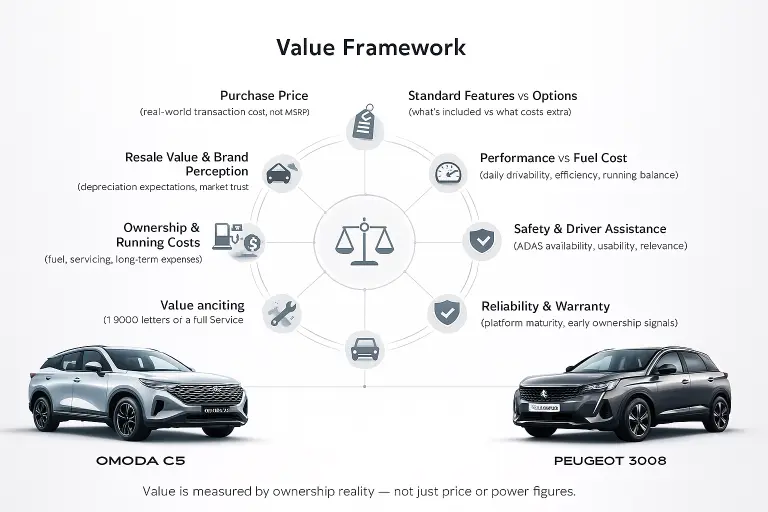
When buyers compare compact SUVs, “value” is often misunderstood. Many focus only on the sticker price or engine figures. However, real value is broader and far more practical. In the Omoda C5 vs Peugeot 3008 debate, value is about what you pay, what you get, and how the car fits into your life over time.
2.1 Our Value Framework: How We Measure Real-World Value
To create a fair and buyer-focused comparison, value is assessed across seven dimensions that directly affect ownership satisfaction. Each one reflects how the car performs beyond the showroom.
- Purchase price
We focus on real-world transaction prices, not just advertised MSRP. Discounts, trim gaps, and market positioning all matter. - Standard features vs paid options
What you receive as standard can change the value equation dramatically. Therefore, we look closely at what requires extra payment. - Performance relative to fuel cost
Power alone means little without efficiency. Instead, we examine how performance feels in daily driving compared to fuel consumption. - Safety and driver assistance
Active and passive safety features are evaluated based on availability, usability, and real-world relevance. - Reliability signals and warranty
Long-term confidence depends on platform maturity, early reliability data, and manufacturer warranty coverage. - Ownership and running costs
Fuel, servicing, and wear items all shape the true cost of ownership. These factors often matter more than the purchase price. - Resale value and brand perception
Brand strength influences depreciation. As a result, resale expectations are part of any honest value judgment.
Together, these seven factors create a realistic picture of value in the Omoda C5 vs Peugeot 3008 comparison.
2.2 How This Omoda C5 vs Peugeot 3008 Comparison Was Built
Trust matters in a buying decision. For that reason, this comparison is based on multiple reliable sources rather than marketing claims alone.
- Manufacturer specifications provide the baseline for engines, dimensions, and equipment.
- Independent road tests offer insight into ride quality, efficiency, and real-world performance.
- Owner feedback and early reliability signals help reveal strengths and weaknesses that specs cannot show.
- Regional ownership realities are also considered, including fuel costs, servicing access, and parts availability.
By combining official data with real-world experience, this Omoda C5 vs Peugeot 3008 analysis aims to deliver clarity, credibility, and practical value for serious buyers.
3. Pricing & Equipment: What You Actually Get for the Money
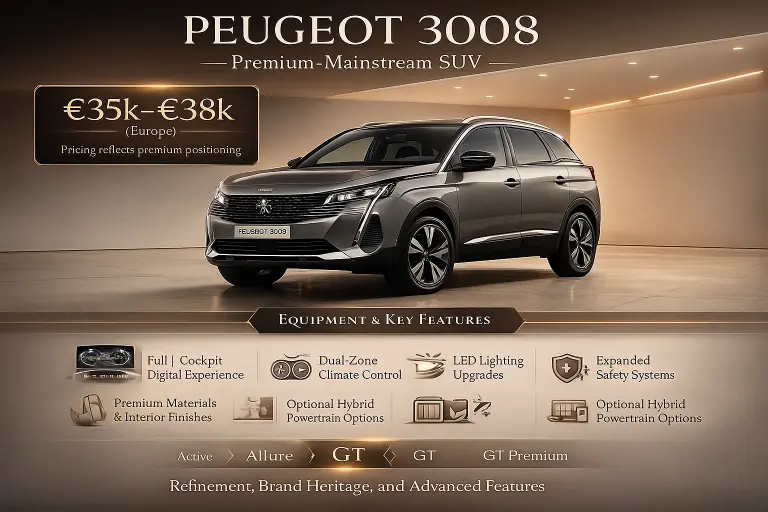
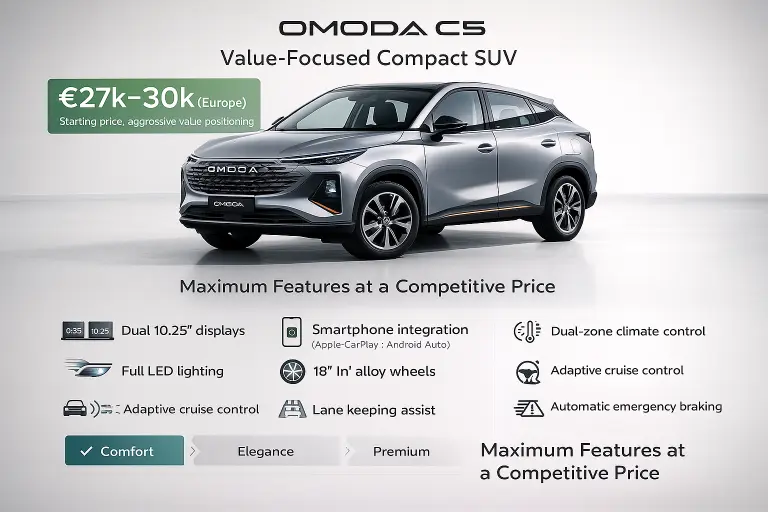
The first real test of value happens at the pricing sheet. This is where aspirations meet budget constraints, and where marketing promises face financial reality. In the Omoda C5 vs Peugeot 3008 comparison, pricing immediately reveals two very different philosophies.
At first glance, both SUVs appear competitive. However, once you look beyond headline figures, the real value story becomes far more nuanced.
Base Price & Market Positioning
MSRP Ranges Across Key Markets
The Omoda C5 enters global markets with aggressively low pricing. As a result, it positions itself clearly as the value-focused challenger.
In most European markets, the C5 starts around €27,000–€30,000, depending on country and taxation. Fully equipped versions typically reach €35,000–€38,000.
Meanwhile, pricing varies by region:
- Middle East: approx. $25,000–$28,000
- Asia (ex-China): approx. $23,000–$26,000
- Africa: approx. $30,000–$32,000, reflecting import duties and lower volumes
By contrast, the Peugeot 3008 operates in a higher pricing bracket. This reflects its premium-mainstream positioning rather than outright luxury status.
In Europe, the 3008 begins around €35,000–€38,000 for base petrol models. Prices extend to €48,000–€52,000 for fully equipped hybrid variants. Elsewhere:
- Middle East: approx. $32,000–$35,000
- Asia: approx. $30,000–$34,000
- Africa: approx. $35,000–$40,000, where Peugeot retains strong brand presence
Understanding the Price Gap
When you compare roughly equivalent trim levels, the difference typically falls between $5,000 and $8,000. That gap is not trivial. It can represent months of repayments, a higher trim upgrade, or reduced financial strain over ownership.
Therefore, the core question becomes unavoidable:
Is the Peugeot 3008 worth paying thousands more than a similarly equipped Omoda C5?
This single question defines the entire value debate.
Two Different Market Strategies
Omoda’s strategy is straightforward. It aims to disrupt established players by offering modern design and generous equipment without charging for badge prestige. In effect, the goal is to deliver most of the premium experience at a significantly lower cost.
Peugeot, on the other hand, occupies the upper end of the mainstream segment. It deliberately prices above budget rivals while staying below premium German brands. Consequently, buyers pay extra for design identity, brand heritage, and perceived refinement.
Because of this, value cannot be measured by price alone. The C5 wins on numerical value almost by default. The real question is whether the 3008’s intangible strengths genuinely justify its premium.
Trim Levels & Feature Value
Omoda C5: Generous Standard Equipment
Omoda simplifies the buying process with a limited trim structure. In most markets, three main levels are offered: Comfort, Elegance, and Premium.
Crucially, even the base Comfort trim arrives well-equipped. Standard features typically include:
- Dual 10.25-inch digital displays
- Smartphone integration
- Dual-zone automatic climate control
- Full LED lighting
- 18-inch alloy wheels
- Adaptive cruise control
- Lane keeping assist
- Automatic emergency braking
As a result, buyers are not forced into higher trims to access essential technology or safety.
Mid-level Elegance trims add convenience features such as leather upholstery, panoramic sunroof, 360-degree camera, and wireless charging. These enhancements improve comfort rather than capability.
Top Premium variants introduce luxury touches like ventilated seats, ambient lighting, and larger wheels. However, even at this level, pricing usually remains below mid-range Peugeot 3008 models.
Peugeot 3008: Tiered Premium Progression
Peugeot follows a more traditional European trim ladder: Active, Allure, GT, and GT Premium.
Base Active models feel intentionally restrained. Equipment is adequate but limited, often including smaller screens, fabric seats, and fewer driver-assistance systems. In many markets, advanced ADAS features remain optional.
The Allure trim is where the 3008 becomes competitive. It introduces:
- The full i-Cockpit digital experience
- Dual-zone climate control
- LED lighting upgrades
- Expanded safety systems
This is the trim most buyers choose — and the one that matters most for value comparisons.
Higher GT and GT Premium trims enhance refinement further. Premium materials, advanced lighting, and sophisticated hybrid systems elevate the experience. However, each step upward significantly increases cost.
Key Value Differentiators
Infotainment & Connectivity
The Omoda C5 delivers its full digital interface from the base model. Screens are large, modern, and responsive.
The Peugeot 3008 counters with a more distinctive and polished i-Cockpit layout. However, accessing its best version requires stepping up to higher trims. Therefore, technology accessibility favors the C5.
Advanced Driver Assistance Systems (ADAS)
Here, the value gap is clear.
The C5 includes most advanced safety features as standard. In contrast, the 3008 often requires trim upgrades or option packs. Consequently, safety-focused buyers achieve better value with the Omoda at lower prices.
Interior Materials & Ambience
This is where Peugeot justifies its premium. The 3008’s interior design feels more sculpted and characterful. Material choices and layout create a more upscale impression.
By comparison, the C5’s cabin is well executed but more conventional. Whether this subjective difference warrants thousands more depends entirely on personal taste.
Powertrain Choice
The Peugeot 3008 offers petrol, diesel, and plug-in hybrid options. This flexibility can translate into real-world savings for certain usage patterns.
The Omoda C5’s petrol-only lineup limits choice. While sufficient for many buyers, it lacks the efficiency pathways some markets still value.
Best-Value Trim Recommendation
Omoda C5: Comfort Trim
The Comfort trim delivers the strongest value. It includes nearly all essential technology and safety systems without unnecessary luxury inflation. Unless leather or panoramic glass is a priority, higher trims offer diminishing returns.
Peugeot 3008: Allure Trim
For the 3008, Allure represents the true entry point to its intended experience. Base models feel compromised, while higher trims escalate costs quickly. Allure balances refinement and price most effectively.
The Direct Comparison That Matters
The most honest comparison is between a C5 Comfort and a 3008 Allure.
In most markets, the Omoda undercuts the Peugeot by $6,000–$8,000 while offering comparable or superior standard equipment. The 3008 responds with stronger refinement, brand confidence, and interior distinction.
Ultimately, this section reveals a simple truth:
Value is not universal — it is personal.
If you want maximum features for minimum spend, the Omoda C5 is difficult to ignore. If refinement, heritage, and long-term brand trust matter more, the Peugeot 3008 justifies its premium.
4. Performance & Efficiency Trade-Offs
Power and fuel economy exist in constant tension. More of one usually means less of the other. However, the real question is not which SUV produces more horsepower on paper. Instead, it’s whether each model delivers sufficient real-world performance while keeping fuel costs reasonable over years of ownership.
In the Omoda C5 vs Peugeot 3008 comparison, two very different philosophies emerge. Omoda prioritizes simplicity and cost control. Peugeot emphasizes choice and optimization. Understanding these approaches helps buyers match engines to actual driving habits rather than aspirational ones.
Engines & Transmissions
Omoda C5: Turbocharged Petrol Simplicity
The Omoda C5 adopts a deliberately focused powertrain strategy. In most markets, it relies on turbocharged petrol engines paired with automatic transmissions.
The core engine is a 1.6-liter turbocharged four-cylinder, producing approximately 145–147 horsepower and 210 Nm of torque. This unit comes from Chery’s established engine portfolio, emphasizing proven reliability rather than cutting-edge experimentation.
Power is sent to the front wheels via either:
- a 7-speed dual-clutch automatic, or
- a CVT, depending on market availability
The dual-clutch favors quicker responses, while the CVT prioritizes smoothness and efficiency. Notably, manual transmissions are generally unavailable, reinforcing Omoda’s comfort-first philosophy.
Some regions also receive a more powerful 1.6-liter variant producing 185–197 horsepower. This version noticeably improves acceleration. However, availability remains limited compared to the standard engine.
Overall, Omoda’s strategy avoids complexity. By offering fewer powertrain choices, manufacturing costs stay lower, reliability risks are reduced, and savings are passed to buyers.
Peugeot 3008: Broad Powertrain Choice
Peugeot takes the opposite approach. The 3008 offers one of the most diverse powertrain portfolios in the segment.
Petrol options include:
- 1.2-liter turbo three-cylinder (130 hp): efficient but strained under load
- 1.6-liter turbo four-cylinder (180 hp): the most balanced petrol option
Both engines are available with manual or 8-speed automatic transmissions, depending on market.
Diesel variants feature a 1.5-liter BlueHDi (130 hp, 300 Nm). This engine excels at long-distance driving and fuel efficiency, although diesel availability continues to decline due to emissions regulations.
Plug-in hybrid (PHEV) models combine a 1.6-liter petrol engine with an electric motor. Total output ranges from 225 to 300 horsepower, with an electric-only range of 50–60 km. These versions deliver strong performance and potential tax benefits—but at a substantial price premium.
Transmission Refinement
Peugeot’s 8-speed automatic reflects years of refinement. Shifts are smooth, well-timed, and unobtrusive. It enhances both comfort and perceived quality.
Omoda’s dual-clutch performs competently but can hesitate at low speeds, especially in traffic. The CVT avoids this issue but introduces engine droning under acceleration. While neither option feels class-leading, both remain acceptable for everyday driving.
Power, Torque & Daily Driving Feel
Acceleration Expectations
The standard Omoda C5 reaches 100 km/h in around 10.5–11 seconds. This is adequate rather than exciting. Highway merging and overtaking are manageable but require planning.
The higher-output C5 improves acceleration to roughly 9.5 seconds, which feels meaningfully quicker when fully loaded.
Peugeot’s performance varies widely:
- 1.2 petrol: 11.5–12 seconds, feels underpowered when loaded
- 1.6 petrol: ~9 seconds, confident and well-matched
- Diesel: similar times, but stronger mid-range torque
- PHEV 225: ~7.5–8 seconds
- PHEV 300: under 6 seconds
The electrified 3008 variants are genuinely quick, delivering instant torque that transforms the driving experience.
Urban vs Highway Behavior
City Driving
In urban environments, the Omoda C5 performs adequately. The CVT version is particularly smooth in stop-and-go traffic. However, the dual-clutch can feel abrupt at low speeds.
The Peugeot 3008 shines in the city, especially in PHEV form. Electric-only driving eliminates noise and vibration entirely. Even petrol versions benefit from the refined automatic transmission.
Highway Cruising
On highways, differences become clearer.
The Omoda C5 maintains speed comfortably but requires commitment for overtaking. Engine noise becomes noticeable under load, reinforcing its budget-oriented positioning.
The Peugeot 3008, particularly with the 1.6 petrol or diesel, cruises with greater composure. The diesel excels here, offering effortless overtaking and excellent long-distance efficiency. PHEV versions remain refined but lose efficiency once the battery is depleted.
Comfort vs Responsiveness
Neither SUV targets sporty driving. However, their tuning philosophies differ.
The Omoda C5 prioritizes comfort. Suspension tuning favors softness, body roll is noticeable, and steering is light. This suits family buyers seeking relaxed transportation.
The Peugeot 3008 feels more controlled. Steering is sharper, body control is better, and overall composure inspires greater confidence. The small steering wheel polarizes opinion, so a test drive is essential.
Fuel Economy & Energy Cost Over Time
Official vs Real-World Consumption
Omoda C5
- Official: ~6.5–7.0 L/100km
- Real-world: ~7.5–8.5 L/100km mixed
Peugeot 3008 1.6 petrol
- Real-world: ~7.5–8.5 L/100km (similar to C5)
Peugeot 3008 diesel
- Real-world: ~5.5–6.5 L/100km
- Significant savings for high-mileage drivers
Hybrid Advantage Scenarios (3008 PHEV)
PHEV efficiency depends entirely on charging behavior.
- Best case: regular charging, short trips → near-zero fuel use
- Moderate case: mixed use → meaningful savings
- Worst case: no charging → higher fuel consumption than petrol
Without charging access, the PHEV’s value proposition collapses.
Estimated Cost per Kilometer (15,000 km/year)
- Omoda C5 petrol: ~$0.12/km
- Peugeot 3008 petrol: ~$0.12/km
- Peugeot 3008 diesel: ~$0.096/km
- Peugeot 3008 PHEV (optimal use): ~$0.057/km
Although the PHEV saves the most annually, its $10,000–$15,000 price premium means fuel savings alone rarely justify the upgrade.
Performance & Efficiency Verdict
In everyday driving, neither SUV dominates outright.
The Omoda C5 delivers adequate performance and predictable fuel costs at a lower purchase price.
The Peugeot 3008 offers greater powertrain flexibility and refinement—but charges accordingly.
Ultimately, the decision hinges on whether you value choice and electrification options enough to pay the Peugeot premium—or prefer straightforward performance at a lower cost, which favors the Omoda.
5. Interior, Technology & Everyday Comfort: Omoda C5 vs Peugeot 3008
You’ll spend thousands of hours inside your SUV over years of ownership. The dashboard you face every morning, the seat supporting your back on long drives, and the technology guiding your daily routine matter far more than acceleration figures ever will.
In the Omoda C5 vs Peugeot 3008 comparison, interior design reveals two very different philosophies. One emphasizes modern styling and generous technology at an accessible price. The other focuses on tactile quality, distinctive design, and long-term refinement. Understanding these differences helps you choose the cabin you’ll genuinely enjoy living with—not just admiring in a showroom.
Cabin Design & Perceived Quality: Omoda C5 vs Peugeot 3008
Materials, Layout & Ergonomics
Omoda C5 Interior: Contemporary and Familiar
The Omoda C5 interior follows proven, conventional design principles. Everything feels immediately intuitive. The dashboard layout is logical, with a large central touchscreen, digital instrument cluster, and clearly separated climate controls.
Material quality exceeds expectations for the price. Soft-touch plastics appear on key contact areas like the upper dashboard and door tops, while harder plastics are limited to lower sections and finished with acceptable textures. Decorative stitching adds visual appeal without overdoing it.
Importantly, Omoda retains physical buttons for essential functions such as climate control and volume. This enhances real-world usability, allowing adjustments without taking your eyes off the road.
Cost control is visible on closer inspection. Panel gaps are not always perfectly uniform, and some plastics flex slightly when pressed. Assembly quality is solid but not premium. Nothing feels fragile—just honest about its positioning.
Ergonomically, the C5 is easy to live with. Visibility is good, seating adjustments are straightforward, and the driving position suits a wide range of body types without forcing adaptation.
Peugeot 3008 Interior: Distinctive i-Cockpit Design
The Peugeot 3008 interior takes a bold, unconventional approach with its i-Cockpit layout. A small steering wheel sits below a high-mounted digital instrument cluster, requiring drivers to look over the wheel rather than through it.
This setup divides opinion. Some drivers love the aircraft-inspired feel, while others struggle to adapt even after extended use. Body proportions and seating preferences play a major role—making a long test drive essential.
Material quality in the Peugeot 3008 vs Omoda C5 comparison clearly favors the French SUV. Soft-touch materials extend further, stitching is more precise, and trim elements feel more substantial. Toggle-style switches add tactile satisfaction, though piano-black surfaces attract fingerprints easily.
Build quality feels more refined overall. Switchgear operates with tighter tolerances, and the cabin conveys long-term durability born from decades of refinement experience.
“Looks Premium” vs “Feels Premium”
This distinction defines the interior comparison.
The Omoda C5 looks premium at first glance—large screens, modern graphics, and attractive detailing impress immediately. Over time, however, it feels functional rather than luxurious.
The Peugeot 3008 both looks and feels premium. Materials, switch action, and overall solidity create a sense of lasting quality you notice daily. Whether this difference justifies the price premium depends on how much you value tactile refinement over visible features.
Infotainment & Connectivity: Omoda C5 vs Peugeot 3008 Technology
Screen Size & Usability
Omoda C5 Infotainment System
The C5 features dual 10.25-inch screens across most trims. Graphics are clean, icons are large, and menus are logically arranged. Response times are generally good, though occasional lag appears during heavier operations.
Brightness is adequate but can struggle in direct sunlight. Voice control exists but remains limited and inconsistent.
Peugeot 3008 Infotainment System
Depending on trim, the 3008 offers up to a 12.3-inch digital instrument cluster and a 10-inch central touchscreen. Graphics are more polished, animations smoother, and customization options deeper.
However, increased reliance on touchscreen controls—especially for climate settings—introduces usability friction compared to physical buttons.
Software Stability & Updates
- Omoda C5: Stable but clearly first-generation software. Minor glitches occur, and over-the-air updates are rare.
- Peugeot 3008: More mature and responsive software with fewer bugs, though still behind class-leading systems. Updates typically require dealer visits.
Smartphone Integration Quality
Both models support Apple CarPlay and Android Auto.
- Omoda C5: Mostly wired connections, reliable overall but with occasional compatibility quirks.
- Peugeot 3008: Wireless integration on higher trims, more consistent connections, and better audio quality—especially with premium sound systems.
For most buyers, smartphone integration becomes the primary infotainment experience, reducing the importance of native software quality.
Space, Comfort & Practicality: Omoda C5 vs Peugeot 3008
Front & Rear Seating Comfort
- Omoda C5: Comfortable for daily use, but seat support is average on long journeys.
- Peugeot 3008: Superior seat contouring, better lumbar support, and optional massage functions make it noticeably better for extended driving.
Rear-seat space is acceptable in both, with the 3008 offering slightly better comfort and recline options.
Cargo Space Comparison
- Omoda C5: ~360L rear / ~1,075L folded
- Peugeot 3008: ~520L rear / ~1,480L folded
The Peugeot clearly wins on cargo capacity and practical storage features like underfloor compartments and power tailgate availability.
Family Practicality Verdict: Omoda C5 vs Peugeot 3008
Both SUVs suit small families with one or two children. The Peugeot 3008 offers more usable cargo space, better storage design, and superior long-distance comfort. The Omoda C5 delivers solid family functionality at a significantly lower price.
Neither is a true family hauler—but both balance style with everyday practicality.
Interior & Comfort Verdict
The Omoda C5 vs Peugeot 3008 interior comparison highlights a clear value trade-off:
- Omoda C5: Modern design, good technology, strong usability, excellent value.
- Peugeot 3008: Better materials, superior comfort, refined execution, higher cost.
Choose the C5 if price and visible features matter most. Choose the 3008 if you value tactile quality and long-term comfort you’ll appreciate every single day.
6. Safety & Driver Assistance Value: Omoda C5 vs Peugeot 3008
Safety is the most important feature you hope you’ll never need. While serious accidents are rare, the quality of a vehicle’s safety engineering—and its ability to prevent crashes altogether—can define outcomes in critical moments.
In the Omoda C5 vs Peugeot 3008 comparison, safety value comes down to two questions:
- How well does each vehicle protect occupants in a crash?
- How much accident-prevention technology do you get without paying extra?
The answers reveal meaningful differences in philosophy and value.
Safety Ratings & Crash Protection: Omoda C5 vs Peugeot 3008
Euro NCAP and Independent Testing
Omoda C5 Safety Ratings
The Omoda C5’s independent safety record remains incomplete in several markets. As of early 2025, full Euro NCAP testing is not available in all regions where the C5 is sold, which creates uncertainty for buyers who rely on standardized European benchmarks.
In China’s C-NCAP testing, the C5 achieved a five-star rating. While respectable, C-NCAP standards are generally less demanding than Euro NCAP, making direct comparisons difficult.
Where European or comparable testing data exists, the C5 demonstrates solid structural performance:
- Adult occupant protection: ~80–85%
- Child occupant protection: ~80–85%
These results indicate good but not class-leading protection. The lack of comprehensive Euro NCAP validation remains the C5’s biggest safety question mark.
Peugeot 3008 Safety Ratings
The Peugeot 3008 benefits from extensive independent testing and earned a five-star Euro NCAP rating, with:
- Adult occupant protection: 87%
- Child occupant protection: 87%
- Vulnerable road user protection: 72%
These results place the 3008 comfortably above minimum safety standards. While not the segment leader, it delivers consistent, well-validated protection.
Although the 3008 was tested under earlier Euro NCAP protocols, Peugeot’s long-standing safety record provides confidence in its crashworthiness.
Passive Safety Comparison: Structural Design & Restraints
Body Structure and Crash Engineering
Both SUVs use high-strength steel and modern crash structures.
- Omoda C5: Uses a reinforced “cage-type” structure with strengthened pillars and door beams. Engineering appears sound, but independent validation is limited.
- Peugeot 3008: Benefits from decades of Stellantis crash-engineering experience, with refined crumple zones and excellent cabin integrity.
Airbags and Seat Belts
Both vehicles offer:
- Six airbags as standard (front, side, curtain)
- Three-point seat belts with pretensioners and load limiters
Neither includes newer center airbags, keeping both aligned with mainstream expectations rather than premium innovation.
The Peugeot 3008 adds more advanced rear-seat belt monitoring, a small but meaningful advantage for families.
Passive Safety Verdict
Both vehicles provide solid crash protection. The Peugeot 3008 inspires greater confidence due to extensive testing and mature engineering, while the Omoda C5 appears adequately safe but less thoroughly validated.
ADAS Comparison: Omoda C5 vs Peugeot 3008 Safety Technology
Advanced Driver Assistance Systems (ADAS) are now the most important safety differentiator. These systems prevent accidents, not just reduce injury severity.
Standard Safety Technology: Omoda C5 Advantage
Omoda C5 Standard ADAS
The Omoda C5 delivers exceptional safety value by including a full ADAS suite as standard, even on base trims:
- Adaptive Cruise Control (ACC)
- Lane Keeping Assist (LKA)
- Automatic Emergency Braking (AEB)
- Blind Spot Monitoring (BSM)
- Rear Cross-Traffic Alert
- Traffic Sign Recognition
While not the most refined implementations, these systems work reliably and provide meaningful real-world protection—without requiring trim upgrades.
Peugeot 3008 ADAS: Tiered Availability
Standard Equipment
- AEB with pedestrian detection
- Lane departure warning (no steering assist)
- Traffic sign recognition
Mid-Trim / Optional
- Adaptive cruise control
- Active lane keeping
- Blind spot monitoring
- Rear cross-traffic alert
High-Trim (GT / Premium)
- ACC with stop-and-go
- Highway driver assist
- Advanced lane centering
- Night vision (select markets)
Matching the C5’s standard ADAS level requires upgrading the 3008 by $3,000–$5,000, significantly affecting value.
Real-World ADAS Performance: What Actually Matters
Adaptive Cruise Control
Both systems excel on highways and reduce fatigue, but neither enables hands-free driving. Stop-and-go performance is limited unless you opt for higher 3008 trims.
Value: High for highway drivers, limited for city-only use.
Lane Keeping Assistance
Both systems offer gentle steering corrections, not autonomous control. Performance drops on poor road markings.
Value: Moderate—useful as a safety backup.
Automatic Emergency Braking
AEB is the most impactful safety technology available, reducing rear-end crashes by up to 50%.
- Peugeot 3008: More refined, fewer false positives
- Omoda C5: Slightly less polished, but still highly effective
Value: Extremely high for all drivers.
Blind Spot Monitoring
Simple, proven, and effective in both vehicles. The fact that it’s standard on the C5 but optional on the 3008 is a major value advantage.
Value: High, especially in dense traffic.
Safety & ADAS Value Verdict: Omoda C5 vs Peugeot 3008
- Best safety value on a budget: Omoda C5
- Best refined safety systems (higher trims): Peugeot 3008
Who Should Choose What?
- Budget-conscious families: Omoda C5
- Buyers choosing high trims anyway: Peugeot 3008
- Parents prioritizing maximum safety tech per dollar: Omoda C5
Final Safety Insight
The Omoda C5 vs Peugeot 3008 comparison shows that modern vehicles are broadly safe—but how safety is priced differs dramatically.
By standardizing advanced driver assistance, the Omoda C5 democratizes life-saving technology, putting accident-prevention systems into more vehicles regardless of budget. The Peugeot 3008 counters with more refined execution—but only if you’re willing to pay for it.
From a pure safety value perspective, the Omoda C5 delivers one of the strongest arguments in the segment.
7. Reliability Signals & Ownership Confidence
Reliability is the most consequential variable you can’t fully verify at purchase. A car that looks like great value on day one can quietly erode that advantage through downtime, repairs, and cumulative frustration. Over time, inconvenience often costs more than money.
The Omoda C5 vs Peugeot 3008 reliability comparison exposes a fundamental asymmetry: one is a new-market model from an emerging brand with limited long-term data, while the other benefits from years of real-world ownership evidence. We can’t forecast the future—but we can read the signals, identify risks, and be explicit about where certainty ends.
7. Reliability Track Record & Early Signals Omoda C5 vs Peugeot 3008
Peugeot 3008: Proven Platform, Known Weaknesses
Established Ownership History
The current-generation Peugeot 3008 debuted in 2016, giving nearly a decade of ownership data across diverse markets and conditions. This allows assessment based on lived experience rather than assumptions.
Overall, the 3008 demonstrates average to slightly above-average reliability for the mainstream SUV segment. It isn’t class-leading, but it isn’t problematic either—reflecting the reality of modern, technology-heavy vehicles.
Recurring Issues Reported
Long-term ownership data highlights several patterns:
- Electrical and infotainment glitches: Occasional touchscreen freezing, lag, or system reboots. These rarely immobilize the vehicle but degrade daily usability.
- AdBlue system faults (diesel models): Faulty sensors triggering warnings or engine start restrictions—a known Stellantis issue.
- Suspension wear: Premature wear of bushings and dampers on rough roads, increasing long-term maintenance costs.
- Earlier dual-clutch transmission issues: Low-speed judder and clutch wear in early models, largely mitigated in later revisions.
- PHEV complexity: Plug-in hybrids introduce additional failure points. Long-term reliability data remains limited.
Positive Reliability Indicators
- Petrol engines and the 8-speed automatic transmission have proven generally durable with proper maintenance.
- Structural integrity and corrosion resistance are strong.
- The 3008 ages predictably rather than deteriorating abruptly.
Peugeot’s integration into Stellantis provides engineering depth and manufacturing maturity. While not flawless, the execution is consistently competent.
Omoda C5: Unknown Longevity, Favorable Design Signals
The New-Model Reality
The Omoda C5 presents a different challenge: there is no meaningful long-term reliability dataset yet. Any judgment relies on engineering analysis, supplier quality, and early ownership signals rather than historical certainty.
This uncertainty is legitimate. New models—even from established brands—often reveal weaknesses only after years of use. A new brand entering new markets compounds that risk with immature service networks and evolving parts logistics.
However, “new” does not mean “inexperienced.”
Omoda is backed by Chery Automobile, a major global manufacturer with decades of production and engineering expertise. The C5 benefits from this foundation, even if the brand itself is unfamiliar to many buyers.
Engineering & Component Provenance
- The 1.6-liter turbo engine and transmissions are not experimental designs; they’re proven across Chery’s wider portfolio.
- Critical systems source from global tier-one suppliers such as Bosch and Continental—often the same suppliers used by European brands.
- Fewer powertrain variants and less mechanical complexity reduce failure probability.
In short: the C5 is engineered conservatively, not aggressively.
Early Owner Feedback
Initial ownership reports from China, Australia, and Southeast Asia are broadly positive, with no widespread systemic failures emerging so far.
That said, early data is inherently optimistic. Problems often surface only after higher mileage, repeated heat/cold cycles, and years of mixed usage. One to two years of data cannot validate ten-year durability.
Clear-eyed Reality
We can’t confidently predict the C5’s long-term reliability. It may prove excellent, merely average, or reveal late-emerging issues. Buying one means accepting uncertainty in exchange for value—an explicit trade-off, not a hidden one.
Warranty & After-Sales Confidence
Omoda C5: Aggressive Coverage to Offset Uncertainty
Omoda counters brand unfamiliarity with unusually generous warranties:
- 7-year / 150,000 km comprehensive warranty
- 7-year powertrain warranty
- 7-year anti-corrosion coverage
This dramatically reduces financial risk during early ownership and signals strong manufacturer confidence—or at minimum, a willingness to absorb early failures.
However, warranties don’t eliminate inconvenience. Repairs still consume time, and coverage often depends on strict dealer servicing compliance.
Peugeot 3008: Conventional Warranty, Proven Execution
Peugeot offers industry-standard coverage:
- 3-year / 100,000 km basic and powertrain warranty
- 12-year anti-corrosion warranty
- Optional paid extensions
While shorter, this warranty is backed by decades of claims handling experience, predictable processes, and mature support systems.
Dealer Networks & Service Reality
Omoda C5: Market-Dependent Experience
Service quality varies widely by region:
- Dealer density may be limited.
- Appointment availability can be inconsistent.
- Parts—especially body panels and electronic modules—may face longer lead times.
- Technicians are still gaining experience with the platform.
In strong Chery markets, this may be a non-issue. In newer regions, it’s a real risk that buyers must assess locally.
Peugeot 3008: Mature Infrastructure Advantage
Peugeot benefits from:
- Dense dealer networks
- Established parts supply chains
- Broad aftermarket support
- Experienced technicians
This infrastructure significantly reduces ownership friction—even if individual dealers vary in quality.
Long-Term Ownership Outlook
Maintenance Complexity
Omoda C5
- Straightforward servicing
- No diesel aftertreatment or PHEV systems
- Fewer high-voltage or dual-powertrain components
- Lower theoretical long-term maintenance risk
Peugeot 3008
- Petrol versions: manageable
- Diesel: added AdBlue and DPF complexity
- PHEV: significantly higher long-term complexity and cost exposure
Parts Availability Trajectory
- Omoda C5: Wear items are manageable; specialty parts remain the main risk, especially after accidents.
- Peugeot 3008: Strong OEM and aftermarket availability, though not immune to global supply disruptions.
Bottom Line: Reliability Trade-Offs, Clearly Defined
Omoda C5 represents a calculated risk:
- Outstanding upfront value
- Strong warranty protection
- Unknown long-term durability
- Best for buyers comfortable with uncertainty and newer brands
Peugeot 3008 offers predictable ownership:
- Known reliability profile
- Mature service and parts ecosystem
- Higher purchase cost
- Best for risk-averse buyers who value certainty over savings
Neither choice is objectively superior. This decision hinges on risk tolerance, local dealer strength, and whether you value known reliability or are willing to trade certainty for exceptional value.
8. Running Costs & Resale Reality Omoda C5 vs Peugeot 3008
The sticker price is only the opening move. Real ownership costs accumulate quietly—fuel, insurance, servicing, consumables, and eventually depreciation, which often dwarfs every other expense combined. Over five years, these hidden costs can exceed the purchase price difference between two competing vehicles.
That’s where the Omoda C5 vs Peugeot 3008 comparison becomes revealing. A cheaper car can lose its advantage through weak resale, while a more expensive one can justify its price through lower running costs or stronger residual values. Evaluating total cost of ownership—not just entry price—prevents optimizing the wrong variable.
Fuel, Hybrid & Energy Costs (Real-World Translation)
On paper, petrol versions of the C5 and 3008 are closely matched. In practice, powertrain choice and driving pattern determine whether costs diverge meaningfully.
Key Takeaway First
- Petrol C5 vs petrol 3008: Near-identical fuel spend.
- 3008 Diesel: Consistently cheaper if you drive a lot.
- 3008 PHEV: Only cost-effective if you charge regularly and drive mostly urban routes.
Annual Fuel Cost Summary (Typical Scenarios)
Urban-Heavy Driving (15,000 km/year, frequent charging available)
- C5 petrol: ≈ $1,970
- 3008 petrol: ≈ $1,860
- 3008 diesel: ≈ $1,440
- 3008 PHEV (optimized use): ≈ $1,000
Balanced Mixed Driving (15,000 km/year)
- C5 petrol: ≈ $1,860
- 3008 petrol: ≈ $1,745
- 3008 diesel: ≈ $1,360
- 3008 PHEV: ≈ $980
Highway-Heavy Driving (20,000 km/year)
- C5 petrol: ≈ $2,325
- 3008 petrol: ≈ $2,175
- 3008 diesel: ≈ $1,700
- 3008 PHEV: ≈ $1,550
Interpretation:
Fuel costs barely separate the petrol models—expect ~$100–150 per year difference. Diesel and PHEV only make financial sense if your usage profile aligns with their strengths. Otherwise, their higher purchase prices dilute the savings.
Insurance, Servicing & Wear Costs
Insurance
- Omoda C5: Slightly lower premiums due to lower replacement cost, though insurers may price cautiously due to limited claims history.
- Peugeot 3008: Marginally higher premiums, especially for PHEV variants with expensive battery systems.
Typical difference: $50–150 per year in favor of the C5.
Servicing & Maintenance
Omoda C5
- Simpler mechanical layout
- Competitive service pricing to attract new buyers
- Estimated $2,500–$3,750 over five years
Peugeot 3008
- Higher service costs per visit
- Diesel adds AdBlue and DPF considerations
- PHEV significantly increases complexity
- Estimated $3,250–$4,750 over five years (petrol)
Gap: roughly $750–$1,000 over five years, widening for diesel and PHEV models.
Tires, Brakes & Consumables
- Tire costs: broadly identical
- Brake costs: similar for petrol versions; PHEV benefits from regenerative braking
- Other consumables: no meaningful difference
Five-year consumables total: ~$500–$800 for both vehicles.
Depreciation: The Silent Cost Multiplier
Depreciation is the largest ownership expense—and where brand strength matters most.
Omoda C5: New-Brand Penalty
- Limited used-market confidence
- Smaller buyer pool
- Steeper early depreciation
Expected retention:
- 3 years: ~40–45%
- 5 years: ~30–35%
Early buyers absorb the cost of brand establishment.
Peugeot 3008: Predictable but Not Class-Leading
- Stronger resale liquidity
- Easier trade-ins
- Moderate depreciation by segment standards
Expected retention:
- 3 years: ~55–60%
- 5 years: ~40–45%
Diesel holds slightly better; PHEV residuals remain uncertain due to battery anxiety.
Five-Year Total Cost of Ownership (Typical Buyer)
Omoda C5 Comfort
- Total cost: ~$36,700
- Lowest absolute ownership cost despite heavy depreciation
Peugeot 3008 Allure Petrol
- Total cost: ~$41,000
- ~$4,300 more over five years (~$72/month)
3008 Diesel
- Total cost: ~$37,500
- Nearly matches C5 if you drive enough to exploit fuel efficiency
Peugeot 3008 PHEV
- Total cost: ~$49,100
- Financially the most expensive; savings don’t offset purchase and depreciation costs
Resale Reality Verdict
Several conclusions stand out:
- The Omoda C5 wins on absolute cost, even after heavy depreciation.
- The petrol 3008 costs modestly more, buying resale ease, brand confidence, and market liquidity.
- The diesel 3008 can equal or beat the C5 for high-mileage drivers.
- The PHEV is a lifestyle and emissions choice, not a cost-minimization strategy.
Crucially, ownership duration matters.
- Short ownership cycles (≤3 years): Peugeot’s stronger residuals reduce the cost gap.
- Longer ownership (5+ years): The C5’s low entry price dominates the equation.
Bottom Line
If your priority is minimum total cash outlay, the Omoda C5 delivers on its value promise—even accounting for resale weakness. If you value predictability, liquidity, and lower exit friction, the Peugeot 3008 justifies its premium.
This isn’t a question of “cheap vs expensive.”
It’s a question of how much uncertainty you’re willing to price in—and whether saving upfront matters more than flexibility later.
9. Omoda C5 vs Peugeot 3008: Pros & Cons at a Glance
After analyzing specifications, real-world costs, and long-term ownership realities, it’s time to distill the Omoda C5 vs Peugeot 3008 comparison into clear, buyer-focused conclusions. Every vehicle involves trade-offs. What matters is understanding which compromises you’re making—and whether they align with your priorities, budget, and risk tolerance.
Omoda C5 vs Peugeot 3008 — Omoda C5 Strengths & Weaknesses
Omoda C5 Value Advantages Compared to Peugeot 3008
Exceptional Price-to-Equipment Ratio
First and foremost, the Omoda C5 delivers outstanding value for money. Advanced driver-assistance features that often cost thousands extra on rivals come standard here. Moreover, large dual displays, modern connectivity, and a full safety suite are included without forcing buyers into expensive trims. For cost-conscious shoppers, this alone is a decisive advantage.
Standard ADAS Across the Range
Equally important, adaptive cruise control, lane-keeping assist, blind-spot monitoring, and autonomous emergency braking are standard on every C5. As a result, safety is not a luxury add-on but a baseline expectation. For families balancing safety with affordability, this levels the playing field dramatically.
Modern Design That Hides Its Budget Roots
Visually, the C5 punches above its price. Its exterior looks contemporary and confident, while the cabin delivers strong first impressions thanks to its screen-forward layout and clean design. Consequently, the C5 feels far more premium than its price suggests—at least initially.
Long Warranty Coverage Reduces Early Risk
In addition, a seven-year / 150,000 km warranty in most markets provides meaningful reassurance. This coverage doesn’t eliminate long-term uncertainty, but it does reduce financial exposure during the most critical ownership years.
Simple, User-Friendly Operation
Unlike many tech-heavy rivals, the C5 remains easy to live with. Controls are intuitive, menus are straightforward, and daily use requires little adaptation. For buyers who value functionality over novelty, this simplicity is a genuine strength.
Lowest Five-Year Ownership Cost in the Comparison
Despite heavy depreciation, the C5’s low purchase price results in the lowest total five-year ownership cost in the Omoda C5 vs Peugeot 3008 analysis. Therefore, for long-term owners focused on minimizing total spend, the numbers clearly favor the C5.
Omoda C5 Drawbacks Compared to Peugeot 3008
Unproven Long-Term Reliability
However, uncertainty remains the C5’s biggest weakness. Limited long-term data means buyers are accepting risk—plain and simple. While the vehicle may prove reliable, the absence of decades-long ownership history matters to risk-averse buyers.
Developing Dealer and Service Networks
Additionally, dealer coverage varies widely by region. In mature markets, support is reasonable. In newer ones, parts delays and limited service access can become frustrating. This makes local research essential before purchase.
Steep Depreciation and Weak Resale Liquidity
Furthermore, resale value is a clear pain point. The C5 depreciates quickly and attracts fewer used-car buyers. If you plan to trade in within a few years, this drawback becomes financially significant.
Interior Quality Lags Behind Appearances
Although visually appealing, the cabin doesn’t fully match the Peugeot 3008 in tactile quality. Over time, plastics feel less substantial, and fit-and-finish reveals its budget focus.
Infotainment Software Feels Underdeveloped
The system works, but polish is lacking. Occasional lag and minor glitches undermine the premium look. That said, drivers relying heavily on Apple CarPlay or Android Auto may find this less problematic.
Adequate, Not Engaging Performance
Performance is serviceable rather than exciting. While acceleration is sufficient for daily use, it lacks the refinement and composure offered by the 3008, especially when fully loaded.
Limited Powertrain Choice
Finally, the single petrol-only strategy restricts flexibility. There’s no diesel efficiency, no hybrid option, and no electrified alternative—an important limitation for certain driving profiles.
Omoda C5 vs Peugeot 3008 — Peugeot 3008 Strengths & Weaknesses
Peugeot 3008 Advantages Over Omoda C5
Refined Interior and Premium Execution
The Peugeot 3008 immediately feels more sophisticated. Materials not only look premium—they feel it. The i-Cockpit design adds character, and the overall execution reflects a higher level of development maturity.
Proven Reliability Record
Equally important, the 3008 benefits from years of real-world ownership data. Buyers know what they’re getting, which significantly reduces uncertainty compared to newer brands.
Strong Dealer Network and Parts Availability
Moreover, Peugeot’s established service infrastructure offers peace of mind. Routine servicing, warranty work, and parts sourcing are predictable and widely accessible.
Superior Ride Comfort and Refinement
On the road, the 3008 feels calmer and more composed. Noise suppression, seating comfort, and suspension tuning all favor long-distance driving and daily comfort.
Multiple Powertrain Options
Unlike the C5, the 3008 offers petrol, diesel, and plug-in hybrid variants. This flexibility allows buyers to optimize for fuel economy, performance, or electrified driving—depending on usage.
Stronger Resale Value and Easier Trade-In
As a result of brand recognition, the 3008 holds value better and sells faster on the used market. For buyers who change cars every few years, this advantage directly reduces ownership cost.
Peugeot 3008 Weaknesses in the Omoda C5 vs Peugeot 3008 Comparison
Higher Purchase Price
However, the 3008 commands a significant premium. Comparable trims cost $6,000–$8,000 more than the C5, immediately narrowing its value proposition for budget-focused buyers.
Key Safety Features Locked Behind Higher Trims
Unlike the C5, advanced ADAS features often require upgrading trims or option packs. Consequently, safety becomes expensive rather than standard.
Higher Servicing and Maintenance Costs
Over time, servicing costs add up. Diesel and PHEV variants further increase expenses through added complexity and consumables.
PHEV Models Offer Poor Financial Value
Despite lower fuel costs, the PHEV’s high purchase price overwhelms any savings. It makes sense only for buyers prioritizing electric driving—not cost efficiency.
Polarizing i-Cockpit Ergonomics
While distinctive, the small steering wheel and high gauges divide opinion. A test drive is essential, as comfort varies significantly between drivers.
Diesel Long-Term Uncertainty
Finally, diesel models face regulatory and resale risks as electrification accelerates—an important consideration for long-term ownership.
Final Perspective: Omoda C5 vs Peugeot 3008
Ultimately, the Omoda C5 vs Peugeot 3008 comparison has no universal winner. The C5 excels at delivering maximum features for minimum cost, accepting uncertainty in exchange for affordability. The 3008, by contrast, offers refinement, brand confidence, and long-term predictability—at a clear financial premium.
The real decision comes down to priorities:
Do you value price and equipment above all else, or are you willing to pay more for refinement, resale strength, and reduced risk?
Neither choice is wrong—only misaligned with the buyer making it.
10. Value Scorecard: Side-by-Side Comparison
Numbers and analysis tell part of the story, but sometimes you need a clear, at-a-glance assessment that cuts through the complexity. This scorecard evaluates both SUVs across the eight dimensions that matter most to value-focused buyers. Each category receives a score out of 10, with detailed explanations of how those scores were determined.
These aren’t arbitrary numbers—they reflect the comprehensive analysis throughout this comparison, weighted toward real-world impact on your ownership experience rather than marketing specifications.
Overall Value Scorecard
| Category | Omoda C5 | Peugeot 3008 | Winner |
|---|---|---|---|
| Purchase Price | 9/10 | 6/10 | Omoda C5 |
| Standard Features | 9/10 | 7/10 | Omoda C5 |
| Performance vs Efficiency | 7/10 | 8/10 | Peugeot 3008 |
| Safety | 8/10 | 8/10 | Tie |
| Comfort & Space | 7/10 | 8/10 | Peugeot 3008 |
| Reliability Confidence | 6/10 | 7/10 | Peugeot 3008 |
| Ownership Costs | 8/10 | 7/10 | Omoda C5 |
| Resale Value | 5/10 | 7/10 | Peugeot 3008 |
| TOTAL SCORE | 59/80 | 58/80 | Virtual Tie |
Category Breakdown & Rationale
Purchase Price
Omoda C5: 9/10
The C5 delivers exceptional value in this category, entering markets at $6,000-$8,000 below comparable Peugeot 3008 trims. This represents a 20-25% price advantage—substantial savings that immediately benefit budget-conscious buyers. The C5 doesn’t quite earn a perfect 10 because some competitors offer even lower entry prices, though typically with fewer features.
The aggressive pricing makes modern SUV ownership accessible to buyers who might otherwise be priced out of the segment or forced into older used vehicles. This democratization of contemporary features represents genuine value creation.
Peugeot 3008: 6/10
The 3008’s pricing sits in the premium-mainstream territory, costing meaningfully more than mass-market competitors while not quite reaching true premium pricing. For what you get—distinctive design, quality materials, and established brand backing—the pricing is defensible but not exceptional.
The 3008 scores solidly above average because it delivers premium-feeling quality at non-premium prices. However, it cannot match the sheer value proposition that aggressive new-entrant pricing provides. You’re paying for brand heritage and refinement—intangibles that some buyers value and others consider overpriced.
Winner: Omoda C5 by a significant margin. The price advantage is substantial and immediate, benefiting every buyer from day one.
Standard Features
Omoda C5: 9/10
The C5 excels by including comprehensive features as standard equipment that competitors lock behind premium trims or option packages. Dual 10.25-inch screens, full ADAS suite including adaptive cruise control and blind spot monitoring, LED lighting, and quality connectivity come standard even on base models.
This strategy maximizes accessible value—buyers get genuinely useful technology without negotiating for expensive packages. The C5 doesn’t earn a perfect 10 because some features like ventilated seats and premium audio still require upgrading, and the base upholstery uses cloth rather than leather.
Peugeot 3008: 7/10
The 3008 provides solid standard equipment but employs traditional tiering that reserves many desirable features for higher trims. Base Active models feel deliberately stripped to encourage upgrading. The Allure trim (where most buyers land) delivers good equipment, but you’ve paid several thousand dollars more to access it.
The 3008’s distinctive i-Cockpit and quality materials represent genuine value, but the tiered approach to ADAS and technology limits accessibility. You get a more sophisticated overall package on well-equipped models, but you must pay premium prices to access it.
Winner: Omoda C5 for democratizing features that genuinely improve safety and usability rather than reserving them for buyers with larger budgets.
Performance vs Efficiency
Omoda C5: 7/10
The C5 delivers adequate performance that satisfies typical family needs without inspiring enthusiasm. The 1.6-liter turbo provides competent acceleration and reasonable fuel economy, achieving its mission of balanced everyday capability. Real-world fuel consumption sits around 7.5-8.5 L/100km in mixed driving—acceptable but not exceptional.
The C5’s straightforward single-powertrain approach simplifies choices while limiting optimization opportunities. You cannot choose diesel for highway efficiency or hybrid for urban driving. What you get is good enough for most buyers without excelling in any particular scenario.
Peugeot 3008: 8/10
The 3008 scores higher through powertrain diversity that allows optimization for different priorities. Petrol models deliver similar efficiency to the C5 with slightly better refinement. Diesel variants offer meaningful fuel savings for high-mileage drivers. PHEV models provide strong performance combined with electric driving capability when charged regularly.
This flexibility adds value by matching powertrains to usage patterns. However, the score doesn’t reach 9 or 10 because accessing this diversity requires paying significant premiums—the PHEV costs $10,000-$15,000 more than base petrol models. The best-value petrol 3008 performs similarly to the C5 while costing more.
Winner: Peugeot 3008 for offering meaningful choice and the ability to optimize, though the advantage is moderate rather than dramatic.
Safety
Omoda C5: 8/10
The C5 delivers strong safety value through comprehensive ADAS as standard equipment. Automatic emergency braking, adaptive cruise control, lane keeping assist, and blind spot monitoring come on every model—features that demonstrably prevent accidents. The generous ADAS provision represents exceptional value for safety-conscious families.
The C5 doesn’t score higher due to incomplete Euro NCAP testing in some markets, creating uncertainty about structural protection. Available testing shows solid results (80-85% in protection categories), but the lack of comprehensive validation prevents full confidence. The C5 likely protects occupants adequately, but we’re partially relying on manufacturer claims rather than independent verification.
Peugeot 3008: 8/10
The 3008 achieves the same score through a different balance. It has comprehensive Euro NCAP testing with strong five-star results (87% adult protection, 87% child protection), providing confidence in structural safety. The established track record and mature safety engineering inspire trust.
However, the 3008 requires upgrading beyond base models to access comprehensive ADAS, limiting safety technology accessibility for budget-conscious buyers. On well-equipped Allure and GT trims, the 3008’s safety package is excellent—but you must pay more to get it.
Winner: Tie. The C5 democratizes active safety technology, while the 3008 provides better-validated structural protection. Both deliver strong safety overall through different approaches.
Comfort & Space
Omoda C5: 7/10
The C5 provides comfortable, spacious accommodation for typical family needs. Front seats offer adequate support for most journeys. Rear-seat space accommodates adults without complaint for typical trips. Cargo capacity handles weekly shopping and family trips competently.
However, the C5’s seats lack the sophisticated contouring and support needed for all-day comfort on extended journeys. Materials feel good at first touch but don’t convey the same quality impression over time. The cabin is pleasant without being memorable—entirely adequate while acknowledging its value positioning.
Peugeot 3008: 8/10
The 3008 delivers noticeably superior comfort through better-designed seats with more supportive cushioning and shaping. Front occupants benefit from seats that remain comfortable through hours of driving. The distinctive interior design creates an upscale atmosphere that enhances perceived quality.
Cargo capacity exceeds the C5 by approximately 160 liters—meaningful for families who regularly transport larger items. Interior storage is more thoughtfully designed. Materials maintain their premium feel over extended ownership. The 3008 doesn’t earn 9 or 10 because rear-seat space, while good, doesn’t dramatically exceed the C5, and the polarizing i-Cockpit design doesn’t suit all drivers.
Winner: Peugeot 3008 for delivering superior long-distance comfort and more sophisticated interior execution that justifies its premium positioning.
Reliability Confidence
Omoda C5: 6/10
The C5’s score reflects genuine uncertainty about long-term reliability. As a new model from an emerging brand in many markets, comprehensive ownership data simply doesn’t exist. Early reports suggest adequate reliability, and the engineering appears sound, but predicting five-year durability requires accepting unknowns.
The generous seven-year warranty provides substantial protection, offsetting some risk. The relatively simple engineering reduces potential failure points. However, concerns about parts availability, dealer network maturity, and unknown service costs in years 5-10 prevent higher confidence.
The C5 might prove highly reliable, justifying buyer confidence. Or it might experience issues that only become apparent after years of diverse use. This uncertainty is real and legitimate, reflected in the moderate score.
Peugeot 3008: 7/10
The 3008 benefits from nearly a decade of ownership data showing generally solid reliability. It’s neither exceptionally trouble-free nor particularly problematic—a middle-ground result typical of mainstream European vehicles. Known issues exist but aren’t widespread enough to suggest systematic problems.
The established dealer network, proven parts availability, and mature service procedures provide confidence that problems, when they occur, can be resolved efficiently. The 3008 doesn’t score higher because reliability isn’t exceptional—some competitors from Japanese or Korean manufacturers demonstrate better long-term durability records.
Winner: Peugeot 3008 for providing greater ownership confidence through established track records and comprehensive support infrastructure, though neither vehicle demonstrates exceptional reliability.
Ownership Costs
Omoda C5: 8/10
The C5 delivers strong value in ongoing costs through competitive servicing prices, similar fuel consumption to petrol 3008 models, and slightly lower insurance premiums. The straightforward engineering keeps maintenance complexity and costs reasonable.
However, the C5 doesn’t earn 9 or 10 because potential parts availability issues could increase repair costs, and the lack of diesel or hybrid options limits efficiency optimization. The five-year ownership cost advantage over the 3008 Allure petrol is real but moderate—approximately $4,000-$4,500 total, or roughly $70-75 monthly.
Peugeot 3008: 7/10
The 3008’s ownership costs sit moderately higher due to more expensive servicing (particularly for PHEV models), slightly higher insurance, and premium parts pricing. However, diesel variants offer meaningful fuel savings that partially offset these costs, and the better resale value reduces the effective ownership expense.
The 3008 isn’t expensive to own relative to the segment, but it costs more than the C5 across most categories. The score reflects solid rather than exceptional ownership cost value.
Winner: Omoda C5 for delivering lower total ownership costs, though the advantage is moderate rather than dramatic and assumes no unusual repair expenses.
Resale Value
Omoda C5: 5/10
This is the C5’s weakest category. New brands face severe depreciation as they establish market presence. The C5 will likely retain only 40-50% of value after three years and 30-40% after five years—steep losses that represent the “new brand penalty” early adopters subsidize.
Limited used-car market liquidity compounds the problem. Fewer dealers accept C5 trade-ins, fewer buyers seek them used, and selling becomes more difficult with longer marketing periods and lower offers. The C5’s low purchase price partially mitigates this by reducing the absolute dollar value lost, but the percentage depreciation remains severe.
The score isn’t lower because some emerging brands have eventually established better residual values once market reputation solidifies. If Omoda succeeds in building positive perception, later C5 models might hold value better.
Peugeot 3008: 7/10
The 3008 delivers solid rather than exceptional residual values, retaining approximately 55-60% after three years and 40-45% after five years for petrol models. This is respectable for a mainstream European brand without reaching the exceptional retention of premium German marques or certain reliability-focused Japanese manufacturers.
The 3008 benefits from strong used-car demand, established pricing benchmarks, and wide dealer acceptance for trade-ins. Selling a used 3008 is straightforward with minimal hassle. Diesel variants historically held value well but face declining demand. PHEV residuals remain uncertain due to battery degradation concerns.
Winner: Peugeot 3008 by a significant margin, delivering predictable depreciation patterns and strong resale liquidity that makes ownership exit substantially easier.
What the Scorecard Reveals
The near-tie in total scores (59 vs 58) might seem anticlimactic, but it actually confirms what detailed analysis throughout this comparison has shown: both SUVs deliver genuine value through different approaches, and the “better” choice depends entirely on your priorities.
The Omoda C5 excels at: Upfront affordability, standard features accessibility, comprehensive ADAS without premium pricing, and lowest absolute ownership costs. It’s the rational choice for value-focused buyers who prioritize tangible features over intangible brand qualities.
The Peugeot 3008 excels at: Superior comfort and refinement, powertrain flexibility, established reliability confidence, and stronger resale value. It’s the choice for buyers who value ownership confidence, premium feel, and reduced uncertainty enough to justify paying more.
Neither vehicle dominates the comparison. Neither is objectively “better.” They represent different value propositions optimized for different buyer priorities. Understanding which categories matter most to you—and scoring them according to your personal weighting—reveals which SUV delivers better value for you specifically.
The scorecard format crystallizes this comparison into scannable data while the detailed breakdown ensures you understand the reasoning behind each score. This combination of quick reference and thorough explanation helps you make an informed decision based on your individual circumstances rather than generic proclamations about which vehicle is “best.”
11. Verdict: Omoda C5 vs Peugeot 3008 — Which One Makes Sense for You?
After examining pricing, performance, safety, comfort, reliability, and total ownership costs, we arrive at the question that brought you here: which compact SUV delivers better value in 2025?
The honest answer is both—and neither. This isn’t evasion; it’s recognition that “value” means fundamentally different things to different buyers. The Omoda C5 vs Peugeot 3008 comparison reveals two distinct value propositions, each compelling for the right buyer in the right circumstances.
The Direct Answer: Which Offers Better Value Overall?
For pure financial value and feature accessibility, the Omoda C5 wins decisively. It costs $6,000-$8,000 less upfront while including comprehensive safety technology and modern features as standard equipment. Over five years of typical ownership, it costs approximately $4,000-$4,500 less in total expenses than a comparable Peugeot 3008 Allure petrol. For buyers operating on realistic budgets who want maximum capability per dollar spent, the C5 delivers unmatched value.
For ownership confidence and long-term satisfaction, the Peugeot 3008 justifies its premium. It provides superior comfort for extended driving, more sophisticated refinement throughout the cabin, powertrain flexibility to optimize for your usage patterns, and established reliability data backed by comprehensive dealer support. The stronger resale value reduces your effective ownership cost, and the ease of reselling eliminates the uncertainty and hassle of marketing an unfamiliar brand.
Therefore, the verdict depends on what you’re optimizing for: lowest cost with maximum features, or lowest uncertainty with established quality? Both positions are legitimate, and neither buyer is making a poor decision.
Choose the Omoda C5 If You Value…
Aggressive upfront pricing that makes SUV ownership accessible. You want to minimize your initial financial commitment without sacrificing modern features or capability. The C5’s $28,000-$35,000 pricing range delivers contemporary crossover ownership at costs that don’t strain your budget or require extended loan terms you’ll regret later.
Comprehensive safety technology without premium pricing. You prioritize protecting your family with advanced driver assistance systems but refuse to pay thousands extra to access them. The C5’s standard adaptive cruise control, lane keeping assist, blind spot monitoring, and automatic emergency braking provide potentially life-saving technology on every trim level.
Maximum features for your money, measured objectively. You appreciate dual digital screens, generous standard equipment, LED lighting, and modern connectivity. The C5 delivers these tangible, measurable features without requiring negotiation for expensive option packages or upgrades to premium trims.
Straightforward capability without complexity. You want a reliable daily driver that starts every morning, transports your family comfortably, and doesn’t require specialist mechanics or expensive parts. The C5’s simpler engineering and single-powertrain focus deliver exactly this uncomplicated ownership experience.
Willingness to accept some uncertainty for immediate savings. You acknowledge that the C5 represents a calculated risk as a newer brand with limited long-term validation. However, the generous seven-year warranty provides protection during critical years, and the significant upfront savings justify accepting some unknown future risk. You’re an early adopter comfortable with being part of establishing a new brand’s reputation.
Rational, spreadsheet-driven decision making. You’ve calculated total ownership costs, compared feature lists, and determined that the C5 delivers superior value on metrics that matter to you. You’re comfortable explaining your choice to friends and family who might question your unfamiliar brand selection because you’ve done the math.
Choose the Peugeot 3008 If You Prioritize…
Ownership confidence backed by established track records.
You prefer brands with decades of market presence and proven reliability data. The 3008’s comprehensive testing, known issue patterns, and mature dealer support eliminate uncertainty. You sleep better knowing your vehicle comes from a manufacturer with institutional knowledge refined across multiple generations.
Superior comfort and refinement for regular long-distance driving. You frequently drive several hours at a stretch and deeply appreciate seats engineered for all-day comfort, suspension tuned to absorb rough roads gracefully, and cabin quality that maintains its premium feel over years. The 3008’s superior ergonomics and materials justify its premium for serious drivers.
Distinctive design that stands apart from mainstream competitors. You want your SUV to reflect personality and taste. The 3008’s i-Cockpit interior, striking exterior design, and French sophistication deliver aesthetic differentiation that makes you genuinely happy every time you approach your vehicle. You value this emotional connection enough to pay for it.
Powertrain flexibility to optimize for your specific usage. You benefit from choosing diesel for high-mileage highway driving, or PHEV for urban commuting with charging access, or simply selecting the petrol variant that best matches your performance and efficiency priorities. The 3008’s diverse lineup allows genuine optimization rather than accepting a one-size-fits-all solution.
Strong resale value and easy ownership exit. You typically keep vehicles 3-5 years before trading for something new. The 3008’s better residual values (retaining 55-60% after three years versus the C5’s 40-50%) and strong used-car demand make selling or trading straightforward. You avoid the hassle and financial uncertainty of marketing an unfamiliar brand when ownership ends.
Premium feel at mainstream pricing. You appreciate quality materials, precise build quality, and attention to detail that elevates the daily driving experience. The 3008 delivers these intangibles at prices below true premium brands. You’re willing to pay moderately more upfront for subjective qualities that create lasting satisfaction throughout ownership.
Comprehensive dealer network access. You value knowing that authorized service exists within reasonable distance, parts availability won’t delay repairs, and technicians have extensive experience with your vehicle. The 3008’s mature support infrastructure eliminates concerns about finding qualified service or waiting weeks for specialty components.
Understanding the Trade-Offs
Every vehicle purchase involves compromise. Neither the Omoda C5 nor Peugeot 3008 excels in every category, and pretending otherwise disrespects your intelligence. Here’s what you’re accepting with each choice:
Choosing the Omoda C5 means accepting:
- Uncertain long-term reliability with limited ownership data to validate durability beyond warranty periods
- Potential parts availability challenges particularly for specialty components after accidents or unusual failures
- Severe depreciation during initial ownership years as the brand establishes market reputation
- Less sophisticated refinement in materials quality, road noise isolation, and long-distance comfort
- Limited powertrain optimization with a single engine option preventing efficiency maximization for specific usage patterns
- Possible resale difficulties requiring patience and potentially lower offers when ownership ends
- Developing dealer networks that may require traveling further for service or waiting longer for appointments
Choosing the Peugeot 3008 means accepting:
- Higher purchase price requiring $6,000-$8,000 more initial investment for comparable equipment levels
- Tiered ADAS availability forcing upgrades to mid-range or higher trims to access comprehensive safety technology
- Moderately higher ownership costs through more expensive servicing, slightly higher insurance, and premium parts pricing
- Average rather than exceptional reliability with known issues in certain systems that create occasional ownership frustrations
- Mainstream depreciation that’s better than the C5 but weaker than reliability-focused Japanese competitors
- Polarizing interior design with the i-Cockpit not suiting all drivers and requiring specific adaptation
- PHEV complexity if choosing electrified models, with dual-powertrain maintenance costs and battery degradation concerns
The Bottom Line: Both Are Right for the Right Buyer
The Omoda C5 vs Peugeot 3008 comparison doesn’t produce a clear winner because they’re optimized for different priorities. The C5 maximizes value for buyers focused on upfront affordability and feature accessibility. The 3008 maximizes confidence for buyers willing to pay moderately more for established quality and reduced uncertainty.
If you’re shopping with a strict budget and need maximum safety technology: The Omoda C5 represents extraordinary value, delivering features that would cost thousands more from established competitors. You’re getting genuinely useful capability at prices that make modern SUV ownership accessible.
If you’re shopping with moderate budget flexibility and prioritize long-term satisfaction: The Peugeot 3008 justifies its premium through superior refinement, ownership confidence, and resale value. The additional $70-75 monthly over five years buys tangible quality improvements and eliminates uncertainty.
If you’re torn between them: Test drive both extensively. Sit in the seats for extended periods. Experience the materials quality firsthand. Navigate the infotainment systems. Then examine your actual budget honestly—not what you could technically afford, but what leaves you comfortable with monthly payments and emergency repair funds.
The “right” choice emerges when you align your authentic priorities with what each vehicle delivers best. The Omoda C5 excels at democratizing modern features, making them accessible regardless of budget constraints. The Peugeot 3008 excels at delivering premium experiences at non-premium prices, rewarding buyers who value subjective quality.
Both represent genuine value. Both serve their intended buyers well. The question isn’t which is better—it’s which better matches who you are, how you use vehicles, and what you genuinely care about beyond what marketing tells you to prioritize. Answer those questions honestly, and your decision becomes clear.
Conclusion: Choosing Smart Value in 2026
In today’s crowded compact SUV market, abundance is both a blessing and a burden. With dozens of capable options competing for attention, buyers are no longer asking which car is good, but rather which car is right for me. Within this context, the Omoda C5 vs Peugeot 3008 value comparison reveals something more nuanced than a simple winner and loser—they represent two fundamentally different interpretations of value.
Core Value Insights from the Omoda C5 vs Peugeot 3008 Comparison
First and foremost, purchase price alone fails to capture the full value equation. While the Omoda C5 undercuts the Peugeot 3008 by roughly $6,000–$8,000 at entry level, long-term ownership costs reduce that advantage to approximately $4,000–$4,500 over five years. Depreciation, servicing, and insurance quietly narrow gaps that initially appear dramatic. Consequently, informed buyers must assess total cost of ownership rather than optimizing for sticker price alone.
Equally important, feature democratization has emerged as a defining value differentiator. In the Omoda C5, advanced driver-assistance systems—such as adaptive cruise control, lane-keeping assist, and blind-spot monitoring—are included as standard. By contrast, the Peugeot 3008 restricts similar safety technologies to higher trims. As a result, the C5 delivers broader access to accident-prevention tools, which represents tangible value for safety-focused families.
That said, brand maturity still carries weight. The Peugeot 3008 benefits from stronger resale value, a proven reliability record, and a well-established dealer network. For buyers planning to sell within three to five years, these advantages justify part of the price premium. However, for owners intending to keep their vehicle long term—and who can tolerate uncertainty—the Omoda C5’s lower upfront cost often translates into superior financial efficiency despite steeper depreciation.
Beyond numbers, subjective quality plays a decisive role. The Peugeot 3008’s superior seat comfort, refined ride, and higher-grade interior materials significantly enhance daily driving satisfaction. Although these attributes resist spreadsheet analysis, they strongly influence long-term enjoyment. Some buyers dismiss such differences as cosmetic; others recognize them as the difference between merely owning a car and genuinely enjoying it.
Meanwhile, the Omoda C5 exemplifies the disruptive potential of emerging brands. By combining aggressive pricing with modern technology, it challenges established players directly. Nevertheless, this value comes with trade-offs: early adopters accept higher depreciation and limited long-term reliability data. For risk-tolerant buyers, this exchange is reasonable—yet for conservative owners, it may be a deal-breaker.
Powertrain strategy further separates these two SUVs. The Peugeot 3008’s diesel and plug-in hybrid options provide meaningful efficiency advantages for specific use cases, such as high-mileage highway driving or urban commuting with home charging. However, these configurations demand higher upfront investment and years of optimal usage to justify financially. In contrast, the Omoda C5’s single-engine simplicity avoids decision fatigue while meeting the needs of most buyers adequately.
Omoda C5 vs Peugeot 3008: Which SUV Offers Better Value for You?
Ultimately, value depends on priorities. If you define value as features per dollar, standard safety technology, and minimal ownership cost, the Omoda C5 emerges as the clear winner. It delivers modern capability without forcing buyers into financial strain.
Conversely, if your definition of value emphasizes ownership confidence, refinement, resale strength, and long-term comfort, the Peugeot 3008 justifies its premium. Its strengths compound over years of daily use, particularly for buyers who appreciate subtle quality improvements.
Neither framework is inherently superior. A first-time family buyer faces different constraints than an established professional upgrading from a premium brand. Likewise, someone who keeps cars for a decade values different attributes than a short-term leaser. Problems arise not from choosing the “wrong” SUV, but from choosing based on someone else’s priorities rather than your own.
A Final Perspective on Long-Term Ownership Value
Buying a car is not merely a transaction—it’s a multi-year relationship. The vehicle you choose will shape thousands of daily moments, from school runs to long road trips. Over time, the cheapest option can become costly if it frustrates you daily, while a slightly more expensive choice may repay itself through consistent satisfaction.
Ask yourself which SUV you will enjoy living with five years from now. Will you appreciate the money saved—or regret compromises you feel every day?
The Omoda C5 delivers accessible, safety-focused value that lowers the barrier to modern SUV ownership. For budget-conscious families seeking maximum equipment at minimum cost, it represents smart, defensible value.
The Peugeot 3008, on the other hand, offers refined execution and peace of mind that elevate everyday driving. For buyers who can afford the premium and value what it brings, it represents a different—but equally valid—form of smart value.
In the end, the best choice in the Omoda C5 vs Peugeot 3008 debate is not the objectively “better” SUV. It’s the one that aligns with your priorities, your financial reality, and the kind of ownership experience you want long after the novelty fades. That’s how true value is chosen in 2026.
❓ FAQ Omoda C5 vs Peugeot 3008
How far can the BYD Dolphin go in real-world driving?
In real conditions, the BYD Dolphin typically achieves 300–420 km depending on battery size, driving style, and weather.
Is the BYD Dolphin good for daily use?
Yes, its compact size, smooth ride, low running costs, and easy charging make it ideal for daily urban driving.
How long does it take to charge the BYD Dolphin?
Fast DC charging takes around 30–40 minutes (10–80%), while home AC charging usually takes 6–7 hours.
Is the BYD Dolphin reliable?
The Dolphin benefits from BYD’s Blade Battery technology, known for durability, safety, and low degradation.
Who should buy the BYD Dolphin?
It’s best suited for city drivers, first-time EV buyers, and anyone seeking an affordable, efficient electric car.