Last Updated: March 2026 — Price data verified across Tesla US, EU, and AU markets
Tesla price drop history is one of the most important things a prospective buyer can understand before signing anything. Since 2019, Tesla has cut vehicle prices more than 30 times across global markets — sometimes by $2,000, sometimes by $20,000. These aren’t clearance sales or one-off promotions. They are a deliberate, recurring pricing strategy that has reshaped how EV buyers think about purchase timing, resale value, and the true cost of ownership. Understanding Tesla’s historical price cuts and pricing strategy is the difference between buying at the right moment and waking up six weeks later to find your new car is worth $5,000 less than you paid for it.
Why Tesla’s Pricing History Matters More Than Ever in 2026
The EV market has become significantly more competitive since 2023. However, Tesla’s pricing behaviour hasn’t become more predictable — if anything, it’s become more reactive. Because Hyundai, BYD, Chevrolet, and Volkswagen are all competing directly in Tesla’s price brackets, Tesla’s margin pressure is real and ongoing. That means further price adjustments remain entirely possible in 2026. I’ve tracked every major Tesla price change since 2020, and the pattern is clear: buyers who understand the timing logic make substantially better financial decisions than those who don’t. This article gives you that pattern, clearly and without the hype.
Tesla Price Drop History — Quick Answer:
Tesla has made over 30 price reductions across its model lineup since 2019, with the most significant cuts occurring in early 2023 — when Model 3 and Model Y prices dropped by up to $13,000–$20,000 in the U.S. in a single announcement. Prices have since stabilised but remain subject to adjustment. Key insight for buyers: Tesla prices are most likely to move at the start of each quarter, in response to competitor launches, or when inventory builds above target levels. Waiting for a cut is possible — but it carries real risk if tax credit eligibility or incentive windows are involved.
Tesla’s Pricing Strategy — Overview
Why Tesla Adjusts Vehicle Prices Frequently
Tesla price drop history begins with understanding the model itself. Tesla operates without a dealership network, which means every pricing decision flows directly from corporate — no regional negotiation, no holdback incentives, no end-of-quarter lot clearance. Because Tesla controls the entire transaction, it can change prices globally within hours. That flexibility is a structural advantage — but it also means every buyer is subject to the same price, updated in real time. When prices fall, everyone who bought recently loses equity immediately.
The practical mechanism behind Tesla’s price changes is demand management. Specifically, when order volume falls below production targets, Tesla reduces prices to stimulate demand and maintain factory utilisation — particularly at Gigafactory Austin and Gigafactory Shanghai. By contrast, when demand outpaces production (as it did in 2021–2022), Tesla raised prices repeatedly to manage delivery backlogs and capture margin. The result is a pricing model that functions more like airline seats than traditional automotive retail.
How Tesla Pricing Differs From Traditional Automakers
Every article on this topic treats Tesla’s dynamic pricing as some kind of radical innovation. I disagree — it’s simply direct retail applied to a high-value product, and it creates real risks that traditional dealership pricing doesn’t. With a franchise dealer, the MSRP is a ceiling you negotiate down from. With Tesla, the listed price is the actual transaction price, updated without notice. As a result, there is no floor, no negotiation, and no protection against a price cut the week after you take delivery.
| Pricing Factor | Tesla (Direct Sales) | Traditional Automakers (Dealer Network) |
|---|---|---|
| Price Setting | Centralised — Tesla sets globally NO NEGOTIATION | MSRP + dealer markup/discount NEGOTIABLE |
| Price Changes | Can change overnight, multiple times per year | Model year changes; occasional mid-cycle adjustments |
| Regional Variation | Market-specific but centrally controlled | Dealer discretion within regional MSRP bands |
| Buyer Protection | None — no price-match or protection period RISK | Some dealers offer price-match within 30 days SAFER |
| Transparency | Full — listed price = transaction price CLEAR | Variable — final price depends on dealer negotiation |
Major Tesla Price Drops Over the Years
Tesla Price Drop History: Key Cuts From 2019–2022
The Tesla price drop history from 2019 through 2022 is largely a story of production scaling. As Gigafactory Shanghai came online in late 2019 and began ramping output aggressively through 2020–2021, Tesla’s cost per vehicle fell significantly. The Model 3 Standard Range entered the U.S. market at $35,000 in 2019 — a price Tesla had promised for years but only briefly offered before raising it. However, by 2021, the Model Y had become Tesla’s best-selling vehicle globally, and prices were rising rather than falling as demand outpaced supply. The 2021–2022 period saw multiple price increases of $1,000–$5,000 per trim, reversing earlier gains for used Tesla buyers.
Because battery material costs surged during this period — lithium carbonate prices increased more than 500% between 2021 and 2022 — Tesla raised prices repeatedly to protect margins. That said, the underlying cost trajectory was already pointing toward eventual reductions once supply chains normalised. Buyers who purchased at late-2022 peak prices were most exposed to the correction that followed.
The Biggest Tesla Price Cuts: 2023–2025
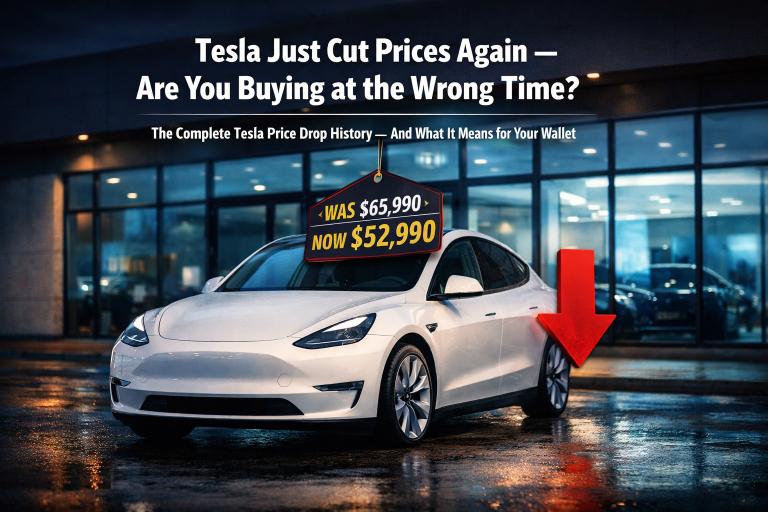
This is where the Tesla price drop history becomes genuinely significant for buyers. In January 2023, Tesla executed the largest single-event price reduction in its history — cutting Model 3 and Model Y prices in the U.S. by $3,000–$13,000 depending on trim, and making similar cuts across EU, UK, and AU markets. The Model Y Long Range dropped from $65,990 to $52,990 in a single announcement. In China, reductions of up to 13–24% triggered protests from recent buyers outside Tesla showrooms. What’s more, a second wave of cuts followed in April 2023, further reducing entry-level Model 3 pricing.
Through 2024 and into 2025, Tesla continued using price adjustments as a demand lever — though with smaller individual cuts of $1,000–$3,000. The refreshed Model 3 Highland launched at a competitive price point globally, and Model Y received mid-cycle pricing adjustments in multiple markets. By contrast, Model S and Model X saw fewer but more targeted price changes, reflecting their position in a less price-sensitive luxury segment.
| Date | Model | Market | Price Change | New Starting Price (approx.) |
|---|---|---|---|---|
| Jan 2023 | Model Y LR AWD | USA | −$13,000 | ~$52,990 |
| Jan 2023 | Model 3 RWD | USA | −$3,000 | ~$43,990 |
| Jan 2023 | Model Y | China | −13–24% | ~¥259,900 |
| Apr 2023 | Model Y RWD | USA | −$2,000 | ~$43,990 |
| Oct 2023 | Model 3 Highland (refresh) | USA | −$1,250 | ~$40,240 |
| Jan 2024 | Model Y All variants | EU / UK | −£2,000–£3,500 | ~£42,990 |
| Apr 2024 | Model S / Model X | USA | −$5,000 | ~$74,990 / ~$79,990 |
| Q1 2025 | Model Y (Juniper refresh) | USA / EU / AU | Competitive relaunch | ~$44,990 USA |
Which Tesla Models Have Seen the Biggest Price Changes
Model 3 and Model Y Pricing Trends
Within the full Tesla price drop history, Model 3 and Model Y tell the most dramatic story — because they represent the highest sales volume and therefore the greatest buyer exposure. The Model Y peaked at approximately $65,990 for the Long Range AWD in the U.S. in late 2022, before the January 2023 cut brought it to $52,990. That $13,000 reduction wiped significant value from every recently purchased Model Y overnight — a moment that should permanently reframe how buyers think about Tesla purchase timing.
As a result, the Model Y is now positioned as a genuine sub-$40,000 vehicle in the U.S. after the $7,500 IRA tax credit — a remarkable shift from its 2022 peak pricing. The refreshed Model Y Juniper launched globally in early 2025 with competitive pricing designed to respond directly to the Hyundai Ioniq 5 and Chevrolet Equinox EV. For buyers considering the best electric SUVs under $40,000 in 2026, the post-credit Model Y price point is now one of the most compelling in the segment.
Model S and Model X Price Fluctuations
By contrast, Model S and Model X pricing has moved less dramatically in percentage terms but has still seen meaningful adjustments. Both luxury models were repriced upward significantly in 2021–2022, with the Model S Plaid reaching $129,990 at its peak. However, following the broader 2023 pricing reset, both models received cuts of $5,000–$15,000 across variants. The Model S Long Range dropped to approximately $74,990 — still expensive, but a return to near-2020 pricing levels after the peak.
The luxury segment is less price-elastic than the mass-market segment, which is why Tesla’s Model S and X pricing changes tend to be less frequent but more deliberate. Specifically, these adjustments often coincide with hardware refresh cycles or competitor launches — such as the Lucid Air’s pricing adjustments — rather than quarterly demand management cycles.
Why Tesla Reduces Prices
Competition in the EV Market
Every article on Tesla pricing cites “competition” as a driver. That’s correct — but the specifics matter more than the headline. The January 2023 cuts coincided directly with BYD surpassing Tesla in quarterly global EV sales for the first time, and with Hyundai’s Ioniq 5 winning multiple car-of-the-year awards while undercutting Tesla’s pricing in Europe and the U.S. Because Tesla cannot compete on dealer relationships or brand heritage, its primary competitive lever in the mass market is price — and it has used that lever aggressively.
That said, competition alone doesn’t explain every cut. Admittedly, some Tesla price reductions have been triggered by softer-than-expected order intake at specific factories — particularly Gigafactory Austin, which has faced utilisation challenges during model transition periods. Therefore, reading Tesla price movements requires tracking both competitive context and Tesla’s own production and inventory data simultaneously.
Production Efficiency and Battery Cost Declines
The underlying cost structure of EV manufacturing has shifted significantly since 2020. Battery cell costs — the largest single component in any EV — fell from approximately $130/kWh in 2020 to below $80/kWh by 2025, based on industry data from BloombergNEF. Because Tesla’s 4680 battery cell programme at Gigafactory Austin is specifically designed to reduce pack manufacturing cost further, Tesla’s ability to cut prices while maintaining margin has improved structurally over time. What’s more, vertical integration in areas like casting (the Gigapress single-piece casting process) has reduced manufacturing labour cost per vehicle measurably.
Specifically, Tesla’s gross margin on automotive sales peaked at approximately 30% in 2022 before the 2023 price cuts compressed it to the 17–19% range. However, even at these margins, Tesla remains more profitable per vehicle than most traditional automakers — which means further targeted price reductions remain financially feasible in 2026.
What Tesla Price Drop History Means for Buyers
Should You Wait for a Tesla Price Cut?
I get this question at least twice a week: “Should I wait for Tesla to cut prices before buying?” My answer is always the same — it depends on two factors that most people don’t think about together: the probability of a near-term cut and the cost of waiting. If a $7,500 tax credit is available to you right now but has an income cap or phase-out risk, waiting six months for a $2,000 price cut while potentially losing $7,500 in credit eligibility is a terrible trade. By contrast, if you’re outside a tax credit window and buying at what feels like a demand peak, a three-month wait for a quarter-end inventory adjustment is a reasonable strategy.
The timing pattern in Tesla’s price drop history shows that cuts are most likely at: the start of a new quarter (when delivery targets reset), immediately following a major competitor launch, during periods of rising inventory, and around annual model refreshes. However, none of these are guaranteed — and Tesla has also raised prices during high-demand periods. Waiting indefinitely is not a strategy; it’s a decision to never buy.
— A competitor has just launched a directly competitive vehicle in your market.
— You are at quarter-end and within 4–6 weeks of Tesla’s delivery push.
— You are not in a time-limited tax credit window.
— You can absorb a further 2–3 month delay without financial or logistical impact.
Impact on Resale Value and Ownership Costs
The 2023 price cuts had a direct and measurable impact on Tesla resale values — and understanding this is central to the Tesla price drop history story for anyone considering a used Tesla purchase. When new Model Y prices fell by $13,000 in January 2023, used Model Y values in the $45,000–$55,000 range fell by approximately $8,000–$12,000 within 60 days, according to iSeeCars depreciation tracking. Owners who had purchased at peak 2022 prices experienced losses of 20–30% within the first year — among the steepest first-year depreciation figures in recent automotive history.
As a result, Tesla ownership costs look very different depending on when you bought. By contrast, buyers who purchase at or near Tesla’s price floor — as determined by the company’s direct sales history — face lower depreciation risk. The current post-cut pricing environment means new Tesla buyers in 2026 are starting from a more defensible position than 2022 buyers were. For a detailed look at Tesla’s full running costs including charging, the 5-year financial picture is now considerably more competitive than it appeared at peak pricing.
✅ Buy Now — Makes Sense If:
- $7,500 IRA tax credit is currently available to you
- Tesla inventory in your preferred spec is readily available
- Competitor pricing doesn’t offer better value at this moment
- You have a clear delivery need within 60–90 days
- Prices are at or near a recent 12-month low
⏳ Wait — Makes Sense If:
- Delivery windows are shortening (demand cooling signal)
- A major competitor model has just launched nearby in price
- Quarter-end is 4–6 weeks away and inventory is building
- You are not in a tax credit eligibility window
- A refresh or new variant has been confirmed but not released
Tesla Pricing Trends in the 2026 EV Market
Future Pricing Pressure in the EV Industry
The competitive dynamics that drove Tesla’s 2023 price cuts have not eased in 2026 — they have intensified. BYD’s global expansion, Hyundai’s continued investment in the Ioniq platform, and Chevrolet’s Equinox EV at sub-$28,000 after the IRA credit are all exerting downward pressure on Tesla’s mass-market positioning. Specifically, the Model Y and Model 3 now face credible alternatives at similar or lower price points in most major markets — a situation that simply did not exist in 2020 when Tesla’s premium pricing was essentially unchallenged in the EV segment.
Therefore, the probability of further Tesla price adjustments in 2026 is higher than it was during Tesla’s high-demand period of 2021–2022. However, the scale of future cuts is likely to be smaller — in the $1,000–$3,000 range per event — rather than the structural $10,000+ reductions seen in 2023. Battery cost declines are also moderating, which limits Tesla’s ability to cut aggressively while maintaining margin.
What Buyers Should Watch Before Purchasing
Honestly, the most practical signal I watch for is Tesla’s own delivery window data. When the configured delivery estimate on Tesla’s website compresses from 4–8 weeks to “1–3 weeks” or “available now,” that typically signals inventory accumulation — which historically precedes a price adjustment. What’s more, monitoring the EV tax credit eligibility calendar for 2026 is equally important, because changes to the IRA income caps or vehicle price limits could affect your net purchase cost independently of Tesla’s own pricing decisions.
The other factor worth tracking is the Model Y Juniper’s reception and initial sales trajectory. Because this is the highest-volume Tesla globally, any signs of slower-than-expected Juniper take-up in Q2 or Q3 2026 would be a meaningful signal that a pricing response is possible before year-end.
FAQ — Tesla Price Changes Explained
Why does Tesla frequently change vehicle prices?
Tesla uses pricing as a real-time demand management tool. Because Tesla sells directly without a dealer network, it can change prices globally within hours — and does so to balance production output against order volume. When demand falls below factory targets, Tesla reduces prices to stimulate orders. When demand exceeds production capacity, it raises prices to manage backlogs and capture margin. This dynamic pricing model is fundamentally different from traditional automakers and creates both opportunities and risks for buyers depending on where they are in the cycle.
Which Tesla model has dropped the most in price?
The Model Y Long Range AWD holds the record for the largest single-event Tesla price reduction in the U.S. market — dropping by approximately $13,000 in January 2023, from ~$65,990 to ~$52,990. However, when cumulative reductions from peak 2022 pricing are considered alongside the $7,500 IRA tax credit applied to the refreshed Juniper model, the effective price reduction from peak to current is closer to $28,000–$30,000 for a comparably equipped Model Y in the U.S. — one of the most dramatic value shifts in recent automotive history.
Do Tesla price drops affect used car values?
Yes — directly and significantly. When Tesla cut new Model Y prices by $13,000 in January 2023, used Model Y resale values fell by approximately $8,000–$12,000 within 60 days, according to iSeeCars tracking data. This is because used Tesla prices are anchored to new prices — if a used Model Y with 15,000 miles is priced at $55,000 and a new one now costs $52,990, the used vehicle has no price justification. Therefore, buyers who purchased at 2022 peak prices experienced first-year depreciation of 20–30% — significantly above the industry average. However, buyers purchasing used Teslas now are entering at a much lower baseline, which reduces future depreciation exposure.
Should buyers wait for Tesla price reductions?
Only if specific conditions align. Waiting makes financial sense when: Tesla’s delivery windows are compressing (signalling cooling demand), a quarter-end is approaching with inventory building, or a major competitive launch is imminent. However, waiting is a poor strategy if you are currently eligible for the $7,500 IRA tax credit and face uncertainty about future eligibility — since losing a $7,500 credit while waiting for a $2,000 price cut is a net loss of $5,500. The best approach is to monitor Tesla’s delivery lead times and competitor pricing monthly rather than making a binary buy-now-or-wait decision.
The Tesla price drop history tells a consistent story: Tesla prices reflect supply-demand dynamics and competitive pressure more than traditional vehicle value — and that creates both opportunity and risk for buyers. The buyers who navigate this best are those who track the signals rather than the rumours: delivery lead times, competitor launches, quarter-end inventory patterns, and tax credit windows. Buy at the right moment, and the post-2023 price floor makes Tesla a genuinely competitive ownership proposition in 2026. Buy at the wrong moment, and the same dynamic pricing model that made Tesla famous will work against you.