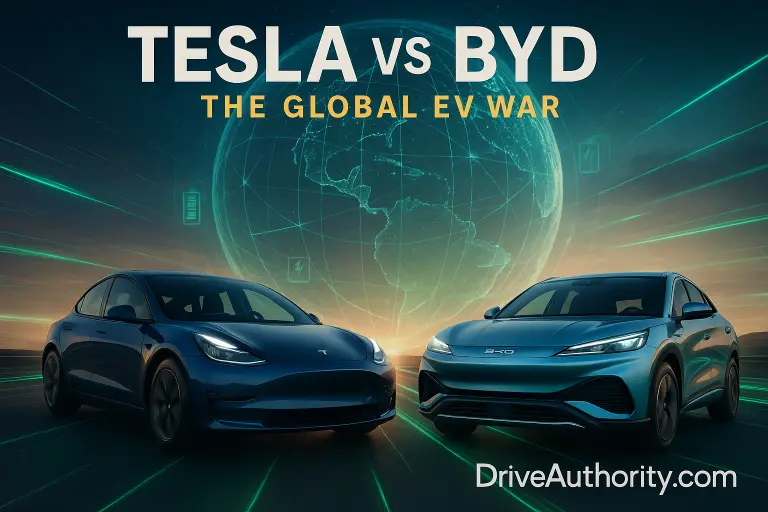
Tesla vs BYD: The Real Battle for EV Dominance

Tesla vs BYD: The Real Battle for EV Dominance

The Global EV War Heats Up

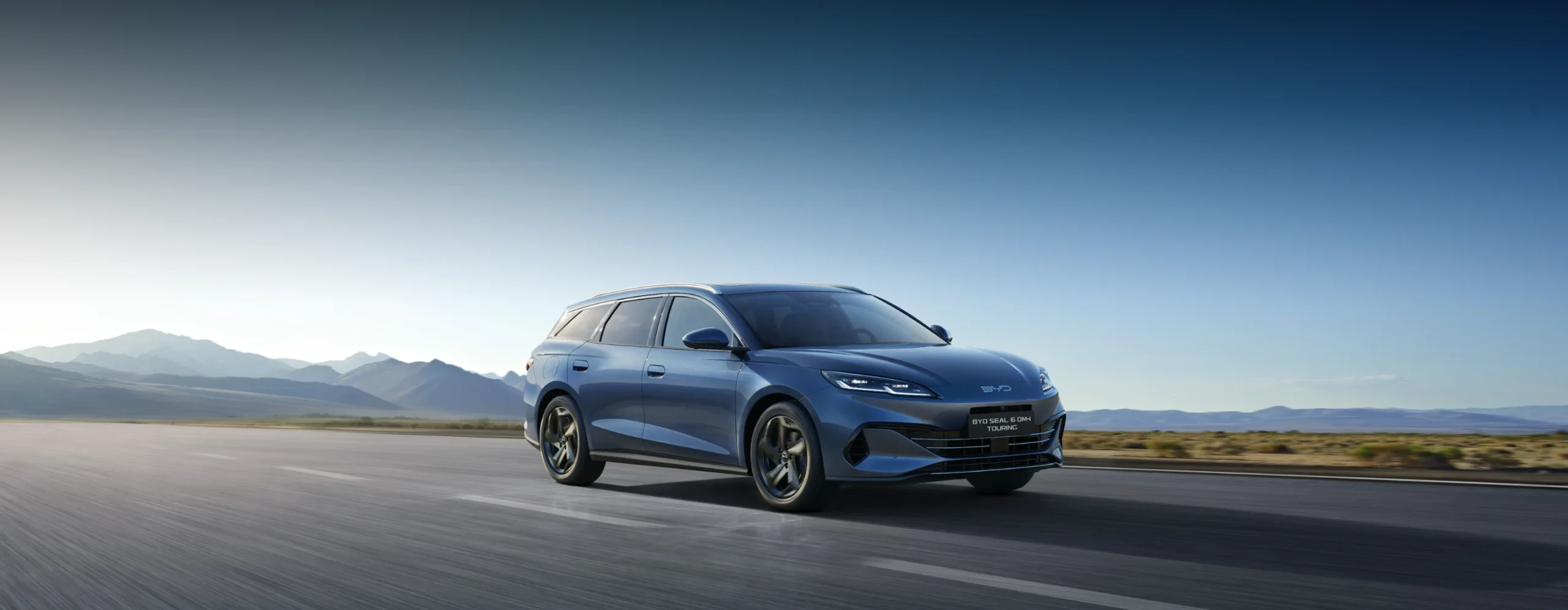
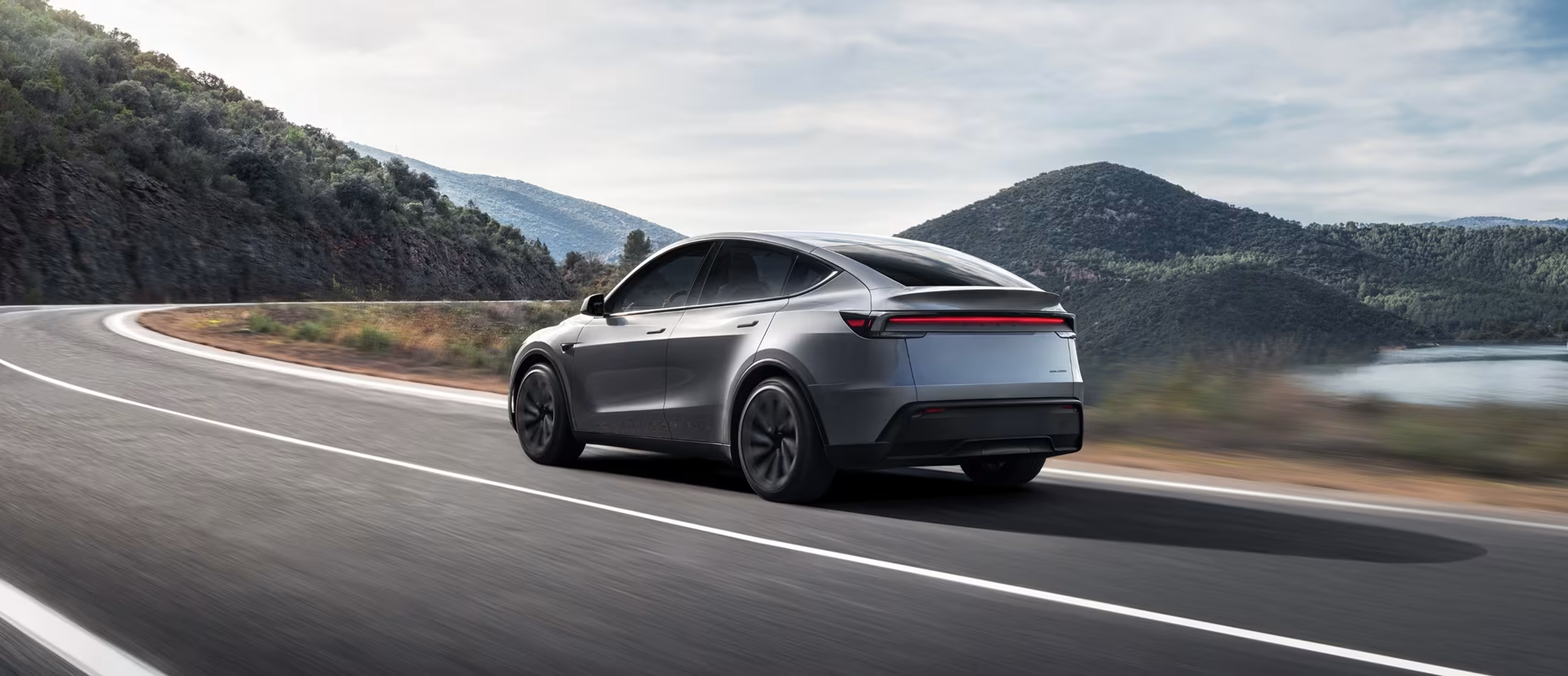
Tesla vs BYD has become the defining rivalry in the electric vehicle industry — a battle that symbolizes the shift from traditional carmaking to a cleaner, smarter, and more competitive future. Over the past decade, electric vehicles have surged from a niche innovation to a global movement, changing how the world thinks about mobility, energy, and sustainability.

As the EV market expands at record speed, two names dominate every headline: Tesla, the American trailblazer known for its innovation and performance, and BYD, the Chinese powerhouse leading the charge in affordability and mass adoption. Their competition isn’t just about selling cars — it’s about setting the direction of an entire industry.

In 2025, this contest between Tesla vs BYD defines who will lead the next generation of clean transportation — and who will shape the future of how we drive, charge, and live.

2. Company Background: Tesla vs BYD — East Meets West

When exploring the story of Tesla vs BYD, the contrast between these two electric vehicle giants is striking. One was born from Silicon Valley’s daring innovation. The other rose from China’s disciplined pursuit of scale and efficiency.

Tesla vs BYD: How Tesla’s Innovation Redefined the West

Founded in 2003, Tesla set out to prove that electric cars could be fast, stylish, and desirable. Under Elon Musk’s leadership, the company evolved from a small startup into a global technology icon. Its focus on performance, minimalist design, and intelligent software reshaped how people think about electric mobility.

Furthermore, Tesla’s influence extends well beyond automobiles. The company has disrupted energy storage, solar technology, and autonomous driving. As a result, Tesla has become a symbol of the West’s relentless drive for innovation and ambition — always moving fast, breaking limits, and redefining what’s possible.

Tesla vs BYD: How BYD Became China’s EV Powerhouse

Meanwhile, BYD (Build Your Dreams) followed a very different path. Founded in 1995 by Wang Chuanfu, it began as a small battery manufacturer in Shenzhen, China. Over time, BYD transformed its deep battery expertise into the backbone of its EV dominance.

Unlike Tesla, which focused on luxury and technology, BYD emphasized affordability, efficiency, and vertical integration. Because it designs and produces its own batteries, chips, and components, the company operates with unmatched cost control. Consequently, BYD now leads global EV sales — proving that discipline and scale can rival even the boldest innovation.

Elon Musk vs Wang Chuanfu: Leadership and Vision in the Tesla vs BYD Rivalry

At the core of Tesla vs BYD lies a fascinating leadership duel. Elon Musk is the bold visionary — outspoken, daring, and obsessed with pushing humanity forward. He dreams of Mars, autonomy, and limitless technology.

Wang Chuanfu, by contrast, is a methodical strategist. He focuses on sustainability, consistency, and steady growth. While Musk thrives on risk and spectacle, Wang builds power quietly through precision and patience.

Ultimately, Tesla vs BYD represents far more than a corporate rivalry. It reflects two distinct philosophies — the West’s passion for innovation versus the East’s mastery of scale and stability. Both are racing toward one goal: to define the future of electric mobility.

3. Production and Market Share: Who Leads the Numbers Game?

As of 2025, the electric-vehicle race is no longer just about headlines — it’s about who can produce at scale. BYD and Tesla now compete in a game measured in millions of cars, not thousands. BYD dominates global sales volume, while Tesla continues to excel in profitability, innovation, and brand influence.

Global Snapshot: Production and Market Share in 2025

The global EV market is expanding at record speed — for example, global electric car sales surpassed 17 million in 2024 and are expected to exceed 20 million in 2025. IEA Within that surge, BYD has taken the lead. One research firm forecasts BYD capturing approximately 15.7% of global BEV market share in 2025 — helping it surpass Tesla in unit leadership. International Banker Meanwhile, Tesla’s 2025 production runs remain strong: in Q2 2025 Tesla produced over 410,000 vehicles and delivered about 384,000. Tesla Investor Relations

BYD’s Home Advantage in China

BYD’s dominance in China rests on three key pillars: scale, efficiency, and vertical integration. The company produced millions of vehicles annually, combining both BEVs and plug-in hybrids. Because it manufactures its own batteries and chips, BYD controls costs and ensures consistent supply — advantages that many competitors struggle to match. In addition, China’s government incentives and vast consumer market amplify BYD’s edge. As the world’s largest EV market, China offers BYD a unique home base from which to project global leadership. IEA+2Tridens

Tesla’s Strength in the West

Tesla’s stronghold remains in North America and Europe, where its reputation for performance, safety, and cutting-edge software continues to attract loyal buyers. Even though Tesla trails BYD in total unit volume, it leads in profitability per vehicle. Its Supercharger network and over-the-air updates have built a level of customer trust that few rivals can replicate. However, Tesla faces growing pressure from Chinese EV brands expanding into Europe, forcing it to refine pricing and production strategies. Autovista24

East vs West: A Shifting Power Dynamic

In China, BYD dominates through affordability and availability. In the West, Tesla commands influence through innovation and branding. Together, these dynamics reveal a split global market — one where scale competes directly with sophistication. Moreover, policy shifts and tariffs could significantly reshape this balance. Government incentives, trade barriers, and consumer sentiment will continue to influence who wins market share in 2025 and beyond. reuters.com

The Takeaway

In short, BYD leads in numbers, while Tesla leads in influence. The Chinese automaker’s ability to mass-produce affordable EVs gives it global scale, yet Tesla’s technology and profitability keep it an industry benchmark. Consequently, the future of electric mobility may not be about one winner — but about how these giants push each other to innovate faster and smarter.

4. Technology Face-Off: Innovation and Performance

Intent: informational — compare battery tech, autonomy/software, charging, range, and R&D focus so the reader understands where Tesla and BYD truly differ (and why it matters).


Battery technology: BYD’s Blade vs Tesla’s 4680

BYD’s Blade Battery is built around LFP (lithium-iron-phosphate) chemistry arranged in long, thin prismatic “blade” cells. The design prioritizes safety and lifecycle stability; BYD stresses that the Blade format passes rigorous nail-penetration and thermal-runaway tests that make it extremely hard to catch fire. Moreover, BYD has pushed rapid refinements (Blade 2.0) that promise higher energy density and much faster charge/discharge rates — narrowing the traditional range gap between LFP and higher-energy chemistries. BYD+1

In contrast, Tesla’s 4680 cell is a large cylindrical form factor that aims to raise specific energy, reduce pack complexity, and lower cost per kWh through scale and a “structural pack” approach. The 4680 promises higher energy density than older cylindrical cells and improved thermal performance per unit of volume. However, scaling 4680 production has proved technically demanding; Tesla has made steady progress but still faces manufacturing and supply-chain hurdles as it ramps up volumes. Thus, the trade-off looks like this: BYD emphasizes safe, low-cost LFP blades that scale quickly, while Tesla bets on cell-level innovation and pack integration to push energy density and vehicle performance. Battery Design+1

Why it matters: BYD’s approach lowers cost and risk and suits mass-market models. Tesla’s approach targets higher range and performance for premium segments — but requires bigger capital and manufacturing finesse to deliver at scale. TopElectricSUV+1


Autonomy and software ecosystems: Autopilot (Tesla) vs DiPilot (BYD)

Tesla built its reputation on a software-centric vehicle platform. Autopilot and Full Self-Driving (FSD) — now iterating through successive software versions and hardware generations — offer advanced driver assistance with frequent OTA updates that change vehicle behavior over time. Tesla’s strength is its large fleet data set, rapid software iteration, and deep integration between vehicle hardware and neural-network models. Still, regulatory scrutiny and real-world safety debates remain central challenges. Tesla+1

BYD’s DiPilot takes a different, more tiered route. The system ships in multiple hardware grades (DiPilot 100/300/600) and is being rolled out across BYD brands; higher tiers add LiDAR and more sensors for advanced scenarios. BYD has also pushed to make ADAS features widely available — in some cases free across large parts of its line-up — leveraging partnerships and lower hardware costs to spread functionality into mass segments. Consequently, BYD’s strategy favors broad accessibility and incremental capability improvements, rather than promising near-term full autonomy. BYD+1

In short: Tesla bets on vertically integrated AI, huge fleet learning, and premium software monetization. BYD bets on hardware tiering, widespread availability, and rapid deployment across price points. Both strategies have merit, depending on whether you value bleeding-edge features or ubiquitous availability. Tesla+1


Charging networks, range, and real-world performance

Tesla’s Supercharger network remains a major competitive moat. With tens of thousands of high-power connectors worldwide, Superchargers deliver predictable long-distance travel and a tightly integrated user experience (payment, navigation, and charge scheduling). Tesla has also been opening its network (NACS standard) to other EV makers in key markets, broadening the reach of its charging ecosystem. That network advantage translates directly into superior long-trip convenience for many Tesla owners. Tesla+1

BYD historically relied on third-party chargers and partnerships, but it is now aggressively building its own ultrafast and megawatt-class charging plans — first in China and then in Europe. BYD’s public roadmap includes expanding ultrafast hubs and partnerships (for example with retailers and energy firms) to support very high-power charging and commercial EV use cases. If BYD’s megawatt/ultrafast rollout succeeds, fast fueling times could erode one of Tesla’s strongest service differentiators. CleanTechnica+1

On range and performance, Tesla vehicles frequently top independent range and acceleration charts for mainstream models, thanks to higher-energy cell chemistry in some lines, advanced pack design, and aerodynamic vehicle engineering. BYD models have closed the gap rapidly, especially with Gen-2 blade cells and careful weight/efficiency tuning; nonetheless, Tesla typically retains an edge in raw range and 0–60 acceleration in comparable price bands. However, BYD often wins on total cost of ownership and real-world value. TopElectricSUV+1


R&D focus and innovation strategy — different paths to the same finish line

  • Tesla: invests heavily in system-level innovation (cells → pack → vehicle → software → energy). Its R&D bets include next-gen cells, neural-network driving stacks, battery manufacturing automation, and vertical integration of charging. Tesla’s philosophy is high-risk, high-reward — pushing to change entire supply chains and vehicle architectures. Battery Technology+1
  • BYD: focuses R&D on pragmatic, scaleable improvements (battery chemistry optimization, manufacturing cost reduction, modular vehicle platforms). BYD’s vertical control of key components — especially batteries — lets it iterate quickly on cost and safety, then deploy those gains across many models. In short, BYD pursues incremental, high-leverage advances that drive down costs and broaden adoption. BYD+1

Because of these distinct approaches, we should expect continued convergence: BYD will push denser, faster-charging LFP cells; Tesla will push more efficient and lower-cost cell/pack designs. Ultimately, competition will accelerate innovation for consumers.


Quick comparison (compact)

  • Battery safety & cost: BYD (Blade, LFP) — safer, lower cost, excellent cycle life. BYD
  • Energy density & performance potential: Tesla (4680) — higher theoretical specific energy, but harder to scale. Battery Design
  • Autonomy: Tesla — aggressive software-first approach and fleet learning; BYD — tiered hardware rollout (DiPilot) for broad availability. Tesla+1
  • Charging & network: Tesla — mature Supercharger network and integrated UX; BYD — rapid megawatt/ultrafast rollout and charging partnerships. Tesla+1

Sources (selected)

  1. BYD — Blade Battery overview and press releases. BYD+1
  2. BYD DiPilot rollout and reporting. BYD+1
  3. Tesla Autopilot / FSD support pages and recent update notes. Tesla+1
  4. 4680 / cell architecture analysis and production context. Battery Design+1
  5. Charging networks — Tesla Supercharger scale and BYD megawatt/ultrafast plans. Tesla+1

⚡ Tesla vs BYD — Technology Face-Off at a Glance

CategoryTeslaBYD
Battery Technology4680 cylindrical cells – high-energy density, structural battery pack, faster performance potential but complex manufacturing.Blade Battery (LFP) – ultra-safe, long lifespan, cost-efficient, slightly lower energy density but rapidly improving.
Core ChemistryNCA/NCM and 4680 high-nickel formulas for premium range.LFP (lithium-iron-phosphate) for safety and affordability; Blade 2.0 increases density.
Autonomy & SoftwareAutopilot / FSD with OTA updates, deep fleet learning, and strong AI integration.DiPilot (100 / 300 / 600 tiers) – practical ADAS rollout, LiDAR on higher trims, focus on accessibility.
Charging EcosystemSupercharger network (worldwide 70k+ connectors) with seamless navigation and NACS standard expansion.Partner-based + Ultrafast/Megawatt chargers under construction in China & Europe.
Performance & RangeLonger range, quicker acceleration, advanced aerodynamics.Competitive real-world range; emphasizes value and reliability over outright speed.
R&D FocusBold, system-wide innovation — battery, AI, manufacturing automation.Pragmatic, scalable improvements — cost reduction and vertical supply control.
Market StrategyPremium innovation, software monetization, strong brand margins.Mass-market affordability, rapid global expansion, production at scale.

🧠 Key Insight

Tesla and BYD represent two philosophies of innovation:

  • Tesla pushes boundaries through high-risk, high-reward technological breakthroughs.
  • BYD scales efficiently through vertical integration and practical engineering.
    Together, they are driving the world’s transition to cleaner, smarter transportation.

5. Pricing and Market Strategy: Luxury vs Affordability

(Intent: informational and comparative — helping readers understand how pricing philosophies shape each company’s position and influence in the global EV race.)

When it comes to pricing, Tesla and BYD operate on opposite ends of the same electric spectrum. Tesla has built its empire around premium innovation and aspirational branding, while BYD has achieved dominance through affordability, accessibility, and sheer scale. Their contrasting strategies reveal not only different business philosophies — but also how each company envisions the path to global EV adoption.

Tesla: The Power of a Premium Brand

From the start, Tesla positioned itself as more than a car company — it’s a status symbol of innovation. Every Model 3, Model Y, or Cybertruck carries the aura of cutting-edge technology and environmental consciousness fused with luxury.
Tesla’s pricing reflects that identity. Even as it introduces “entry-level” trims, its vehicles remain aspirational, targeting upper-middle and high-income buyers who value performance, design, and tech sophistication.

Moreover, Tesla’s strategy hinges on software monetization — turning features like Full Self-Driving (FSD) and premium connectivity into additional revenue streams. This transforms ownership into an evolving experience: customers don’t just buy a car; they invest in a continuously improving platform.

However, maintaining a luxury image while scaling production globally presents a paradox. As Tesla pushes to lower costs and penetrate new markets, it risks diluting the exclusivity that defines its brand. Balancing accessibility with aspiration will be one of Musk’s toughest strategic challenges in the late 2020s.

BYD: Building Dreams for the Masses

BYD’s name — Build Your Dreams — perfectly encapsulates its mission: make electric mobility attainable for everyone. Instead of chasing luxury margins, BYD mastered the art of vertical integration to drive down costs without sacrificing reliability or quality.

By manufacturing its own batteries, chips, and drivetrains, BYD eliminates many of the external dependencies that inflate costs for competitors. This allows it to sell EVs at prices that make sense for the mass market, especially in developing regions where affordability determines adoption.

In China, BYD’s extensive lineup — from the budget-friendly Dolphin to the upscale Han — covers nearly every price bracket, reflecting a clear goal: electrify the entire pyramid, not just the top.
Outside China, BYD has started exporting aggressively to Europe, Southeast Asia, and Latin America, tailoring its models to local price sensitivities and regulations. Its strength lies not in exclusivity, but in consistency, scale, and adaptability.

Different Markets, Different Mindsets

The Tesla vs BYD pricing divide mirrors broader economic realities between East and West.

  • In North America and Europe, EV buyers tend to prioritize performance, safety, and brand prestige — values Tesla embodies perfectly.
  • In China, India, and emerging markets, price and practicality dominate. BYD’s localized production and supply chain give it a decisive edge.

This divergence isn’t just about purchasing power; it’s about psychology. Tesla sells a vision — the feeling of driving the future. BYD sells mobility freedom — the chance to participate in that future without breaking the bank.

Global EV Affordability Trends and Government Incentives

The trajectory of global EV pricing is being reshaped by policy, innovation, and competition.
Governments around the world are pushing hard to make EVs mainstream through subsidies, tax breaks, and infrastructure investment:

  • The U.S. Inflation Reduction Act (IRA) offers significant tax credits for vehicles assembled domestically, giving Tesla a home-market advantage.
  • China’s NEV (New Energy Vehicle) policy continues to support local manufacturers like BYD with production incentives and infrastructure funding.
  • The European Union has leaned heavily on CO₂ emission regulations and purchase subsidies to accelerate adoption, though these may phase out gradually after 2025.

As battery costs continue to fall — potentially dropping below $80/kWh by 2030 — the price gap between combustion and electric vehicles will close further. In this race, BYD benefits first from economies of scale, while Tesla benefits later from technological breakthroughs and brand trust.

The Takeaway: Two Roads to the Same Destination

Tesla and BYD represent two pricing philosophies — luxury innovation vs scalable accessibility.
Tesla turns technology into aspiration. BYD turns efficiency into empowerment.

Yet both are essential to the global EV revolution.
Tesla pulls the market upward, setting benchmarks for performance and desirability.
BYD pulls it outward, making clean mobility a global reality.

The intersection of those forces — aspiration meeting accessibility — is exactly where the future of electric mobility will be forged.

6. Global Expansion Plans: Who’s Winning the EV Race Worldwide?

(Intent: informational and comparative — analyze how Tesla and BYD are expanding their global presence through factories, supply chains, and partnerships.)

The battle between Tesla and BYD is no longer confined to their home markets — it’s now a global EV war for dominance across Europe, Latin America, and Africa. Both brands are racing to establish production hubs, partnerships, and logistics networks that will define the next decade of electric mobility.

While Tesla focuses on scaling its Gigafactories and optimizing global logistics, BYD is building an extensive manufacturing and supply chain footprint that mirrors China’s Belt and Road ambitions. Each strategy reveals a different path to global leadership — one powered by innovation, the other by industrial reach.


Tesla’s Gigafactory Strategy: Scaling Innovation Across Continents

For Tesla, global expansion is a story of engineering and automation at scale. Its Gigafactories — from Nevada and Berlin to Texas and Shanghai — are more than production plants; they are strategic command centers for innovation and market penetration.

Each Gigafactory is designed around a single philosophy: vertical integration meets regional efficiency.

  • Gigafactory Shanghai became Tesla’s volume powerhouse, serving Asia and parts of Europe with streamlined logistics and local component sourcing.
  • Gigafactory Berlin-Brandenburg strengthens Tesla’s foothold in the EU market, helping it sidestep import tariffs and appeal to sustainability-focused European consumers.
  • Gigafactory Texas anchors Tesla’s North American supply chain, supporting Cybertruck production and next-gen 4680 battery cells.

This “distributed yet unified” model allows Tesla to reduce shipping costs, control quality, and adapt to local policies — a crucial advantage as EV regulations tighten worldwide.

Yet expansion isn’t without friction. Labor disputes in Germany, energy price volatility in Europe, and supply chain vulnerabilities during geopolitical tensions expose Tesla’s dependency on global stability. The company’s challenge now is not just scaling production — but scaling resilience.


BYD’s International Manufacturing Push: China’s EV Powerhouse Goes Global

In contrast, BYD’s global expansion strategy emphasizes localization, cost efficiency, and rapid deployment.
Rather than relying solely on megafactories, BYD is establishing multiple regional hubs designed to serve emerging markets quickly and affordably.

  • In Europe, BYD is constructing new plants in Hungary and Spain, strategically located near major automotive supply corridors. This move reduces dependence on Chinese exports and aligns with EU sustainability goals.
  • In Latin America, BYD’s presence in Brazil, Mexico, and Chile is accelerating. These plants are not just assembly lines — they’re part of a broader ecosystem of battery recycling, bus production, and renewable energy integration.
  • In Africa, BYD is exploring partnerships and CKD (Completely Knocked Down) assembly strategies to enter markets like Morocco, Egypt, and South Africa, where affordable EVs could leapfrog traditional combustion markets.

This decentralized model mirrors China’s industrial playbook: produce locally, distribute globally. It leverages BYD’s battery expertise and low-cost engineering to win markets where affordability and infrastructure readiness matter most.

The result? BYD isn’t just exporting cars — it’s exporting an entire EV ecosystem built on batteries, buses, solar panels, and charging networks.


Partnerships and Supply Chain Strategies: Tesla’s Vertical Integration vs BYD’s Strategic Alliances

Another major battleground in the Tesla vs BYD global race lies in how each company manages its EV supply chain and partnerships.

Tesla’s Approach — Vertical Integration and Control:
Elon Musk’s vision has always been about reducing dependency. From battery cells to software chips, Tesla integrates as much as possible in-house. Its partnerships, such as with Panasonic, CATL, and LG Energy Solution, are designed to complement — not control — Tesla’s long-term autonomy.
This model gives Tesla extraordinary data synchronization, quality consistency, and brand coherence, but it also limits flexibility during regional disruptions.

BYD’s Approach — Collaborative Expansion and Strategic Alliances:
BYD, meanwhile, thrives on partnership diversity. It collaborates with governments, utilities, and energy companies to accelerate EV adoption. Its alliances with ride-hailing services (like Didi and Uber’s regional partners) and logistics firms create recurring demand for fleets of electric buses and taxis.
Furthermore, BYD supplies batteries to other automakers — even to competitors — strengthening its role as a supplier of choice in the global EV supply chain. This dual identity as both manufacturer and supplier gives BYD an edge in influence that extends far beyond its own brand.


Expansion in Emerging Markets: The New EV Frontier

The next decade of the global EV race will be shaped not just by who dominates in Europe or the U.S., but by who wins emerging markets.

  • Tesla faces challenges entering price-sensitive regions where its vehicles remain out of reach for average consumers. Its bet lies in future Gigafactories that may produce smaller, more affordable models — rumored to be under $30,000 — to tap into developing economies.
  • BYD, on the other hand, is already embedded in these regions through aggressive pricing and local partnerships. By combining affordability with robust battery technology, BYD could electrify millions of vehicles in markets that Tesla hasn’t yet fully reached.

In essence, Tesla’s strategy is top-down — innovate, then scale down. BYD’s is bottom-up — scale first, then innovate upward.
Both are valid. But in emerging markets where infrastructure and purchasing power remain barriers, BYD currently holds the upper hand.


The Takeaway: The Global EV Chessboard Is in Motion

Tesla and BYD are no longer just automakers — they’re global players in the new energy economy.

  • Tesla’s Gigafactories represent the Western model of innovation through centralization.
  • BYD’s network of smaller, localized plants represents the Eastern model of growth through adaptability and reach.

Both strategies are reshaping global trade, energy systems, and transportation policy.
Ultimately, the winner of the global EV war may not be the one that sells the most cars, but the one that builds the most resilient, sustainable, and scalable ecosystem for the world’s electric future.

7. Sustainability and Supply Chain Ethics: Who’s Truly Driving a Greener Future?

(Intent: informational and evaluative — analyze how Tesla and BYD handle environmental responsibility, ethical sourcing, and long-term sustainability in the EV supply chain.)

As the global EV revolution accelerates, sustainability in electric vehicle manufacturing has become a defining battleground. Consumers and regulators now ask not only how fast an EV can go — but how cleanly it’s made.

Both Tesla and BYD champion the shift to zero-emission mobility, yet their approaches to supply chain ethics, battery recycling, and carbon neutrality differ in scope and philosophy. The question isn’t just who sells more EVs — it’s who can build a truly sustainable future from the ground up.


Tesla’s Sustainability Strategy: Innovation Meets Carbon Accountability

Tesla’s sustainability ethos begins with its mission: “to accelerate the world’s transition to sustainable energy.” But translating that vision into tangible impact requires deep environmental engineering — across battery sourcing, manufacturing, and recycling.

Carbon-Neutral Production and Energy Integration

Tesla’s Gigafactories are designed to operate on renewable energy, with solar, wind, and storage integration central to their architecture. Gigafactory Nevada, for example, was built to eventually run entirely on clean energy — creating what Tesla calls a closed-loop energy ecosystem.

In 2025, Tesla continues investing heavily in energy storage systems (Powerpack, Megapack) that stabilize grids and offset emissions from production. Its goal: achieve net-zero operations across all facilities by the early 2030s.

However, critics point out that Tesla’s rapid scaling and supply-chain dependencies still create a significant carbon footprint — especially around mining and logistics. The company acknowledges these gaps and is developing localized supply partnerships to minimize transcontinental shipping emissions.

Battery Recycling and Closed-Loop Systems

Tesla’s recycling approach centers on closed-loop battery recovery through its Nevada pilot line and partnerships with recycling firms like Redwood Materials. The goal is to recover over 90% of critical materials such as lithium, nickel, and cobalt from end-of-life batteries.

This circular model helps reduce dependence on new mining while stabilizing raw material costs. It’s an example of sustainability through innovation — leveraging technology to shrink environmental impact rather than outsourcing the problem.

Ethical Lithium and Cobalt Sourcing

Tesla sources lithium primarily from Australia and North America — regions with stricter labor and environmental oversight compared to some global suppliers. The company’s sustainability reports emphasize responsible mineral sourcing and traceability in alignment with OECD standards.

Still, Tesla faces scrutiny over nickel and cobalt supply chains, particularly in the Democratic Republic of Congo. To mitigate this, Tesla is actively shifting toward cobalt-free battery chemistries, reducing ethical risk while improving energy density through advanced cathode formulations.


BYD’s Sustainability Commitment: Green Supply Chains at Scale

For BYD, sustainability isn’t a marketing slogan — it’s woven into the company’s industrial DNA. From the start, BYD built its empire around battery technology and clean energy integration, positioning itself as a complete ecosystem provider rather than a single-product company.

Vertical Integration and Carbon Reduction

Because BYD manufactures nearly every key EV component in-house — including batteries, chips, and electric drivetrains — it has exceptional control over emissions and waste across its EV supply chain.
This vertical integration minimizes third-party transport and external processing, drastically reducing embedded carbon per vehicle.

Moreover, BYD’s newer factories are designed with low-energy, high-efficiency manufacturing lines and solar-assisted operations, aligning with China’s 2060 carbon neutrality targets. It also operates extensive fleets of electric buses and logistics vehicles, actively decarbonizing its own transport chain.

Battery Recycling and Second-Life Use

BYD’s approach to battery recycling centers on extending battery lifespan before recycling. Through its energy storage division, the company repurposes used EV batteries for stationary storage applications — powering factories, charging hubs, and residential microgrids.
After secondary use, materials are recovered through in-house or partnered recycling facilities, supporting a circular economy model that complements its battery manufacturing scale.

This pragmatic approach — reuse first, recycle later — maximizes material efficiency while reducing waste.

Responsible Mining and Material Sourcing

Unlike Tesla’s global network of suppliers, BYD leverages domestic sourcing within China for much of its lithium and rare earth materials, lowering transport emissions but raising questions about transparency and oversight.
However, BYD has begun publishing sustainability disclosures that align with Global Reporting Initiative (GRI) frameworks, committing to greater accountability in ethical sourcing and worker welfare standards.

The company’s transition to LFP (lithium iron phosphate) batteries — which are cobalt-free — also dramatically reduces ethical risks tied to mining operations in high-risk regions. In this sense, BYD’s technological choice is both a business advantage and an ethical stance.


Tesla vs BYD: Two Roads Toward Sustainable Mobility

CategoryTeslaBYD
Carbon-Neutral GoalsTargets full carbon neutrality by 2030s through renewable-powered Gigafactories and energy storage systems.Aligns with China’s 2060 neutrality plan; integrates solar and EV infrastructure to decarbonize operations.
Battery RecyclingClosed-loop system via Redwood Materials and in-house recycling pilot; >90% recovery rate target.Second-life battery repurposing before recycling; strong focus on LFP chemistry longevity.
Ethical SourcingOECD-aligned traceability; sourcing lithium from Australia/US; shifting to cobalt-free batteries.Domestic lithium sourcing; cobalt-free Blade Battery reduces ethical risk; increasing transparency reporting.
Supply Chain ModelGlobal vertical integration; challenges with logistics emissions.Localized vertical supply chain; reduced transport emissions, strong ecosystem control.

The Takeaway: Sustainability Is the True Measure of Leadership

Tesla and BYD have both redefined what sustainability means in the automotive world — but in distinct ways:

  • Tesla leads in innovation-driven sustainability — using technology, automation, and global integration to minimize waste and emissions.
  • BYD leads in systemic sustainability — designing an entire supply ecosystem that’s efficient, localized, and circular by default.

In the end, the true winner of the EV race won’t be the one with the fastest acceleration or the largest market share — it will be the company that proves large-scale manufacturing and environmental responsibility can coexist.

The Tesla vs BYD rivalry, at its core, is no longer just about cars.
It’s about who can build a cleaner industrial future — and inspire the rest of the world to follow.

8. Consumer Perception and Brand Loyalty: Emotion vs Pragmatism in the EV Era

(Intent: interpretive and comparative — analyze how brand image, emotional appeal, and customer experience shape Tesla’s cult-like following and BYD’s growing global trust.)

When it comes to consumer perception in the electric vehicle market, few rivalries are as psychologically rich as Tesla vs BYD.
While both brands lead the EV revolution, they do so through radically different emotional currencies: Tesla sells aspiration, whereas BYD sells assurance.

This contrast — between vision-driven loyalty and value-driven trust — may well determine which company sustains long-term dominance as EV adoption matures globally.


Tesla’s Cult Following: Emotion, Innovation, and Identity

No other car brand in modern history has cultivated a community-driven identity quite like Tesla.
To own a Tesla is not merely to purchase an EV — it’s to join a movement.

The Power of Visionary Branding

Tesla’s brand loyalty in the EV market is deeply tied to Elon Musk’s personal mythos. His narrative of technological disruption and Mars-bound ambition imbues Tesla with symbolic capital — a sense that buying the car is participating in humanity’s next leap.

This emotional engagement model fuels Tesla’s high retention rates and word-of-mouth marketing power. According to a 2024 Consumer Reports survey, Tesla ranks among the top five automakers for brand loyalty, with repeat purchase intent exceeding 70%.

However, its customer satisfaction tells a more complex story. While Tesla owners praise acceleration, software innovation, and Supercharger convenience, they consistently express frustration with build quality, service delays, and communication gaps.
This suggests that Tesla’s loyalty is identity-based rather than experience-based — sustained more by belief in the mission than perfection of execution.

Digital Experience and Network Effects

Tesla’s digital-first ecosystem reinforces loyalty through over-the-air updates, integrated apps, and a sense of continuous improvement.
Owners feel their vehicles evolve over time — a psychological reinforcement that deepens commitment without new purchases.
In essence, Tesla has transformed the automotive ownership model into a tech platform experience, blending utility with emotional attachment.


BYD’s Brand Reputation: Reliability, Practicality, and Trust at Scale

In contrast, BYD’s consumer perception is rooted in pragmatism and dependability.
Rather than projecting a singular charismatic leader, BYD positions itself as a stable, engineering-driven company committed to making electric mobility accessible for all.

Practical Innovation and Quality Assurance

BYD’s global customers often highlight build quality, efficiency, and affordability as primary loyalty drivers. In emerging markets like Brazil, Thailand, and South Africa, BYD’s cars are seen as reliable, low-maintenance tools — not luxury statements.

This resonates strongly with mass-market buyers who prioritize practicality over prestige.
A 2024 J.D. Power China Customer Satisfaction Index (CSI) ranked BYD above the industry average for vehicle reliability, after-sales service, and perceived value, underscoring the company’s steady improvement in user experience.

Moreover, BYD’s expansion into public transportation and fleet vehicles (e.g., electric buses and taxis) has reinforced its image as a trustworthy mobility provider — a brand that scales sustainability, not just sells dreams.

Affordability Meets Emotional Confidence

Where Tesla promises transformation, BYD offers reassurance. Its affordability strategy aligns with middle-class aspirations in developing regions — giving customers confidence that going electric is both rational and achievable.
This “trust-through-accessibility” model builds a quieter, but potentially more enduring, form of brand loyalty.

In short: Tesla inspires followers; BYD earns believers.


Global Consumer Insights: Diverging Perceptions, Converging Influence

MarketTesla’s PerceptionBYD’s Perception
North AmericaInnovative, aspirational, premium — yet criticized for service issues.Emerging competitor, still building brand recognition.
EuropeTech-forward disruptor with strong EV infrastructure appeal.Reliable alternative, particularly attractive for affordability-conscious buyers.
ChinaOnce a niche import, now a premium symbol of status and performance.National pride brand; strong loyalty due to reliability and domestic trust.
Emerging Markets (LATAM, Africa, SEA)Aspirational but limited by cost and infrastructure.Practical, affordable, and increasingly dominant through local assembly.

These data points highlight a crucial insight:
While Tesla dominates emotional loyalty, BYD is mastering functional loyalty — the kind built through consistent performance, not personality cults.

As the global EV industry matures, pragmatic loyalty may ultimately prove more resilient than emotional hype. Consumers evolve; they may tire of narratives, but not of reliability.


The Psychology of EV Brand Loyalty

From a behavioral economics lens, Tesla’s brand attachment mirrors “identity signaling” — consumers buy it to express innovation, status, or environmental consciousness.
In contrast, BYD’s loyalty aligns with risk minimization and value optimization — the satisfaction of a rational purchase that delivers what it promises.

These represent two distinct loyalty loops:

  • Tesla thrives on belief reinforcement (belief in vision → ownership pride → evangelism).
  • BYD thrives on trust reinforcement (trust in product → positive experience → repeat purchase).

Both strategies can win — but they lead to different kinds of empires.


The Takeaway: Two Roads to Consumer Trust

The battle for EV brand loyalty is ultimately a reflection of two philosophies of influence:

  • Tesla’s cult following shows the power of visionary magnetism — an emotional bond that transcends rationality.
  • BYD’s reliability-first image proves that trust and accessibility can build mass loyalty without spectacle.

In a fragmented global market, both models have room to succeed.
But as EVs become mainstream, the center of gravity may shift from charisma to consistency — and in that transition, BYD’s grounded approach could quietly become the stronger foundation for long-term brand trust.

9. Future Outlook: What Lies Ahead for Tesla and BYD — EV Industry Predictions 2025–2030

(Intent: predictive and strategic — give clear, evidence-based forecasts for the next 5 years in the EV industry, explain how AI, solid-state batteries, and policy will reshape competition, and assess which company is better positioned for long-term dominance.)

Before we dive in, a quick framing assumption: these predictions assume no major geopolitical shocks (large-scale trade embargoes or war), continued steady declines in battery costs, and gradual tightening of emissions policy worldwide. With that in mind — here’s a concise, scenario-aware roadmap for 2025–2030.


Short-term (2025–2027): Consolidation, scale, and software monetization

Key expectations:

  • Volume & market share: BYD will likely maintain or extend its unit-volume lead via aggressive localization, fleet wins (buses, taxis), and continued price pressure. Tesla will remain highly profitable per vehicle but will face unit-share compression as Chinese brands expand globally.
  • Profitability & margins: Tesla’s higher ASP (average selling price) and software/aftermarket monetization (FSD subscriptions, services) preserve healthy margins; BYD’s margins improve through scale but remain lower per unit.
  • Software & AI rollout: Expect faster rollout of driver-assistance upgrades from both sides. Tesla will continue to push OTA features and deeper fleet learning; BYD will accelerate accessible ADAS tiers across its lineup.
  • Charging & infrastructure: Tesla’s NACS expansion increases charging parity in key Western markets; BYD’s partnerships and ultrafast hubs significantly improve charging options in China, Latin America, and other target regions.

Why this matters: the late-2020s are about turning prototypes and pilots into commercially robust, repeatable offerings. Execution — not hype — will separate winners from also-rans.


Medium-term (2027–2030): Technology inflection points — batteries, AI, and circularity

Key technology and policy drivers that will reshape the field:

AI and autonomy in EVs — “software will eat the drivetrain”

  • Fleet data and software advantage: Tesla’s massive global fleet continues to be a unique data source for iterative autonomy improvement. If regulatory windows open, Tesla could reach meaningful SAE Level 3/4 capabilities earlier than many rivals — converting autonomy into a new revenue stream (robotaxi, fleet services).
  • BYD’s pragmatic ADAS scaling: BYD will likely take a tiered rollout approach — offering robust Level 2/3 features broadly while reserving higher-end LiDAR and compute for premium models and partners. This delivers widespread safety gains without betting the company on full autonomy bets.

Net effect: AI amplifies winner-take-most dynamics in software value (user experience, subscription revenue), but hardware and regulatory constraints will temper how fast that value can be realized.

Solid-state and next-gen battery tech — when density meets durability

  • Solid-state timeline: Commercial, scalable solid-state batteries remain an important but uncertain wildcard in the 2027–2030 window. Early pilots may appear, but mass rollout hinges on cost, manufacturability, and lifecycle proofs.
  • Practical chemistries win first: Meanwhile, improved LFP/advanced LFP (Blade 2.0-style) and high-nickel formulations will continue to drive near-term cost and safety wins. BYD’s LFP mastery gives it a durable advantage for affordable ranges; Tesla’s higher-energy chemistries offer premium range leadership.
  • Recycling & circular supply: The company that operationalizes closed-loop battery recycling at scale (recovering lithium, nickel, cobalt efficiently) will enjoy raw-material cost insulation and ESG credibility.

Bottom line: solid-state is strategic but not guaranteed to be a near-term decider; incremental chemistry and pack innovations will matter more through 2030.

Government policy & industrial incentives — the macro lever

  • Incentives and localization rules: Policymaking will continue to favor domestic production and local content (tax credits, sourcing rules). Tesla benefits in regions with localized Gigafactories and favorable incentives (e.g., IRA-style credits); BYD benefits where low cost and industrial partnerships are prioritized.
  • Regulation on safety and autonomy: Stricter ADAS and autonomous vehicle safety rules will slow commercial rollouts but raise the bar for compliant, monetizable autonomy — a moat for firms with strong validation and compliance teams.

Strategic Scenarios: Three plausible 2025–2030 outcomes

  1. Dueling Empires (Most Likely): BYD rules unit volume globally, especially in price-sensitive markets; Tesla retains leadership in software, brand equity, and profitability in premium segments. Both coexist and push each other into faster innovation cycles.
  2. Tesla Breakthrough (Conditional): If Tesla scales fully validated autonomy (robotaxi) and commercializes it profitably before rivals, it could leap into outsized services revenue and tilt long-term value. This requires regulatory wins and near-flawless safety validation.
  3. BYD Consolidation (Conditional): If BYD successfully commoditizes advanced battery tech, builds a global localized supply network faster than competitors, and captures fleet/regional public transport contracts at scale, it could translate volume leadership into durable profitability.

Which Company Is Better Positioned for Long-Term Dominance? — A balanced verdict

Short answer: It depends what “dominance” means.

  • For unit volume and global electrification (mass adoption): BYD is better positioned.
    Rationale: deep vertical integration, cost leadership through LFP mastery, existing dominance in China, and an aggressive localization playbook give BYD a durable advantage for electrifying large swathes of the world, especially in emerging markets and fleet segments.
  • For software value, brand influence, and high-margin innovation: Tesla holds the edge.
    Rationale: Tesla’s fleet data, OTA ecosystem, Supercharger reach, and brand premium create strong monetizable advantages. If Tesla successfully converts autonomy into a service (robotaxi/fleet), its valuation and margins could soar beyond vehicle margins alone.
  • For sustainability and ethical sourcing: a toss-up leaning BYD in scale, Tesla in transparency.
    BYD’s LFP choice and circular second-life strategies reduce raw-material ethical exposure; Tesla’s transparency initiatives and partnerships with Western recyclers strengthen traceability and ESG credentials.

Overall assessment: Over the next five years, BYD will likely win the volume and infrastructure war, accelerating global EV accessibility. Tesla will likely win the innovation and services war, extracting disproportionate value per vehicle. Long-term dominance in the auto industry will be multidimensional — market share, profitability, software services, and sustainability — so both companies can be “dominant” on different axes.


Strategic risks and wildcard factors to watch (what could flip the script)

  • Regulatory clampdowns on autonomy (safety incidents slowing FSD-like rollouts).
  • Major breakthroughs in battery cost or chemistry (cheap, high-density pack manufacturing at scale).
  • Geopolitical supply shocks (rare earths, lithium supply disruptions, or trade restrictions).
  • A successful Tesla or BYD strategic acquisition that materially expands capability (e.g., a leading autonomy firm, major raw-material play, or global OEM alliance).

Final takeaway: Compete, converge, and co-create the future

Tesla and BYD are not just competitors — they are co-drivers of a massive industrial transition. Competition will accelerate innovation, push down costs, and expand charging and recycling ecosystems. Over the next five years, expect market segmentation rather than a single monopolist: BYD at scale and accessibility, Tesla at premium innovation and software monetization. The true long-run winner will be whichever company (or coalition) builds the most resilient, flexible, and circular EV ecosystem — because sustainable dominance requires both reach and responsibility.

10. Final Verdict: The Real Winner in the Tesla vs BYD Battle for EV Supremacy

(Intent: synthesis and closure — distill insights from all previous sections into a clear, balanced, and strategic conclusion that emphasizes both rivalry and co-evolution.)


The Tesla vs BYD Rivalry — Two Roads, One Revolution

After tracing this global duel across innovation, pricing, expansion, and strategy, one thing is unmistakable: Tesla and BYD are not merely competing — they’re defining the trajectory of modern mobility. Each company embodies a distinct philosophy that reflects its cultural DNA and strategic worldview.

  • Tesla represents the frontier spirit — daring, disruptive, and relentlessly focused on pushing technological limits.
  • BYD personifies disciplined pragmatism — efficient, scalable, and deeply grounded in industrial execution.

Together, they symbolize the two forces shaping the 21st-century EV landscape: breakthrough innovation and mass democratization.


Innovation and Technology: Two Paths to the Future

Tesla’s power lies in its ability to invent the future before it arrives.
From the 4680 cell to full self-driving software and its integrated energy ecosystem, Tesla continues to lead on high-end performance, software sophistication, and user experience. It monetizes intelligence — turning vehicles into updatable, data-rich platforms.

BYD’s genius, however, is in engineering for the present at scale.
Its Blade Battery, modular production, and vertical integration have made EVs safer, cheaper, and more accessible to millions. BYD proves that you don’t need to be flashy to be revolutionary — you just need to build consistently and intelligently.

In short: Tesla leads in aspiration; BYD leads in execution.


Pricing and Market Reach: Premium vs People’s Power

The two automakers sit at opposite ends of the market — and that’s precisely why both win.

  • Tesla dominates the premium EV segment, commanding strong brand loyalty and higher margins per vehicle.
  • BYD reigns over the mass market, scaling fast in China and emerging economies where affordability matters most.

As global consumers shift from early adoption to mass adoption, BYD’s accessibility may give it short-term unit leadership — but Tesla’s pricing discipline, software revenue, and brand strength ensure long-term financial resilience.


Global Expansion: Factories, Frontiers, and the Geography of Power

Tesla’s Gigafactories — in the U.S., Europe, and soon India — represent its mission to localize production and create a vertically integrated clean-energy ecosystem. Meanwhile, BYD’s global manufacturing push in Southeast Asia, South America, and Europe reveals a quietly ambitious strategy: to electrify the world from the bottom up.

BYD’s strength is its scale and adaptability; Tesla’s is its brand and innovation velocity. Both understand that the real prize isn’t one market, but planetary reach.


Sustainability and Ethics: Toward Circular Dominance

In an age where environmental integrity defines corporate legitimacy, both Tesla and BYD are racing to close the loop.

  • Tesla advances transparency in supply chains and invests in recycling partnerships across North America and Europe.
  • BYD’s LFP chemistry and end-to-end control minimize ethical risks and resource volatility.

Neither is perfect — but both are driving the EV sector toward a more circular, carbon-neutral reality.


Consumer Perception and Loyalty: Emotion vs Trust

Tesla’s cult following turns customers into evangelists. The brand commands fierce devotion — not just for cars, but for a vision of the future. BYD, by contrast, builds quiet trust through reliability, value, and safety — a more grounded but equally powerful form of loyalty.

While Tesla wins hearts, BYD wins households. And in the next phase of EV adoption, both matter.


The Future Outlook: Complementary Titans

Looking ahead, Tesla’s edge lies in AI, autonomy, and digital monetization — the high-margin future of software-defined vehicles. BYD’s advantage lies in production mastery and affordability — making EVs accessible to the next billion drivers.

Their trajectories may diverge, but their destinies are intertwined. Tesla’s breakthroughs raise expectations; BYD’s efficiency brings those expectations to life at scale.


The Real Winner in Tesla vs BYD

So, who wins? The honest answer: the world does.

Because competition between Tesla and BYD doesn’t just create better cars — it creates better systems: cleaner energy, smarter cities, and a global supply chain forced to evolve. Tesla and BYD are co-architects of a new industrial age, each making the other sharper, faster, and more visionary.

  • If Tesla embodies the dream of innovation that inspires,
  • then BYD embodies the power of execution that endures.

The future of electric mobility won’t belong to one brand — it will belong to the ecosystem they’re both building.


Final Takeaway:
The EV revolution isn’t a zero-sum game. Tesla and BYD are two sides of the same transformation — one defined by audacity, the other by discipline. Their rivalry ensures progress; their coexistence ensures the planet’s transition toward a cleaner, smarter, and more connected future.

11. FAQ: Tesla vs BYD — Your Top Questions Answered

1. Which company sells more electric cars: Tesla or BYD?

As of 2025, BYD leads in total EV unit sales, thanks to its mass-market affordability, strong domestic Chinese demand, and vertical integration that enables high-volume production. Tesla remains highly profitable per vehicle but produces fewer units overall, focusing on premium segments in North America and Europe.


2. Are BYD cars better than Tesla in 2025?

“Better” depends on what you value.

  • BYD excels in affordability, battery safety, and mass-market accessibility, making it a strong choice for practical buyers.
  • Tesla excels in software innovation, range, performance, and brand prestige, appealing to consumers seeking cutting-edge technology and premium experience.

In short: BYD wins in scale and value, Tesla wins in innovation and experience.


3. What makes Tesla different from BYD?

Tesla and BYD differ across philosophy, technology, and strategy:

  • Tesla: premium, innovation-driven, software-centric, globally aspirational. Known for Autopilot/FSD, 4680 battery tech, Supercharger network, and high-performance EVs.
  • BYD: practical, scale-driven, affordable, vertically integrated. Known for Blade Battery safety, broad ADAS (DiPilot), and rapid production in emerging and developed markets.

Essentially, Tesla inspires, while BYD empowers.


4. Who will dominate the EV market by 2030?

Market dominance will be multidimensional:

  • BYD is likely to dominate global unit volume and emerging markets due to affordability and production mastery.
  • Tesla is likely to dominate premium segments, software, and autonomous EV services thanks to fleet data, OTA updates, and brand loyalty.

The long-term “winner” may not be a single company; instead, the EV ecosystem will thrive because both brands push each other to innovate faster, scale smarter, and operate more sustainably.

1 thought on “Tesla vs BYD: The Real Battle for EV Dominance”

  1. Pingback: How Do Chinese EVs Compare to US EVs? 2026 Expert Analysis

Leave a Comment

Your email address will not be published. Required fields are marked *

Scroll to Top