Why Chinese EVs Are Reshaping the Global Car Industry
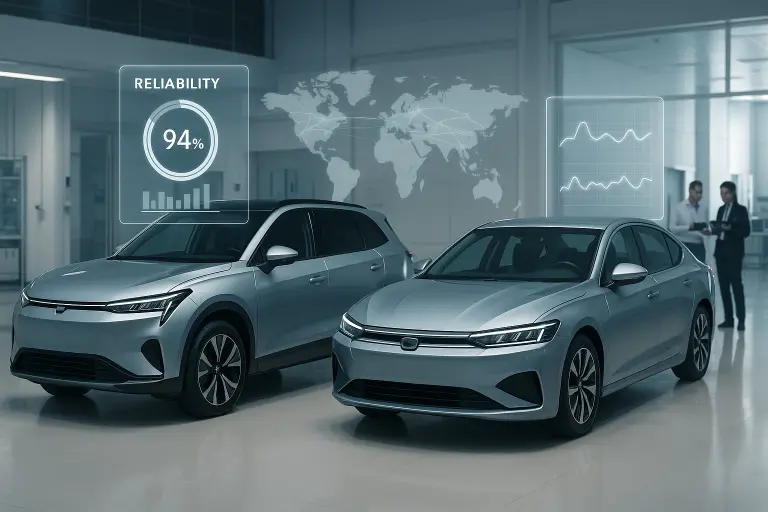
Why Chinese EVs are reshaping the global car industry is no longer a speculative question — in 2026, it is an observable, data-confirmed reality. Chinese electric vehicle manufacturers moved from domestic dominance to genuine global competitive threat in under a decade. Three structural advantages drove that shift: battery manufacturing scale and cost leadership, vertically integrated supply chains, and a product development speed that compresses the typical automotive cycle by two to three years. Consequently, Shenzhen and Shanghai now set the pricing, technology, and feature benchmarks — not Wolfsburg, Detroit, or Tokyo. This article explains how that happened, what it means for the industry through 2030, and what it means for car buyers today.
For buyer-focused context on the Chinese EV landscape, our Chinese electric cars prices, brands, and pros/cons guide covers the consumer decision framework. For the geopolitical and trade dimensions, the IEA Global EV Outlook 2025 provides authoritative market share and adoption data referenced throughout this article.
Jump To Section
- The Rise of Chinese EV Manufacturers
- Pricing Disruption – How Chinese EVs Are Undercutting Global Brands
- Battery Technology Leadership & Supply Chain Control
- Innovation Speed – Software-Defined Vehicles & OTA Updates
- Global Expansion Strategy
- How Chinese EVs Are Forcing Legacy Automakers to Respond
- Impact on Consumers – What This Means for Buyers in 2026
- Risks & Controversies Surrounding the Expansion
- Long-Term Industry Outlook – 2030 and Beyond
- FAQs
- Final Verdict
The Rise of Chinese EV Manufacturers
The transformation of China from a net importer of automotive technology to the world’s largest EV exporter is one of the most consequential industrial shifts of the 21st century. Understanding why Chinese EVs are reshaping the global car industry, therefore, requires understanding how that transformation was engineered — deliberately and systematically, over a longer timeframe than most Western observers recognised.
From Domestic Dominance to Global Expansion
China became the world’s largest EV market by volume in 2015 and has not relinquished that position. By 2026, China accounts for approximately 60% of global EV sales. That domestic base funded the R&D, manufacturing scale, and supplier ecosystem now underpinning export ambitions. BYD alone sold over 3 million EVs and plug-in hybrids in 2024, surpassing Tesla in total electrified vehicle sales globally. Additionally, SAIC (parent of MG), Geely (owner of Volvo, Polestar, Lotus, and Zeekr), and CATL each operate at scales providing structural cost advantages unavailable to most Western competitors. As a result, the export phase — aggressive entry into Europe, Southeast Asia, Latin America, and the Middle East — began in earnest in 2021–2022 and has accelerated every year since.
Vertical Integration in Battery Production
CATL controls approximately 37% of global EV battery production. BYD, meanwhile, manufactures its own cells, modules, packs, motors, and semiconductors. Together, this vertical integration eliminates multiple supplier margins from the cost stack. It also gives manufacturers direct control over the technology that determines range, longevity, and performance. Western OEMs, by contrast, depend on external battery suppliers and are only beginning the multi-year process of building in-house cell capability. Consequently, the gap in battery manufacturing experience — measured in billions of cells and decades of process refinement — is not closable quickly, regardless of capital investment.
State Support & Industrial Policy
Chinese EV manufacturers have benefited from sustained, coordinated industrial policy: direct purchase subsidies for consumers, preferential land and energy pricing for manufacturers, government-funded charging infrastructure, and R&D grants in battery chemistry and autonomous driving. While European and US trade investigations framed these as market-distorting subsidies, the more important observation is different. Those policies produced a durable technological and manufacturing advantage that persists even as subsidy structures evolve. Today, the competitive moat is rooted in accumulated scale and expertise — not ongoing government transfers.
| Year | China EV Global Market Share | BYD Annual Sales (EV + PHEV) | CATL Global Battery Share |
|---|---|---|---|
| 2018 | ~45% | ~250,000 | ~24% |
| 2020 | ~44% | ~430,000 | ~25% |
| 2022 | ~59% | ~1,860,000 | ~37% |
| 2024 | ~62% | ~3,100,000 | ~37% |
| 2026 (est.) | ~58–63% | ~4,000,000+ | ~35–38% |
Pricing Disruption – How Chinese EVs Are Undercutting Global Brands
Price disruption is the most immediately visible dimension of why Chinese EVs are reshaping the global car industry. Chinese manufacturers offer feature-competitive, long-range electric vehicles at prices Western OEMs consistently struggle to match. Matching them would require sacrificing margin to a degree most Western cost structures simply cannot sustain.
Lower Manufacturing Costs
Chinese EV manufacturing benefits from lower labour costs, government-subsidised factory construction, and supplier ecosystems built specifically for EV production rather than retrofitted from combustion-car platforms. A Chinese OEM building a purpose-designed EV factory in 2022–2024 draws on accumulated learning from every factory built before it. Lean processes, supplier proximity, and optimised logistics, therefore, reduce per-unit cost below what any first-generation EV factory in Europe or North America can currently match. Labour cost differentials, while narrowing, remain meaningful: automotive assembly labour in China costs approximately 20–30% of equivalent European rates.
Battery Cost Leadership (LFP Dominance)
LFP battery chemistry — championed by BYD and produced at massive scale by CATL — costs approximately $85–$95 per kWh at pack level in 2026. By comparison, NMC chemistry dominant in Western EVs runs $110–$140/kWh. That cost difference translates directly into vehicle pricing. A 60 kWh LFP pack costs $5,100–$5,700 at Chinese production scale, versus $6,600–$8,400 for an equivalent NMC pack from a Western supplier. As a result, the per-vehicle cost advantage from battery chemistry alone runs $1,500–$2,700 — a gap that compounds across every model in a lineup. For a deeper look at how this drives retail prices, see our guide to why Chinese electric cars are so cheap.
Direct-to-Consumer Sales Models
Several Chinese EV brands — NIO, XPeng, Li Auto, and BYD’s premium Yangwang sub-brand — have adopted direct-to-consumer sales architectures. This eliminates traditional dealership margin from the cost stack. By selling online and through experience centres rather than franchised dealers, these brands reduce distribution costs by $1,500–$3,000 per vehicle. Tesla pioneered this model in Western markets. Chinese brands, however, have adopted it at scale domestically and are now extending it to export markets — creating further pricing pressure on franchised-dealer-dependent Western competitors.
| Specification | Chinese EV Example | Comparable Western EV | Price Gap |
|---|---|---|---|
| Compact sedan, 300+ km real range | BYD Seal (~$28,000) | VW ID.3 Pro (~$42,000) | ~$14,000 |
| Mid-size SUV, 400+ km WLTP | BYD Atto 3 (~$33,000) | VW ID.4 Pro (~$48,000) | ~$15,000 |
| Premium sedan, 500+ km WLTP | BYD Han EV (~$42,000) | Tesla Model 3 LR (~$52,000) | ~$10,000 |
| Budget hatchback, 200+ km | MG4 Standard (~$26,000) | Renault Megane E-Tech (~$38,000) | ~$12,000 |
Battery Technology Leadership & Supply Chain Control
Battery technology is the central axis around which the entire reshaping of the global car industry revolves. Chinese manufacturers do not merely produce batteries at lower cost — in several critical dimensions, they lead on technology as well.
LFP vs NMC Strategy Differences
The global industry split between LFP and NMC chemistry is not simply a cost story — it reflects fundamentally different engineering philosophies. Western OEMs chose NMC for its higher energy density: more range from smaller, lighter packs. That made sense when range anxiety dominated buyer concerns. Chinese manufacturers bet on LFP for lower cost, longer cycle life, thermal stability, and daily 100% charge tolerance. As real-world ownership data accumulated, LFP’s longevity advantages proved as commercially important as its cost advantages. The range density gap narrowed as pack design improved. By 2026, LFP accounts for roughly 45% of global EV battery installations — and that share grows as Western OEMs shift their entry and mid-range models to iron-based chemistry.
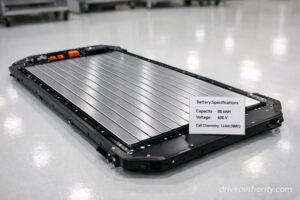
Blade Battery & Structural Battery Packs
BYD’s Blade Battery architecture is a structural LFP pack that doubles as a load-bearing vehicle component. Notably, it passed the nail penetration test without thermal runaway. It also eliminated the conventional module layer, increasing volumetric efficiency by 50%, and enabled vehicle floor structures with improved rigidity. This is not incremental improvement — it is a full rearchitecting of the battery system. Consequently, it simultaneously improved safety, longevity, cost, and packaging. Competitors are developing structural pack equivalents, but BYD’s manufacturing head start is measured in millions of units already produced.
Control of Critical Minerals
China controls approximately 60% of global lithium refining capacity, 70% of cobalt processing, and 80% of synthetic graphite anode production — the three most battery-critical materials beyond lithium carbonate. This upstream control gives Chinese battery manufacturers lower and more stable input costs than any competitor sourcing processed materials elsewhere. The EU Critical Raw Materials Act and the US Inflation Reduction Act’s domestic content requirements both target this dependency directly. Building alternative refining and processing capacity, however, takes a decade — not a year.
How 800V Architecture Is Accelerating Charging Speeds
Chinese EV manufacturers are deploying 800V charging architecture across an expanding range of models — not just flagship products. BYD’s Yi Fang platform, Huawei’s DriveONE powertrain, and XPeng’s SEPA2.0 architecture all support 800V operation. This enables 300–500 kW peak charging speeds on compatible infrastructure. Furthermore, CATL’s Shenxing battery and BYD’s Flash Charge technology both target 400 km of range recovery in under 10 minutes. That threshold eliminates the charging time objection that historically slowed EV adoption among high-mileage drivers. Notably, this technology reaches volume Chinese production before comparable Western models at equivalent price points.
Innovation Speed – Software-Defined Vehicles & OTA Updates
Software development velocity is the second major dimension of why Chinese EVs are reshaping the global car industry. Rather than adapting legacy electronic systems designed for combustion vehicles, Chinese manufacturers have built software-first architectures from the ground up.
Over-the-Air Feature Deployment
NIO, XPeng, and BYD deploy meaningful OTA updates — not just bug fixes, but performance improvements, new features, and efficiency gains — on monthly to quarterly cycles. Dozens of OTA iterations have expanded NOMI, NIO’s AI assistant, with each release adding functional capability. XPeng’s NGP (Navigate on Pilot) system now covers urban roads — a domain it reached entirely through software updates, without hardware changes. As a result, this model of post-sale improvement creates ownership experiences that evolve over time rather than degrading — a structural reversal of the traditional automotive product life cycle.
Integrated Infotainment Ecosystems
Chinese EVs are built around deeply integrated digital ecosystems — Huawei HarmonyOS, NIO’s NIO OS, XPeng’s Xmart OS. These connect vehicle functions, mobile devices, home smart systems, and in-car AI assistants into a single coherent experience. By comparison, Apple CarPlay and Android Auto bolt a phone operating system onto a separate, less capable native system. For a generation of buyers who expect their vehicle’s digital experience to match their smartphone’s, Chinese EVs consequently set a standard that traditional infotainment systems structurally cannot match.
AI-Driven Driver Assistance (Level 2+ / Level 3 Progress in 2026)
Huawei’s ADS 3.0, XPeng’s XNGP, and BYD’s DiPilot systems all compete directly with Tesla FSD on urban autonomous driving capability in 2026. Notably, Huawei ADS 3.0 operates without high-definition mapping in urban environments — a capability that significantly expands its operational domain. XPeng has also accumulated more than 2 billion kilometres of autonomous driving data from its Chinese fleet. This trains its systems at a pace that Western competitors, without equivalent domestic fleet density, cannot easily match. Furthermore, the data advantage compounds as Chinese fleets grow: more cars, more kilometres, better AI, faster iteration.
Global Expansion Strategy – Europe, Southeast Asia, Latin America
Chinese EV global expansion is not a single homogeneous strategy — it is a market-by-market approach calibrated to local regulatory environments, consumer preferences, and competitive landscapes.
Export Growth & Local Assembly Plants
Chinese EV exports reached approximately 1.2 million units in 2024, up from under 100,000 in 2020. Europe has been the primary target market. BYD, MG, NIO, XPeng, and Ora have all established dealership and service infrastructure in major European markets. To circumvent tariff barriers, BYD has also begun construction of European manufacturing facilities — in Hungary and Turkey. These will produce locally assembled vehicles eligible for preferential tariff treatment. In short, this local assembly strategy mirrors the approach Japanese manufacturers used in the 1980s: establish market presence, demonstrate quality, then invest in local production. For context on how this plays out specifically in Europe, see our analysis of why Chinese EVs are taking over Europe.
Trade Barriers & Tariff Responses
In 2024, the European Union imposed provisional anti-subsidy duties of 17–38% on Chinese EV imports, on top of the existing 10% standard tariff. US policy went further — 100% tariffs on Chinese EVs effectively prohibited direct import, though they did not stop Chinese technology entering via third-country assembly. Neither barrier halted expansion: volume growth continued in Europe despite the duties, as the pre-tariff price advantage absorbed a significant increase and still left Chinese models competitive. Local assembly investments progressively neutralise these constraints over the medium term.
Strategic Partnerships & Joint Ventures
In markets where direct import faces regulatory or commercial barriers, Chinese manufacturers are forming partnerships with established local entities. BYD has partnered with Toyota for EV platform development, while CATL runs battery joint ventures with BMW, Ford, and Stellantis. Geely’s ownership of Volvo, Polestar, and a stake in Mercedes-Benz embeds Chinese capital and technology into the heart of European premium automotive. These partnerships move technology, brand credibility, and market access in both directions — making the China/West automotive divide increasingly hard to draw as a clean line.
How Chinese EVs Are Forcing Legacy Automakers to Respond
The competitive pressure from Chinese EVs has triggered a response across every major Western automaker — but the responses vary significantly in ambition, coherence, and credibility.
Accelerated EV Roadmaps
Volkswagen Group accelerated its EV transition timeline by two years in direct response to Chinese competitive pressure. It also announced a $15 billion investment in Chinese EV development and planned 800V architecture across its entire MEB platform successor. Similarly, Ford restructured its Model e division, GM accelerated its Ultium platform, and Stellantis invested in LFP chemistry — all reflecting the same competitive urgency. However, accelerating timelines does not compress the manufacturing learning curve. Building a competitive EV at Chinese-comparable cost requires volume. Volume, in turn, requires time that roadmap announcements cannot substitute for.
Price Reductions & Margin Pressure
Tesla initiated a global price war in early 2023 that significantly compressed margins across the premium EV segment. Chinese manufacturers — operating at lower cost with more aggressive volume targets — sustained that pressure. Traditional automakers with higher fixed costs and legacy dealer networks struggled to follow. Volkswagen closed three German factories in 2024 — the first domestic closures in the company’s history. Management cited cost competitiveness in EV manufacturing as the direct cause, with Chinese competition named explicitly.
Shift Toward In-House Battery Production
Every major Western OEM has announced in-house battery manufacturing capacity — BMW, VW PowerCo, Ford BlueOval City, GM Ultium Cells, Stellantis StarPlus Energy. These represent genuine strategic repositioning. However, they face a common challenge: first-generation in-house factories are inherently less cost-efficient than mature, high-volume Chinese production. Specifically, the cost per kWh from a new Western gigafactory in 2026–2028 will run 20–35% above equivalent CATL production. That gap closes only as scale and process maturity develop — a process that typically takes 5–8 years from first production.
Impact on Consumers – What This Means for Buyers in 2026
The reshaping of the global car industry by Chinese EVs has direct, positive consequences for car buyers — alongside real risks that informed purchasing decisions must account for.
More Affordable Long-Range EV Options
The most direct consumer benefit of Chinese EV competition is price compression across the entire EV market. Western manufacturers have reduced prices on established models, launched new entry-level variants, and accelerated budget EV programs. All of this happened in response to Chinese price points that Western OEMs could not have matched without competitive pressure. Consequently, the buyer purchasing a VW ID.3 or Renault Megane E-Tech in 2026 pays less than they would have before BYD set a new floor for what a 300km-range EV should cost. For buyers specifically interested in Chinese models, our best Chinese EVs 2026 real-world comparison ranks the strongest options by ownership value.
Faster Charging & Better Efficiency
800V architecture is entering the mainstream faster because Chinese manufacturers deploy it at volume in mid-market vehicles — not just flagship models. This, in turn, accelerates infrastructure investment from charging networks. Those networks must upgrade to support 350 kW+ charging to remain competitive for the vehicles arriving in their markets. The result is a virtuous cycle: more 800V vehicles drive more ultra-rapid charger installation, making 800V vehicles more practical, which drives further sales. As a result, buyers in 2026 access charging speeds that were premium-only features two years ago — at mainstream price points.
Increased Feature Standardisation
Chinese EVs have established new baseline expectations for standard equipment: large touchscreen displays, OTA update capability, advanced driver assistance, heat pumps, and integrated smartphone ecosystems — all at price points where Western alternatives offered far less. Western manufacturers now face a straightforward choice: match these expectations or lose buyers. That competitive pressure has compressed the feature gap that previously justified Western price premiums. Standard equipment levels across the market have risen as a direct result.
| Factor | Chinese EV | Established Western EV |
|---|---|---|
| Purchase price (mid-range) | ✅ Lower — significant advantage | ⚠️ Higher — premium for brand trust |
| Battery technology | ✅ LFP longevity, competitive range | ✅ NMC energy density, mature systems |
| Software / OTA | ✅ Faster iteration, deeper integration | ⚠️ Improving but slower cycle |
| Long-term reliability data | ⚠️ Growing but shorter track record | ✅ Extensive multi-year fleet data |
| Resale value | ⚠️ Lower in most Western markets | ✅ Established brand premium |
| Service network | ⚠️ Expanding but thinner in many markets | ✅ Globally distributed |
| Geopolitical stability | ⚠️ Tariff and supply chain exposure | ✅ Established trade relationships |
For buyers weighing the full ownership risk picture, our hidden costs of Chinese EVs guide and risks of buying a cheap electric car provide the detailed frameworks needed to evaluate a Chinese EV purchase beyond the sticker price.
Risks & Controversies Surrounding the Expansion
The reshaping of the global car industry by Chinese EVs carries structural risks for buyers, governments, and incumbent manufacturers that the headline pricing story does not capture.
Data Privacy & Cybersecurity Concerns
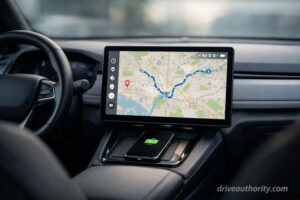
Connected Chinese EVs collect significant volumes of data — location, driving behaviour, passenger information, camera feeds — through architectures rooted in Chinese software ecosystems. Several governments have, consequently, initiated reviews or restrictions on Chinese EVs operating in sensitive areas. The US has proposed restrictions on connected vehicle technology from “countries of concern.” Similarly, multiple European intelligence agencies have raised concerns about data flows from Chinese-connected vehicles to servers under Chinese jurisdiction. These are not settled issues. Moreover, the regulatory landscape governing connected Chinese vehicles in Western markets is actively evolving. For buyers in government, defence, or sensitive commercial sectors, the data architecture of any vehicle purchase deserves explicit evaluation.
Geopolitical Trade Tensions
Chinese EV expansion is occurring at a moment of elevated geopolitical tension between China and its major export markets. EU anti-subsidy tariffs, US 100% EV import duties, and proposed reciprocal measures all create an environment where the cost and availability of Chinese EVs can change materially with policy shifts. A buyer who purchases a Chinese EV in a tariff-exposed market may consequently find that resale value, parts cost, and brand support are affected by forces entirely outside automotive dynamics. In short, the geopolitical risk premium on Chinese EV ownership is real — and not yet fully priced into most buyer decisions.
Brand Trust & Resale Value Questions
Despite significant quality improvement, Chinese EV brands still carry a trust deficit in most Western used car markets. This suppresses resale values relative to equivalent established brands. That gap is narrowing — BYD and MG in particular are accumulating the track record data that drives used car buyer confidence. However, it remains a meaningful ownership cost factor for buyers who plan to sell within 5–7 years. Our Chinese car reliability assessment for 2025 provides current brand-level trust benchmarks for the most active export brands.
Long-Term Industry Outlook – 2030 and Beyond
The trajectory of Chinese EV global expansion through 2030 is not linear — it will be shaped by tariff evolution, technology leapfrogging, local manufacturing investment, and the speed at which Western OEMs close the cost and technology gaps that currently define the competitive landscape.
Market Share Forecast
Analysts project Chinese brands will hold 30–35% of global EV sales by volume outside China by 2030 — up from roughly 8–12% in 2024. Southeast Asia, Latin America, the Middle East, and Africa will see the largest gains, where Western brands hold thinner presence and tariff barriers are lower. European and North American growth will be slower, but local assembly investments will progressively erode that constraint. A 15–20% Chinese share of the European EV market by 2030 now reads as a base case, not a bull scenario.
Battery Innovation Roadmap
CATL’s Shenxing battery targets 1,000 km range and 10-minute charging. Those figures would remove the two remaining substantive objections to EV adoption for the widest range of buyers. BYD’s next-generation Blade Battery targets 400+ Wh/kg energy density — enabling substantially lighter or longer-range packs. Both manufacturers have announced production investments backing these 2026–2028 commercialisation timelines. These are not research projections; they are funded manufacturing commitments.
Solid-State Battery Competition
Solid-state batteries — which promise higher energy density, faster charging, and improved safety through elimination of liquid electrolyte — represent the next major chemistry transition. Toyota has announced 2027–2028 solid-state production targets; CATL has its own solid-state roadmap for 2027 onwards. The outcome of this technology race will significantly affect the competitive balance: if Toyota achieves volume production of solid-state cells first, it could restore Japanese battery competitiveness at the premium end of the market. If CATL scales solid-state before Toyota, it extends Chinese battery leadership into the next technology generation.
Regional Manufacturing Shifts
The most consequential long-term development is the migration of Chinese EV manufacturing into Western and emerging markets. BYD’s Hungarian plant, joint ventures in Brazil and Mexico, and prospective assembly in South Africa and India all represent a strategic shift from export to local production. Once local production is established, the tariff barrier argument collapses. With it goes the last structural protection Western incumbents hold against Chinese price competition in their home markets. In Europe, this transition runs 2026–2030. In North America, stricter IRA content requirements push the timeline further out. For buyers and investors, however, this manufacturing migration is the most important long-term variable in the Chinese EV story.
FAQs – Why Chinese EVs Are Reshaping the Global Car Industry
Why are Chinese EVs growing so fast globally?
Three structural advantages drive Chinese EV global growth: battery manufacturing scale and cost leadership through CATL and BYD’s vertical integration; state-supported industrial policy that funded a decade of R&D and infrastructure investment; and a domestic market of sufficient scale to fund technology development that can then be exported at competitive prices. No single Western manufacturer can replicate all three simultaneously in a short timeframe.
Why Chinese EVs are reshaping the global car industry — is this permanent?
The structural advantages — battery manufacturing scale, supply chain control, software development velocity — are durable rather than cyclical. Even if subsidy structures normalise, the accumulated manufacturing expertise and supply chain integration represent competitive moats that take a decade to erode. Western OEMs are responding, but the response timeline means Chinese competitive advantages will persist through at least 2030 and likely beyond in battery cost and software capability.
Are Chinese electric cars better than Western brands?
Better depends on the dimension evaluated. Chinese EVs lead on price, feature-per-dollar, software integration speed, and increasingly on battery longevity for LFP models. Western brands lead on long-term reliability data, resale value, service network depth, and — in some segments — build quality. For a buyer who prioritises technology and value, current Chinese EVs are genuinely competitive. For a buyer who prioritises proven long-term reliability and resale certainty, established Western brands still hold meaningful advantages. See our objective Chinese EV quality analysis for a detailed breakdown.
How are Chinese EVs cheaper?
Lower battery cost through LFP chemistry and CATL scale, lower manufacturing labour costs, government-subsidised factory and R&D investment, direct-to-consumer distribution eliminating dealer margin, and export pricing strategies designed to build market share ahead of profitability. The cost advantage is multi-layered — removing any single element does not eliminate the gap, which is why tariffs slow but do not stop Chinese EV market penetration.
Will Chinese EVs dominate the global market?
Dominate is too strong — significant market share growth is more accurate. Chinese brands are projected to hold 30–35% of global EV volume outside China by 2030. Tariff barriers, local content requirements, data security regulations, and consumer brand preferences will limit penetration in some markets. In others — Southeast Asia, Latin America, the Middle East — Chinese dominance is already effectively established and unlikely to be reversed.
Are Chinese EV batteries more advanced?
On LFP chemistry, yes — BYD’s Blade Battery and CATL’s LFP cell technology lead the world on cycle life, thermal stability, and cost per kWh. NMC high-energy-density chemistry tells a different story: the technology gap is smaller and Western manufacturers remain competitive. Solid-state development is genuinely open — CATL and Toyota lead the race to volume production, with other Chinese manufacturers close behind at advanced development stages.
Is it safe to buy a Chinese EV in 2026?
For most buyers in markets with established Chinese brand service infrastructure, yes — with appropriate due diligence. Choose a brand with proven financial stability, confirm service network coverage, verify battery warranty terms, and model total cost of ownership rather than comparing purchase prices alone. For specific ownership risk evaluation, our guide to buying a Chinese EV in 2026 provides a structured decision framework.
Final Verdict – A Structural Shift, Not a Temporary Trend
Why Chinese EVs are reshaping the global car industry is ultimately a story about structural competitive advantages — in battery manufacturing, supply chain integration, software velocity, and cost architecture. These have accumulated over a decade. Furthermore, they cannot be neutralised by tariffs, policy responses, or marketing alone. The Western automotive industry is responding with genuine urgency and significant capital investment. However, closing a manufacturing experience gap measured in billions of cells, and a software gap measured in billions of kilometres of autonomous driving data, takes time that competitive announcements cannot compress.
For car buyers, the practical implication is straightforward: competition between Chinese and Western EVs is producing better vehicles at lower prices than either side would have generated independently. BYD’s pricing pressure has reduced the cost of a Volkswagen. XPeng’s software ambition has raised the infotainment expectations that BMW must meet. Moreover, iron-based chemistry adoption across the West accelerated directly because LFP proved its longevity. Every buyer in every market, therefore, benefits from this competition — regardless of which brand they ultimately choose.
Every informed buyer’s task in 2026 is to evaluate individual models on their specific merits — range, reliability data, service infrastructure, total ownership cost — rather than on country of origin. This industry reshaping is happening now. Buyers who understand the dynamics are consequently best positioned to make decisions that serve their actual needs rather than their brand assumptions.
To compare Chinese and Western EVs side by side on ownership value, explore our Chinese EV vs Japanese hybrid reliability comparison, review BYD vs Tesla vs MG 5-year ownership costs, and see our guide to buying a Chinese EV in 2026 for UK and EU buyers.