Last Updated: March 2026 — Specs, pricing, and ownership data current for 2026 model year
The Tesla Model Y and Ford Mustang Mach-E are the two best-selling electric SUVs in the U.S. market — and in 2026 they remain the most direct head-to-head comparison any mid-size EV buyer will face. Both offer over 300 miles of range, practical family interiors, and competitive pricing under $60,000. But they diverge sharply on charging ecosystem, driving character, software maturity, and long-term ownership economics. This guide compares the Tesla Model Y vs Ford Mustang Mach-E across every dimension that matters before you buy in 2026.
Tesla Model Y vs Ford Mustang Mach-E 2026 — Quick Verdict:
The Tesla Model Y leads on range efficiency (~330 EPA miles), Supercharger network access, and software depth. The Mach-E offers a more traditional SUV interior, Ford BlueCruise hands-free driving, and broader financing options. Model Y starts at ~$44,990; Mach-E at ~$42,995. For most buyers prioritizing charging convenience and long-term value, the Model Y holds the edge — but the Mach-E wins on cabin comfort and driving feel.
Quick Comparison — Tesla Model Y vs Mach-E Key Specs (2026)
Price, Range, and Performance
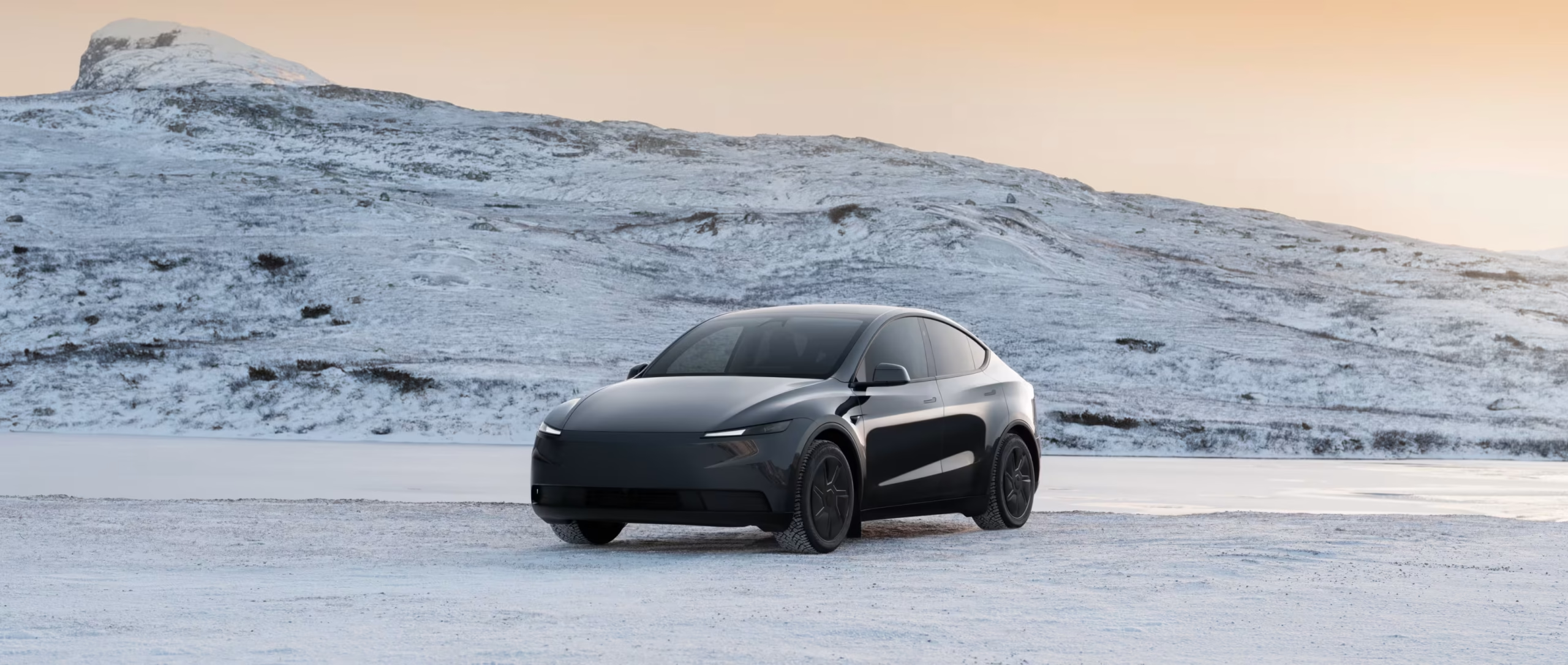
| Specification | Tesla Model Y RWD | Ford Mustang Mach-E Select RWD | Edge |
|---|---|---|---|
| Base Price (2026) | ~$44,990 | ~$42,995 | Mach-E LOWER |
| EPA Range | ~330 miles | ~305 miles | Model Y LONGER |
| Battery (usable) | ~82 kWh | ~91 kWh (extended) | Mach-E larger pack |
| 0–60 mph (base) | ~6.6 sec | ~6.1 sec | Mach-E FASTER |
| Peak DC Charging | ~250 kW (V3 Supercharger) | ~150 kW | Model Y FASTER |
| Cargo (behind rear seats) | 68 cu ft (seats folded) | 59.6 cu ft (seats folded) | Model Y MORE |
| Touchscreen Size | 15.4 inches | 15.5 inches | Tie |
| Hands-Free Driving | Autopilot (standard) | BlueCruise (standard) | BlueCruise on more roads |
Charging Speed and Battery Size
The Model Y’s charging speed advantage is significant on paper — 250 kW peak at V3 Superchargers vs 150 kW peak for the Mach-E. In practice, this means the Model Y can add roughly 180 miles of range in 15 minutes under ideal conditions, while the Mach-E adds approximately 60–70 miles in the same window at a 150 kW CCS charger. For road trippers, this difference compounds across multiple stops. For daily home-charging commuters, it’s irrelevant.
Tesla Model Y vs Mach-E — Performance and Driving Experience
On paper these are closely matched EVs. Behind the wheel they feel distinctly different — and that difference matters more to some buyers than the spec sheet suggests.
Acceleration, Power Output, and AWD Systems
The base Mach-E Select RWD actually edges the base Model Y RWD in 0–60 mph at around 6.1 seconds versus 6.6 — a consequence of Ford tuning the Mach-E’s motor mapping for spirited performance feel. The gap inverts sharply in the AWD variants: the Model Y Long Range AWD hits 0–60 in approximately 4.8 seconds, while the Mach-E GT Performance AWD achieves around 3.5 seconds. The performance ceiling of the Mach-E GT is genuinely impressive — but at nearly $63,000 before incentives, it’s a different value proposition than the Model Y Performance at a comparable price point.
Handling, Ride Comfort, and Road Feel
The Mach-E’s tuning philosophy prioritizes ride comfort and traditional SUV behavior — softer suspension, more body roll in corners, and a steering feel that’s closer to a conventional Ford SUV than a sports car. Owners consistently describe it as relaxed and confidence-inspiring on long highway stretches. The Model Y’s suspension is firmer, particularly on 20-inch wheels, and delivers a more planted, performance-oriented feel. It’s sharper to drive but less forgiving on rough roads than the Mach-E. Neither is sports-car precise, but if ride quality is your priority, the Mach-E is the more comfortable daily companion.
Range Efficiency and Charging Infrastructure in 2026
Real-World Driving Range in 2026
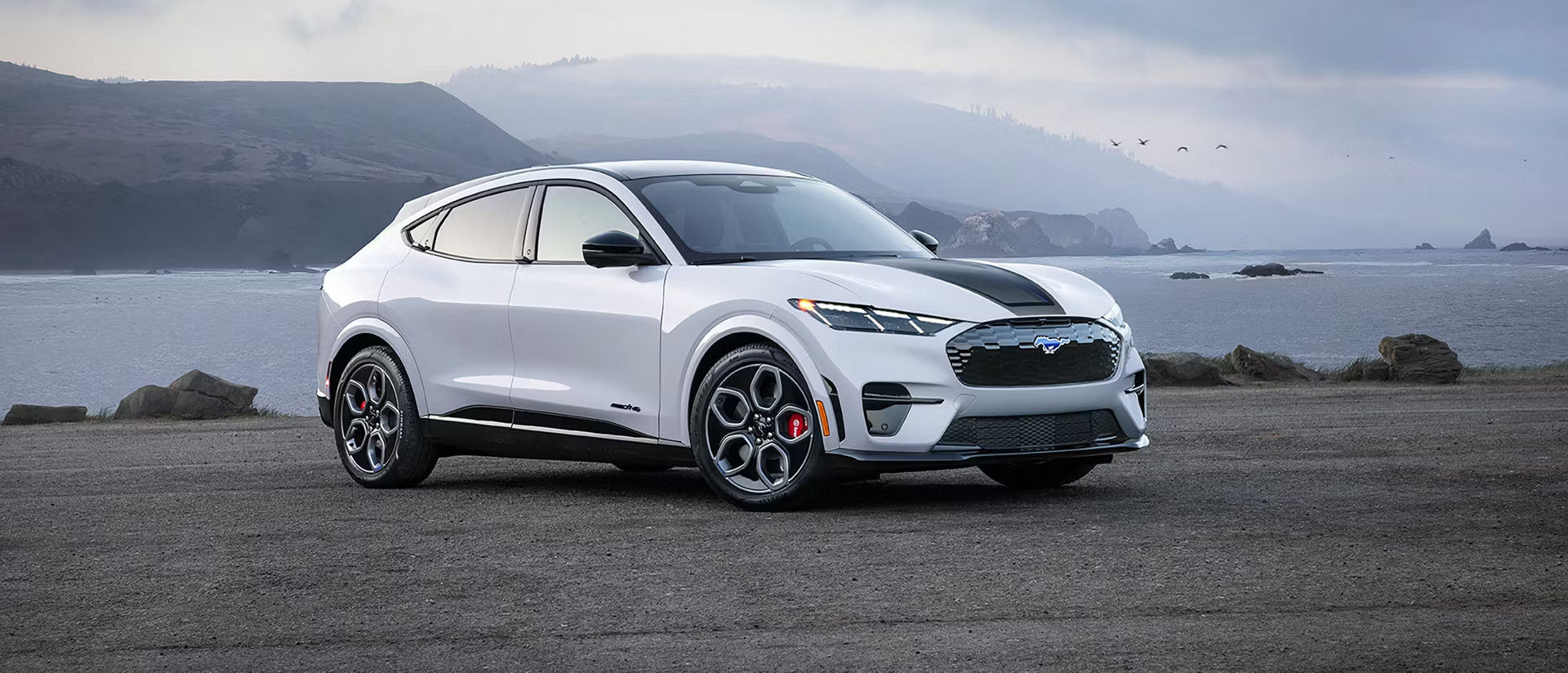
EPA ratings rarely survive real-world driving. Based on aggregated owner data, the Model Y RWD achieves approximately 285–310 miles in mixed real-world driving — around 90–94% of its EPA rating, which is above average for an EV of its class. The Mach-E Extended Range RWD delivers approximately 265–285 miles in equivalent conditions — closer to 87–93% of its EPA figure. The Model Y’s efficiency advantage is partly structural: its lower drag coefficient and more efficient powertrain architecture extract more range from a smaller battery than the Mach-E’s larger pack manages in practice.
Tesla Supercharger Network vs Public CCS Charging
This is the most decisive practical difference between the two vehicles in 2026. Tesla’s Supercharger network covers approximately 17,000+ U.S. stalls with an industry-leading uptime and reliability record. Model Y owners navigate long trips using Tesla’s built-in trip planner which automatically routes through Supercharger stops — the experience is seamless and largely anxiety-free. Mach-E owners use the BlueOval Charge Network powered by Electrify America and other CCS networks, which has improved substantially but still lags Tesla in stall availability and reliability outside major corridors. In 2026, Ford vehicles can also access Tesla Superchargers via NACS adapter — but at slightly higher rates than Tesla owners pay, and without native in-car routing integration.
Interior Design and Technology Experience — Model Y vs Mach-E
Tesla Minimalist Interface and Software Updates
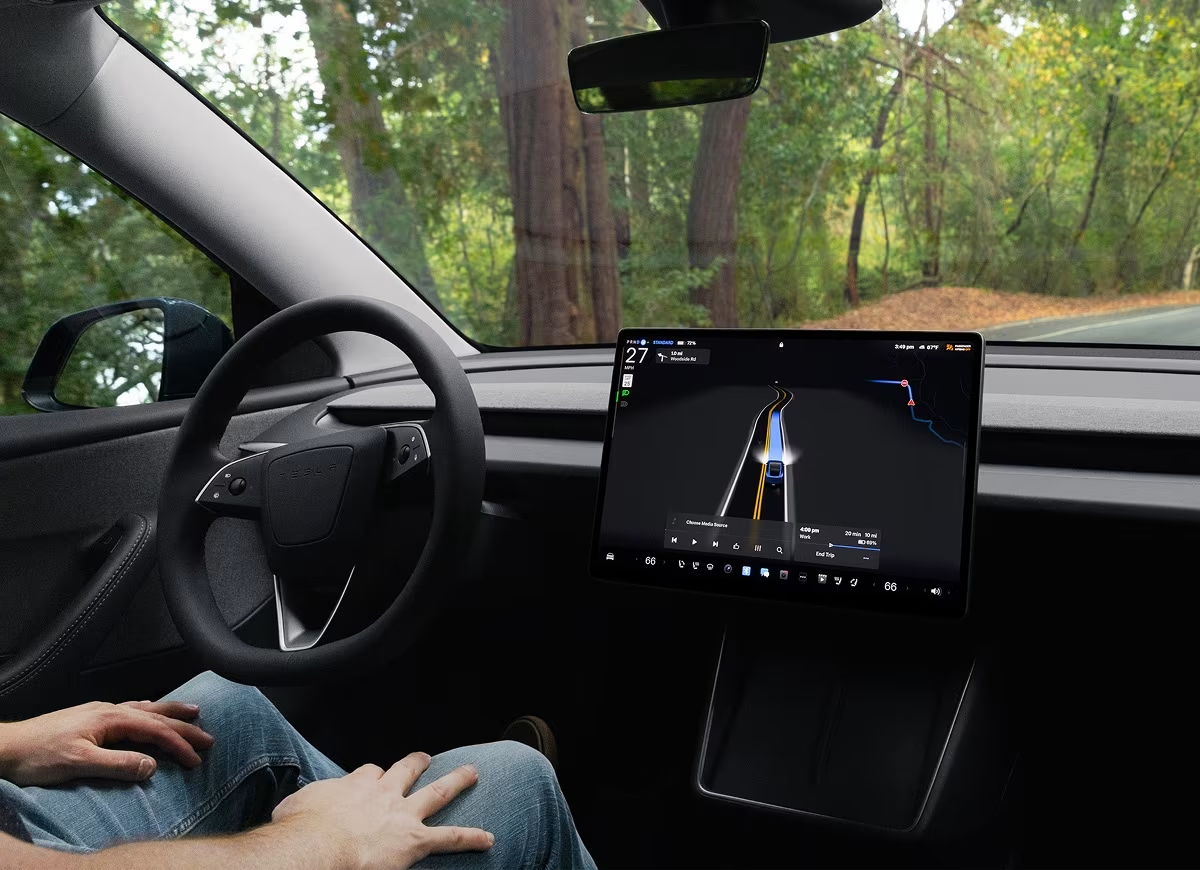
Tesla’s interior design philosophy is extreme minimalism: a single 15.4-inch landscape touchscreen controls nearly every vehicle function — climate, navigation, media, mirrors, seat adjustment — with virtually no physical buttons. This is either a feature or a frustration depending on the driver. The software experience is undeniably mature: Tesla’s over-the-air updates are the most comprehensive in the industry, regularly adding new features, improving efficiency, and updating ADAS capabilities. As of 2026, Tesla’s Full Self-Driving (FSD) supervised feature set remains the most capable commercially available driver assistance package in terms of highway and urban lane handling — though it still requires active driver supervision.
Mach-E Cabin Comfort and Infotainment System
The Mach-E’s interior takes the opposite approach — physical climate controls are retained, materials quality is genuinely competitive with the Model Y at comparable price points, and the SYNC 4A infotainment running on a 15.5-inch portrait touchscreen is more intuitive for drivers transitioning from traditional vehicles. Ford’s BlueCruise hands-free highway driving system is available on more mapped road miles than Tesla’s equivalent feature in some regions, though Tesla’s city-street capability exceeds Ford’s at equivalent price levels. The Mach-E also offers wireless Apple CarPlay and Android Auto — an integration Tesla famously does not support, which remains a genuine friction point for smartphone-first users.
Ownership Costs and Reliability — Tesla Model Y vs Mach-E 2026
Maintenance and Service Costs
Both vehicles benefit from EV’s inherently low maintenance profile — no oil changes, no spark plugs, minimal brake wear thanks to regenerative braking. Tesla’s service model has improved but still draws criticism for appointment wait times and occasional parts delays in some markets. Ford’s service network is vastly larger with over 3,000 EV-certified dealerships nationwide — a meaningful convenience advantage for buyers who want traditional dealer service access. Annual maintenance costs for both run approximately $300–$450/year under normal use, based on aggregated owner service data.
Warranty Coverage and Long-Term Reliability in 2026
Both vehicles carry comparable warranty packages in 2026: 4-year/50,000-mile basic warranty and 8-year/100,000-mile battery and electric drive unit warranty — standard across most U.S. EVs. Tesla Model Y has a longer real-world reliability dataset due to earlier market entry, and that data generally supports above-average powertrain durability. Mach-E’s long-term dataset is shorter but early J.D. Power IQS scores have improved year-over-year from 2022 to 2025 after early software quality concerns were largely addressed via OTA updates.
| Cost Category | Tesla Model Y (5-Year Est.) | Ford Mustang Mach-E (5-Year Est.) |
|---|---|---|
| Fuel / Charging (15K mi/yr, home) | ~$3,200 | ~$3,500 |
| Maintenance (routine service) | ~$1,500–$2,000 | ~$1,800–$2,400 |
| Insurance (avg. U.S. estimate) | ~$8,500–$10,000 | ~$7,500–$9,000 |
| Depreciation (5-year residual ~40–45%) | ~$24,700 loss | ~$23,100 loss |
| Estimated 5-Year Total Cost | ~$37,900–$40,000 | ~$35,900–$38,000 |
Practicality for Families and Daily Use — Model Y vs Mach-E
Cargo Space and Interior Flexibility
The Model Y’s cargo advantage is real and measurable: 68 cubic feet with seats folded versus 59.6 cubic feet for the Mach-E. The Model Y also offers a front trunk (frunk) adding useful storage separate from the rear cargo area — useful for groceries, charging cables, or wet gear. Both vehicles offer fold-flat rear seats and similar rear legroom for adults. The Model Y’s rear seating is flat and versatile; the Mach-E’s rear bench is slightly more contoured and comfortable for long-journey passengers. Optional third-row seating on the Model Y (a low-profile bench suitable for children) gives it a family flexibility edge that the Mach-E cannot match.
Safety Ratings and Driver Assistance Systems
Both vehicles hold strong safety credentials. The Tesla Model Y earned a 5-star overall NHTSA safety rating across all categories in its most recent evaluation. The Mach-E also carries 5-star NHTSA ratings and an IIHS Top Safety Pick+ designation — the Mach-E’s IIHS performance is particularly strong in headlight ratings where it outperforms the Model Y’s standard headlight configuration. For driver assistance, Tesla’s Autopilot (standard) handles lane centering and adaptive cruise control on all highway miles, while Ford’s BlueCruise offers hands-free driving on pre-mapped “Blue Zones” covering approximately 130,000 highway miles in the U.S. — a genuine hands-free advantage over Tesla’s standard Autopilot for eligible roads.
Which EV Is the Better Choice in 2026 — Model Y or Mach-E?
There is no universal answer — but there is a clear framework based on what each vehicle does best.
⚡ Choose Tesla Model Y If:
- You take frequent road trips and want seamless Supercharger routing
- Maximum range efficiency matters for your commute
- You want the most mature EV software and OTA updates
- Cargo space and family flexibility are priorities
- You charge primarily at home and value long-term resale
🐎 Choose Mach-E If:
- Apple CarPlay or Android Auto is non-negotiable
- Ride comfort and traditional SUV feel are priorities
- You want hands-free BlueCruise highway driving
- Ford dealer service network access matters
- Lower base price or Ford financing incentives fit your budget
Best for Technology and Charging Ecosystem
The Tesla Model Y wins this category decisively. Tesla’s Supercharger network, in-car trip planning, and OTA software cadence create an ownership experience that remains the benchmark for the EV segment. If you regularly drive beyond your home-charging range, or if you want software that improves meaningfully month over month, the Model Y is the better long-term technology bet in 2026.
Best for Driving Feel and Traditional SUV Comfort
The Mach-E is the better choice for buyers transitioning from a conventional SUV. Its ride quality is softer, its cabin feels more familiar, its physical controls reduce the learning curve, and its Apple CarPlay integration removes the friction of adapting to Tesla’s ecosystem. For buyers who want an EV that drives and feels like a premium Ford SUV rather than a technology platform, the Mach-E delivers that experience with less compromise.
FAQ — Tesla Model Y vs Ford Mustang Mach-E (2026)
Which has better range — Model Y or Mach-E?
The Tesla Model Y RWD leads with approximately 330 EPA miles versus the Mach-E Extended Range RWD at ~305 miles. In real-world mixed driving, the Model Y typically delivers around 285–310 miles while the Mach-E averages 265–285 miles. The Model Y’s efficiency advantage comes from its lower drag coefficient and more efficient powertrain rather than a larger battery — the Mach-E actually carries a bigger pack but converts kWh to miles less efficiently.
Is the Mach-E cheaper to own than the Tesla Model Y?
The Mach-E has a slightly lower base price (~$42,995 vs ~$44,990) and marginally lower estimated 5-year ownership cost by roughly $2,000–$3,000, primarily from lower insurance premiums and comparable maintenance costs. However, the Model Y’s higher resale value and charging efficiency narrow this gap significantly for high-mileage drivers. Over 75,000 miles, total cost of ownership for both vehicles is within 5–8% of each other — not a decisive financial difference.
Does the Mach-E work with Tesla Superchargers in 2026?
Yes — Ford Mustang Mach-E owners can access Tesla Superchargers in 2026 via a NACS adapter (available from Ford or third-party suppliers). The charging hardware is compatible, but Mach-E owners pay standard non-Tesla rates rather than the preferential rates Tesla owners receive, and in-car navigation doesn’t natively route to Supercharger stops. It adds flexibility but doesn’t replicate the integrated Supercharger experience that Model Y owners get by default.
Which EV holds its resale value better?
The Tesla Model Y consistently outperforms the Mach-E on residual values in U.S. market data. At 3 years, Model Y retains approximately 50–58% of original value versus 44–50% for the Mach-E, based on aggregated used market pricing through early 2026. Tesla’s stronger brand recognition, Supercharger network value, and consistent software updates support its resale premium. The gap narrows when comparing well-equipped Mach-E GT trims against base Model Y configurations.