Last Updated: March 2026 — Reflects current U.S. tariff policy on imported electric vehicles
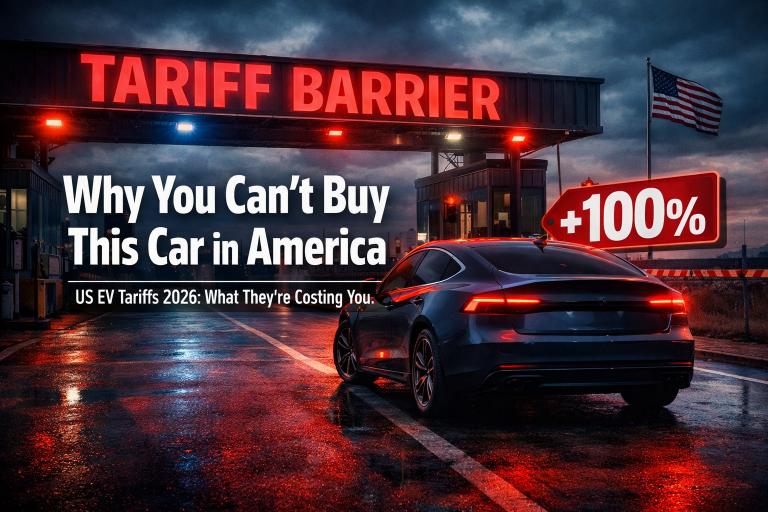
US EV tariffs are one of the most significant policy forces reshaping the electric vehicle market in 2026 — and most car buyers don’t fully understand how they work or what they actually mean for prices. The U.S. currently imposes 100% tariffs on Chinese-made EVs and elevated duties on electric vehicles from other non-USMCA countries. These policies are keeping entire brands out of the American market, inflating prices on others, and ultimately limiting the choices available to U.S. buyers at budget price points. This guide explains exactly how US EV tariffs work in 2026, which vehicles are affected, how much prices are impacted, and what buyers should factor into their purchase decisions.
US EV Tariffs 2026 — Quick Summary:
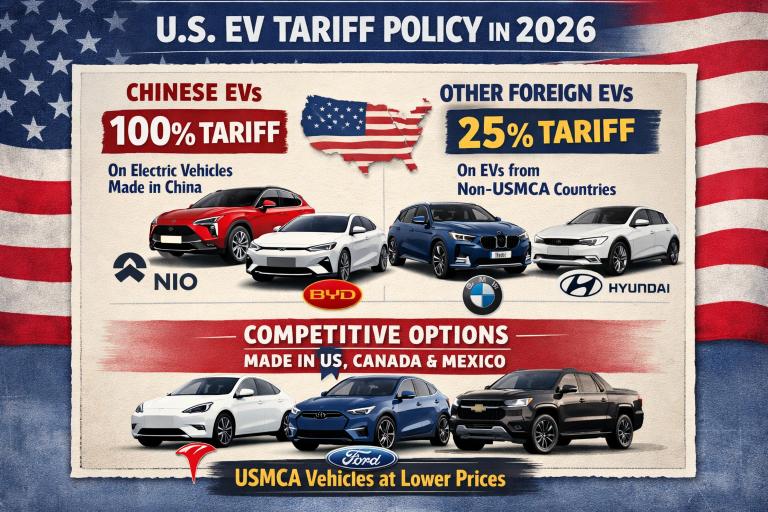
The U.S. imposes a 100% tariff on Chinese-manufactured EVs and 25% tariffs on non-USMCA imported EVs as of 2026. This effectively blocks BYD, Nio, and other Chinese brands from the U.S. market and raises the base cost of some European-brand vehicles assembled outside North America. EVs assembled in the U.S., Canada, or Mexico (USMCA) face no additional tariffs and qualify for the $7,500 federal tax credit under IRA rules.
What Are US EV Tariffs and Why They Exist in 2026
How Import Tariffs on Electric Vehicles Work
A tariff is a tax applied to goods when they cross a national border. For electric vehicles, U.S. tariffs are calculated as a percentage of the vehicle’s declared import value and paid by the importer — in practice, the cost is passed directly to U.S. consumers through higher sticker prices. Under the current policy framework in 2026, the U.S. maintains two primary EV tariff tiers: a 100% tariff on EVs manufactured in China (regardless of the brand’s country of origin), and a 25% tariff on EVs imported from countries outside the USMCA trade agreement (U.S., Canada, Mexico). Vehicles assembled within USMCA territory face standard automotive import duties of 2.5% or less — effectively no barrier for most manufacturers who build in North America.
Policy Goals Behind US EV Tariffs
The stated policy rationale behind U.S. EV tariff escalation — particularly the 100% China EV tariff introduced under the Biden administration in 2024 and maintained in 2026 — is threefold. First, protecting nascent domestic EV manufacturing from lower-cost Chinese competition. Second, addressing concerns about Chinese government subsidies that allow brands like BYD to price vehicles below market cost. Third, reducing U.S. supply chain dependency on Chinese battery technology and manufacturing. Critics argue the tariffs primarily harm American consumers by limiting affordable EV options, while proponents point to the domestic manufacturing investment they have stimulated from Ford, GM, and battery suppliers expanding U.S. production capacity.
Which Electric Vehicles Are Affected by US EV Tariffs in 2026
Imported EV Brands and Models Impacted by Tariff Policies
| Brand / Model | Assembly Location | Tariff Rate | U.S. Market Status | IRA Credit Eligible |
|---|---|---|---|---|
| BYD Seal / Dolphin / Atto 3 | China | 100% BLOCKED | Not sold in U.S. | No |
| Nio ET5 / ES6 | China | 100% BLOCKED | Not sold in U.S. | No |
| Xpeng / Zeekr / Li Auto | China | 100% BLOCKED | Not sold in U.S. | No |
| BMW iX (some trims) | Germany / S. Carolina | 2.5–25% VARIES | Available (U.S.-built trims) | Sparingly |
| Volkswagen ID.4 | Chattanooga, TN (USA) USMCA | 2.5% | Available + credit eligible | Yes |
| Tesla Model Y / Model 3 | Fremont, CA / Austin, TX USA | 2.5% | Full availability | Yes (income limits apply) |
| Chevy Equinox EV | Ingersoll, Canada USMCA | 2.5% | Full availability | Yes |
| Hyundai Ioniq 6 | Georgia, USA USMCA | 2.5% | Full availability + credit | Yes (2024+ Georgia-built) |
Vehicles Manufactured in the US That Avoid Tariffs
Any EV assembled in the United States, Canada, or Mexico under USMCA qualifies for the standard 2.5% automotive tariff rate — effectively no meaningful cost barrier. More importantly for buyers, USMCA-assembled EVs are the only vehicles eligible for the $7,500 federal EV tax credit under the Inflation Reduction Act. This creates a significant financial advantage for domestically assembled models: the effective price gap between a $42,000 USMCA-assembled EV (with $7,500 credit) and an equivalent $36,000 imported EV (ineligible for credit) is smaller than the sticker price difference suggests — and for Chinese EVs facing 100% tariffs, the math makes U.S. market entry commercially impossible at competitive price points.
How US EV Tariffs Influence Electric Car Prices in 2026
Direct Price Increases on Imported EVs
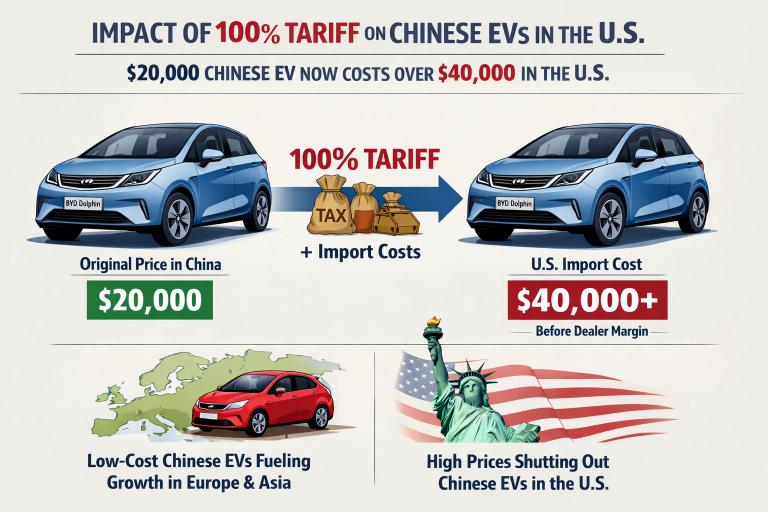
The math of tariff impact is straightforward. A Chinese EV with a $22,000 manufacturing cost and $4,000 shipping and compliance cost arrives at a U.S. port with a declared import value of approximately $26,000. A 100% tariff adds another $26,000 — immediately pushing the landed cost to $52,000 before U.S. dealer margin, advertising, and profit. At a final retail price of $58,000–$65,000, the vehicle would need to compete against a Tesla Model 3 Long Range at $44,990 or a Chevy Equinox EV at $34,995 — both eligible for up to $7,500 in federal credits. The competitive math is impossible, which is why no Chinese brand has successfully entered the U.S. passenger EV market despite dominating in Europe and Asia.
The 25% tariff on non-USMCA European and Korean EVs has a more nuanced effect. A European-assembled premium EV with a $55,000 import value faces approximately $13,750 in additional tariff cost — real money that either compresses manufacturer margins or raises consumer prices. Several European brands have responded by shifting U.S.-destined production to North American facilities: VW moved ID.4 production to Tennessee, Hyundai built a new Georgia plant specifically to gain IRA and USMCA benefits.
Indirect Effects on Competition and Market Pricing
Tariff protection has a second-order effect that directly impacts buyers: reduced competitive pressure allows domestic EV makers to maintain higher prices than they would face in an open market. Analysts estimate that if BYD were able to sell freely in the U.S., entry-level EV pricing could fall by $5,000–$10,000 on comparable models as domestic manufacturers responded to competitive pressure. The absence of Chinese competition is one factor sustaining current U.S. EV price floors — and is why the $35,000 truly affordable EV remains elusive in the American market despite being a reality in Europe, Australia, and Asia.
Impact of US EV Tariffs on Chinese and European EV Brands in 2026
Chinese EV Manufacturers and the US Market Barrier
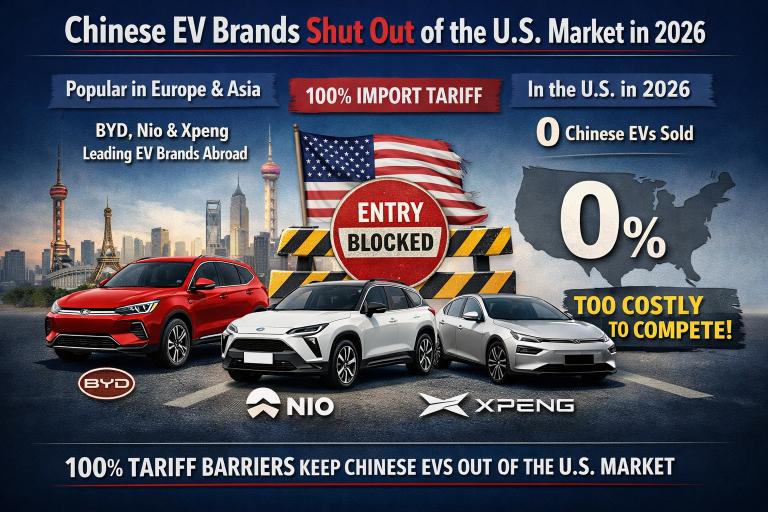
BYD is the world’s largest EV manufacturer by volume. Nio, Xpeng, Li Auto, and Zeekr are competitive, well-funded brands with strong European and Asian market positions. None of them sell passenger cars in the United States in 2026 — a situation entirely attributable to the 100% tariff barrier. BYD has publicly stated that U.S. market entry is not viable under current tariff conditions. Some Chinese brands have explored building North American manufacturing facilities to bypass the tariff — BYD has evaluated Mexico as a potential USMCA production base — but as of 2026, no Chinese passenger EV manufacturer has committed to a North American assembly investment that would clear the tariff and IRA credit requirements.
European EV Brands Navigating Higher Import Costs
European manufacturers face a more workable but still costly tariff situation. BMW, Mercedes, Audi, and Volvo all sell EVs in the U.S., but models assembled in Europe face the 25% non-USMCA tariff — a cost absorbed partly through margin compression and partly through pricing strategy. Volkswagen’s decision to build the ID.4 in Chattanooga, Tennessee is the clearest example of a European manufacturer restructuring production specifically to eliminate U.S. tariff exposure and gain IRA credit eligibility. Rivian, Tesla, GM, and Ford — all U.S.-built — benefit most from the current framework, facing no tariff friction and full access to the $7,500 federal credit pipeline.
Do US EV Tariffs Help American Automakers in 2026?
Benefits for Domestic EV Production
Potential Downsides for Consumers
✅ Arguments For EV Tariffs
- Protects U.S. EV manufacturing jobs from subsidized Chinese competition
- Incentivizes domestic battery supply chain investment (IRA + tariff combination)
- Reduces U.S. dependency on Chinese battery cell technology
- Has stimulated $50B+ in new U.S. EV manufacturing investment since 2022
- Gives domestic manufacturers runway to reach cost parity with Chinese brands
- Aligns with national security concerns around critical mineral supply chains
⚠️ Arguments Against EV Tariffs
- U.S. consumers pay $5,000–$10,000 more than necessary for equivalent EVs
- Delays mass EV adoption by keeping entry prices artificially high
- Reduces buyer choice — no sub-$25,000 EV option in the U.S. market
- Reduces competitive pressure on domestic manufacturers to innovate on cost
- European buyers benefit from BYD competition; U.S. buyers do not
- Climate goals may be slowed if EV affordability is constrained
The honest answer is that EV tariffs have delivered measurable domestic manufacturing investment — GM, Ford, and battery suppliers have accelerated U.S. plant construction in response to the combined IRA incentive and tariff protection framework. But the consumer cost is real: the U.S. has no equivalent to the BYD Dolphin or MG4 EV available below $25,000, a gap that makes entry-level EV adoption harder for budget buyers than it is in Europe or Australia. Whether that tradeoff is worth it is a genuine policy debate — but buyers should understand clearly that the current framework is one reason why affordable EVs are scarce in the American market.
What US EV Buyers Should Expect in 2026 and Beyond
EV Models Likely to Become More or Less Expensive
Under the current tariff framework, prices for USMCA-assembled EVs are likely to remain stable or decline modestly as domestic production scales — particularly for the Chevy Equinox EV, VW ID.4, and Hyundai Ioniq 5/6 which now have U.S. or Canadian assembly. Tesla’s domestic production base insulates its pricing from tariff risk entirely. The models most exposed to potential price volatility are European-branded EVs with partial non-USMCA production exposure — if tariff rates change or trade agreements shift, pricing on these models could move meaningfully. Chinese brands entering via Mexican manufacturing facilities (if any commit to this strategy) would represent the most significant market disruption scenario — potentially introducing $28,000–$35,000 EVs into the U.S. market for the first time.
Smart EV Buying Strategies Given Current Tariff Policy
② Focus on Chevy Equinox EV, VW ID.4, Hyundai Ioniq 5/6, and Tesla for the best credit-eligible value
③ Avoid grey-market Chinese EV imports — they don’t meet U.S. FMVSS safety standards and cannot be registered
④ Monitor Mexican manufacturing announcements — BYD or Chery building in Mexico could change the entry-level EV market materially within 2–3 years
⑤ Check IRA credit eligibility at fueleconomy.gov before committing — rules change and not all USMCA models qualify
FAQ — US EV Tariffs 2026
What are US EV tariffs in 2026?
In 2026, the U.S. imposes a 100% tariff on EVs manufactured in China and a 25% tariff on EVs imported from non-USMCA countries (outside the U.S., Canada, and Mexico trade zone). EVs assembled within USMCA territory face the standard 2.5% automotive import rate and are the only vehicles eligible for the $7,500 federal EV tax credit under the Inflation Reduction Act. The 100% China tariff was introduced under the Biden administration in 2024 and has been maintained in 2026, effectively blocking all Chinese-manufactured passenger EVs from the U.S. market.
Do tariffs make electric cars more expensive in the US?
Yes — indirectly and directly. Directly, the 25% non-USMCA tariff adds $8,000–$15,000 to the landed cost of European-assembled premium EVs, costs that are partially passed to consumers. The 100% China tariff makes Chinese EVs commercially impossible to sell in the U.S. at competitive prices. Indirectly, the absence of low-cost Chinese EV competition reduces pricing pressure on domestic manufacturers — an estimated $5,000–$10,000 premium that U.S. buyers pay versus buyers in open-market countries like Australia and the UK where BYD and MG compete freely.
Which EV brands are most affected by US tariffs?
Chinese brands are the most severely affected — BYD, Nio, Xpeng, Li Auto, Zeekr, and GWM Ora are all entirely absent from the U.S. market due to the 100% tariff. These brands collectively represent millions of annual EV sales in Europe and Asia. European brands with non-U.S. assembly also face meaningful cost friction — though many (VW, Hyundai, BMW) have restructured production to qualify for USMCA treatment. Tesla, GM, Ford, and Rivian benefit most from the current framework as exclusively or primarily U.S.-assembled manufacturers.
Can US EV tariffs change in the future?
Yes — tariff policy can change with each administration, trade negotiation, or legislative action. The most likely near-term change scenarios are: a reduction in the non-USMCA tariff rate as part of U.S.-EU trade negotiations, or the entry of Chinese brands through Mexican manufacturing facilities (which would qualify for USMCA treatment). A full reversal of the 100% China EV tariff is considered unlikely in the current political environment, but partial adjustments to specific battery component tariffs under the IRA framework are under ongoing review. Buyers planning purchases 12–24 months out should monitor federal trade policy announcements.