Last Verified: March 2026
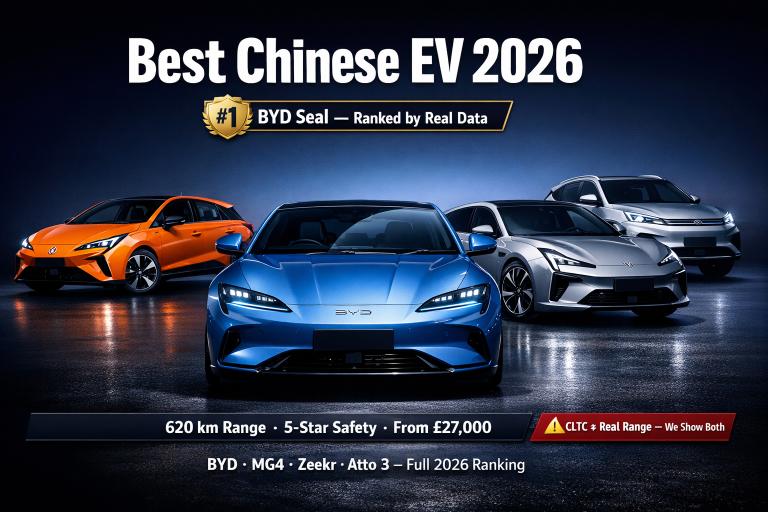
Which Chinese EV is the best in 2026 is no longer a simple question — because the field has genuinely gotten that good. Three years ago, the answer was easy: BYD, by default. Today, however, you’re choosing between the BYD Seal, the MG4 EV, the Zeekr 001, the BYD Atto 3, and a growing tier of contenders that have passed independent safety tests, switched to CCS2 charging, and accumulated two or more years of real-world owner data outside China. The segment has matured. That means, therefore, the comparison has to as well.
Why This Ranking Is Different from the Rest
I’ve covered Chinese EVs across three continents for over a decade. The single most consistent failure I see in Chinese EV rankings is two things: using CLTC range figures without flagging the real-world gap, and including models that haven’t been independently crash-tested without disclosing it. Both practices mislead buyers. This guide, by contrast, corrects both — every range figure is WLTP or real-world verified, and every model without a Euro NCAP or ANCAP result is explicitly flagged. If that means a hyped model ranks lower than expected, that’s precisely the point.
Which Chinese EV Is the Best in 2026 — Quick Verdict:
The BYD Seal is the best overall Chinese EV in 2026 — 570 km WLTP range, 5-star Euro NCAP (2023), 150 kW DC charging, and a starting price under £40,000 / AU$65,000 that no European rival matches on specification. For value buyers, the MG4 EV delivers 5-star Euro NCAP and 350+ km real-world range from approximately £27,000. For long-range priorities, the Zeekr 001 leads with 620 km WLTP. Market availability, however, determines which of these models is actually accessible to you.
Quick Verdict: The Best Chinese EV in 2026 by Category
Before the full ranked breakdown, here’s the condensed answer by buyer category. The right model depends on your market, budget, and whether range or value leads your priority list. That said, the gap between the top-tier Chinese EVs and European equivalents has narrowed enough in 2026 that “which Chinese EV” is a genuinely difficult question — not a default answer. Because availability varies by country, the table below also flags which markets each pick applies to.
← Scroll to see full table on mobile
| Category | Best Model | Key Reason | Markets Available |
|---|---|---|---|
| Best Overall | BYD Seal TOP PICK | 570 km WLTP · 5-star Euro NCAP · 150 kW DC · sub-£40K | UK, EU, AU, LATAM |
| Best Value | MG4 EV BEST PRICE | 5-star Euro NCAP · ~350 km real-world · from ~£27,000 | UK, EU, AU, NZ |
| Best Range | Zeekr 001 | 620 km WLTP · 200 kW DC · pre-conditioning standard | EU, AU (limited) |
| Best Family SUV | BYD Atto 3 | 5-star Euro NCAP · practical cargo · from ~AU$44,990 | AU, EU, UK, SE Asia |
| Best Premium Pick | Zeekr 7X LIMITED DATA | Premium interior · 800V architecture · NCAP pending | EU (2025 launch) |
How This Ranking Works: Criteria and Market Scope
Every Chinese EV roundup you’ve read in the last two years has the same problem: it lists models by brand size, uses CLTC range without flagging it, and includes unrated vehicles in safety comparisons. This ranking, however, doesn’t do any of those things. Here’s exactly what earns — and loses — a place on this list.
The Five Criteria Behind This Ranking
1 — Real-World Range (WLTP Only)
WLTP-certified or independently measured real-world figures are used throughout. CLTC figures are referenced for context where necessary, however the ranking itself is based on WLTP or confirmed real-world test data. No model is ranked on CLTC alone — because CLTC consistently overstates what buyers actually experience outside China.
2 — Value Density
Value density measures how much safety technology, range, and charging capability you receive per dollar or pound at the launch price in the primary market. Because the Chinese EV segment is specifically defined by price competition, value per specification point matters more here than in any other segment. A model that charges £5,000 less for the same verified specification earns a higher value score.
3 — Independent Safety Test Result
A Euro NCAP or ANCAP result is required for Tier 1 and Tier 2 placement. Models without an independent test result are placed in Tier 3 regardless of specification, and flagged explicitly in every table. China NCAP results are not substituted — the test protocols are materially different.
4 — Ownership Data Confidence
A minimum of 18 months of real-world owner data from outside China is required for Tier 1. That threshold specifically filters out models that launched with strong press coverage but have no accumulated Western-market reliability record to support them.
5 — Market Availability
Models are ranked on confirmed availability in Australia, the UK, or European markets. China-only models are therefore excluded — not because they’re unimportant, but because they’re inaccessible to the primary audience of this guide.
Which Markets This Guide Covers
Primary coverage is Australia, the UK, and Continental Europe — specifically because these three markets have the deepest Chinese EV owner data, the most complete independent safety test records, and the highest buyer intent volume outside China in 2026. Secondary coverage includes Southeast Asia and Latin America where relevant model-specific data is available. The U.S. market is largely excluded because Chinese EVs face prohibitive tariffs in 2026 — that’s an honest constraint, not an oversight. As a result, if you’re a U.S. reader, the MG and BYD sections are therefore less directly applicable to your purchase decision.
Best Chinese EVs of 2026: Full Ranked List
Three tiers. The criteria above determine placement — not brand size, not press event impressions. Models move tiers when independent test data and owner records catch up to their specification. As a result, a model that launches with strong reviews but no safety test will always start in Tier 3, regardless of specification. Here’s where each model stands in March 2026.
Tier 1: Best Overall Chinese EVs in 2026
BYD Seal — Best Overall Chinese EV
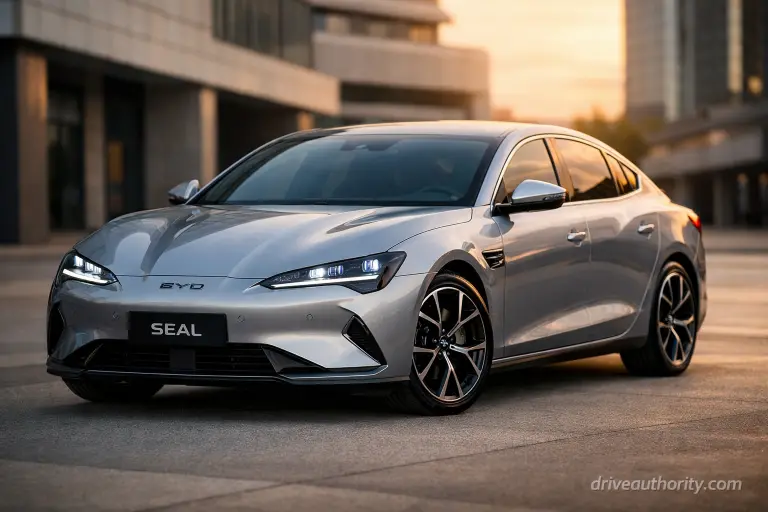
From approximately £37,490 (UK) / AU$63,900 (Australia). WLTP range: 570 km (Long Range AWD) or 520 km (RWD). This is the model that, when I first drove it in late 2023, made me genuinely reassess where Chinese EVs sit against European mid-size sedans. The first thing I noticed was the interior quality — it’s not “good for a Chinese car,” it’s simply good. Euro NCAP tested it in 2023 and awarded 5 stars, with an 84% adult occupant score. Peak DC charging at 150 kW means a 10–80% charge in approximately 26 minutes. CCS2 is standard in both EU and Australian markets. Because it ticks all five ranking criteria simultaneously — WLTP range, safety data, 18+ months of owner records, sub-£40K pricing, and confirmed market availability — no other Chinese EV earns Tier 1 as cleanly. Best for: buyers who want a premium mid-size EV experience at a significant discount to Tesla Model 3 or BMW i4.
BYD Atto 3 — Best Chinese Family SUV
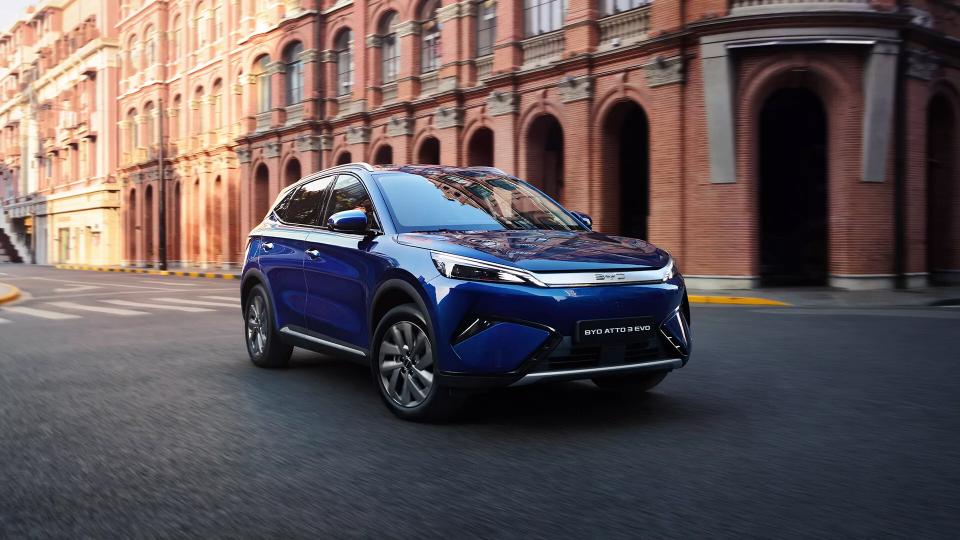
From approximately £36,490 (UK) / AU$44,990 (AU). WLTP range: 420 km. The Atto 3 is, by volume, the most widely owned Chinese EV outside China with genuine two-year ownership data across multiple markets. Euro NCAP awarded it 5 stars in 2022. The ownership record confirms what the safety test suggests — this is a competently built, reliable compact SUV that delivers on its specification. The catch, however, is charging speed: peak at 88 kW DC results in a 10–80% time of approximately 45 minutes. By contrast to the Seal, that charging rate is the Atto 3’s clearest competitive weakness in 2026. Best for: family SUV buyers who prioritize safety certification and an established service network over maximum charging speed.
MG4 EV — Best Value Under £30,000
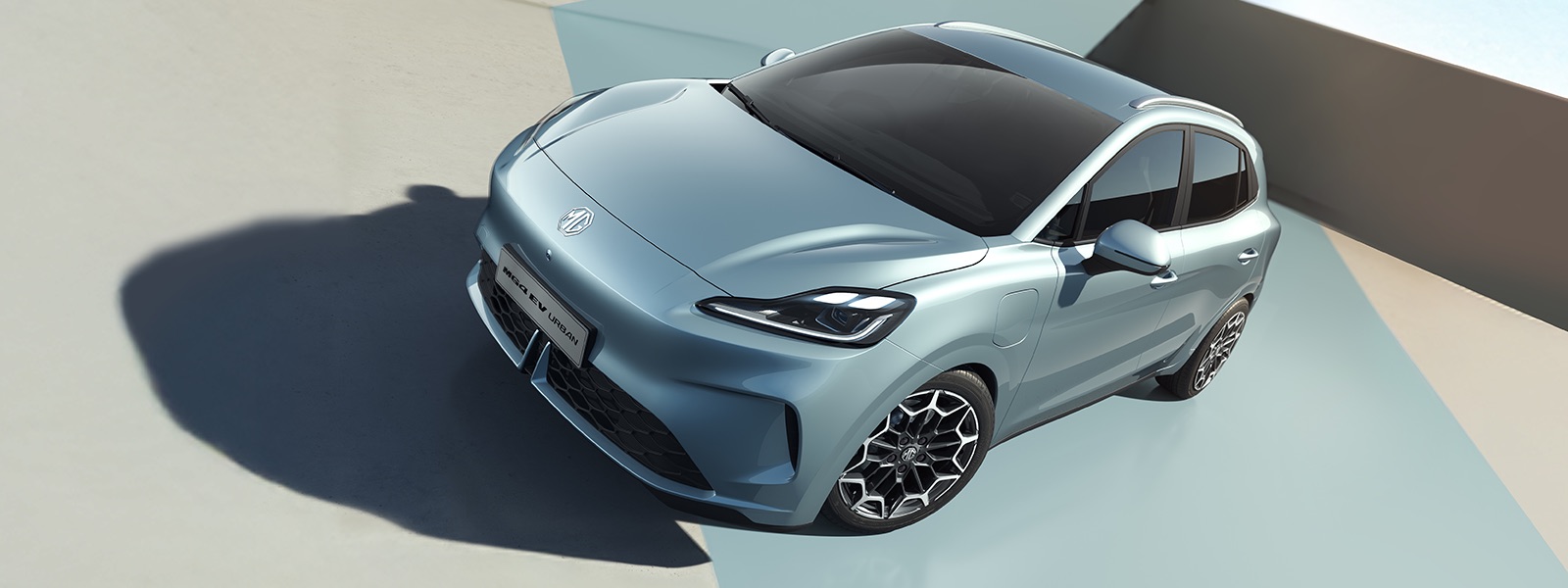
From approximately £27,195 (UK) / AU$38,990 (AU). WLTP range: 350 km (Standard) / 450 km (Long Range). The MG4 is the value-per-safety-rating champion in this segment. Euro NCAP 5-star result in 2023, with an 82% adult occupant score. For approximately £10,000–£15,000 less than the Seal, you get a 5-star tested compact hatchback EV with 350 km real-world range. That’s more than adequate for the 85% of drivers who travel under 60 km per day. Admittedly, the interior quality gap versus the Seal is real and noticeable on a side-by-side comparison. Best for: budget-conscious buyers who won’t compromise on independent safety verification.
Tier 2: Strong Contenders With Specific Trade-offs
Zeekr 001 — Best Range, Safety Test Pending
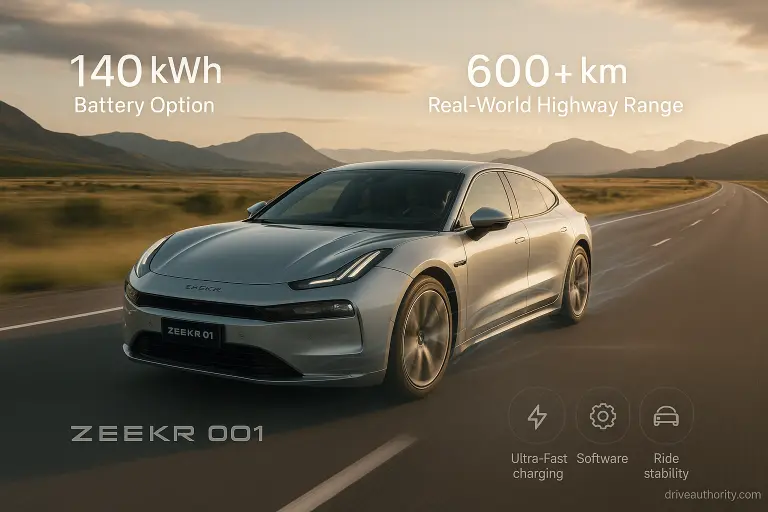
From approximately €53,000 (EU). WLTP range: 620 km. On range alone, the Zeekr 001 leads every Chinese EV available in Western markets in 2026. Its 200 kW DC peak charging rate, combined with standard battery pre-conditioning, means it handles long-distance driving as well as any European rival at this price. The trade-off, however, is Euro NCAP status: as of March 2026, the 001 has not completed a full Euro NCAP assessment. That gap — and that gap alone — prevents Tier 1 placement regardless of technical specification. Therefore, it belongs in Tier 2 until that result is published. Best for: long-range drivers in EU markets who are comfortable with the current absence of a Euro NCAP result.
BYD Dolphin — Best Urban EV Under £27K
From approximately £26,395 (UK) / AU$38,800 (AU). WLTP range: 340 km. The Dolphin competes directly with the MG4 on price, and Euro NCAP tested it in 2023 with a 5-star result. What’s more, its 60 kW AC onboard charger is the strongest in the budget EV segment — overnight Level 2 charging is therefore faster than any competitor at this price. The trade-off is DC peak charging: 65 kW maximum means highway fast charging stops take significantly longer than the Seal or MG4 Long Range. Best for: urban-primary drivers who charge predominantly at home and rarely use public DC fast chargers.
Omoda E5 — Promising SUV, Safety Data Pending
From approximately AU$46,990 (AU). WLTP range: ~430 km (manufacturer data). The Omoda E5 is a compelling mid-size SUV on specification — standard ADAS suite, competitive range, and a price that undercuts European equivalents significantly. However, as of March 2026, an independent Euro NCAP or ANCAP crash test result has not been published. That is a firm Tier 2 constraint. The ownership record outside China also remains limited at under 18 months in most Western markets. Best for: SUV buyers in Australia who are comfortable committing before the safety test result is available.
Tier 3: Emerging Models Worth Watching
The Zeekr 7X and NIO ET5 both represent the next generation of Chinese premium EV ambition — 800V architecture on the Zeekr 7X and NIO’s battery swap capability are genuinely differentiated features that no European rival offers at the same price. However, neither model has accumulated 18 months of Western-market owner data, and neither has a published Euro NCAP or ANCAP result as of this writing. Both are therefore flagged as Tier 3 — promising, but insufficiently verified for a definitive recommendation. Specifically, what would move them up is a Euro NCAP 5-star result and a 24-month owner record from EU or Australian buyers.
← Scroll to see full table on mobile
| Model | Tier | Price Range | WLTP Range | Safety Rating | Markets |
|---|---|---|---|---|---|
| BYD Seal LR BEST OVERALL | 1 | £37K / AU$64K | 570 km | ⭐⭐⭐⭐⭐ Euro NCAP 2023 | UK, EU, AU |
| BYD Atto 3 | 1 | £36K / AU$45K | 420 km | ⭐⭐⭐⭐⭐ Euro NCAP 2022 | UK, EU, AU, SEA |
| MG4 EV LR BEST VALUE | 1 | £27K / AU$39K | 450 km | ⭐⭐⭐⭐⭐ Euro NCAP 2023 | UK, EU, AU, NZ |
| Zeekr 001 LR | 2 | €53K+ | 620 km LONGEST | ⚠️ Not yet tested | EU, AU (limited) |
| BYD Dolphin | 2 | £26K / AU$39K | 340 km | ⭐⭐⭐⭐⭐ Euro NCAP 2023 | UK, EU, AU |
| Omoda E5 | 2 | AU$47K+ | ~430 km | ⚠️ Not yet tested | AU, select EU |
| Zeekr 7X | 3 | €50K+ | ~580 km | ⚠️ Not yet tested | EU (2025 launch) |
Range Reality: Real-World Numbers vs. CLTC Claims
This is the section that most Chinese EV articles don’t include — and that’s exactly why so many buyers feel misled after purchase. CLTC range figures are not fake. They’re just measured in conditions that don’t reflect how most people actually drive. Here, specifically, is the data that closes the gap between the marketing brochure and your real-world charge stops.
Why CLTC Range Overstates Real-World Performance
The Test Cycle Gap: CLTC vs. WLTP Explained
The CLTC (China Light-Duty Vehicle Test Cycle) uses a lower average speed profile than WLTP, assumes warmer ambient temperatures, and applies no cabin heating load. The result is consistently higher range figures than buyers experience in European, Australian, or New Zealand conditions. Specifically, the typical CLTC-to-WLTP conversion produces approximately a 15–20% reduction in range. In practice, a model quoted at 600 km CLTC will therefore typically return 480–510 km on the WLTP cycle — and 380–430 km at sustained 110 km/h highway speed.
Cold-Weather Range: The Additional Gap Most Buyers Miss
That highway gap, however, is only part of the story in colder climates. Cold-weather operation in Northern Europe — specifically below 5°C with cabin heating active — reduces real-world highway range by a further 15–25% on most battery chemistries. As a result, if you’re buying in the UK, Scandinavia, or elevated-altitude Australian markets, you should plan against the WLTP figure minus approximately 20%, not the CLTC figure minus 15%. That distinction significantly affects how many charging stops you need on a 400 km winter journey.
Real-World Range for Top Ranked Models at Highway Speed
The figures below are based on WLTP certification data and independent highway-speed test results from ADAC (Germany), Which? (UK), and owner telematics aggregated by Spritmonitor. Because real-world results vary by driving style, load, and temperature, these are best understood as directional benchmarks rather than guarantees. That said, they are specifically more reliable than manufacturer CLTC figures for planning real-world journeys.
← Scroll to see full table on mobile
| Model | CLTC Claimed | WLTP Rated | Est. Real-World at 110 km/h |
|---|---|---|---|
| BYD Seal LR AWD | 700 km | 570 km | ~420–460 km STRONG |
| Zeekr 001 LR | 760 km | 620 km | ~460–510 km BEST |
| MG4 EV Long Range | 520 km | 450 km | ~330–370 km |
| BYD Atto 3 | 480 km | 420 km | ~300–340 km |
| BYD Dolphin SR | 400 km | 340 km | ~250–280 km URBAN ONLY |
| Omoda E5 | ~520 km | ~430 km (est.) | ~310–350 km |
Safety Ratings and ADAS: What’s Been Independently Tested
I get this question at least twice a week: “Are Chinese EVs actually safe?” My answer is always the same — some of them demonstrably are, because they’ve been tested. Others we genuinely don’t know yet, because they haven’t been. The distinction matters enormously and should be the first filter you apply before any price or range comparison.
Euro NCAP and ANCAP Results for Ranked Models
The BYD Seal, BYD Atto 3, BYD Dolphin, and MG4 EV have all passed Euro NCAP testing with 5-star results. That is a meaningful, independent verification — Euro NCAP’s protocol is one of the most demanding in the world. Specifically, it includes vulnerable road user protection, child occupant protection, and assisted driving system evaluation that China NCAP’s current protocol does not replicate at the same stringency. What that means for you as a buyer: a Chinese EV with a Euro NCAP 5-star result has been validated by the same body that tests Volkswagen, Toyota, and Volvo. The gap between Chinese and European brands on safety testing is therefore no longer a category gap — it’s a model-by-model distinction.
Models Without a Euro NCAP Result: What That Means
By contrast, the Zeekr 001, Zeekr 7X, and Omoda E5 do not have published Euro NCAP or ANCAP results as of March 2026. That doesn’t mean they’re unsafe — it means the independent evidence doesn’t yet exist. Specifically, for family buyers or buyers in markets where vehicle safety regulation is strict, that absence is a meaningful risk factor each buyer must weigh personally. This guide will not rank unverified models above verified ones, because doing so would misrepresent the state of the evidence.
Standard ADAS Across Ranked Models at Base Trim
What’s Standard vs. Optional at Base Price
Automatic emergency braking, lane-keep assist, and speed limit sign recognition are standard at base trim across all Tier 1 models as of 2026. Blind-spot monitoring, however, is standard on the BYD Seal and Zeekr 001 at base — on the MG4 it requires the SE trim upgrade at approximately £1,500 additional. That £1,500 gap is therefore worth factoring into your like-for-like comparison if blind-spot monitoring is on your must-have list.
OTA Safety Updates: Why They Matter Post-Purchase
OTA safety system updates — specifically ADAS algorithm improvements delivered without a physical service visit — are supported by BYD, MG (SAIC), and Zeekr across their current-generation platforms. That capability is specifically relevant because it means safety system performance can improve after delivery. As a result, the ADAS specification you buy today is not necessarily the final version — which is a meaningful long-term ownership advantage over brands that require dealer visits to update driver assistance software.
← Scroll to see full table on mobile
| Model | Test Body | Stars | Adult Occupant % | AEB Standard? |
|---|---|---|---|---|
| BYD Seal | Euro NCAP 2023 | ⭐⭐⭐⭐⭐ | 84% | ✅ Yes — all trims |
| MG4 EV | Euro NCAP 2023 | ⭐⭐⭐⭐⭐ | 82% | ✅ Yes — all trims |
| BYD Atto 3 | Euro NCAP 2022 | ⭐⭐⭐⭐⭐ | 81% | ✅ Yes — all trims |
| BYD Dolphin | Euro NCAP 2023 | ⭐⭐⭐⭐⭐ | 80% | ✅ Yes — all trims |
| Zeekr 001 | Not yet tested | ⚠️ PENDING | — | ✅ Yes (claimed) |
| Omoda E5 | Not yet tested | ⚠️ PENDING | — | ✅ Yes (claimed) |
Charging Speed, Network Access, and Real-World Usability
Charging compatibility was a genuine concern for Chinese EV buyers in 2022–2023, when several models used proprietary GB/T connectors in export markets. That problem is largely resolved in 2026 — however, “largely” is not “completely.” The differences in peak charging rates between models are, in practice, wide enough to affect real-world ownership experience significantly.
Charging Port Standards and Network Compatibility in 2026
CCS2 Compliance Across Ranked Models
All Tier 1 and Tier 2 models in this ranking are CCS2 compliant in EU and Australian markets as of 2026. That means full access to public DC fast-charging networks including Ionity, Chargefox, and any CCS2-compatible public charger. MG earlier-generation models (MG ZS EV pre-2022) used GB/T adapters in some markets — however, that limitation does not apply to the MG4 EV, which uses native CCS2 throughout.
Peak DC Charging Rates: Model by Model
Charging speeds vary significantly across ranked models. Specifically, the peak DC rates are: Zeekr 001 — 200 kW, BYD Seal — 150 kW, MG4 EV Long Range — 135 kW, BYD Atto 3 — 88 kW, BYD Dolphin — 65 kW. As a result, buyers who regularly use public DC fast chargers on inter-city routes will find the Dolphin and Atto 3 meaningfully slower to replenish than the Seal or Zeekr 001. That gap is worth calculating against your actual driving pattern before buying.
Charging Session Time: 10–80% Comparison
Battery pre-conditioning — warming the battery to optimal temperature before a DC charge session — is supported by the BYD Seal, Zeekr 001, and MG4 EV Long Range. The Atto 3 and Dolphin, however, do not support pre-conditioning in current software versions, though BYD has indicated OTA support is in development. In practice, pre-conditioning reduces 10–80% session times by approximately 10–15% at peak DC rates, specifically in ambient temperatures below 15°C. For overnight home charging at Level 2, the BYD Dolphin’s 60 kW onboard AC charger is the strongest in the budget segment. As a result, a 30 kWh charge completes in approximately 30 minutes from a 22 kW public AC charger — a meaningful advantage for urban buyers who rely on mixed public and home charging.
← Scroll to see full table on mobile
| Model | Peak DC Rate | 10–80% Time (est.) | Pre-Conditioning? | Port Standard |
|---|---|---|---|---|
| Zeekr 001 LR FASTEST | 200 kW | ~20 min | ✅ Yes | CCS2 |
| BYD Seal LR | 150 kW | ~26 min | ✅ Yes | CCS2 |
| MG4 EV LR | 135 kW | ~28 min | ✅ Yes | CCS2 |
| BYD Atto 3 | 88 kW | ~45 min | ❌ No (OTA pending) | CCS2 |
| BYD Dolphin SR | 65 kW | ~29 min (30 kWh bat.) | ❌ No (OTA pending) | CCS2 |
Which Chinese EV Is Best for You? Decision by Buyer Profile
The full ranking is useful context. However, the right Chinese EV depends specifically on who you are and how you actually drive — not just which model scores highest on a composite index. Because buyers in this segment cover five very distinct use cases, here’s the identity-matched breakdown that resolves the decision for each profile.
5-star Euro NCAP. CCS2 standard. ~350 km real-world range. No Chinese EV at this price delivers an independently verified safety result. Because the MG4 is available at lower cost than any other 5-star-tested Chinese EV, it’s the correct choice for any buyer for whom safety certification is non-negotiable and budget is firm.
5-star Euro NCAP. 420 km WLTP. 440L boot. Established service network in UK, EU, and Australia with 3+ years of market presence. The Atto 3 is the safest, most owner-validated Chinese EV SUV available in 2026. Admittedly, 88 kW DC charging is its only significant weakness for road trip buyers.
620 km WLTP. 200 kW DC. Pre-conditioning standard. No Chinese EV in 2026 beats those numbers at this price. That said, the absence of a Euro NCAP result means you’re accepting a safety data gap. Therefore, it’s the right pick only if range and charging speed lead your priority list and you’ve factored the untested status into your decision.
5-star Euro NCAP. ~340 km WLTP — more than sufficient for urban use. The 60 kW AC onboard charger is the best in its class for overnight and public AC sessions. Because most urban commuters drive under 50 km daily, the lower DC peak rate is irrelevant. Lowest total cost of ownership of any 5-star Chinese EV in 2026.
The Seal is the model I’d personally choose in 2026 if I were buying a Chinese EV. 5-star Euro NCAP. 570 km WLTP. 150 kW DC. Interior that genuinely competes with the Tesla Model 3. It’s the only Chinese EV that combines verified safety, long range, fast charging, and a premium cabin experience at a sub-£40K price — and no European rival matches all four at once.
FAQ: Which Chinese EV Is the Best in 2026?
What is the best Chinese EV to buy in 2026?
The BYD Seal Long Range is the best Chinese EV to buy in 2026 for buyers in the UK, EU, and Australia. It combines 570 km WLTP range, a 5-star Euro NCAP result (2023), 150 kW DC charging, and a starting price under £40,000 — a specification no European equivalent matches at that price. For buyers with a budget under £30,000, however, the MG4 EV is the correct pick. It’s specifically the only independently safety-tested Chinese EV available at that price with over 350 km of real-world range.
Is BYD the best Chinese EV brand in 2026?
BYD is the most comprehensively validated Chinese EV brand in Western markets in 2026. Specifically, it has more independently tested models and more real-world owner data outside China than any competitor. However, Zeekr leads on range and charging speed, and MG leads on value at sub-£30,000. Therefore, BYD is the best brand overall — but the best specific model for your use case may come from a different brand, depending on whether range, value, or family practicality leads your priority list.
Are Chinese EVs as good as Tesla or Hyundai in 2026?
In specific categories, yes — and that’s a significant shift from 2022. The BYD Seal, for instance, competes directly with the Tesla Model 3 on range, charging speed, and safety rating at a lower price in the UK and EU. The MG4 EV’s Euro NCAP result and real-world range are comparable to the Hyundai Kona EV at a lower price. Where the gap remains, however, is software quality, charging network size, and resale value. Tesla’s Supercharger network advantage and stronger residuals are not yet matched by any Chinese brand in Western markets.
Which Chinese EV has the best real-world range in 2026?
The Zeekr 001 Long Range leads all Chinese EVs in 2026 with a WLTP-certified range of 620 km and an estimated real-world highway range of approximately 460–510 km at 110 km/h. That said, the Zeekr 001 has not yet completed a Euro NCAP safety test as of March 2026. Therefore, if you need the longest range AND independent safety verification, the BYD Seal Long Range at 570 km WLTP with a 5-star Euro NCAP result is the safer overall choice.
The Bottom Line on the Best Chinese EV in 2026
The honest conclusion is this: the Chinese EV segment in 2026 is no longer a category you choose despite the trade-offs. It’s a category you choose because of specific strengths — range, value, charging speed — that genuine competitors at equivalent pricing can’t match. The BYD Seal is the proof point. A 5-star safety result, 570 km WLTP range, and 150 kW charging at under £40,000 is a combination that didn’t exist in this market segment two years ago. The only filter that still separates the best from the rest is independent safety verification. Apply that filter first — then compare everything else with confidence.