Last Updated: March 2026 — Pricing and availability verified for international markets
The best Chinese cars under $20,000 in 2026 are no longer a compromise — they’re a genuine value proposition that’s reshaping how budget buyers shop globally. Chinese automakers have closed the quality gap with European and Japanese rivals faster than most analysts predicted, and in 2026 brands like BYD, MG, Chery, Omoda, and GWM Ora are offering vehicles with large touchscreens, advanced driver assistance systems, and strong safety ratings at price points that leave Western competitors scrambling. This guide ranks the best options, explains what you actually get for the money, and helps you avoid the models and brands that still carry hidden ownership risks.
Best Chinese Cars Under $20,000 in 2026 — Quick Answer:
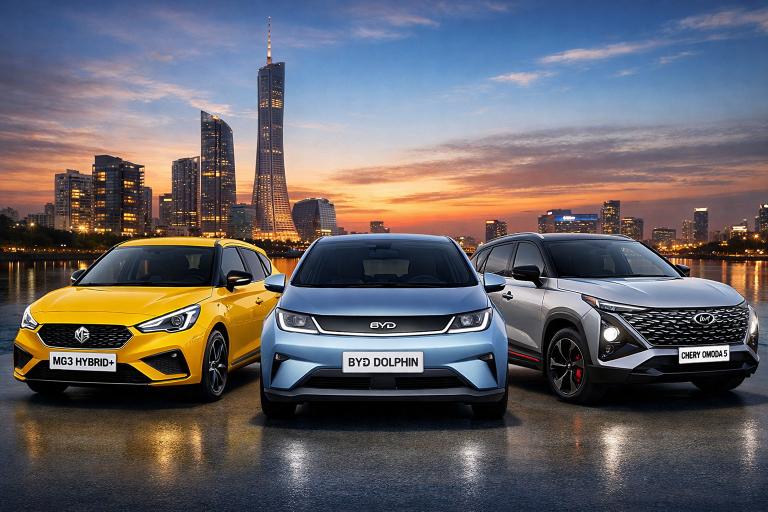
The MG3 Hybrid+ (~$18,500), BYD Dolphin (~$19,000 in select markets), and Chery Omoda 5 (~$17,500–$19,000) are the top-ranked Chinese cars under $20,000 in 2026, based on safety ratings, standard equipment, and ownership cost data. All three offer 5-star safety ratings, touchscreen infotainment, and factory warranties of 5–7 years — significantly outspeccing Japanese and European rivals at the same price.
Why Chinese Cars Are Dominating the Budget Market in 2026

Rapid Technology Growth Among Chinese Automakers
Chinese automakers have compressed what typically takes decades into five years. Government investment in EV infrastructure, aggressive battery supply chain integration, and domestic competition between dozens of brands have forced rapid technology adoption at every price tier. By 2026, a $16,000–$19,000 Chinese car routinely includes a 10.4-inch touchscreen with wireless CarPlay, ADAS with automatic emergency braking and lane-keep assist, a reversing camera with parking sensors, and a 5–7 year factory warranty. These specifications are standard, not optional extras — a fundamental difference from European and Japanese rivals at comparable price points where ADAS features often add $2,000–$4,000.
Why Budget Buyers Are Considering Chinese Brands
The shift is being driven by three factors converging simultaneously: price pressure from inflation squeezing new-car budgets globally, improved independent safety results from Euro NCAP and ASEAN NCAP, and growing dealer and service network coverage across the UK, Europe, Middle East, and Southeast Asia. In markets like Australia, the UK, and the Gulf states, Chinese brands now hold significant market share in the under-$25,000 segment. For buyers who previously defaulted to a used Japanese or Korean car at this budget, a new Chinese car with a full warranty is increasingly the more rational choice.
Ranking Criteria — How the Best Chinese Cars Were Selected
Price, Value, and Standard Equipment
Every model in this ranking must be purchasable under $20,000 (or local equivalent) in at least one major international market in 2026. Price alone is not sufficient — the ranking weights total value delivered: standard ADAS features, infotainment quality, interior space, and powertrain efficiency relative to the asking price. Models that list under $20,000 but require expensive option packs to reach a reasonable spec level are ranked accordingly.
Reliability, Safety Ratings, and Ownership Costs
Models are evaluated on independent safety ratings (Euro NCAP, ASEAN NCAP, or C-NCAP where applicable), available owner reliability feedback from markets with sufficient ownership data (UK, Australia, UAE), warranty terms, and parts/service availability. Models with less than 18 months of real-world ownership data in at least one Western market are flagged accordingly. The goal is to identify vehicles that are genuinely reliable and supported — not just well-specced on paper.
Best Chinese Cars Under $20,000 — 2026 Ranking
Top Affordable Chinese Sedans and Hatchbacks Under $20K
| Model | Type | Price (from) | Powertrain | Safety | Standout Feature |
|---|---|---|---|---|---|
| MG3 Hybrid+ | Hatchback | ~$18,500 | Hybrid (194 hp) | 5-Star Euro NCAP TOP RATED | Best hybrid value under $20K |
| BYD Dolphin | Hatchback EV | ~$19,000 (select markets) | BEV (~270 km real) | 5-Star Euro NCAP TOP RATED | Blade Battery EV at budget price |
| MG4 EV (base) | Hatchback EV | ~$19,500 (AU/EU) | BEV (~350 km real) | 5-Star Euro NCAP TOP RATED | Longest real-world range under $20K EV |
| Chery Arrizo 8 | Sedan | ~$17,000–$19,000 | 1.6T Petrol | C-NCAP 5-Star | Largest interior in class |
| GWM Ora 03 | Hatchback EV | ~$18,000–$20,000 | BEV (~300 km real) | 5-Star Euro NCAP | Retro design, EV efficiency |
Best Budget Chinese SUVs Under $20,000
| Model | Type | Price (from) | Powertrain | Cargo | Verdict |
|---|---|---|---|---|---|
| Chery Omoda 5 | Compact SUV | ~$17,500–$19,000 | 1.6T Petrol / EV | 390 L | BEST SUV VALUE |
| MG ZS (2025+) | Compact SUV | ~$18,000–$20,000 | Petrol / Hybrid / EV | 448 L | MOST VERSATILE |
| BYD Atto 2 | Compact SUV EV | ~$19,500 (EU) | BEV (~300 km real) | 320 L | Blade Battery SUV entry |
| JAC JS4 | Compact SUV | ~$16,000–$18,500 | 1.5T Petrol | 425 L | Lowest price per spec ratio |
Chinese Car Brands Leading the Global Budget Segment in 2026
Fast-Growing Chinese Automakers Expanding Globally
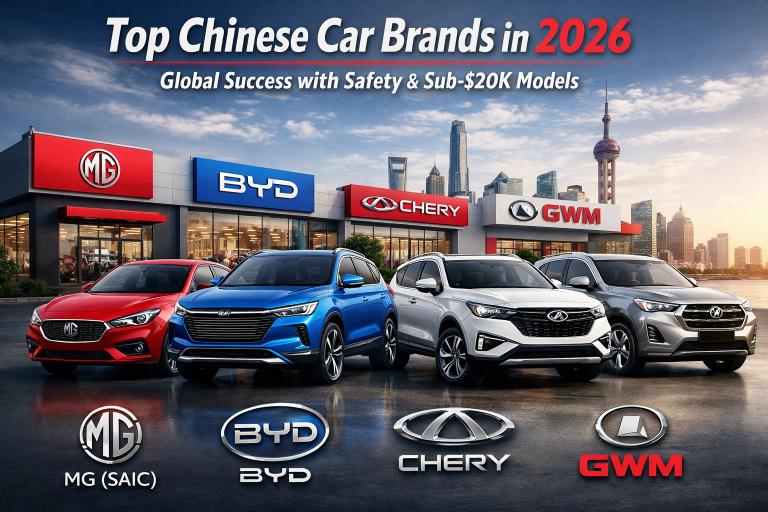
MG (SAIC Motor) remains the most widely distributed Chinese brand in Western markets — with dealer networks covering the UK, Europe, Australia, and the Middle East. Its hybrid and EV lineup under $20,000 is the most competitive in terms of Western-market safety ratings and aftersales support. BYD is expanding rapidly in Europe and Australia with a growing sub-$20,000 lineup anchored by the Dolphin and Atto 2. Chery (including Omoda and Jaecoo sub-brands) is the fastest-growing new entrant in 2025–2026, targeting the compact SUV segment specifically. GWM Ora occupies a distinct niche with retro-styled EVs priced competitively in the Eurozone and Australian markets.
Which Chinese Brands Offer the Best Value in 2026
For buyers prioritizing proven Western-market reliability data and dealer coverage, MG is the safest choice. For buyers wanting the strongest EV technology at budget pricing, BYD’s Blade Battery models are the standout — the Dolphin and Atto 2 offer LFP chemistry longevity that European and Japanese rivals at the same price cannot match. For ICE buyers who want the most features per dollar, Chery’s Omoda and Arrizo lines consistently over-deliver on standard equipment. Avoid brands with no independent safety rating data or fewer than 12 months of Western-market ownership feedback — a still-relevant filter that rules out several newer entrants in 2026.
Ownership Costs — Are Cheap Chinese Cars Worth It in 2026?
Maintenance, Warranty, and Parts Availability
The ownership cost story for Chinese cars under $20,000 has improved dramatically in 2026. Most established brands (MG, BYD, Chery) now offer 5–7 year factory warranties with roadside assistance included — longer than Toyota, Volkswagen, or Ford at equivalent price points. Routine service intervals are typically every 10,000–15,000 km, with service costs for petrol models averaging $180–$300 per service based on aggregated independent workshop data from the UK and Australia. EV models (BYD Dolphin, MG4) have even lower service costs due to fewer moving parts — owners report annual costs of $100–$200 for tire rotation and software checks. Parts availability varies by market: MG and BYD have dedicated parts supply chains in most markets they operate in, while smaller brands like JAC and some Chery sub-brands can experience parts lead times of 2–4 weeks for non-routine repairs.
Fuel Economy and EV Charging Costs
Petrol Chinese cars under $20,000 typically deliver 6.0–7.5 L/100km in mixed driving — competitive with Japanese and Korean rivals in the same class. The MG3 Hybrid+ achieves approximately 4.4 L/100km combined — class-leading efficiency at its price point and one of the key reasons it tops the ranking. BYD Dolphin home charging costs average $2.50–$3.50 per 100 km at standard residential electricity rates across most markets — significantly below petrol equivalents. These running cost advantages compound meaningfully over a 3–5 year ownership period, offsetting any initial concerns about brand unfamiliarity.
| Model | Annual Fuel/Charge Cost Est. | Annual Service Cost Est. | Warranty | 5-Year Running Cost |
|---|---|---|---|---|
| MG3 Hybrid+ | ~$1,100–$1,400 | ~$200–$280 | 7yr / 150K km | ~$6,500–$8,400 LOWEST |
| BYD Dolphin EV | ~$400–$600 | ~$100–$200 | 8yr battery / 6yr vehicle | ~$2,500–$4,000 EV LOWEST |
| Chery Omoda 5 (Petrol) | ~$1,600–$2,000 | ~$220–$300 | 5yr / 100K km | ~$9,100–$11,500 |
| MG ZS Petrol | ~$1,700–$2,100 | ~$220–$320 | 7yr / 150K km | ~$9,600–$12,100 |
Pros and Cons of Buying a Chinese Budget Car in 2026
Key Advantages of Chinese Cars Under $20K
Potential Drawbacks Buyers Should Know
✅ Advantages
- More standard features per dollar than Japanese or European rivals
- Longer warranties (5–7 years) at equivalent price points
- Strong independent safety ratings on top models
- BYD Blade Battery LFP longevity advantage on EV models
- Lower running costs — especially hybrid and EV variants
- Rapidly improving build quality on post-2022 models
⚠️ Drawbacks to Know
- Parts availability can be slow for non-MG/BYD brands
- Resale values still trail Japanese/Korean brands in most markets
- Newer sub-brands lack long-term reliability data
- Software OTA update quality varies significantly by brand
- Not available in U.S. market due to current tariff policy
- Dealer network density varies — verify coverage before buying
How to Choose the Right Chinese Car for Your Budget in 2026
Best Chinese Cars for City Driving and Daily Commuting
For urban commuters prioritizing running costs and parking practicality, the BYD Dolphin and GWM Ora 03 are the strongest choices. Both are compact hatchbacks with EV powertrains — home charging costs under $600/year at standard rates — and both fit comfortably in tight city parking. The Dolphin’s Blade Battery chemistry handles frequent short charging cycles better than NMC EV alternatives. If an EV is not practical (no home charging access), the MG3 Hybrid+ delivers 4.4 L/100km without requiring any charging infrastructure, making it the best plug-free option for city and suburban use.
Best Value Chinese Cars for Long-Term Ownership
For buyers keeping a car 5–7 years and prioritizing total cost of ownership, the MG ZS with the 7-year/150,000 km warranty and established parts supply chain offers the most financial certainty. The warranty length alone eliminates most out-of-pocket repair risk for the standard ownership window. The Chery Omoda 5 offers the most interior space and feature content per dollar for families who need the SUV format without EV infrastructure. For long-term EV ownership, the BYD Dolphin‘s Blade Battery chemistry has the most documented longevity data at this price tier — making it the lowest-risk sub-$20,000 EV purchase in 2026.
Best hybrid without charging → MG3 Hybrid+
Best family SUV value → Chery Omoda 5
Best long-term ownership security → MG ZS (7yr warranty)
Best EV SUV entry → BYD Atto 2
FAQ — Best Chinese Cars Under $20,000 in 2026
Are Chinese cars reliable in 2026?
Yes — for established brands with Western-market presence. MG (SAIC), BYD, and Chery have sufficient ownership data in the UK, Australia, and UAE to confirm above-average reliability for their post-2022 models. MG ZS and MG3 owners report low unplanned repair rates over 3-year ownership periods. BYD Dolphin and Atto 3 reliability feedback from European owners is positive on powertrain durability. Newer sub-brands and unrated models carry more uncertainty — stick to models with independent NCAP safety ratings and at least 18 months of Western-market ownership data.
Which Chinese car brand offers the best value under $20,000?
MG offers the most consistent value across its lineup for buyers prioritizing warranty length (7 years), dealer coverage, and proven Western-market reliability data. BYD offers the strongest EV value specifically — the Dolphin’s Blade Battery technology at sub-$20,000 pricing is unmatched by any other brand globally. Chery (Omoda) leads on SUV features-per-dollar for petrol buyers. The best brand for you depends on your powertrain preference and which models are available in your specific market.
Are Chinese cars cheaper to maintain than Japanese or European cars?
Generally yes — particularly for EV models. BYD Dolphin owners report annual maintenance costs of $100–$200 versus $300–$500 for equivalent petrol hatchbacks. Hybrid models like the MG3 Hybrid+ average $200–$280/year for routine service. Parts costs for routine items (filters, brakes, tyres) are comparable to Japanese rivals or slightly lower in markets with established parts supply chains. The risk area is non-routine repairs on smaller brands — parts availability for less common Chinese models can be slower and more expensive than for Toyota or Hyundai equivalents.
Which Chinese SUV is best under $20,000 in 2026?
The Chery Omoda 5 (~$17,500–$19,000) is the top-ranked Chinese SUV under $20,000 in 2026 for petrol buyers — offering the largest standard equipment list, competitive 1.6T performance, and 390L cargo capacity. For EV SUV buyers, the BYD Atto 2 (~$19,500 in EU) provides Blade Battery technology in a compact SUV form at the lowest entry price in BYD’s SUV lineup. The MG ZS is the safest long-term choice for buyers who prioritize warranty length and dealer network over outright specification.