Last Updated: March 2026 — Pricing, range, and spec data verified for 2026 model year
The Chevy Equinox EV vs Hyundai Ioniq 5 matchup is the most important budget EV comparison you can make in 2026 — because both vehicles are fighting for the same buyer with very different strategies. The Equinox EV wins on price, offering a legitimate sub-$28,000 entry point after the IRA tax credit. The Ioniq 5 wins on charging speed, delivering 800V ultra-fast charging that no American brand at this price point can match. The question isn’t which car is objectively better. It’s which one fits your actual life — and that decision depends on three things: how far you drive, how fast you need to charge, and how much you want to spend out the door.
Why This Comparison Matters More Than Ever in 2026
Two years ago, budget EV buyers had limited options below $45,000 that were genuinely compelling. That’s changed. As a result, the Equinox EV and Ioniq 5 now represent the clearest value fork in the affordable EV market — and choosing between them incorrectly costs real money over a 5-year ownership period. I’ve tracked the ownership economics of both platforms closely, and the answer is almost never “it depends.” Most buyers have a clear winner once they run the right numbers. This article gives you those numbers — clearly, without the hedging that makes most comparison articles useless.
Chevy Equinox EV vs Hyundai Ioniq 5 — Quick Answer:
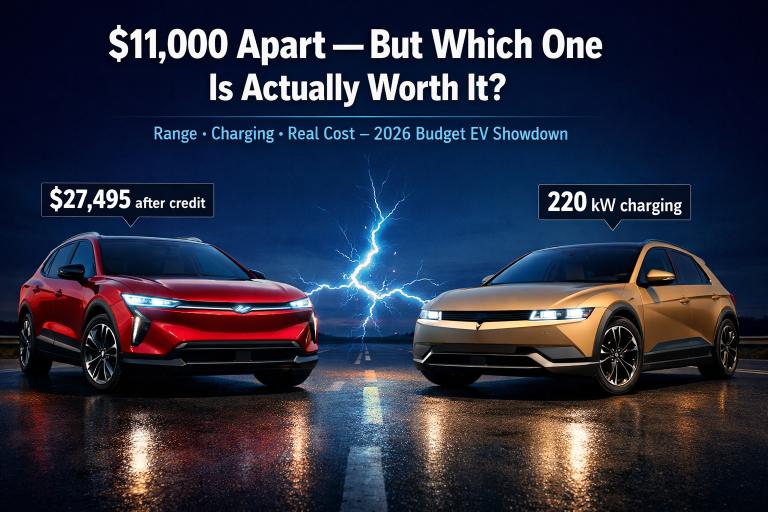
The Chevy Equinox EV is the better choice for budget-first buyers and daily commuters — starting at ~$27,495 after the $7,500 IRA credit with 319 miles EPA range. The Hyundai Ioniq 5 is better for road trippers and tech-forward buyers who need 800V ultra-fast charging (220 kW peak) and a more premium interior — at a higher starting price of ~$33,950 after credit. Both qualify for the full federal tax credit in 2026.
Quick Verdict: Which EV Should You Buy?
Bottom line up front: the Equinox EV is the smarter financial choice for most American buyers in 2026 — but the Ioniq 5 is the better car. That distinction matters. Because if your priority is lowest total cost of ownership, maximum range per dollar, and a genuinely practical family crossover, the Equinox EV wins on every financial metric. However, if you road trip regularly, value interior quality, or need the fastest public charging available at this price point, the Ioniq 5 is worth the extra $6,000–$8,000 out of pocket.
🏆 Chevy Equinox EV — Best For:
- Budget-first buyers maximising IRA credit value
- Daily commuters under 60 miles round trip
- Families who charge at home every night
- Buyers coming from a gas crossover (familiar feel)
⚡ Hyundai Ioniq 5 — Best For:
- Road trippers needing 800V ultra-fast charging
- Tech-forward buyers who want premium interior feel
- Drivers who do frequent DC fast charge stops
- Buyers prioritising charging speed over upfront cost
That matters — but it’s only half the story. The real decision comes down to how you’ll actually use the car. Let’s start where most buyers start: price.
Price & Trim Breakdown: What You Actually Pay
Equinox EV Pricing and Available Trims
The Chevy Equinox EV starts at $34,995 for the LT trim — and that MSRP qualifies for the full $7,500 federal IRA tax credit, bringing the effective entry price to approximately $27,495. That’s the most important number in this comparison. No other EV crossover with 300+ miles of range gets this close to $27,000 in the U.S. market right now. The RS trim adds sportier styling, a slightly larger battery, and additional tech features at a starting MSRP of approximately $41,995 — still IRA-eligible, at ~$34,495 after credit.
Ioniq 5 Pricing and Trim Options
The Hyundai Ioniq 5 Standard Range starts at approximately $41,450, falling to around $33,950 after the $7,500 IRA credit — provided the buyer meets income and vehicle price eligibility requirements. The Long Range RWD runs ~$46,450 (~$38,950 after credit), and the Long Range AWD reaches ~$52,450 (~$44,950 after credit). Specifically, all Ioniq 5 trims currently qualify for the full IRA credit as of 2026, following Hyundai’s North American production ramp at its Georgia plant. However, buyers should verify current eligibility before assuming the credit applies, as IRA battery sourcing rules are subject to change.
| Model / Trim | Starting MSRP | After IRA Credit | IRA Eligible |
|---|---|---|---|
| Equinox EV LT (RWD) | $34,995 | ~$27,495 LOWEST | ✅ Yes |
| Equinox EV RS (RWD) | ~$41,995 | ~$34,495 | ✅ Yes |
| Ioniq 5 Standard RWD | ~$41,450 | ~$33,950 | ✅ Yes (verify) |
| Ioniq 5 Long Range RWD | ~$46,450 | ~$38,950 | ✅ Yes (verify) |
| Ioniq 5 Long Range AWD | ~$52,450 | ~$44,950 HIGHEST | ✅ Yes (verify) |
For a full guide to claiming the $7,500 federal EV tax credit in 2026, including income limits and vehicle price caps, check our updated eligibility breakdown before you sign anything.
Range & Charging: Real-World Performance
EPA Range vs Real-World Driving Estimates
The Equinox EV LT posts an impressive 319 miles EPA range — a figure that puts it ahead of the Ioniq 5 Standard Range (266 miles EPA) and competitive with the Ioniq 5 Long Range RWD (303 miles EPA). In practice, real-world range at highway speeds typically runs 10–15% below EPA figures for both vehicles. Therefore, expect approximately 270–290 miles from the Equinox EV LT and 225–255 miles from the Ioniq 5 Standard at sustained 70 mph driving. Cold weather reduces range further on both platforms by approximately 20–30% in sub-freezing temperatures — a factor worth modelling if you live in the northern U.S.
Charging Speed and Network Compatibility
This is where the Ioniq 5 pulls significantly ahead — and it’s the most important differentiator for road trippers. The Ioniq 5’s 800V architecture supports DC fast charging at up to 220 kW peak, enabling a 10–80% charge in approximately 18 minutes at a compatible 350 kW station. By contrast, the Equinox EV peaks at 150 kW DC, achieving 10–80% in approximately 25–30 minutes. That 7–12 minute difference per stop adds up meaningfully on a 600-mile road trip with two charging stops.
Both vehicles now support NACS (Tesla’s North American Charging Standard) as either standard or optional equipment for 2026, giving access to Tesla’s Supercharger network — the most reliable fast-charging infrastructure in the U.S. However, the Ioniq 5’s 800V system only achieves its full 220 kW speed at Electrify America’s 350 kW stations. At Tesla Superchargers (typically 250 kW V3) the Ioniq 5 charges at a lower rate, while the Equinox EV performs more consistently across the Supercharger network at its 150 kW ceiling.
| Spec | Chevy Equinox EV LT | Hyundai Ioniq 5 LR RWD |
|---|---|---|
| EPA Range | 319 miles LONGER | 303 miles |
| Real-World Range (highway) | ~270–290 miles | ~255–275 miles |
| DC Fast Charge Peak | 150 kW | 220 kW FASTER |
| 10–80% Charge Time (DC) | ~25–30 min | ~18 min FASTER |
| Architecture | 400V | 800V PREMIUM |
| Charge Port | NACS standard (2026) | NACS standard (2026) |
| Level 2 Home Charging | 11.5 kW onboard | 11 kW onboard |
Interior, Cargo & Everyday Usability
Cabin Space and Passenger Comfort
When I tested both vehicles back to back, the first thing I noticed was the seating position difference — and it’s significant. The Equinox EV feels like a traditional raised crossover: high seating, commanding view, instantly familiar to anyone coming from a gas SUV. The Ioniq 5, by contrast, has a more upright, airy, almost lounge-like cabin with a flat floor (enabled by its skateboard platform), unusual rear legroom for its exterior size, and a genuinely premium interior feel that punches well above its price bracket. Headroom is generous in both. However, rear passengers will notice the Ioniq 5’s flat floor as a practical advantage on longer trips with three adults.
The Equinox EV offers more conventional American crossover proportions — which is not a criticism. Because so many buyers are stepping out of a gas CR-V or RAV4 equivalent, the Equinox EV’s familiar ergonomics reduce the adjustment period and feel immediately competent from day one.
Cargo Versatility and Storage Features
The Equinox EV provides 57.1 cubic feet of maximum cargo space with rear seats folded — a class-leading figure that reflects its American crossover DNA. Behind the rear seats, it offers approximately 29.3 cubic feet. The Ioniq 5 trails on raw cargo volume, with approximately 27.2 cubic feet behind the rear seats and 59.3 cubic feet maximum — making it competitive but not quite matching the Equinox for families who regularly move large items. Specifically, the Ioniq 5 adds a front trunk (frunk) of approximately 0.5 cubic feet — small but useful for cables and valuables. The Equinox EV does not offer a frunk on standard trims.
Technology, Driver Assists & Safety
Infotainment Systems Compared
Both vehicles offer large touchscreen infotainment systems with wireless Apple CarPlay and Android Auto — but the execution differs meaningfully. The Equinox EV runs GM’s Ultifi software platform on an 11-inch diagonal screen, paired with a separate 8-inch driver display. The system is clean and responsive, and GM has committed to over-the-air update capability. The Ioniq 5 offers a 12.3-inch centre display paired with a 12.3-inch digital cluster, creating a wide dual-screen cockpit that feels distinctly premium. Both support OTA updates; however, Hyundai’s update cadence and user interface polish have been rated more positively in owner satisfaction surveys.
Driver Assistance and Safety Tech
Both vehicles come well-equipped with ADAS on base trims. The Equinox EV LT includes automatic emergency braking, lane keep assist, following distance indicator, and blind zone steering assist as standard. The Ioniq 5 Standard includes Hyundai SmartSense — forward collision avoidance, lane keeping assist, driver attention warning, and highway driving assist — also standard on the entry trim. As a result, both qualify for meaningful insurer safety discounts. Specifically, the Ioniq 5 holds an IIHS Top Safety Pick+ rating for 2025–2026, while the Equinox EV carries strong NHTSA ratings across categories. That said, the Ioniq 5’s safety rating history at IIHS is currently stronger — a relevant consideration for family buyers.
Head-to-Head Comparison Table
Every spec side by side — the complete picture before you decide.
| Spec | Chevy Equinox EV LT | Hyundai Ioniq 5 LR RWD | Winner |
|---|---|---|---|
| Base MSRP | $34,995 | ~$46,450 | EQUINOX |
| After IRA Credit | ~$27,495 | ~$38,950 | EQUINOX |
| EPA Range | 319 miles | 303 miles | EQUINOX |
| DC Fast Charge Speed | 150 kW | 220 kW | IONIQ 5 |
| 10–80% Charge Time | ~25–30 min | ~18 min | IONIQ 5 |
| Charging Architecture | 400V | 800V | IONIQ 5 |
| Max Cargo (seats folded) | 57.1 cu ft | 59.3 cu ft | IONIQ 5 |
| Frunk Available | No | Yes (~0.5 cu ft) | IONIQ 5 |
| AWD Available | Yes (RS trim) | Yes (LR AWD) | Tie |
| Battery Warranty | 8 yr / 100,000 mi | 10 yr / 100,000 mi | IONIQ 5 |
| Vehicle Warranty | 3 yr / 36,000 mi bumper-to-bumper | 5 yr / 60,000 mi bumper-to-bumper | IONIQ 5 |
| IIHS Safety Rating | Top Safety Pick (2025–26) | Top Safety Pick+ (2025–26) | IONIQ 5 |
| IRA Tax Credit | $7,500 ✅ | $7,500 ✅ (verify) | Tie |
Which EV Fits Your Situation?
Choose the Equinox EV If…
The Equinox EV is the right call if budget is your primary constraint and you charge at home most nights. At ~$27,495 after the IRA credit, it’s the most affordable 300+ mile EV available from an American brand in 2026 — and for commuters driving 30–80 miles per day, the 319-mile range means charging approximately twice per week. That said, if you road trip more than once per month and rely on DC fast charging, the 150 kW ceiling and 25–30 minute charge stops will become a real friction point over time. The Equinox EV is an exceptional daily driver. It’s a mediocre road trip car compared to the Ioniq 5.
Choose the Ioniq 5 If…
The Ioniq 5 earns its price premium specifically for buyers who road trip regularly or want the most future-proof charging architecture available under $50,000. Its 800V, 220 kW charging capability means stops at Electrify America that take 18 minutes versus 28 minutes — a difference that matters enormously on a 10-hour driving day. What’s more, the Ioniq 5’s 10-year battery warranty (versus 8 years on the Equinox) and 5-year bumper-to-bumper warranty (versus GM’s 3-year) represent tangible long-term ownership security that justifies a portion of the price gap. For buyers who want to own their EV for 7+ years, the Ioniq 5’s warranty terms are meaningfully better.
For a broader look at how the Ioniq 5 fits into the full best electric SUVs under $40,000 in 2026, including how it compares to the Mach-E and VW ID.4 in the same segment, our ranked guide covers all the key alternatives.
FAQ: Chevy Equinox EV vs Hyundai Ioniq 5
Is the Chevy Equinox EV cheaper than the Hyundai Ioniq 5?
Yes — significantly. The Equinox EV LT starts at $34,995 MSRP versus approximately $41,450–$46,450 for the Ioniq 5 depending on range variant. After the $7,500 IRA federal tax credit, the Equinox EV LT comes in at approximately $27,495 compared to roughly $33,950–$38,950 for the Ioniq 5 — a gap of $6,000–$11,000 depending on trim comparison. Both vehicles currently qualify for the full IRA credit, however Ioniq 5 eligibility should be verified at the time of purchase as battery sourcing rules may shift.
Which has better range — the Equinox EV or Ioniq 5?
The Equinox EV LT edges ahead on EPA range at 319 miles versus 266 miles for the Ioniq 5 Standard Range and 303 miles for the Ioniq 5 Long Range RWD. In real-world highway driving, expect approximately 270–290 miles from the Equinox EV versus 255–275 miles from the Ioniq 5 Long Range. However, the Ioniq 5 compensates with significantly faster DC charging — reaching 80% in around 18 minutes versus 25–30 for the Equinox EV — which makes its slightly shorter range less of a practical disadvantage on road trips.
Does the Hyundai Ioniq 5 qualify for the federal EV tax credit in 2026?
Yes — as of early 2026, the Ioniq 5 qualifies for the full $7,500 IRA federal tax credit following Hyundai’s launch of North American production at its Metaplant America facility in Georgia. However, buyers must meet income eligibility requirements ($150,000 AGI for single filers, $300,000 for joint) and the vehicle must fall under the applicable MSRP cap. Because IRA battery sourcing rules are reviewed periodically, always verify current eligibility at fueleconomy.gov before purchase.
Which EV is better for families — Equinox EV or Ioniq 5?
Both are genuinely family-capable, but they have different strengths. The Equinox EV offers more rear cargo space at 29.3 cubic feet behind the rear seats and a more conventional raised crossover seating position — familiar and practical for car seat installation and everyday family logistics. The Ioniq 5 offers a flatter rear floor (better for three rear passengers), more legroom per its footprint, and a frunk for cable storage. Because the Equinox EV costs $6,000–$8,000 less after credits, it represents stronger value for budget-conscious families; the Ioniq 5 earns its price premium primarily through charging speed and interior quality rather than family utility.
The Chevy Equinox EV vs Hyundai Ioniq 5 decision is ultimately a question of what you’re optimising for. Optimise for lowest total cost and highest range per dollar — Equinox EV wins, clearly. Optimise for charging speed, warranty coverage, and interior quality — Ioniq 5 wins, clearly. What I’d caution against is the middle ground: paying Ioniq 5 money when you’ll never use the 800V charging advantage, or buying the Equinox EV and discovering on your first road trip that 28-minute charge stops are a real friction point. Know which driver you are before you sign.