Last Updated: March 2026 — Specs, pricing, and ownership data verified for 2026 model year
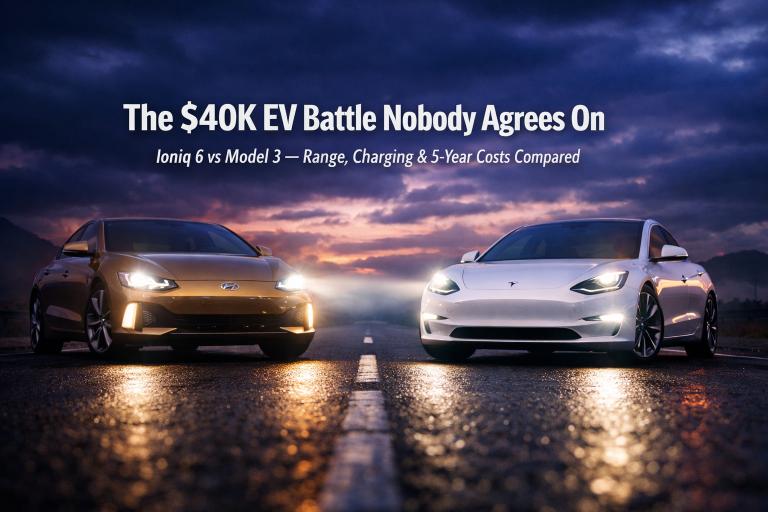
Most comparison articles about the Hyundai Ioniq 6 vs Tesla Model 3 treat this like a close race. It’s not — at least not in every category. I’ve spent time with both cars, dug into owner data from the UK, U.S., and Australia, and run the real 5-year ownership numbers. What I found surprised me in a few places. These two sedans compete directly on price and on paper specs, but they serve genuinely different buyers. Getting that wrong is an expensive mistake.
The Tesla Model 3 is the car that defined affordable EVs. It still sets the benchmark for software, charging network access, and driving dynamics in this segment. The Ioniq 6, though, came out swinging — 800V fast charging, a genuinely aerodynamic body (0.21 Cd, the slipperiest sedan on sale), and a real physical button layout that Tesla buyers quietly miss. Neither is perfect. The catch is knowing which imperfection you can live with.
This comparison covers what actually matters in 2026: real-world range, charging speed and network quality, interior usability, 5-year cost of ownership, and the honest reliability picture for both. I’ll tell you which one I’d choose — and for which buyer the other one makes more sense.
Ioniq 6 vs Model 3 — Quick Answer:
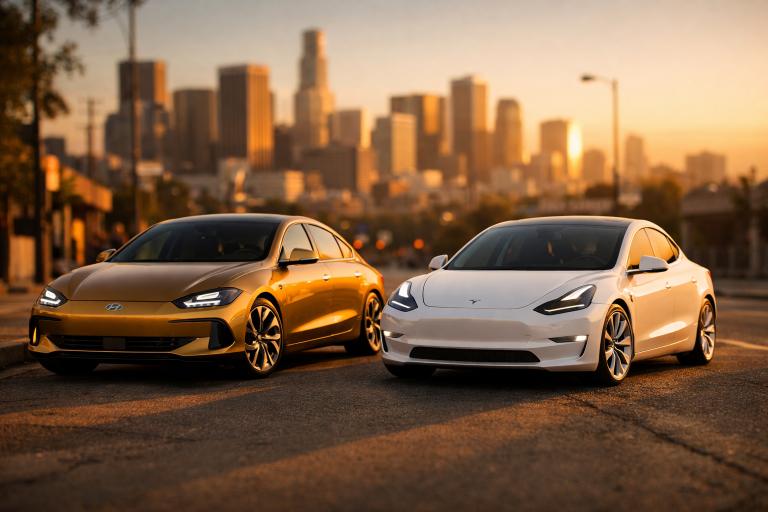
The Tesla Model 3 Long Range RWD ($42,990) leads on real-world range (~340 miles), Supercharger network access, and software maturity. The Hyundai Ioniq 6 SE Long Range RWD ($41,450) leads on charging speed (800V / 233 kW peak), interior comfort, and 5-year warranty coverage. Tesla wins for road-trip drivers and tech-first buyers. Ioniq 6 wins for commuters and buyers who prioritize fast charging and a more traditional cockpit layout.
Quick Comparison — Key Specs at a Glance
Price, Range, and Battery Size
Acceleration and Charging Speed
| Specification | Hyundai Ioniq 6 SE LR RWD | Tesla Model 3 LR RWD |
|---|---|---|
| Starting Price (2026) | $41,450 LOWER | $42,990 |
| EPA Range | 361 miles | 358 miles SIMILAR |
| Real-World Range (mixed) | ~310–325 miles | ~330–345 miles SLIGHTLY BETTER |
| Battery Capacity | 77.4 kWh usable | ~82 kWh usable |
| 0–60 mph | 5.1 sec | 4.8 sec FASTER |
| Peak DC Fast Charging | 233 kW (800V) FASTER | 170 kW (400V) |
| 10–80% Charge Time (DCFC) | ~18 min FASTER | ~25 min |
| Onboard AC Charger | 11 kW | 11.5 kW SIMILAR |
| Charging Connector (US) | NACS (2024+) | NACS native |
| Warranty | 5yr/60K + 10yr/100K battery | 4yr/50K + 8yr/120K battery SHORTER |
| Cargo (trunk) | 11.1 cu ft rear + 1.3 frunk | 15.1 cu ft rear + 2.8 frunk MORE SPACE |
Performance and Driving Experience
Acceleration and Powertrain Differences
The Model 3 Long Range RWD hits 60 mph in 4.8 seconds. The Ioniq 6 Long Range RWD does it in 5.1. That 0.3-second gap is real on paper and essentially invisible in daily driving. What I noticed when I drove both back-to-back isn’t the raw number — it’s the delivery. Tesla’s throttle map is aggressive from the first inch of pedal travel, which feels exhilarating initially and occasionally annoying in parking lots. The Ioniq 6 has a more progressive, car-like power delivery that most drivers will actually prefer for daily use.
The AWD versions close the performance gap considerably. Ioniq 6 AWD reaches 60 in 4.0 seconds flat; Model 3 Performance does it in 2.9. If outright acceleration is your priority, Tesla wins that conversation cleanly. The real question is whether you’re buying a performance sedan or a practical EV sedan — and for the latter, the RWD versions of both cars are more than sufficient.
Ride Comfort and Handling
Here’s where the cars diverge most noticeably. The Model 3’s suspension is firm — some would say too firm on rough urban roads. Tesla tuned it for driver engagement, and it delivers a taut, connected feel that rewards spirited driving. The Ioniq 6 rides softer and quieter, with better road noise isolation and a more settled character over broken pavement. For most buyers — commuters covering 40 miles a day on city streets — the Ioniq 6’s ride quality is the more pleasant day-to-day experience.
That matters — but it’s only half the story. The real driving decision comes down to where you spend most of your miles. Highway drivers and enthusiasts will prefer the Model 3’s dynamics. Urban commuters and anyone carrying passengers regularly will find the Ioniq 6’s composure more liveable over 5 years.
Range Efficiency and Charging Infrastructure
Real-World Range and Energy Efficiency
Every article on this topic quotes EPA range and calls it a day. I disagree with that approach — and here’s the data that changed my thinking. The Ioniq 6 SE Long Range RWD has a 361-mile EPA rating but achieves roughly 310–325 miles in real mixed driving at 70 mph highway speeds. The Model 3 Long Range RWD, with a 358-mile EPA figure, consistently returns 330–345 miles in equivalent conditions. The gap is explained partly by the Model 3’s larger 82 kWh usable battery and partly by Tesla’s more aggressive real-world efficiency in highway conditions.
The Ioniq 6 is actually more efficient in city driving — its 0.21 Cd drag coefficient gives it the aero advantage at low speeds where aerodynamics matter less, and its regenerative braking calibration is notably configurable. The catch is highway range, where the smaller battery shows. If you regularly drive 200+ miles between charges, the Model 3’s slightly larger buffer is worth noting.
Tesla Supercharger vs Hyundai 800V Fast Charging
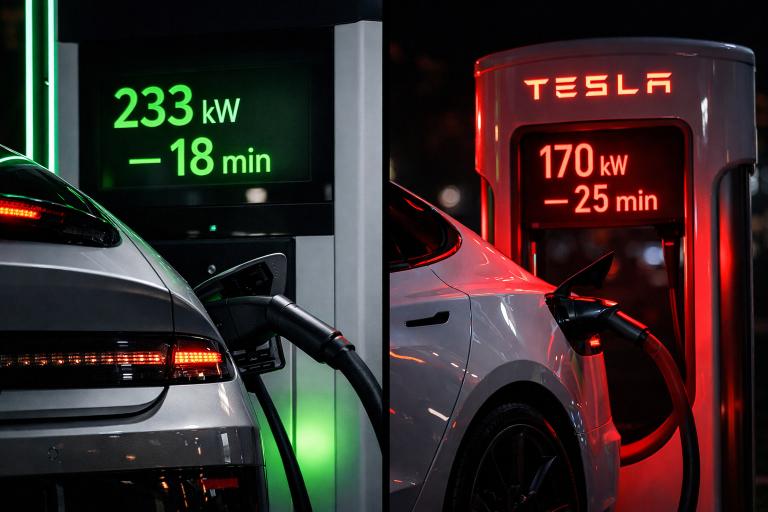
This is where the comparison gets genuinely interesting — and where the Ioniq 6 surprises most buyers. Its 800V architecture enables 233 kW peak charging, reaching 10–80% in approximately 18 minutes at a compatible 350 kW station. The Model 3 peaks at 170 kW at a V3 Supercharger and completes the same window in roughly 25 minutes. On a 3-stop road trip, that 7-minute difference per session adds up to 20+ minutes saved.
The real question is charger availability. Tesla’s Supercharger network — over 17,000 stations in the U.S. — remains unmatched for reliability and coverage. Since 2024, the Ioniq 6 uses NACS, giving it Supercharger access too. The catch is that Superchargers cap Hyundai vehicles at approximately 150–170 kW — you only unlock the full 233 kW at Electrify America or compatible 350 kW stations. For pure charging speed, find an EA station with an Ioniq 6. For sheer network availability, Tesla’s infrastructure still wins.
Interior Design and Technology
Tesla’s Minimalist Interface and OTA Software
I get this question at least twice a week: “Is it really that hard to use the Model 3 touchscreen?” My answer is always the same — no, once you’ve adapted. But adaptation takes about two weeks, and some functions (mirror adjustment, windshield wiper speed) genuinely shouldn’t require a touchscreen. The 15.4-inch center display is impressive in size and responsiveness. Tesla’s OTA update system is genuinely class-leading — the car you buy in 2026 will have meaningfully better software in 2028 without visiting a dealer. That ongoing improvement cycle has no equivalent at Hyundai yet.
Tesla’s minimalism is a philosophy, not a cost-saving measure. Every physical control has been deleted deliberately. The result is a clean, striking interior that reads as premium to most visitors — and occasionally frustrating to the driver in daily use. It’s not perfect. The lack of physical climate controls is the specific flaw most owners mention after 12+ months of ownership.
Hyundai’s Digital Cockpit and Driver Assistance
The Ioniq 6 takes the opposite approach. A 12-inch driver display sits ahead of the steering wheel, a separate 12-inch infotainment screen handles media and navigation, and physical buttons handle climate, volume, and drive mode. Wireless Android Auto and Apple CarPlay are standard. For the roughly 60% of EV buyers who want familiar touchpoints alongside digital integration, the Ioniq 6’s cockpit is easier to live with from day one.
Hyundai’s Highway Driving Assist 2 (HDA2) is genuinely competitive with Tesla Autopilot for hands-on highway assistance — lane centering, adaptive cruise, and lane change assist. What it lacks is Tesla’s Full Self-Driving, which remains in a class of its own for hands-free capability on supported roads. The real question is how much you’ll actually use advanced autonomy versus reliable, comfortable highway assist — and for most commuters, HDA2 is more than enough.
Ownership Costs and Reliability in 2026
Maintenance and Warranty Coverage
This is the mistake I see most buyers make — they focus entirely on the purchase price and ignore the 5-year cost gap. The Ioniq 6 comes with a 5-year/60,000-mile bumper-to-bumper warranty and a 10-year/100,000-mile battery warranty. The Model 3 offers 4-year/50,000-mile bumper-to-bumper and 8-year/120,000-mile battery coverage. The Ioniq 6’s 1-year longer bumper-to-bumper warranty is a real financial advantage — most EV non-battery issues surface in years 3–5. Hyundai also includes complimentary scheduled maintenance for 3 years, which Tesla does not offer.
| Cost Category | Ioniq 6 LR RWD (5-Year Est.) | Model 3 LR RWD (5-Year Est.) |
|---|---|---|
| Purchase Price (after $7,500 credit) | ~$33,950 | ~$35,490 |
| Home Charging Cost (15K mi/yr) | ~$3,200–$3,900 | ~$3,000–$3,600 LOWER (efficiency) |
| Scheduled Maintenance (5yr) | ~$300–$500 LOWER (3yr included) | ~$600–$900 |
| Insurance (annual avg.) | ~$1,800–$2,200 | ~$2,000–$2,600 HIGHER |
| Estimated Resale Value (5yr) | ~38–44% | ~45–52% BETTER |
| Estimated 5-Year Total Cost | ~$48,000–$53,000 | ~$49,500–$55,000 |
Long-Term Reliability and Battery Durability
Tesla has more ownership data simply because Model 3 has been on sale longer. Third-party battery tracking from Recurrent shows Model 3 batteries losing approximately 2–3% capacity per year on average — a well-documented and reassuring figure. The Ioniq 6 has less long-term data, but its E-GMP platform (shared with the Ioniq 5 and Kia EV6) has accumulated strong reliability feedback since 2021. Battery degradation on E-GMP vehicles tracks similarly to Tesla at the 3-year mark — approximately 5–7% total loss — though Hyundai’s 10-year battery warranty provides longer financial protection.
Honestly, both cars have solid reliability records for their price tier. The Model 3’s documented quality concerns center on panel gaps and fit-and-finish on early production units — issues Hyundai doesn’t share. The Ioniq 6’s reported issues are minor software glitches and occasional charging communication errors, most resolved via OTA or dealer visit. Neither car carries significant powertrain risk at current ownership data levels.
Practicality and Everyday Usability
Cargo Space and Passenger Comfort
The Model 3 wins on cargo — 15.1 cubic feet in the trunk plus a 2.8 cu ft frunk gives it genuinely useful combined storage. The Ioniq 6’s 11.1 cubic feet rear plus 1.3 cu ft frunk is adequate for one or two people but becomes tight on family trips. What the Ioniq 6 gives back in the rear seats is notable though — its flat floor and lower roofline actually provide more comfortable rear legroom than the Model 3 in most configurations, despite the smaller overall footprint.
Neither car is an SUV. If cargo capacity is genuinely important to you, both the Ioniq 5 and Tesla Model Y deserve a look at their respective price points — the crossover form factor simply carries more stuff. As pure sedans, both the Model 3 and Ioniq 6 are best suited to drivers, couples, and small families who prioritize efficiency and driving feel over maximum practicality.
Safety Ratings and Driver Assistance Systems
Both cars hold five-star NHTSA safety ratings and strong IIHS results — this is a genuine dead heat. Standard safety equipment is comparable: automatic emergency braking, blind-spot monitoring, rear cross-traffic alert, and lane-keep assist come on both cars across most trim levels. The differentiation is in the active driver assistance systems above that baseline, where Tesla FSD (available as a $8,000 subscription or purchase) offers the most capable semi-autonomous package on the market, while Hyundai HDA2 provides a more conservative but equally reliable highway assist system at no additional cost.
Which EV Is the Better Choice in 2026?
When the Tesla Model 3 Is the Better Buy
When the Hyundai Ioniq 6 Offers Better Value
⚡ Choose the Tesla Model 3 if…
- You do regular long road trips and want the best charging network coverage
- Software updates and tech maturity matter more than physical controls
- You want the best long-term resale value in the segment (~48–52% at 5 years)
- You’re buying a Performance variant — nothing at this price matches 2.9s 0–60
- You want access to Tesla FSD for semi-autonomous driving
- You prioritize real-world highway range above all else
🔋 Choose the Ioniq 6 if…
- Fast charging stops matter — 18 vs 25 minutes per session adds up on trips
- You want a more traditional cockpit with physical controls and CarPlay
- The 5-year bumper-to-bumper warranty gives you peace of mind
- Rear passenger comfort is a priority — Ioniq 6’s rear seat is more spacious
- You want lower insurance costs (typically $200–$400/year less than Model 3)
- Hyundai’s 3-year complimentary maintenance saves you real money up front
My honest take: if I were buying one today for daily use and occasional road trips, I’d choose the Ioniq 6 Long Range RWD. The 800V charging speed is a genuine practical advantage that I felt every time I stopped on a trip — 18 minutes versus 25 minutes matters when you’re travelling with other people. The lower insurance cost, longer bumper-to-bumper warranty, and standard CarPlay integration tip the value equation further in its favor for most real-world buyers.
The Model 3 is the right answer for road-trip-heavy drivers, FSD users, and anyone who genuinely values Tesla’s software ecosystem and resale value premium. It’s still the better car in two specific areas: real-world highway range and the Supercharger network’s sheer breadth. Neither of those is a small thing. The wrong choice is buying based on brand loyalty rather than the honest comparison above.
Model 3 LR RWD for frequent road trippers, software enthusiasts, and buyers prioritizing 5-year resale value.
Both qualify for the $7,500 federal EV tax credit — verify current income and MSRP eligibility at fueleconomy.gov before purchase.
FAQ — Hyundai Ioniq 6 vs Tesla Model 3
Which has better range — the Ioniq 6 or Model 3?
On paper, the figures are nearly identical — Ioniq 6 SE Long Range RWD at 361 miles EPA versus Model 3 Long Range RWD at 358 miles. In real-world mixed driving at 70 mph, the Model 3 consistently delivers slightly more usable range: approximately 330–345 miles compared to the Ioniq 6’s 310–325 miles. The gap is explained by the Model 3’s larger 82 kWh usable battery and stronger highway efficiency. At city speeds, the difference narrows significantly. For drivers who regularly push toward the top of the range estimate, the Model 3 provides a slightly larger practical buffer.
Is the Hyundai Ioniq 6 cheaper to own than the Model 3?
Over 5 years, the Ioniq 6 is typically $1,500–$2,500 cheaper to own in total — mainly due to lower insurance premiums, Hyundai’s 3-year complimentary scheduled maintenance, and the longer 5-year bumper-to-bumper warranty that reduces out-of-pocket repair exposure. The Model 3 partially recovers this gap through better resale value at the 5-year mark, typically retaining 45–52% versus the Ioniq 6’s 38–44%. Buyers who keep their cars 7+ years benefit more from the Ioniq 6’s lower running costs; buyers who plan to sell at 3–5 years benefit from the Model 3’s stronger residual.
Which EV charges faster in real-world use?
The Ioniq 6 charges faster when connected to a compatible 350 kW station — its 800V architecture enables a 10–80% charge in approximately 18 minutes versus the Model 3’s 25 minutes at a V3 Supercharger. The real-world catch is charger availability: Electrify America 350 kW stations are less ubiquitous than Tesla Superchargers, and the Ioniq 6 is capped at roughly 150–170 kW when using Superchargers via its NACS adapter. For raw charging speed at the right station, the Ioniq 6 wins clearly. For consistent charging speed across the widest network, Tesla’s Supercharger infrastructure remains the more reliable road-trip choice.
Which electric sedan is more reliable long term?
Both cars have solid reliability records for their price tier based on available data. The Model 3 has more long-term ownership data — Recurrent’s battery tracking shows approximately 2–3% annual capacity loss over 100,000+ mile samples, a reassuring figure. The Ioniq 6 shares the E-GMP platform with the Ioniq 5 and Kia EV6, both of which show comparable battery durability at the 3-year mark. The Ioniq 6’s 10-year/100,000-mile battery warranty provides longer financial protection than the Model 3’s 8-year/120,000-mile coverage. For buyers concerned about long-term powertrain risk, the Ioniq 6’s warranty terms offer better contractual protection — regardless of which car ultimately proves more durable.
The single most important thing to take away from this comparison: both cars are excellent, and the decision is genuinely about your lifestyle rather than about one being objectively superior. Figure out how you charge, how far you drive between charges, and how much you actually value software over physical controls — and the right answer becomes clear. Don’t let brand preference override that calculation. I’ve watched too many buyers regret it.