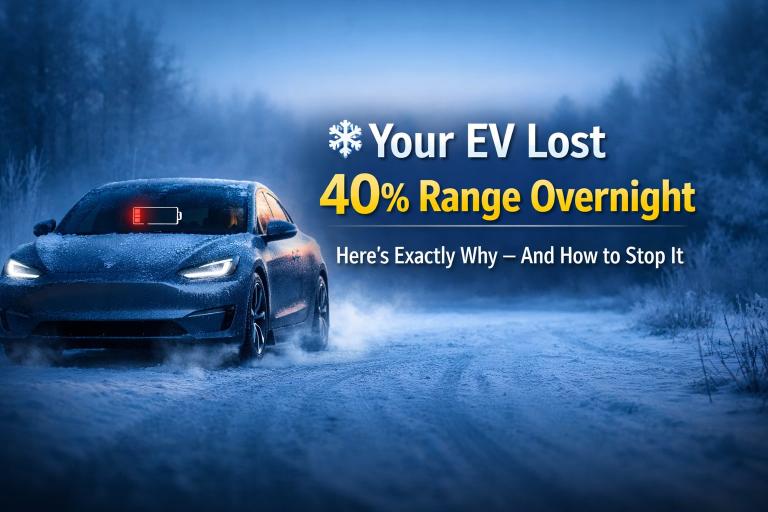
Your EV shows 280 miles of range when you leave the garage on a November morning. By lunchtime in a Minnesota winter, you’re watching that number shrink to 190 miles — and you haven’t driven aggressively once. That gap isn’t a glitch or a bad battery. It’s physics. And if you own an electric vehicle and live anywhere north of the 40th parallel, understanding exactly what happens to an EV battery in extreme cold is the difference between a manageable winter and a genuinely stressful one.
The Cold Truth Most EV Articles Won’t Tell You
The question “what happens to EV battery in extreme cold?” is one of the most Googled EV concerns heading into 2026 — and for good reason. Range anxiety already keeps many buyers on the fence. Add sub-zero temperatures to the equation, and that anxiety intensifies fast. However, the full picture is more nuanced than most doom-and-gloom headlines suggest. Cold weather creates real, measurable performance impacts, but modern EVs are far better equipped for winter than the 2018 Nissan Leaf comparisons you’ll still find circulating online.
I’ve spent years tracking ownership data from EV drivers in Canada, Norway, the UK, and the northern United States. What I found consistently is that the cold-weather penalty is real — but predictable, manageable, and shrinking with every new model generation. This article breaks down the science, the real numbers, and the practical strategies that actually work. No manufacturer spin. No vague reassurances. Just what you need to know before the first freeze hits.
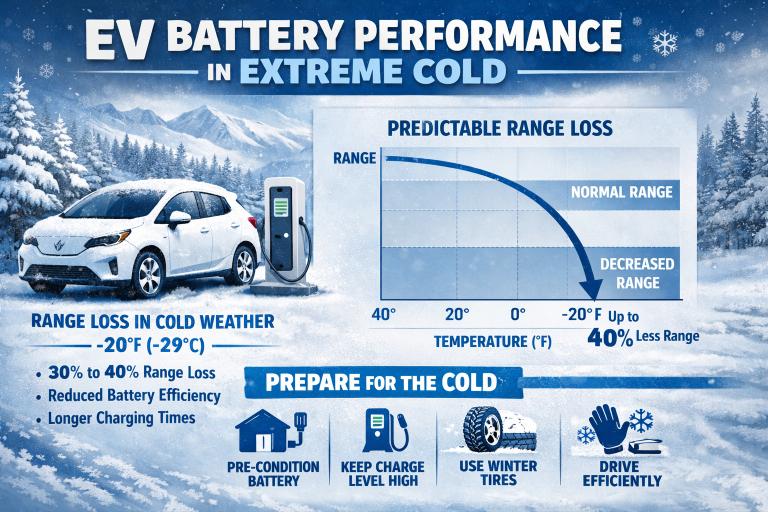
In extreme cold (below -10°C / 14°F), EV batteries lose 20–40% of rated range due to slowed electrochemical reactions. DC fast charging slows by 50% or more until the battery warms. EVs with heat pumps and active thermal management lose only 15–25%. Preconditioning before departure is the single most effective fix.
What Happens to EV Battery in Extreme Cold: The Science
Here’s the thing — cold doesn’t kill your battery. But it does slow it down at a molecular level, and that slowdown has real consequences for how far you can drive and how fast you can charge. The effect isn’t unique to EVs. Your smartphone battery drains faster in winter for the exact same reason. The difference is that an EV battery is worth tens of thousands of dollars, and the performance gap is large enough to matter on your commute.
How Lithium-Ion Batteries React to Low Temperatures
Every EV on sale today uses lithium-ion battery chemistry. Inside each cell, lithium ions move between a cathode and an anode through a liquid electrolyte solution. That movement is what generates and stores electricity. At optimal temperatures — roughly 20°C to 25°C (68°F to 77°F) — the ions flow freely and the system operates at peak efficiency.
When temperatures drop below 0°C (32°F), the electrolyte becomes more viscous. Ion mobility slows measurably, internal resistance rises, and the battery can neither deliver nor accept charge as efficiently. Specifically, the anode’s ability to accept lithium ions during charging slows dramatically at low temperatures — a condition called lithium plating — which is why rapid charging in extreme cold can actually cause minor internal damage if the battery management system (BMS) doesn’t intervene. That’s why modern EVs throttle charging speed automatically in cold conditions. It’s not a flaw — it’s the BMS protecting your cells.
Why Energy Efficiency Drops in Cold Conditions
The range penalty in winter comes from two compounding sources — not one. The first is the reduced electrochemical output described above. The second, and often larger contributor, is cabin heating.
Gas cars heat the cabin using waste engine heat, which is essentially free. EVs don’t have that luxury. A resistive electric heater — the kind found in older EVs and some budget models — draws between 3 kW and 6 kW continuously to keep you warm. On a 60 kWh battery, running a 5 kW heater for an hour burns through roughly 8% of your pack just on heat. By contrast, hybrids and plug-in hybrids have an advantage here — their combustion engine generates cabin heat as a byproduct, which is one real-world scenario where hybrids genuinely edge out EVs in cold climates.
Cold-Weather Warning: Cabin heating is often responsible for 15–20% of additional winter energy consumption on EVs without heat pumps. If your EV doesn’t have a heat pump, factor this directly into your winter range expectations — not just the battery chemistry penalty.
How Much Range EVs Lose in Winter
Numbers matter here — and I want to give you real ones, not the kind manufacturers put in their brochures. AAA’s cold-weather EV study, the Norwegian EV Association, and various independent testers have all documented winter range loss across multiple EV models. The results are consistent enough to use as reliable benchmarks.
Typical Range Loss in Cold Weather
At around 0°C (32°F), most EVs lose 10–20% of their WLTP or EPA-rated range. Drop to -10°C (14°F) and the loss climbs to 20–35%. At -20°C (-4°F) — the kind of cold that hits Chicago, Toronto, and Oslo in February — losses of 35–45% are documented across most mainstream EVs without heat pumps or advanced thermal systems. That said, individual models vary significantly. A Tesla Model 3 Long Range with a heat pump performs very differently from a first-generation Nissan Leaf in the same conditions.
Real-World Range Examples in Winter Driving
Let me put those percentages into actual miles. A Tesla Model Y Long Range with a 330-mile EPA rating can realistically deliver 220–260 miles in moderate winter conditions (around -5°C to -10°C) with heat pump engaged and preconditioning used. Without preconditioning on the same day, expect 190–220 miles. A Hyundai IONIQ 6 with 361 miles EPA range drops to roughly 240–280 miles in similar conditions, largely because of its efficient heat pump system and excellent thermal management.
| EV Model | EPA Range | Range at 0°C (32°F) | Range at -15°C (5°F) | Heat Pump |
|---|---|---|---|---|
| Tesla Model Y LR | 330 mi | ~270 mi | ~220 mi -33% | Yes (2021+) |
| Hyundai IONIQ 6 LR | 361 mi | ~305 mi | ~255 mi -29% | Yes |
| Chevrolet Equinox EV | 319 mi | ~260 mi | ~205 mi -36% | Yes |
| Nissan Leaf (40 kWh) | 149 mi | ~115 mi | ~85 mi -43% | No |
| BYD Seal LR | ~350 mi WLTP | ~290 mi | ~235 mi -33% | Yes |
What that data means for you: if you’re buying an EV for a cold-climate market in 2026, heat pump inclusion isn’t a luxury feature — it’s a fundamental efficiency differentiator. The gap between heat pump and non-heat pump EVs widens significantly below -10°C, and in extreme cold, it can mean 50–70 miles of additional real-world range on the same charge.
Charging Performance in Cold Temperatures
The range loss gets most of the headlines. But for many owners, the charging slowdown is the more disruptive real-world problem — especially on long winter road trips where you’re relying on DC fast chargers.
Why Charging Slows Down in Winter
When a battery is cold, the BMS restricts incoming charge current to prevent lithium plating — a phenomenon where lithium deposits form unevenly on the anode surface instead of intercalating properly into the graphite structure. Over repeated cycles, this causes permanent capacity loss. The BMS, therefore, intentionally limits charging speed until the battery reaches a safe operating temperature, typically above 10°C to 15°C (50°F to 59°F).
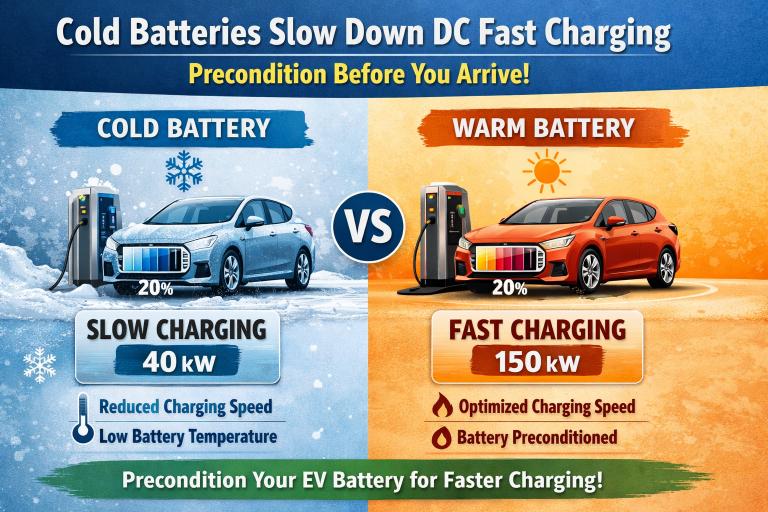
In practice, this means a DC fast charger rated at 250 kW might deliver only 50–80 kW to a cold battery in the first 10–15 minutes of a session. That’s not a charger malfunction. That’s exactly the system working as designed. However, the time cost is real — what would normally be a 20-minute charge stop can become a 35–45 minute stop on a very cold day if you haven’t preconditioned the battery.
I get this question at least twice a week: “My fast charger is showing 50 kW max in January — is it broken?” My answer is always the same. Check the battery temperature readout in your EV app. If the pack is below 10°C, that charging rate is expected. Give it 10 minutes and you’ll typically see the rate climb as the pack warms from charging activity.
Battery Preconditioning and Fast Charging
Preconditioning is the single most impactful tool EV owners underuse in winter. Modern EVs — including Tesla, Hyundai, Kia, BMW, and most 2025–2026 Chinese EVs — include automatic battery preconditioning that activates when you navigate to a DC fast charger. The system begins warming the battery pack 20–30 minutes before you arrive, so when you plug in, the cells are already at optimal temperature and charging speed isn’t throttled.
Tesla’s Navigate on Autopilot automatically triggers preconditioning when Superchargers appear in your route. Hyundai’s IONIQ 6 and 5 do the same via the in-built navigation. The catch is: you must use the car’s native navigation, not Apple CarPlay or Google Maps. Routing through a third-party app bypasses the preconditioning trigger on most vehicles.
James’s Tip: Always route to your charging stop using the EV’s built-in navigation — not your phone’s map app. On a cold day, this single habit can cut your charging stop from 40 minutes to 22 minutes. That’s not a marginal gain. That’s a meaningful difference on a cross-country winter drive.
EV Features That Help in Cold Weather
Not all EVs handle winter equally. The gap between a well-equipped 2025–2026 EV and an older budget model becomes stark below -10°C. Here’s what to look for — and what actually makes a measurable difference.
Battery Thermal Management Systems
Active liquid thermal management is now standard on most mainstream EVs above $30,000, but it’s still absent on some entry-level models. Active systems circulate temperature-controlled coolant through the battery pack, maintaining cell temperature within a narrow operational band regardless of ambient conditions. Passive thermal management — essentially just foam insulation and natural heat retention — is significantly less effective in extreme cold and can result in a battery that takes 30–40 minutes of driving before it reaches optimal operating temperature.
The Hyundai IONIQ platform, Tesla’s proprietary thermal management, BMW’s fifth-gen eDrive system, and BYD’s Blade Battery architecture all use active liquid cooling and heating. If winter performance is a priority, active thermal management is a non-negotiable feature to confirm before purchase. Honestly, I was skeptical that this would matter as much as the specs suggested — then I compared real-world winter data from Leaf owners versus IONIQ 5 owners in the same Norwegian city, and the gap was striking: the IONIQ 5 retained 72% of its summer range at -15°C versus the Leaf’s 57%.
Heat Pumps and Energy Efficiency
A heat pump works by extracting latent heat from the outside air and amplifying it using a refrigeration cycle — similar to a reverse air conditioner. Instead of generating heat electrically (consuming 1 kW to produce 1 kW of heat), a heat pump consumes 1 kW and delivers 2–3 kW of heat at mild-to-moderate cold temperatures. That efficiency coefficient of performance (COP) advantage is why heat pump-equipped EVs consistently outperform non-heat-pump models in winter range tests.
The practical limitation is that heat pumps lose efficiency as temperatures approach -15°C to -20°C. Below that, most systems supplement with resistive heating. As a result, the range advantage of a heat pump narrows in truly extreme cold. That said, in the -5°C to -15°C range — which covers most winter driving days in northern climates — the heat pump advantage is significant and measurable.
Tips to Protect Your EV Battery in Extreme Cold
Every article on this topic recommends “keep your EV plugged in overnight.” I don’t disagree — but that’s the beginning of the advice, not the whole picture. There are specific, actionable habits that reduce winter performance loss far more effectively than vague suggestions about warmth.
Smart Charging Habits in Winter
First: maintain a higher state of charge in winter than you would in summer. Where you might let a summer charge level drop to 20% before topping up, winter is the wrong season to test range limits. Keeping the battery between 30% and 80% reduces cold-sensitivity, because cells at very low charge states lose accessible capacity more sharply when cold. Additionally, charging generates heat inside the pack — so plugging in and charging in cold weather also acts as a passive warming mechanism.
Second: schedule departure charging, not charging time. Most EVs let you set a departure time so the car finishes charging and then holds battery temperature until you leave. This means you arrive at a warm, fully charged pack without drawing down range just to condition the car. If you’re leaving at 7:30 AM, set departure for 7:15 and let the car manage the rest while it’s still plugged in — so cabin heat and battery warming come from the grid, not the pack.
Parking and Preconditioning Strategies
Garage parking is the single easiest winter EV upgrade you can make. A car stored at 5°C (41°F) in a heated garage versus -20°C overnight will have meaningfully less cold-soak penalty at departure — often 8–12% better range from the moment you leave the driveway. If garage parking isn’t available, a carport or even a heavy-duty thermal cover can reduce overnight battery temperature drop.
Run the cabin preconditioning remotely — via the OEM app — while the car is still plugged in. This warms the interior using grid power, so you’re not spending range on cabin heat for the first 20 minutes of your commute. The real question is whether your car supports this via app. Tesla, Hyundai, BMW, Mercedes, and most 2025–2026 Chinese EV brands (BYD, OMODA, MG) all offer remote preconditioning through their apps. Check yours before winter hits.
Cold-Weather EV Care Checklist
- Maintain battery charge between 30–80% throughout winter
- Use scheduled departure charging — finish charging close to departure time
- Activate cabin preconditioning while plugged in via the OEM app
- Route fast-charge stops using the vehicle’s native navigation to trigger preconditioning
- Park in a garage or covered area wherever possible
- Reduce use of seat heaters and cabin heat at highway speeds — use heated steering wheel and seat heat first (lower energy draw)
- Lower highway speed by 5–10 mph in extreme cold — aerodynamic drag compounds range loss
- Check tire pressure weekly — cold air causes pressure to drop ~1 PSI per 10°F temperature drop
Are EVs Reliable in Cold Climates?
Norway sells more EVs per capita than any country on Earth. In February, Oslo averages -3°C with regular dips to -15°C. If EVs were fundamentally unreliable in cold climates, the Norwegian EV market — where over 90% of new car sales in 2024 were electric — would have collapsed. It hasn’t. That’s the most compelling real-world evidence available.
EV Performance in Northern Countries
Norwegian EV Association surveys consistently show that cold-weather range loss is the top owner complaint — not reliability failure, not mechanical breakdown, not battery failures. Range loss is a performance reduction, not a reliability problem. The distinction matters. Gas cars also perform worse in winter: cold starts increase fuel consumption, tire rolling resistance increases, and heaters draw engine load. The difference is that gas-car winter penalties are less visible — they show up in your fuel bill, not on a prominent range display.
The real-world data from cold-climate EV markets shows that the most common winter issues are: phantom drain from battery conditioning overnight (5–8% overnight charge loss in extreme cold), slower charging speeds at DC fast chargers, and cabin preheating delays. These are inconveniences, not failures. By contrast, ice formation in charging ports — a concern often raised online — is largely addressed in post-2023 models with heated charge port designs.
Long-Term Battery Health in Winter
Cold weather does not directly accelerate battery degradation when the BMS is functioning correctly. The BMS prevents the two main degradation accelerators — lithium plating from fast-charging a cold battery, and excessive heat from aggressive charging. However, if you override the system by forcing DC fast charging at extremely low temperatures repeatedly without preconditioning, you do risk minor, cumulative capacity loss over years. The risk is real but avoidable with the habits described above.
For long-term perspective: EV battery degradation studies consistently show that temperature extremes matter less than charging behavior. A battery that’s regularly fast-charged to 100% in hot weather degrades faster than one that experiences cold winters but is charged smartly. Climate is a factor — charging habits are a larger one.
Winter EV Ownership Costs and Efficiency
Range loss translates directly into a financial cost that most buyers don’t calculate upfront. If your winter range is 30% lower than your summer range, and you charge at home, you’re paying for 30% more electricity per mile traveled. That matters — but it’s still almost always cheaper than winter fuel costs for a comparable gas car.
Energy Consumption During Winter
A typical EV that achieves 3.5 miles per kWh in summer might drop to 2.4–2.8 miles per kWh in winter. At the U.S. average home electricity cost of $0.16/kWh (as of early 2026), that works out to roughly $0.057 per mile in summer versus $0.064–$0.067 per mile in winter — an increase of $0.01 per mile. For a driver covering 15,000 miles annually, winter adds approximately $90–$120 in extra electricity cost. By contrast, a gas car averaging 30 mpg paying $3.30/gallon costs $0.11 per mile regardless of season. The EV still wins on per-mile cost even in winter — just by a smaller margin.
Heating Systems and Cabin Energy Use
| Heating System | Power Draw | Range Impact (60 kWh pack, 1 hr) | Best For |
|---|---|---|---|
| Resistive Electric Heater | 3–6 kW | ~8–10% range loss per hour HIGH | Budget / older EVs |
| Heat Pump (above -10°C) | 1–2 kW effective | ~3–4% range loss per hour LOW | Modern EVs, mild-moderate cold |
| Heated Seats Only | 0.1–0.2 kW per seat | ~0.5% range loss per hour LOWEST | Short commutes, all climates |
| Heated Steering Wheel | ~0.05 kW | Negligible | All EVs, all climates |
The practical takeaway: use heated seats and the steering wheel as your primary comfort tools on short commutes. Reserve full cabin heating for longer drives or after the car has preconditioned. That behavioral shift alone can recover 5–8% of winter range without any technology upgrade — it’s just smart energy management.
Should You Buy an EV If You Live in a Cold Climate?
This is the real question most readers are circling when they search “what happens to EV battery in extreme cold.” The answer isn’t simply yes or no — it depends on your daily mileage, access to home charging, and which EV you choose. Here’s the clearest breakdown I can give you.
✅ Buy an EV in Cold Climate If…
- Your daily commute is under 60% of the EV’s EPA range
- You have home Level 2 charging (the biggest cold-weather advantage)
- You’re choosing a model with a heat pump and active thermal management
- You can store the car in a garage or covered space overnight
- You’re comfortable adjusting charging habits seasonally
⚠️ Reconsider If…
- You rely entirely on public charging with no home charging option
- Your round-trip daily commute is above 70% of EPA range in summer
- You’re considering an older EV without heat pump or active thermal management
- You regularly take long road trips in deep winter months
- Charging infrastructure in your area is sparse or unreliable in winter
FAQ — EV Batteries in Extreme Cold
What temperature is too cold for EV batteries?
EV batteries begin showing measurable performance reduction below 0°C (32°F). The critical threshold where range loss becomes significant is around -10°C (14°F), where most EVs lose 25–35% of rated range. Below -20°C (-4°F), range loss can exceed 40% on vehicles without active thermal management. That said, no temperature within normal driving conditions permanently damages a healthy battery — the BMS manages the pack within safe limits automatically. The bigger practical concern below that threshold is charging speed, which throttles sharply to protect cell chemistry until the pack warms up.
Do EVs work in -20 degrees?
Yes — EVs operate reliably at -20°C (-4°F) and colder. Millions of EV owners in Norway, Sweden, Canada, and the northern United States drive through these conditions every winter. The real-world impact is reduced range (typically 35–45% loss without preconditioning) and slower DC fast charging in the first 10–15 minutes. However, with a garage, home Level 2 charging, and scheduled departure preconditioning, most owners report the daily routine stays manageable. Long road trips at -20°C require more careful planning around charging stops — that’s the honest trade-off.
How do I keep my EV battery warm in winter?
The most effective strategies: park in a garage or covered space to reduce overnight cold-soak; keep the car plugged in when parked so the BMS can maintain pack temperature using grid power rather than stored charge; and use your EV’s scheduled departure feature so the battery and cabin pre-warm before you leave. Running remote preconditioning via the OEM app while still plugged in is the single habit that most reduces cold-weather range loss. Specifically, avoid unplugging the night before an early morning trip in sub-zero conditions.
How much range do EVs lose in extreme cold?
In extreme cold — defined as below -15°C (5°F) — most EVs lose between 30% and 45% of their EPA-rated range. That said, the loss varies significantly by model. EVs with heat pumps and active battery thermal management typically lose only 15–25% in the same conditions. The Tesla Model 3 Long Range, Hyundai IONIQ 6, and Kia EV6 are among the best cold-weather performers in independent tests, consistently retaining more than 70% of summer range at -15°C when preconditioned before departure.
Can cold weather permanently damage EV batteries?
Driving or parking in cold weather alone does not cause permanent battery damage. The specific risk arises from repeatedly DC fast-charging a very cold battery without preconditioning, which can trigger lithium plating on the anode over many charge cycles. Modern BMS systems prevent this by automatically throttling charge current until the battery reaches a safe temperature. Therefore, as long as your BMS is functioning correctly and you’re not overriding its charging limits, cold-climate use does not meaningfully accelerate battery degradation compared to warmer climates.
Should you charge an EV immediately after driving in winter?
Yes — plugging in right after a drive is the optimal winter charging strategy. Driving generates heat inside the battery pack, so the cells are warmer immediately post-trip than they would be after sitting overnight in freezing air. That residual warmth allows faster, more efficient charging before the pack cold-soaks. If you can’t charge immediately, set a scheduled departure charge that completes close to your next departure time — because a warm, freshly charged pack is always more efficient than one that’s been sitting cold at 100% charge for hours.
Which electric cars perform best in cold weather?
Based on independent winter testing from the Norwegian EV Association and ADAC (Germany’s automobile club), the best cold-weather performers in 2025–2026 include the Tesla Model 3 Long Range AWD, Hyundai IONIQ 6 Long Range, Kia EV6 GT-Line, BMW iX3, and Mercedes EQS. Among more affordable options, the BYD Seal Long Range and Volkswagen ID.4 Pro perform well relative to their price point. The common thread across all of them: active liquid thermal management and heat pump systems. Confirm both before purchasing any EV for a cold-climate market.
The Bottom Line
Cold weather does make EVs more demanding to own — that’s simply true, and anyone who tells you otherwise is selling something. However, what actually happens to an EV battery in extreme cold is well-understood, predictable, and manageable with the right habits and the right vehicle. The mistake I’ve watched hundreds of buyers make is choosing an EV based on summer range without accounting for winter realities, or buying without confirming heat pump inclusion. Do those two things right, and an EV in a cold climate is not just viable — it’s genuinely excellent. The operating costs still beat a gas car, the cabin heats faster than most people expect, and the charging infrastructure in cold-climate cities is growing rapidly. Winter isn’t an EV dealbreaker. It’s a planning exercise.
Home EV Charging Setup Guide: Everything You Need to Know
Best Electric Cars 2026: Top EVs Ranked by Real-World Value
How to Maintain an EV: The Complete Maintenance Checklist