Last Updated: March 2026 — Pricing, specs, and ownership data verified for 2026 model year
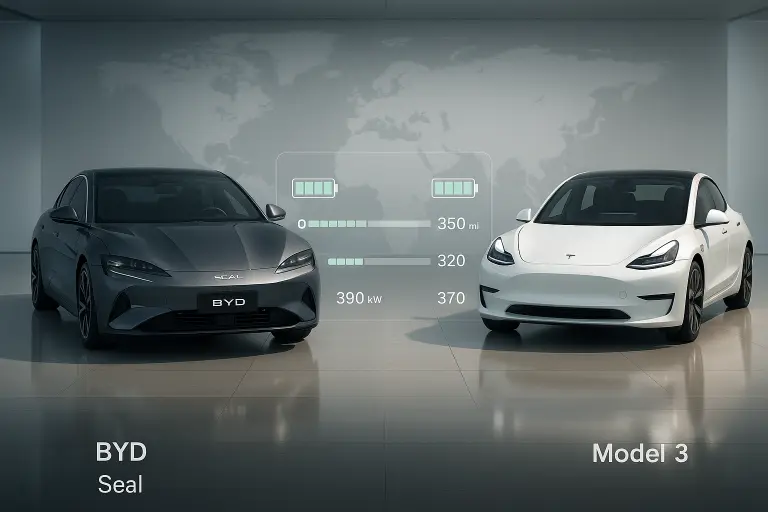
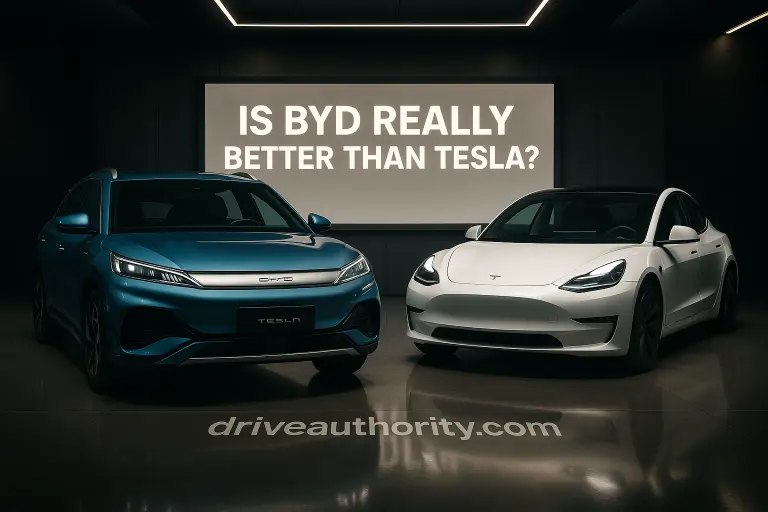
Is BYD really better than Tesla? A few years ago, that question would have seemed absurd. Today it’s one of the most-searched EV comparisons on the internet — and for good reason. BYD overtook Tesla as the world’s largest EV seller by volume in 2023 and has continued expanding aggressively in Europe, Asia, and emerging markets. In 2026, any serious EV buyer evaluating global options needs to understand what BYD actually offers versus Tesla, and where each brand genuinely wins. This comparison cuts through the brand noise and evaluates both on the factors that actually determine ownership value.
Is BYD Better Than Tesla in 2026? — Quick Answer:
Neither brand is universally better — they win in different categories. Tesla leads on charging infrastructure (Supercharger network), software depth, and long-range efficiency. BYD leads on price-to-value ratio, Blade Battery safety, and model variety below $30,000. For U.S. buyers, Tesla remains the stronger choice. For international markets (Europe, Middle East, Asia), BYD offers compelling value Tesla doesn’t match at the same price points.
BYD vs Tesla — Key Differences at a Glance in 2026
Brand Philosophy and Global Strategy
Tesla and BYD approach the EV market from fundamentally different angles. Tesla is a technology-first company that treats its vehicles as software platforms — with revenue from FSD subscriptions, energy products, and AI robotics increasingly central to its business model. BYD is a vertically integrated manufacturing giant that controls its own battery cell production, semiconductor supply chain, and vehicle assembly — a model that allows it to price aggressively while maintaining margins. In 2026, BYD sells across more than 70 countries and offers vehicles from $15,000 to $150,000+, while Tesla’s lineup remains concentrated in the $35,000–$110,000 range.
Core EV Technologies Each Brand Uses
| Category | Tesla | BYD | Edge |
|---|---|---|---|
| Battery Technology | NMC (LR) / LFP (Standard) | Blade LFP (all models) | BYD SAFER LFP |
| Charging Network | 17,000+ U.S. Superchargers | Third-party CCS / proprietary | Tesla NETWORK |
| Software / OTA | Mature, frequent updates | Improving, less mature | Tesla SOFTWARE |
| Entry Price (2026) | ~$35,000 (Model 3) | ~$15,000 (Dolphin, non-U.S.) | BYD LOWER |
| Model Range | 4 core models | 20+ models globally | BYD WIDER |
| U.S. Market Availability | Full availability | Not sold in U.S. (tariffs) | Tesla U.S. ONLY |
BYD Blade Battery vs Tesla Battery Technology in 2026
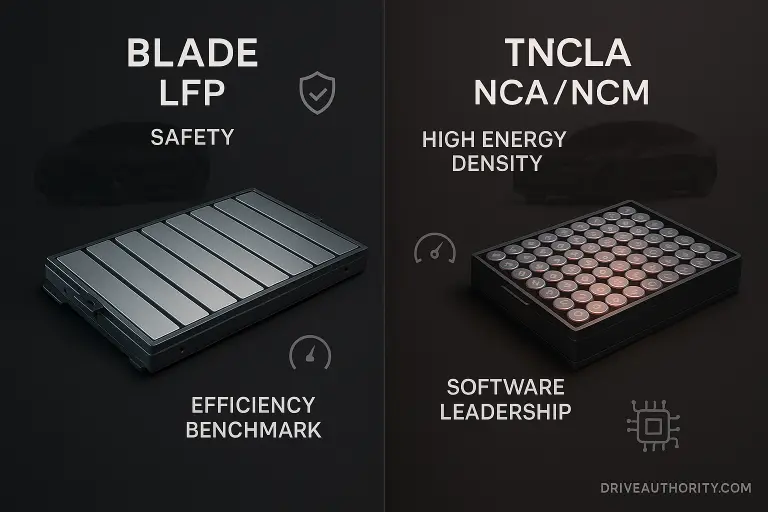
BYD Blade Battery vs Tesla Battery Technology
BYD’s Blade Battery is the brand’s most important technical differentiator. It’s an LFP (lithium iron phosphate) cell-to-pack design that eliminates the module layer between cells and structural casing — improving energy density, reducing thermal runaway risk, and passing the nail penetration safety test that NMC chemistry packs cannot. Tesla uses LFP chemistry in its Standard Range models (Model 3 and Model Y Standard) but NMC chemistry in its Long Range and Performance variants for higher energy density and longer range. The result is a meaningful safety and longevity advantage for BYD’s Blade chemistry — LFP batteries can sustain more charge cycles before degradation and are inherently more thermally stable — but at the cost of lower energy density per kilogram, which is why BYD’s longest-range models still trail Tesla’s Long Range variants in EPA-equivalent figures.
Charging Speed, Efficiency, and Software Integration
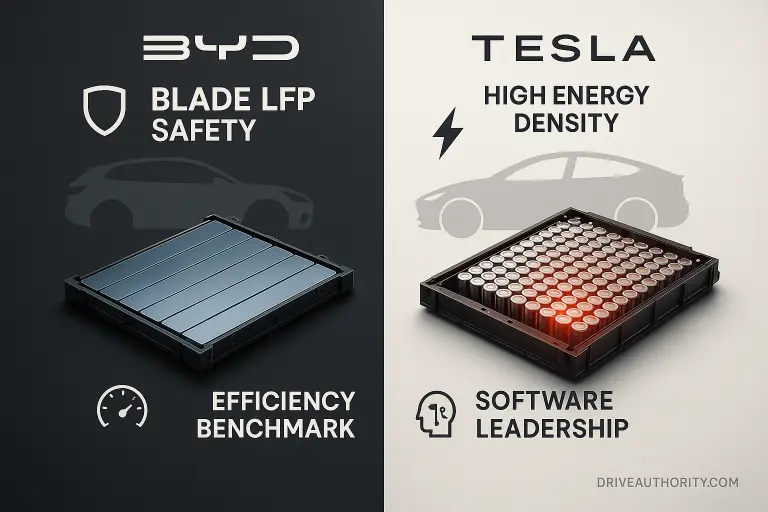
Tesla’s V3 Supercharger peaks at 250 kW with seamless in-car trip routing that automatically plans stops. BYD’s fastest charging models reach up to 150 kW on compatible CCS infrastructure — fast enough for practical long-distance travel but without Tesla’s network density or reliability advantage. BYD’s in-car software handles charging station display but lacks the predictive routing intelligence of Tesla’s proprietary system. For buyers in markets with dense public CCS infrastructure (most of Europe, parts of Australia), this gap is narrower. For U.S. buyers, the Supercharger advantage remains decisive for road trips.
BYD vs Tesla — Performance, Range, and Driving Experience 2026
Acceleration, Powertrain, and Driving Dynamics
Tesla’s performance credentials are well established — the Model Y Performance hits 0–60 in approximately 3.5 seconds, and the Model S Plaid at under 2 seconds remains one of the quickest production cars ever built. BYD’s performance profile is more nuanced: the BYD Seal AWD Performance achieves 0–100 km/h in approximately 3.8 seconds, genuinely competitive with the Model Y Performance at a lower list price in markets where both are sold. The BYD Han EV Performance variant hits comparable figures. BYD’s driving dynamics have improved substantially year over year — 2024–2026 models offer a noticeably more refined ride than early BYD EVs — but Tesla’s steering precision and overall dynamic cohesion still feels a step ahead in enthusiast-oriented driving scenarios.
Real-World Range and Energy Efficiency — BYD vs Tesla
| Model | Battery | EPA / WLTP Range | Real-World Est. | Starting Price |
|---|---|---|---|---|
| Tesla Model 3 LR AWD | 82 kWh NMC | ~358 mi EPA | ~320–335 mi | ~$44,990 U.S. AVAIL. |
| Tesla Model Y LR AWD | 82 kWh NMC | ~330 mi EPA | ~295–315 mi | ~$46,990 U.S. AVAIL. |
| BYD Seal LR AWD | 82.56 kWh LFP | ~520 km WLTP | ~280–310 mi | ~£40,000 (UK) |
| BYD Atto 3 Standard | 60.48 kWh LFP | ~420 km WLTP | ~200–230 mi | ~€38,000 (EU) |
| BYD Han EV LR | 85.44 kWh LFP | ~610 km WLTP | ~310–340 mi | ~€50,000 (EU) |
Interior Technology and Software — Tesla vs BYD in 2026
Tesla Software, Autopilot, and OTA Updates
Tesla’s software ecosystem remains the most mature in the EV industry. Over-the-air updates deliver new features, performance improvements, and safety refinements on a monthly cadence — something most automakers still cannot match. Tesla’s Autopilot (standard on all vehicles) provides lane centering and adaptive cruise control, while FSD Supervised extends to city street navigation and automatic lane changes. Tesla’s in-car UI — a single large touchscreen controlling virtually all vehicle functions — divides opinion, but the underlying software architecture is faster, more responsive, and more feature-complete than any equivalent from BYD in 2026. Apple CarPlay and Android Auto remain unsupported on Tesla — a genuine pain point for a segment of buyers.
BYD Infotainment, Smart Cabin, and DiLink System
BYD’s DiLink infotainment system, running on an Android-based platform, offers a more conventional touchscreen experience with support for both Android Auto and Apple CarPlay on recent models — a feature advantage over Tesla for smartphone-centric users. BYD’s rotating touchscreen (featured on models like the Atto 3 and Seal) is a genuinely distinctive design element that supports both landscape and portrait orientations. The overall software polish and OTA update cadence, however, still trails Tesla: BYD updates are less frequent, and the interface responsiveness on lower-spec trims can feel sluggish compared to Tesla’s consistent performance across its lineup. BYD’s ADAS — the Advanced Driver Assistance System — has improved substantially on 2024–2026 models but remains behind Tesla’s in feature breadth and real-world performance.
BYD: CarPlay + Android Auto supported, rotating screen innovation, improving ADAS, Android-based open platform. If smartphone integration matters most → BYD. If ADAS depth and software maturity matter most → Tesla.
BYD vs Tesla — Pricing, Value, and 5-Year Ownership Costs
Purchase Price and Market Positioning
In international markets where both brands compete directly, BYD offers a compelling price-to-spec advantage. The BYD Seal LR AWD — comparable to the Tesla Model 3 LR AWD in range and performance — lists at approximately £40,000–£42,000 in the UK versus £44,990–£47,000 for the equivalent Model 3, a 10–15% price gap that represents real money on a sub-£50,000 purchase. At the entry level, BYD’s advantage widens significantly: the BYD Dolphin (not available in U.S.) lists at approximately €23,000–€28,000 in Europe with no comparable Tesla at that price point. For U.S. buyers, this comparison is currently academic — BYD vehicles are blocked from the U.S. market by tariffs — but relevant for international buyers and those planning overseas purchases.
Maintenance, Charging, and Long-Term Value
Both brands benefit from EV’s inherently low maintenance profile. BYD’s Blade Battery LFP chemistry has a documented advantage in charge cycle longevity — LFP chemistry sustains more cycles before degradation than NMC, potentially translating to lower battery-related long-term costs. Tesla’s Supercharger cost per kWh is generally competitive with public CCS networks in comparable markets, and home charging costs are equivalent across both brands. Where Tesla has a clear long-term value advantage is resale: Tesla’s brand recognition and software ecosystem support stronger residual values in most markets. BYD’s residual values are improving as the brand matures but still trail Tesla in Europe and remain untested in the U.S.
| Cost Category | Tesla Model Y LR (5-Year) | BYD Seal LR (5-Year) | Edge |
|---|---|---|---|
| Purchase Price (EU/UK market) | ~€50,000 | ~€43,000 | BYD LOWER |
| Annual Maintenance Est. | $300–$450 | $250–$400 | Tie |
| 5-Year Residual Value | ~48–52% | ~38–44% | Tesla HIGHER |
| Charging Infrastructure | Supercharger network | CCS public network | Tesla NETWORK |
BYD vs Tesla — Reliability, Safety, and Long-Term Ownership Data
Reliability Data and Owner Feedback in 2026
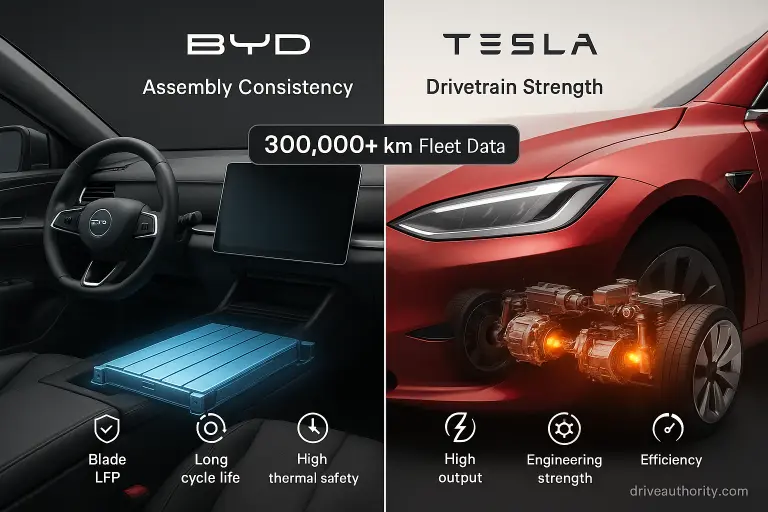
Tesla’s reliability record has improved substantially since the high-complaint 2019–2021 period. J.D. Power IQS scores for Tesla have risen year-over-year, and the most common complaints — panel gaps, paint defects, interior fit issues — have declined with improved Fremont and Giga Texas build processes. BYD’s reliability data is thinner due to shorter market presence in Western markets, but early owner feedback from European and UK buyers of 2023–2025 models is generally positive on build quality consistency — with BYD scoring well on exterior fit and finish in independent quality evaluations. For powertrain reliability, both brands have strong records: EV drivetrains are inherently simpler than ICE powertrains, and neither Tesla nor BYD has significant documented motor or battery failure patterns in post-2021 production vehicles.
Safety Ratings and BYD Blade Battery Durability
BYD’s Blade Battery carries a genuine safety advantage over NMC chemistry: it has passed the nail penetration test — one of the most demanding battery safety evaluations — without catching fire or exploding, a result NMC packs cannot replicate. In crash safety testing, BYD’s 2023–2025 models have earned strong Euro NCAP ratings: the BYD Seal received a 5-star Euro NCAP rating, and the Atto 3 also achieved 5-star status. Tesla Model 3 and Model Y hold 5-star NHTSA and Euro NCAP ratings. Both brands deliver equivalent crash safety outcomes in standardized testing — the BYD battery chemistry advantage is in thermal event safety rather than crash structure performance.
Which Brand Is Better for Different Types of EV Buyers in 2026?
⚡ Choose Tesla If:
- You’re buying in the U.S. (BYD not available)
- Supercharger network access and trip planning matter
- Software maturity and OTA updates are priorities
- You want the best long-range efficiency above 300 miles
- Resale value and brand recognition factor into your decision
- FSD driver assistance capabilities are important
🔋 Choose BYD If:
- You’re buying in Europe, UK, Middle East, or Asia
- Price-to-spec value is your primary priority
- Blade Battery LFP safety and longevity matter to you
- Apple CarPlay / Android Auto integration is non-negotiable
- You want a wider model choice including sub-€30,000 EVs
- You’re buying for a fleet or high-mileage commercial use
When Tesla Is the Better Choice
For buyers in the United States, Tesla is the only practical choice between the two — BYD does not sell passenger vehicles in the U.S. market due to 100% import tariffs. For international buyers evaluating both, Tesla wins when charging infrastructure density matters (road trips, rural areas), when software longevity is a priority, and when resale value in 3–5 years is a significant factor. Tesla’s brand recognition translates directly to used market pricing in most Western markets.
When BYD Offers Better Value
In the UK, Europe, Middle East, and Asia-Pacific, BYD offers genuinely better price-to-specification value than Tesla across most price points below €50,000. The Blade Battery’s safety and longevity credentials are a legitimate ownership advantage. And for buyers prioritizing smartphone integration (CarPlay/Android Auto) or a rotating touchscreen experience, BYD’s interior philosophy is more accessible than Tesla’s minimalist approach.
FAQ — Is BYD Really Better Than Tesla? (2026)
Is BYD really better than Tesla in 2026?
It depends on the market and buyer priorities. In international markets (Europe, UK, Middle East, Asia), BYD offers better price-to-value at most price points below €50,000, superior Blade Battery chemistry safety, and wider model choice. Tesla is better for U.S. buyers (BYD is unavailable due to tariffs), for buyers who prioritize Supercharger network access, software depth, and long-range efficiency above 300 miles. Neither brand is universally superior — the right answer depends on where you live and what ownership factors matter most.
Which EV brand has better battery technology — BYD or Tesla?
Both brands lead in different aspects. BYD’s Blade Battery uses LFP chemistry across all models — safer against thermal runaway, more charge-cycle longevity, and able to pass the nail penetration test. Tesla’s NMC Long Range packs offer higher energy density, enabling longer range per kilogram of battery weight. Tesla uses LFP in Standard Range models only. For long-term safety and degradation longevity, BYD’s Blade chemistry has documented advantages. For maximum range per charge, Tesla’s NMC Long Range packs lead.
Are BYD cars cheaper than Tesla vehicles?
Yes — in markets where both are sold, BYD vehicles are typically 10–25% cheaper than comparable Tesla models at equivalent specification. The BYD Seal LR AWD lists at approximately £40,000–£42,000 in the UK versus £44,990–£47,000 for the Tesla Model 3 LR AWD. At the entry level, BYD offers models like the Dolphin and Atto 3 starting from €23,000–€28,000 in Europe — a segment Tesla does not participate in. In the U.S. market, BYD is currently unavailable, so direct price comparison is not applicable.
Which brand is more reliable long term — BYD or Tesla?
Tesla has a longer reliability track record with more extensive owner data — post-2021 models show improved build quality and above-average powertrain durability. BYD’s reliability data in Western markets is limited by shorter market presence, but early European and UK owner feedback on 2023–2025 models is generally positive. Both brands benefit from EV drivetrains’ inherent simplicity relative to ICE vehicles. BYD’s Blade Battery chemistry carries a documented long-term cycle longevity advantage over Tesla’s NMC Long Range packs — though Tesla’s 8-year warranty coverage provides comparable financial protection for buyers within the standard ownership window.