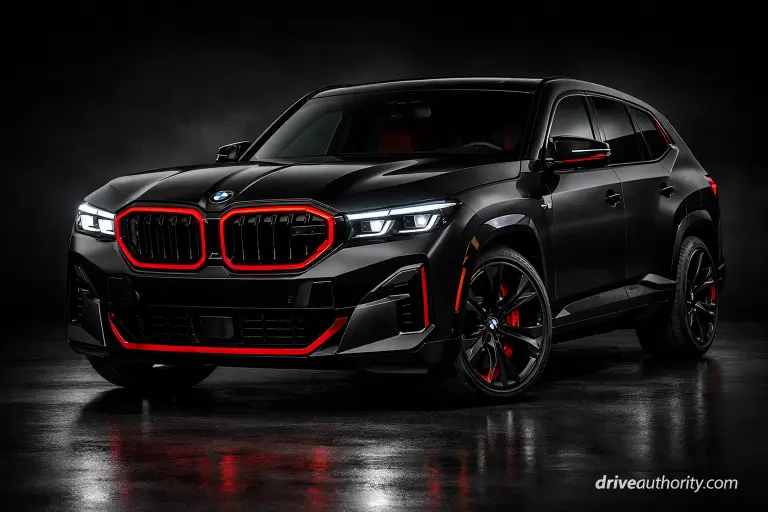
You’re searching for the BMW most expensive car, expecting pricing that’ll match Rolls-Royce or Bentley territory. Instead, you find numbers that seem almost… reasonable. The BMW XM Label Red sits at roughly $187,000, making it BMW’s priciest production model. Yet here’s the paradox: compared to what you’d expect from a flagship luxury machine pushing 738 horsepower, that’s borderline affordable.
This isn’t about BMW skimping on luxury. Rather, it’s about strategic positioning that makes even their most expensive offerings accessible compared to ultra-luxury rivals. Consequently, whether you’re cross-shopping flagship sedans or trying to understand BMW’s pricing philosophy, this breakdown reveals why BMW’s most expensive car might actually represent surprising value.
What Is the BMW Most Expensive Car Today?
The Current Title Holder: BMW’s Priciest Production Model
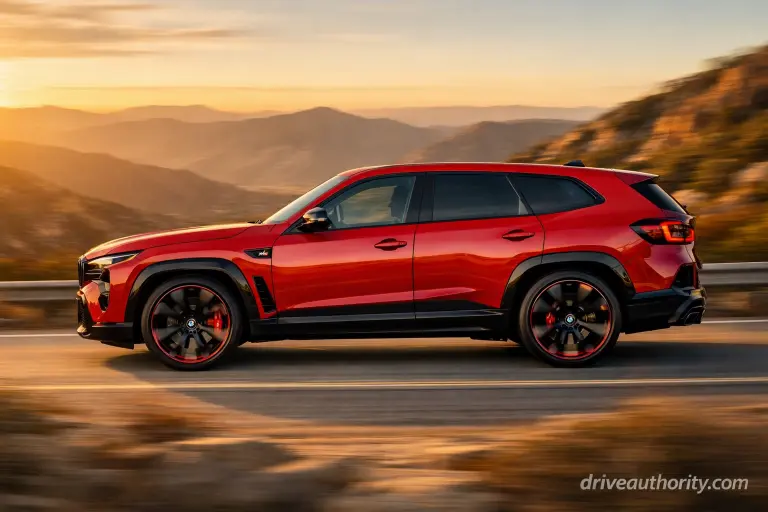
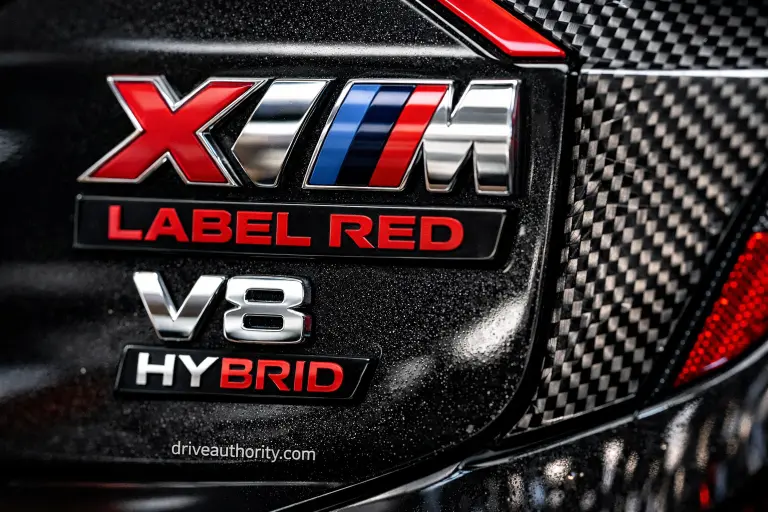
The BMW XM Label Red currently holds the crown as BMW’s most expensive production car, with pricing starting at $186,700 to $187,875 MSRP. Furthermore, this plug-in hybrid SUV isn’t just expensive—it’s BMW M’s first standalone model since the legendary M1 supercar and represents the brand’s boldest performance statement.
Real-world pricing varies significantly. For instance, dealer markups push fully-optioned XM Label Red models into the $188,000 to $199,000 range, with options like individual paint finishes, upgraded wheels, and interior customization easily adding $10,000-$15,000 to the sticker.
The BMW i7 M70 electric sedan follows at $168,500 MSRP, offering a more traditional luxury experience with cutting-edge electric performance. Then there’s the armored elephant in the room: the BMW i7 Protection and 7 Series Protection VR9 models, priced around $500,000 euros ($530,000-plus) for ballistic and explosive protection according to BMW’s official armored vehicle specifications.
Limited Editions vs Production Models
BMW’s pricing structure differentiates between showroom-accessible models and specialized builds. Specifically, the XM Label Red you can theoretically order today differs dramatically from protection variants built in Dingolfing’s specialized facility.
The M8 Competition Gran Coupe at $138,800 to $140,000 represents the most expensive non-SUV regular production BMW. Meanwhile, historic auction prices tell different stories—a 1957 BMW 507 once owned by John Surtees fetched $5 million at auction in 2018, proving collector value transcends production pricing entirely.
Price Breakdown: How Much Does the BMW Most Expensive Car Cost?
Base Price vs Fully Optioned Price for BMW’s Flagship
The $186,700 starting price for the XM Label Red is just the beginning. In fact, BMW Individual Manufaktur options can dramatically inflate costs:
- BMW Individual paint finishes: $3,000-$6,000
- 23-inch M light alloy wheels in Jet Black: $2,500-$4,000
- Bowers & Wilkins Diamond Surround Sound System: $4,200 (often standard on Label models)
- Executive rear seating packages: $5,000-$7,500
- Carbon fiber interior trim packages: $3,000-$5,000
Ultimately, a fully-loaded XM Label Red with every available option can breach $200,000, though most buyers cluster around the $190,000-$195,000 mark.
Regional Pricing Differences
BMW pricing varies dramatically by market. For example, the XM in India carries an ex-showroom price exceeding ₹2.6 crore (roughly $310,000) due to import duties and luxury taxes. Similarly, Middle Eastern markets see comparable premiums, while European pricing hovers around €185,000-€200,000 depending on VAT and country-specific fees.
On the other hand, U.S. buyers face the most competitive pricing, benefiting from BMW’s Spartanburg, South Carolina production facility for X models, though the XM is built in Greer, South Carolina specifically.
Specs That Justify the BMW Most Expensive Car Price
Powertrain & Performance
The XM Label Red pairs a 4.4-liter twin-turbocharged V8 with a performance-tuned electric motor, generating 738 horsepower at 5,600 RPM and 738 lb-ft of torque. Consequently, this makes it the most powerful road-going BMW ever produced.
Performance numbers include:
- 0-60 mph: 3.5-3.6 seconds
- Top speed: Electronically limited (typically 155 mph, with potential upgrades to 170+ mph)
- Electric-only range: Approximately 30-35 miles on WLTP cycle
- Combined fuel economy: Reality hits hard here—expect 15-18 mpg combined in real-world driving
Meanwhile, the i7 M70 delivers 650 horsepower from dual electric motors, hitting 0-60 mph in 3.5 seconds with a range of 268-285 miles.
Interior Luxury & Materials
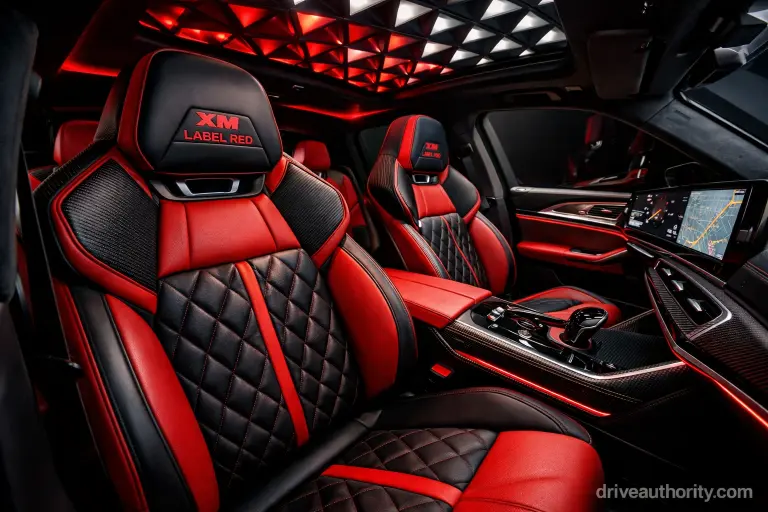
The XM Label features vintage leather on door trim and dashboard, BMW Individual Merino leather upholstery, and a sculptural three-dimensional prism headliner with 100 LED units. Unlike competitors who charge extra for luxury materials, BMW includes most premium touches standard on Label models.
Additionally, the cabin technology rivals anything from ultra-luxury brands:
- BMW Curved Display with 12.3-inch instrument cluster and 14.9-inch touchscreen
- Available 31-inch 8K BMW Theater Screen for rear passengers
- Premium Bowers & Wilkins sound system
- Four-zone climate control with individual rear touchscreens
Advanced Technology & Safety
Standard safety and driver assistance features include:
- Active Blind Spot Detection
- Lane Departure Warning with steering assistance
- Frontal Collision Warning with City Collision Mitigation
- Highway Assistant (hands-free driving up to 85 mph on equipped models)
- Parking Assistant Professional
Moreover, the XM Label employs Adaptive M Suspension Professional with electronically controlled dampers, active stabilizers, active roll stabilization, and Integral Active Steering with rear-wheel steering.
Why the BMW Most Expensive Car Feels “Cheap” in Comparison
Compared to Ultra-Luxury Brands
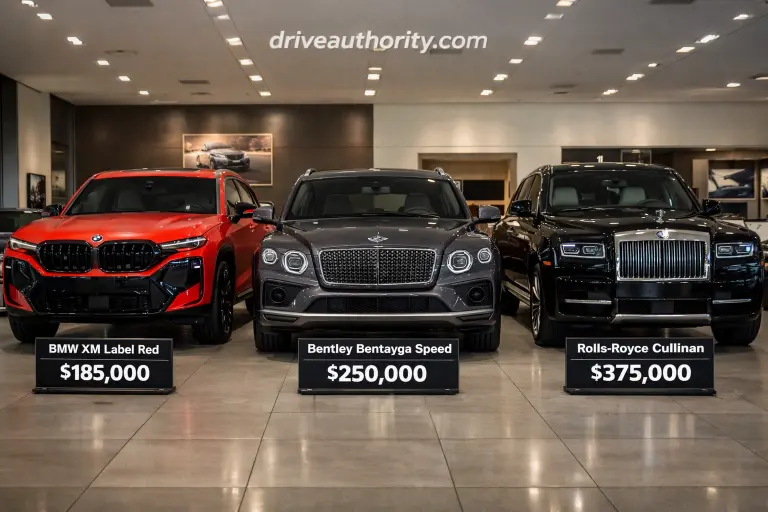
At $186,700, the XM Label costs roughly half what you’d pay for a Bentley Bentayga Speed ($250,000+) or Mercedes-Maybach GLS 600 ($160,000 base, easily $200,000+ optioned). In contrast, Rolls-Royce Cullinan starts around $350,000.
The performance-per-dollar equation favors BMW dramatically. Specifically, the XM’s 738 hp exceeds the Bentayga Speed’s 626 hp and costs $60,000-$80,000 less. Similarly, the Cullinan offers 563 hp for double the price.
Performance per Dollar Analysis
Breaking down cost versus performance reveals interesting patterns:
- XM Label Red: $253 per horsepower
- Bentley Bentayga Speed: $400+ per horsepower
- Rolls-Royce Cullinan: $622 per horsepower
- Lamborghini Urus: $333 per horsepower (650 hp, $230,000+ starting)
BMW’s engineering efficiency shows. Essentially, you’re paying for M division expertise, hybrid powertrain sophistication, and genuine usability—not just badge prestige.
Platform Sharing Across BMW Models
BMW’s CLAR platform architecture underpins the XM, 7 Series, X5, X6, and X7. As a result, this sharing reduces development costs dramatically compared to Rolls-Royce or Bentley’s dedicated platforms.
The XM Label shares:
- Base chassis architecture with X5/X6 (heavily modified)
- Suspension technology across M models
- Interior technology with 7 Series and i7
- Infotainment systems across the BMW range
This engineering efficiency translates to lower costs passed to buyers. Therefore, you’re not paying for ground-up bespoke engineering—you’re benefiting from scale.
Ownership Costs: The Hidden Side of BMW’s Top Model
Maintenance and Servicing
BMW’s maintenance costs remain reasonable compared to ultra-luxury rivals:
- Annual service: $1,200-$2,000 (versus $3,000-$5,000 for Bentley/Rolls-Royce)
- Brake service: $2,500-$4,000 for the XM’s M Sport brakes
- Tire replacement: $2,000-$3,000 (those 23-inch wheels aren’t cheap)
- Hybrid system service: Expect $500-$1,000 annually for battery conditioning and hybrid component checks
Additionally, BMW’s 4-year/50,000-mile warranty and included maintenance (varies by model and year) provide some cushion. According to Consumer Reports automotive cost analysis, BMW maintenance costs fall below most ultra-luxury competitors.
Warranty and After-Sales Support
BMW’s dealer network dwarfs ultra-luxury competitors. Consequently, finding service for an XM is infinitely easier than scheduling Rolls-Royce maintenance. Furthermore, parts availability favors BMW due to platform sharing—many components exist across multiple models.
Protection models receive specialized support through BMW’s Protection Vehicle division, with training programs for authorized service centers.
Depreciation Reality
BMW M8 models lose approximately 59.6% of their value over five years, and the XM will likely follow similar trajectories. Specifically, expect a $186,000 XM Label to be worth $75,000-$85,000 after five years.
First-year depreciation hits hardest—expect 20-25% loss immediately. Subsequently, by year three, you’re looking at 50% retained value. Interestingly, ultra-luxury brands actually hold value better: Porsche Panamera models lose about 47.3% over five years according to Kelley Blue Book depreciation data.
BMW Most Expensive Car vs Key Rivals
BMW vs Mercedes-Maybach
The Mercedes-AMG S 63 E Performance starts around $185,000—nearly identical to the XM Label. Similarly, the Maybach GLS 600 begins at $160,000 but easily reaches $200,000+ with options.
XM Label advantages:
- 100+ more horsepower
- More aggressive performance focus
- M division handling dynamics
Maybach advantages:
- Superior luxury materials and craftsmanship
- Better rear-seat experience
- Higher perceived prestige
- Better depreciation curve
BMW vs Porsche Flagship Models
The Porsche Panamera Turbo E-Hybrid delivers 670 hp and costs significantly more when optioned similarly, easily reaching $200,000+. Likewise, the Cayenne Turbo S E-Hybrid also crosses $180,000 well-equipped.
Performance comparisons favor different priorities. For instance, the M8 Competition Gran Coupe accelerates 0-100 km/h in 3.2 seconds with a top speed of 305 km/h (190 mph), while the Panamera Turbo E-Hybrid hits 60 mph in 3.0 seconds with a 195 mph top speed.
BMW advantages:
- Lower base pricing
- More aggressive styling
- Better technology integration
Porsche advantages:
- Superior handling precision
- Better build quality perception
- Stronger resale values
- More refined driving experience
BMW vs Electric Luxury Rivals
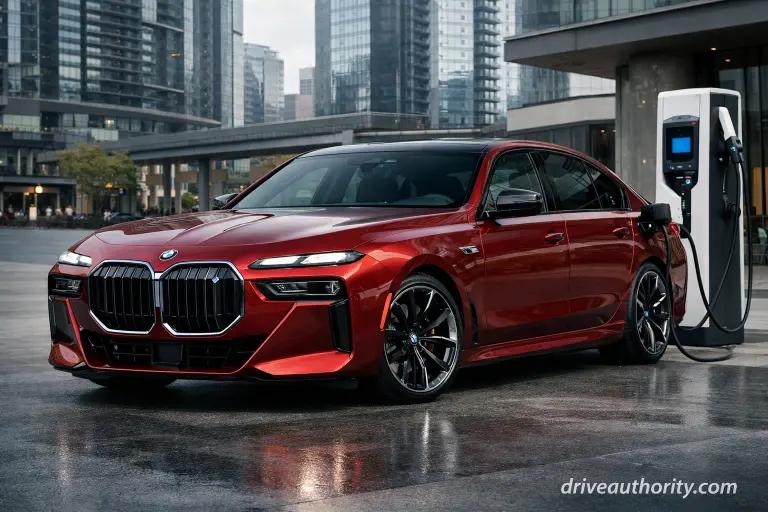
The i7 M70 at $168,500 competes directly with the Tesla Model S Plaid ($109,000), Mercedes-Benz EQS 580 ($125,000), and Lucid Air Sapphire ($250,000).
The i7 M70 offers more traditional luxury than the tech-forward Tesla, more space than the Lucid, and better driving dynamics than the EQS. However, Tesla’s Supercharger network and lower pricing make the Plaid compelling for performance-focused buyers who don’t need BMW’s luxury cocoon.
Who Should Buy BMW’s Most Expensive Car?
The ideal XM Label Red buyer:
- Values performance over badge prestige
- Wants flagship luxury without ultra-luxury pricing
- Needs practical daily usability (five seats, decent cargo space)
- Appreciates BMW M division heritage
- Desires hybrid capability for urban driving
- Can handle depreciation without financial stress
Meanwhile, the i7 M70 suits:
- Executive buyers wanting electric flagship experience
- Technology enthusiasts prioritizing cutting-edge features
- Drivers seeking silent, effortless luxury with supercar acceleration
- Buyers who value rear-seat comfort equally with driving dynamics
Who Should Not Buy the BMW Most Expensive Car
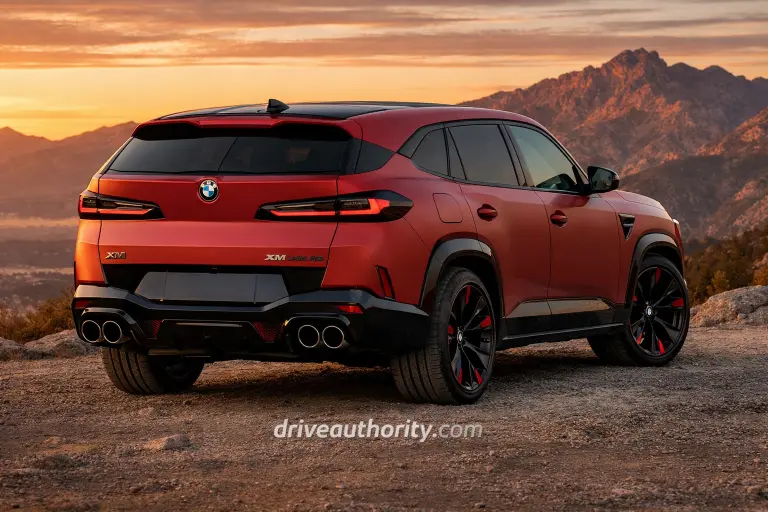
Skip the XM Label if:
- You prioritize badge prestige above all (buy Bentley/Rolls-Royce instead)
- You expect Maybach-level craftsmanship
- You want the most exclusive ownership experience
- You’re concerned about aggressive styling aging poorly
- You need strong resale value protection
- You prioritize ride comfort over handling precision
The XM’s bold design polarizes opinions. Specifically, some view it as overwrought, while others appreciate its aggressive presence. Therefore, if you prefer understated elegance, the 7 Series Protection or i7 M70 makes more sense.
Used Market Insight: Is the BMW Most Expensive Car a Bargain Later?
Depreciation-Driven Affordability
Give it three years, and used XM Label Red models will likely trade around $110,000-$130,000. In other words, that’s $60,000+ off original MSRP, making it tempting for performance bargain hunters.
However, used flagship BMWs carry risks:
- Hybrid system battery degradation
- Expensive maintenance deferred by original owners
- Complex technology systems prone to costly repairs
- Heavy depreciation continues even at lower price points
Risks of Buying Used Flagship BMWs
The most expensive BMWs are expensive to maintain regardless of used pricing. For example, a $100,000 used XM Label still has:
- $3,000+ annual maintenance costs
- $8,000+ for brake jobs
- $15,000-$25,000 hybrid system repairs outside warranty
- Tire costs that rival new economy cars
Consequently, Protection models rarely enter the used market—virtually all used BMW Protection vehicles return to BMW for training purposes.
The Real Meaning of “Expensive” in BMW’s Lineup
Why BMW Caps Its Pricing Intentionally
BMW deliberately positions below ultra-luxury brands to maintain volume and accessibility. Specifically, Rolls-Royce serves the ultra-wealthy. In contrast, BMW, even at its most expensive, targets successful professionals and enthusiasts who’d stretch for the flagship but wouldn’t consider $400,000+ vehicles.
This strategy protects BMW’s “Ultimate Driving Machine” ethos. Generally, ultra-luxury brands sacrifice driving dynamics for comfort and prestige. However, BMW’s most expensive models remain driver-focused performance machines first, luxury vehicles second.
Strategic Positioning Below Ultra-Luxury Brands
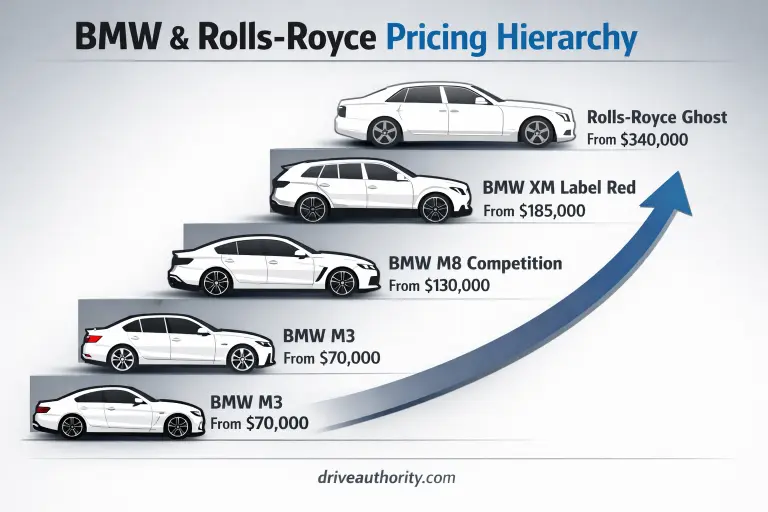
The gap between BMW’s most expensive production car (~$187,000) and Rolls-Royce’s cheapest model (Ghost at $340,000+) is intentional. Therefore, it creates clear segmentation:
- BMW: Performance-luxury for driving enthusiasts
- Rolls-Royce: Ultra-luxury for chauffeur-driven prestige
Even BMW’s armored protection models (~$530,000) cost less than standard Rolls-Royce or Bentley equivalents, despite offering military-grade security.
Verdict: Is BMW’s Most Expensive Car Worth It?
When It Offers Exceptional Value
The XM Label Red represents solid value if:
- You’re cross-shopping Bentayga Speed or Cayenne Turbo S E-Hybrid
- You prioritize performance (738 hp) over brand prestige
- You want hybrid capability in a high-performance SUV
- You value M division engineering and handling dynamics
- You can absorb depreciation as a cost of ownership
Similarly, the i7 M70 offers exceptional value against Mercedes EQS 580 or Lucid Air Grand Touring, delivering more traditional luxury with supercar-quick acceleration.
When It Fails to Justify the BMW Most Expensive Car Price
Skip BMW’s flagship models if:
- You’re comparing against more affordable M models (M5, M3, X5 M) that deliver 80% of the performance for half the cost
- You expect ultra-luxury craftsmanship rivaling Bentley or Maybach
- You need strong resale value protection
- You want the exclusivity of low production volumes
- You prioritize rear-seat luxury over driving experience
Final Recommendation by Buyer Type
Performance enthusiast: The XM Label Red delivers unmatched power in a practical package, but consider if the M5 or X5 M Competition ($110,000-$120,000) offers better value.
Technology-forward executive: The i7 M70 provides cutting-edge electric luxury with proper BMW driving dynamics—justifiable at $168,500.
Prestige-focused buyer: Look elsewhere. Instead, Mercedes-Maybach, Bentley, and Rolls-Royce offer more impressive badge appeal for similar or higher investment.
Value-conscious luxury shopper: Wait 2-3 years and buy used at 40-50% off MSRP. Essentially, let someone else absorb the depreciation hit.
The BMW most expensive car exists in a unique space—too expensive to be an easy decision, too affordable to compete with true ultra-luxury, yet capable enough to challenge anything on the road. Ultimately, it’s “cheap” only compared to expectations of what 738 horsepower and BMW’s flagship engineering should cost. In that context, $187,000 might actually be a bargain.
FAQ: BMW Most Expensive Car
What is the most expensive BMW ever made?
The BMW XM Label Red is currently the most expensive production BMW at $186,700-$187,875 MSRP. However, armored BMW 7 Series Protection and i7 Protection models reach approximately $530,000 for specialized builds. Historically, a 1957 BMW 507 sold for $5 million at auction.
Why is BMW cheaper than Rolls-Royce?
Rolls-Royce operates as BMW Group’s ultra-luxury division with bespoke craftsmanship, dedicated platforms, and lower production volumes. In contrast, BMW leverages platform sharing, higher production volumes, and engineering efficiency to maintain lower pricing while still delivering high performance and luxury.
Is BMW’s most expensive car reliable?
BMW flagship models historically show mixed reliability. Specifically, expect higher-than-average maintenance costs and potential issues with complex hybrid systems and advanced technology. However, the i7 M70’s simpler electric powertrain may prove more reliable long-term than the XM’s plug-in hybrid complexity.
Does BMW make ultra-luxury cars?
BMW’s own brand tops out around $200,000. For ultra-luxury, BMW Group offers Rolls-Royce, with models starting at $340,000+. Therefore, BMW deliberately positions below this threshold to maintain its driver-focused performance identity.
Will BMW ever build a $1M car?
Unlikely in regular production. Specifically, BMW’s brand positioning focuses on accessible performance-luxury. While one-off concepts or historic cars may reach $1M+ at auction, volume production models will likely remain under $250,000 to maintain brand identity and market position.