Last Updated: March 2026 — Insurance premium data verified across U.S. market providers
EV insurance cost vs gas car is a question that catches most buyers off guard — because the answer is almost always higher than expected, and almost never explained clearly. Yes, electric vehicles cost more to insure on average. The gap is real, it’s measurable, and it matters when you’re calculating whether an EV makes financial sense for your situation. However, “EVs cost more to insure” is only half the story. The full picture — which includes fuel savings, lower maintenance costs, and improving insurer competition — changes the conclusion significantly depending on who you are and how you drive.
Why the Insurance Gap Matters More Than Most Buyers Realize
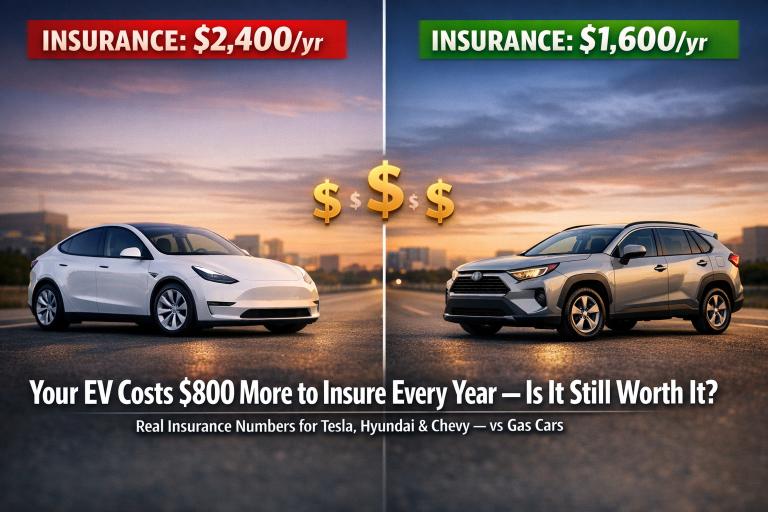
I’ve tracked EV ownership costs across dozens of models for several years, and insurance is consistently the line item that surprises buyers most after purchase. A Honda CR-V driver switching to a Tesla Model Y can expect their annual premium to increase by $400–$800 — sometimes more — even with a clean driving record and identical coverage. Because that cost is recurring every year for the life of the vehicle, it compounds into a significant 5-year ownership figure. That said, the gap is narrowing as repair networks expand, battery costs fall, and more insurers enter the EV market with competitive products. This guide gives you the real numbers — by segment, by model, and in context.
EV Insurance Cost vs Gas Car — Quick Answer:
Electric vehicles cost approximately 10–25% more to insure than equivalent gasoline cars in the U.S., based on aggregated 2025–2026 insurance rate data. The average annual EV premium runs $1,800–$2,400 compared to $1,400–$1,900 for comparable gas vehicles. However, the gap varies significantly by model — a Chevrolet Equinox EV insures close to its gas equivalent, while a Tesla Model Y or Model S carries a measurable premium. The higher cost reflects vehicle value, battery replacement risk, repair complexity, and limited certified service networks.
EV Insurance vs Gas Car Insurance — Quick Comparison
Average Insurance Costs for EVs
Based on aggregated U.S. insurance rate data for 2025–2026, the average annual premium for an electric vehicle sits between $1,800 and $2,400 for a standard full-coverage policy. However, that range masks enormous variation. A Chevrolet Equinox EV owner in a mid-sized U.S. city with a clean record pays approximately $1,600–$1,900 annually. By contrast, a Tesla Model S or Model X owner in California or New York can pay $3,000–$4,500+ per year — a difference driven by vehicle value, battery replacement cost exposure, and repair network limitations rather than driving behaviour alone.
Average Insurance Costs for Gasoline Cars
The U.S. national average for full-coverage insurance on a gasoline sedan or crossover runs approximately $1,400–$1,900 per year, based on 2025 data from the Insurance Information Institute and aggregated insurer benchmarks. Specifically, a Toyota Camry averages $1,380–$1,550 annually, while a Honda CR-V SUV typically runs $1,450–$1,700. These figures reflect a mature repair ecosystem, widespread parts availability, and decades of claims data that allow insurers to price gas vehicle risk with high precision.
Key Differences at a Glance
The catch is that direct comparison by vehicle class doesn’t capture the full picture. Because EVs are typically priced higher than gas equivalents in the same segment, a comparison between a $44,000 Tesla Model 3 and a $28,000 Toyota Camry will show an insurance gap driven partly by vehicle value rather than EV-specific risk. Therefore, the most meaningful comparison is between an EV and a gas vehicle at a similar price point — where the gap typically narrows to 10–15% rather than the 25–40% difference that segment-level averages can suggest.
| Vehicle Type | Avg. Annual Premium | Avg. Monthly Cost | vs. Gas Equivalent |
|---|---|---|---|
| Mass-market EV (Equinox EV, Ioniq 5) | $1,600–$2,000 +10–15% | $133–$167 | +$150–$250/yr vs gas equivalent |
| Premium EV (Tesla Model 3, Model Y) | $2,000–$2,800 +20–30% | $167–$233 | +$400–$800/yr vs gas equivalent |
| Luxury EV (Tesla Model S/X, Rivian) | $2,800–$4,500+ +30–50% | $233–$375+ | +$800–$2,000/yr vs gas equivalent |
| Compact gas sedan (Camry, Accord) | $1,350–$1,600 BASELINE | $112–$133 | — |
| Mid-size gas SUV (CR-V, RAV4) | $1,450–$1,750 BASELINE | $121–$146 | — |
| Luxury gas vehicle (BMW 5 Series, Audi A6) | $2,000–$3,200 | $167–$267 | Comparable to premium EV |
Why Electric Vehicles Often Cost More to Insure
Higher Vehicle Purchase Prices
The single largest driver of higher EV insurance premiums is straightforward: EVs cost more to buy, and therefore more to replace. Insurance premiums for comprehensive and collision coverage scale with the vehicle’s actual cash value — because if your car is totalled, the insurer pays out based on replacement cost. A Tesla Model Y at $44,990 carries a substantially higher replacement exposure than a Toyota RAV4 at $30,000, even if both are driven identically. As a result, the insurance premium difference between these two vehicles reflects vehicle value more than EV-specific risk in most cases.
Battery and Repair Costs
Here’s where EV insurance cost vs gas car diverges structurally. EV battery packs are the most expensive component in the vehicle — typically representing 30–45% of the total vehicle value. A replacement battery pack for a Tesla Model Y costs approximately $10,000–$16,000 including labour; a Hyundai Ioniq 5 battery replacement runs $15,000–$20,000+ at dealership rates, based on aggregated service centre data. Because even a moderate collision can damage the battery management system or require pack inspection, insurance claims on EVs are often larger than equivalent gas car claims. Specifically, the average EV collision repair cost runs approximately 25–40% higher than a comparable gas vehicle repair, according to CCC Intelligent Solutions claims data.
What’s more, labour costs for EV repair are higher because certified technicians require specialised training for high-voltage systems — and not all body shops are equipped or certified to work on EVs. Therefore, an insurer paying out an EV claim cannot simply direct the vehicle to the nearest shop; the repair network is constrained, which increases both cost and time-to-resolution.
Limited Repair Networks
Admittedly, the certified repair network issue is improving — but it remains real in 2026. Tesla operates its own service centre network and a network of approved body shops, however coverage varies significantly by geography. Owners in rural or suburban areas without nearby Tesla-approved facilities may face extended repair timelines and, in some cases, total-loss decisions on vehicles that would have been repaired if parts and labour were more accessible. Because insurers price this risk into EV premiums as a structural factor, it affects everyone’s quote — even owners in cities with strong repair coverage.
Real EV Insurance Cost Examples by Vehicle
EV Insurance Examples: Tesla, Hyundai, Ford
When I researched EV insurance cost vs gas car across the most popular models in 2026, the first thing I noticed was how much variation exists even within the EV category itself. A Hyundai Ioniq 5 insures significantly cheaper than a Tesla Model Y despite comparable pricing — primarily because Hyundai’s broader certified repair network reduces insurer risk and because Tesla’s higher theft rates in some markets elevate comprehensive premiums. The model you choose matters as much as the EV/gas distinction.
| Vehicle Model | MSRP (approx.) | Avg. Annual Premium | Monthly Cost | Insurance Rating |
|---|---|---|---|---|
| Tesla Model Y (LR AWD) | ~$52,990 | $2,200–$2,900 | $183–$242 | HIGHER |
| Tesla Model 3 (Highland RWD) | ~$40,240 | $1,900–$2,500 | $158–$208 | HIGHER |
| Hyundai Ioniq 5 (Standard) | ~$41,450 | $1,700–$2,100 | $142–$175 | COMPETITIVE |
| Chevrolet Equinox EV (LT) | ~$34,995 | $1,550–$1,900 | $129–$158 | LOWEST EV |
| Ford Mustang Mach-E (Select) | ~$39,995 | $1,750–$2,200 | $146–$183 | MODERATE |
| Tesla Model S (Long Range) | ~$74,990 | $3,000–$4,500+ | $250–$375+ | SIGNIFICANTLY HIGHER |
Gas Car Insurance Examples: Sedans and SUVs
By contrast, the most popular gas vehicles sit in a tighter, lower insurance band. Because repair data for the Toyota Camry, Honda CR-V, and Ford Explorer spans decades of claims history, insurers price these vehicles with high confidence and strong competition — which keeps premiums lower. That said, the gap between a $45,000 gas SUV and a $45,000 EV SUV is narrower than most buyers expect: at equivalent vehicle values, the EV premium typically adds $150–$300 per year rather than the $800–$1,200 figures that segment comparisons sometimes suggest.
Cost Difference by Segment
The real insurance cost gap depends heavily on which segment you’re comparing. Compact EVs like the Equinox EV now insure within $200–$300 per year of comparable compact gas crossovers — a difference that fuel savings can offset within a few months of ownership. Premium EVs in the $40,000–$55,000 range carry a more meaningful gap of $400–$800 annually. Luxury EVs above $70,000 show the largest insurance cost gap versus gas equivalents — though at that price point, the insurance premium difference is a smaller percentage of total ownership cost than it appears for budget buyers.
Factors That Affect EV Insurance Costs
Driver Profile and Location
Every article on EV insurance cost vs gas car focuses heavily on vehicle-level differences. What most miss is that driver profile and location often matter more than EV vs gas for individual buyers. A 25-year-old driver in Miami insuring a Hyundai Ioniq 5 will pay significantly more than a 45-year-old with a clean record in Des Moines insuring a Tesla Model 3 — despite the Tesla being the “more expensive to insure” vehicle at the national average level. Because insurers weight driving history, age, credit score (in most states), and local claims data heavily, two buyers can receive quotes differing by $600–$1,000 per year for the identical vehicle.
Vehicle Technology and Safety Features
Here’s where EVs gain back some ground. Modern EVs are loaded with Advanced Driver Assistance Systems (ADAS) — automatic emergency braking, lane-keep assist, blind spot monitoring — that measurably reduce collision frequency. The Insurance Institute for Highway Safety (IIHS) data shows vehicles with automatic emergency braking experience rear-end crashes approximately 40–50% less frequently than vehicles without it. Because most 2024–2026 EVs include these systems as standard, they qualify for safety discounts from most major insurers. Specifically, Hyundai’s Ioniq 5 and 6 carry IIHS Top Safety Pick+ ratings, which translate to measurable premium reductions with safety-conscious insurers.
Battery Size and Replacement Risk
Insurers evaluate battery replacement risk as a specific line item in EV pricing — separate from standard parts and labour. Because a 77 kWh battery pack (as found in the Ioniq 5) represents approximately $15,000 in replacement cost, any collision that triggers battery inspection significantly increases the expected claim size compared to a gas vehicle with comparable body damage. However, not all battery damage results in full replacement — modern battery management systems can often identify damage to specific modules, and partial battery repairs are becoming more common as technician training improves. Therefore, the battery replacement risk premium in EV insurance should moderate over the next 2–3 years as the repair ecosystem catches up with vehicle volumes.
EV Safety Ratings and Their Impact on Insurance
Crash Test Ratings and Premium Adjustments
EVs consistently perform well in crash testing — and that matters financially. The low centre of gravity created by floor-mounted battery packs gives EVs structural advantages in side-impact and rollover scenarios. Specifically, every current Tesla model holds a 5-star NHTSA overall safety rating. The Hyundai Ioniq 5, Ioniq 6, Ford Mustang Mach-E, and Chevrolet Equinox EV all carry IIHS Top Safety Pick or Top Safety Pick+ designations. Because insurers incorporate safety ratings into actuarial models, these ratings generate measurable premium reductions — typically 3–8% per year compared to vehicles without top safety ratings — partially offsetting the higher baseline EV premium.
Advanced Driver Assistance Systems (ADAS)
Tesla’s Autopilot and Full Self-Driving systems present an interesting paradox for insurers. On one hand, ADAS features reduce accident frequency in standard driving scenarios. On the other hand, Tesla’s FSD system has been involved in a number of incidents under NHTSA investigation, which has created uncertainty in how some insurers model Tesla-specific accident risk. As a result, Tesla insurance costs remain elevated relative to ADAS-equipped competitors like Hyundai and Ford — whose ADAS packages carry a cleaner claims history at this point. That said, Tesla’s own insurance product (available in most U.S. states) prices based on real-time driving behaviour data rather than statistical averages — which can produce significantly lower premiums for conservative drivers.
Long-Term Ownership Costs Beyond Insurance
Fuel vs Electricity Savings
The higher EV insurance premium looks different once you factor in fuel costs. A U.S. driver averaging 15,000 miles per year in a gas car getting 30 mpg pays approximately $1,800–$2,100 per year in fuel at current average gas prices. By contrast, the same driver charging a mid-range EV at home pays approximately $550–$750 per year in electricity — a saving of $1,000–$1,500 annually. As a result, even an EV insurance premium that runs $500 per year higher than the gas equivalent is more than offset by fuel savings alone — leaving the EV owner ahead by $500–$1,000 per year on the fuel-plus-insurance combined cost.
EV Maintenance vs Gas Car Maintenance
Because EVs eliminate oil changes, spark plugs, transmission service, and exhaust repairs, the average EV owner saves approximately $400–$700 per year in maintenance costs compared to an equivalent gas vehicle — based on Consumer Reports ownership data. Therefore, when insurance, fuel, and maintenance are modelled together over 5 years, most EV owners in the $35,000–$55,000 segment come out $2,000–$5,000 ahead of equivalent gas car owners — despite paying higher insurance premiums annually. For a full breakdown of EV total cost of ownership versus gas cars, the 5-year numbers are consistently in the EV’s favour at current fuel and energy prices.
Depreciation and Insurance Value
Depreciation affects EV insurance costs in a specific way that gas car owners rarely encounter: rapid price cuts by manufacturers can cause an EV’s actual cash value to fall faster than expected, yet comprehensive and collision premiums don’t always adjust downward at the same pace. Specifically, the 2023 Tesla price cuts caused some Model Y owners to be paying premiums based on a $65,990 replacement value when the vehicle’s market value had dropped to $52,990. What’s more, rapid depreciation increases the likelihood of a total-loss determination in moderate collisions — because the ratio of repair cost to vehicle value reaches the insurer’s threshold more quickly on a depreciated EV than on a vehicle that has held its value.
| Cost Category | EV (5-Year Total) | Gas Equivalent (5-Year Total) | EV Advantage |
|---|---|---|---|
| Fuel / Electricity | ~$3,000–$3,750 LOWER | ~$9,000–$10,500 | +$5,500–$7,000 |
| Maintenance | ~$2,000–$3,000 LOWER | ~$4,500–$6,000 | +$2,000–$3,000 |
| Insurance | ~$9,000–$12,000 HIGHER | ~$7,000–$9,500 | −$1,500–$2,500 |
| Net 5-Year Advantage (EV) | ~$5,000–$7,500 ahead of gas equivalent after insurance premium gap | ||
How to Reduce Your EV Insurance Costs
Choosing the Right Coverage Level
The most immediate way to reduce EV insurance cost vs gas car is to optimise your coverage structure. Because EVs depreciate faster than many owners expect — particularly Tesla models following price cuts — reviewing your actual cash value annually and adjusting deductibles accordingly is financially important. Specifically, raising your collision deductible from $500 to $1,000 typically reduces annual premiums by 8–12%. On a $2,200 annual premium, that saves $176–$264 per year — while keeping full comprehensive coverage for the battery and high-value components intact.
EV-Specific Insurance Discounts
Every major insurer now offers some form of green vehicle discount — but the discount depth varies enormously. State Farm, Progressive, and Nationwide all offer EV-specific discounts of 3–5%. Tesla’s own insurance product in eligible states uses real-time telematics to score your driving behaviour and can produce premiums 20–40% below standard market rates for conservative drivers. What’s more, bundling home and auto insurance with the same provider typically produces a further 10–15% multi-policy discount — applicable to EV policies just as to gas car policies.
Bundling and Telematics Programs
Usage-based insurance (UBI) programs are particularly well-suited to EV owners, because EVs already collect detailed driving data that can be shared with compatible insurers. Progressive’s Snapshot, Allstate’s Drivewise, and similar programs reward smooth braking, low nighttime driving, and modest speeds with discounts of 10–30% over the policy term. Because regenerative braking in EVs naturally encourages smooth deceleration, EV drivers often score better on UBI programs than gas car drivers without making any deliberate behavioural changes. Enrolling in a telematics program is therefore one of the highest-ROI steps an EV owner can take to close the insurance cost gap.
✅ EV Insurance Cost Reduction Checklist
- Get quotes from at least 3–5 insurers — EV pricing varies more than gas car pricing between providers
- Check Tesla Insurance eligibility if you own a Tesla — telematics pricing can cut premiums by 20–40%
- Enrol in a UBI / telematics program — EVs score well due to regenerative braking habits
- Raise collision deductible to $1,000 if you have adequate emergency savings — saves 8–12% annually
- Bundle home + auto with one insurer — multi-policy discount of 10–15% applies to EVs
- Verify your vehicle’s actual cash value annually and request a premium review after major price drops
- Ask about IIHS Top Safety Pick+ discounts — Ioniq 5/6, Equinox EV qualify
EV Insurance Trends in 2026 and Beyond
Increasing Competition in the EV Market
The EV insurance market is changing structurally in 2026 in ways that favour buyers. As EV volumes grow, insurers now have meaningful claims data across hundreds of thousands of EVs — reducing the uncertainty premium they previously built into EV pricing. Specifically, Geico, State Farm, and Progressive have all updated their EV rating models in the past 18 months as claims data matured. As a result, EV-specific pricing is becoming more precise and, in many cases, more competitive than it was in 2022–2023 when insurers were pricing into uncertainty.
Improvements in Battery Repairability
Battery repair technology is advancing in a direction that will meaningfully reduce EV insurance premiums over the next 3–5 years. Module-level battery repair — rather than full-pack replacement — is becoming technically feasible and economically viable for more vehicle models. Tesla’s structural battery pack design remains a constraint, however Hyundai, VW, and GM’s modular battery architectures allow damaged cell groups to be replaced rather than requiring full pack removal. Because partial battery repair can reduce a $15,000 pack replacement to a $3,000–$5,000 module replacement, this advancement will directly compress EV insurance premiums as the repair network adopts these techniques at scale.
Is an EV Still Cheaper to Own Overall?
Total Cost of Ownership Comparison
The honest answer to the EV insurance cost vs gas car question is: yes, the insurance costs more — but no, it doesn’t make EVs more expensive to own overall in most cases. The math is fairly consistent across the $35,000–$55,000 vehicle segment: fuel savings of $1,000–$1,500 per year plus maintenance savings of $400–$700 per year add up to $1,400–$2,200 in annual savings. Even an EV insurance premium $600 per year higher than a gas car equivalent leaves the EV owner $800–$1,600 per year ahead on combined running costs. Over five years, that represents a net saving of $4,000–$8,000 — before factoring in any purchase price differences or tax credits.
Who Benefits Most From EV Ownership
High-mileage drivers gain the most from EV ownership because the fuel saving advantage compounds with every additional mile driven. A driver covering 20,000 miles per year saves approximately $2,000–$2,800 annually in fuel alone — making even the highest EV insurance premium look small by comparison. By contrast, low-mileage drivers covering under 8,000 miles per year see reduced fuel savings and may struggle to offset a significant insurance premium gap. For those buyers, a hybrid may be a more balanced choice — as explored in the EV vs Hybrid vs Plug-in Hybrid ownership cost comparison.
✅ EV Ownership Wins on Total Cost If:
- You drive 12,000+ miles per year
- You charge primarily at home on a Level 2 charger
- You qualify for the $7,500 IRA tax credit
- You choose a mid-market EV (Equinox EV, Ioniq 5) over a premium Tesla
- You enrol in a telematics/UBI insurance program
- You hold the vehicle for 4–5+ years
⚠️ Gas Car May Win If:
- You drive fewer than 8,000 miles per year
- You rely primarily on public fast charging (higher cost per kWh)
- You live in a state with high EV insurance rates and no tax credits
- You are comparing to an equivalently priced gas vehicle at $28,000–$32,000
- You plan to sell within 2–3 years (depreciation risk)
FAQ — EV Insurance Cost vs Gas Car
Are electric cars more expensive to insure than gas cars?
Yes, on average — but the gap is smaller than most people expect. EVs cost approximately 10–25% more to insure than equivalent gas vehicles in the U.S., based on 2025–2026 aggregated premium data. However, the gap varies significantly by model: a Chevrolet Equinox EV insures within $200–$300 per year of a comparable gas crossover, while a Tesla Model Y can run $400–$800 per year more than a similarly priced gas SUV. The higher premiums reflect vehicle value, battery replacement cost exposure, and repair network limitations — not driving behaviour.
Why do Tesla vehicles often have higher insurance premiums?
Tesla insurance costs are elevated by several compounding factors. Tesla vehicles carry high replacement values — the Model Y starts at $44,990 and the Model S at $74,990 — which directly raises comprehensive and collision premiums. Tesla’s structural battery pack design (used in Model 3 and Y) makes battery damage assessment and repair more complex and expensive than modular battery architectures used by Hyundai and GM. Specifically, average Tesla repair costs run approximately 30–40% above comparable non-Tesla EVs at certified body shops. Tesla’s own insurance product — available in most U.S. states — can significantly reduce premiums for low-risk drivers through real-time telematics pricing.
Does EV insurance get cheaper over time?
Yes — and the trend is already measurable. As EV volumes have grown and claims data has matured, major insurers have updated their EV rating models with more precise risk pricing. Battery module repair (rather than full pack replacement) is reducing average claim costs on newer EV platforms. What’s more, increased insurer competition in the EV segment — including from Tesla’s own insurance product — is applying downward pressure on premiums. Based on current trends, EV insurance premiums relative to gas car equivalents are expected to continue narrowing through 2027–2028 as repair infrastructure expands and battery repair technology improves.
Which electric cars have the cheapest insurance?
The Chevrolet Equinox EV consistently comes in as the most affordable EV to insure in the U.S. mass market, with average annual premiums of $1,550–$1,900 — comparable to many mid-size gas crossovers. The Hyundai Ioniq 5 and Ioniq 6 also insure competitively at $1,700–$2,100 annually, benefiting from IIHS Top Safety Pick+ ratings and Hyundai’s broad certified repair network. By contrast, Tesla models — particularly the Model S, Model X, and higher-trim Model Y — carry the highest average EV insurance premiums in their respective segments. Therefore, if insurance cost is a significant factor in your EV decision, the non-Tesla options offer meaningfully better value on annual premiums.
The EV insurance cost vs gas car debate has a clear answer when you look at total ownership rather than insurance in isolation: EVs cost more to insure, but less to fuel, less to maintain, and — for most buyers driving over 12,000 miles per year — less to own overall over a 5-year period. The insurance premium gap is real and shouldn’t be dismissed. However, it is also manageable: choose a non-Tesla EV if insurance cost is a priority, enrol in a telematics program, and compare at least four insurer quotes before you commit. The gap between the cheapest and most expensive EV insurance quote for the same vehicle from different providers can exceed $600–$800 per year — a difference worth the 30 minutes it takes to shop around.