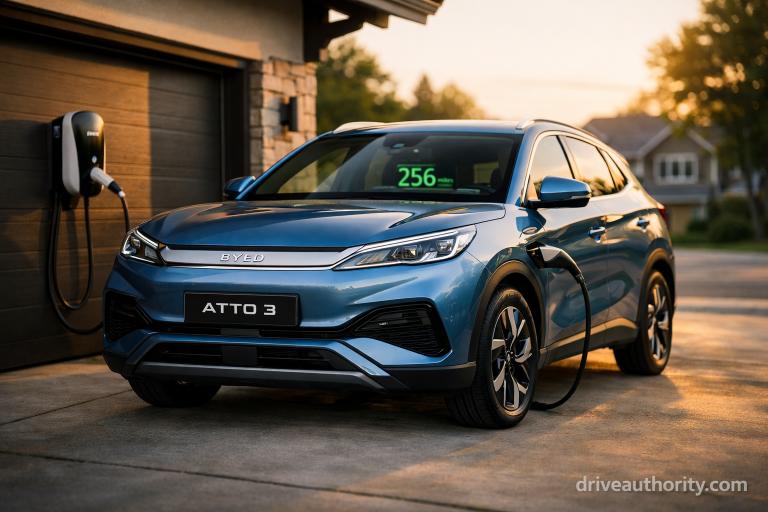
Short answer: The BYD Atto 3 advertises up to 260 miles of range, but most US buyers discover they get 180-210 miles in real-world conditions—and that’s before winter hits.
BYD Atto 3 Real-World Range (Quick Reality Check)
- Advertised: up to 260 miles
- Typical real-world: 180–210 miles
- Winter (cold climates): 140–170 miles
The BYD Atto 3 promises competitive range at an attractive price point, making it tempting for budget-conscious EV shoppers. But the gap between advertised range and actual daily performance creates uncertainty for buyers trying to plan their charging routines and determine if this Chinese electric SUV fits their lifestyle. The range discrepancy isn’t a defect—it’s the predictable result of how automakers test EVs versus how Americans actually drive them.
This gap is normal for EVs—and predictable once you understand how range testing works.
What the Range Problem Really Is
The BYD Atto 3’s range issue stems from the difference between laboratory testing conditions and real-world American driving patterns. When BYD tests the Atto 3 under controlled conditions—constant 55 mph speeds, no climate control, flat roads, and optimal battery temperature—the vehicle achieves its maximum rated range. These test conditions rarely match actual ownership.
Consider a typical suburban commuter:
- Highway speeds of 65-75 mph
- Air conditioning running during summer months
- Occasional stop-and-go traffic
- Hilly terrain
Each factor pulls range downward. The electric motor works harder at highway speeds due to wind resistance. Climate control systems draw significant power—sometimes 15-20% of battery capacity in extreme temperatures. Elevation changes force the battery to work harder on inclines, and aggressive acceleration patterns in traffic further reduce efficiency.
The BYD Atto 3 uses a 60.5 kWh battery pack, which is mid-sized for today’s EV market. While adequate for many drivers, this battery capacity means less buffer when real-world conditions reduce efficiency.
Key Insight: The Atto 3 doesn’t lose more range than other EVs—it just has less battery buffer to hide those losses.
Unlike larger battery packs that can absorb efficiency losses while still delivering usable range, the Atto 3’s battery size makes those losses more noticeable in daily driving.
Why Most People Misunderstand BYD Atto 3 Range
Many shoppers assume that advertised EV range works like a gas tank—if it says 260 miles, you can drive 260 miles regardless of conditions. This misconception leads to disappointment when reality doesn’t match expectations. The truth is that EV range behaves more like fuel economy ratings on gas vehicles: it’s a best-case scenario, not a guarantee.
Another common misunderstanding involves comparing Chinese EVs to established brands. Some buyers believe newer Chinese manufacturers like BYD somehow use inferior battery technology that explains the range gap. The reality is that all EVs—regardless of manufacturer—experience similar percentage drops between rated and real-world range. For comparison, a Tesla Model Y rated at 330 miles often delivers 260-280 miles in similar conditions—showing that percentage loss is normal across all EVs.
Tesla feels more consistent because a larger battery makes efficiency losses less noticeable—not because the losses don’t exist.
The difference is that larger battery packs hide the efficiency losses better.
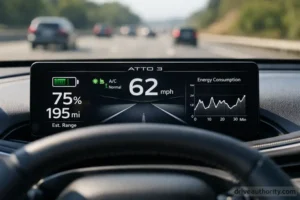
What actually matters for the BYD Atto 3 isn’t the advertised maximum range—it’s whether the real-world range of 180-210 miles covers your daily driving needs with margin for unexpected detours or charging delays. Most American households drive 30-40 miles per day, making even the reduced range perfectly adequate for regular commuting if home charging is available.
Secondary Factors That Amplify the Range Problem
Beyond the primary testing-versus-reality gap, a few other elements affect BYD Atto 3 range but aren’t the core issue:
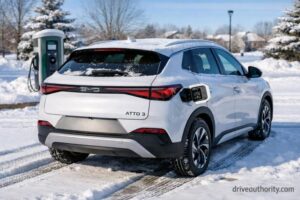
Cold weather battery chemistry: Like all lithium-ion batteries, the Atto 3’s battery loses capacity in freezing temperatures. Buyers in northern states might see range drop to 140-170 miles during winter months, though this affects every EV on the market to varying degrees. Understanding common problems with Chinese electric cars helps set realistic expectations across all weather conditions.
Charging infrastructure anxiety: Some buyers worry about the Atto 3’s range because public charging networks in their area are sparse. While legitimate, this is separate from the vehicle’s actual range capability—it’s an infrastructure question, not a battery limitation.
Software calibration differences: BYD’s range estimation software may be calibrated differently than American brands, potentially showing more optimistic remaining range on the dashboard than drivers will actually achieve. This creates perception problems even when the battery performs as designed.
How to Tell If BYD Atto 3 Range Affects You
This range limitation matters differently depending on your specific driving patterns and charging access:
You should be concerned if:
- Your daily commute exceeds 80 miles round-trip without guaranteed charging access at work or home
- You regularly drive in extreme temperatures (below 20°F or above 95°F) where climate control is essential
- You frequently take weekend trips of 150+ miles and your area has limited DC fast charging stations
- You live in an apartment or rental without reliable overnight charging access
- Your driving style involves frequent highway speeds above 70 mph
- You need one vehicle to handle both daily commuting and occasional long-distance travel without careful planning
You should feel confident if:
- Your daily driving totals less than 60 miles with home charging available each night
- You have a second vehicle for long trips or are comfortable with strategic charging stops
- Your commute involves primarily city or suburban driving at speeds below 60 mph
- You live in moderate climates where extreme heating or cooling isn’t required year-round
- You’re comfortable planning routes around charging infrastructure for longer trips
- Your work provides charging stations, effectively giving you two charging opportunities daily
Rule of Thumb: If your lifestyle puts you in the “concerned” list more than twice, range will require active planning.
The fundamental question isn’t whether the BYD Atto 3’s real-world range matches its advertised maximum—it won’t. The question is whether 180-210 miles of actual range fits your lifestyle without creating daily anxiety or constant charging calculations.
Practical, Safe Next Steps
Calculate your actual needs first: Track your current weekly driving for two weeks. Note your longest single-day trip and your typical daily mileage. If your longest regular day is under 140 miles, the Atto 3’s real-world range provides adequate buffer even in winter. If you regularly exceed 160 miles in a day, you’ll need to identify charging locations along your routes or consider EVs with longer range.
Test drive in your actual conditions: Request a longer test drive that includes highway speeds, climate control usage, and the type of terrain you regularly encounter. Many dealerships now allow extended test drives specifically for EV evaluation. Pay attention to the range estimate’s rate of decrease relative to actual miles driven—this ratio reveals your personal efficiency under real conditions. Don’t rely on the salesperson’s estimates; the only valid data comes from your specific driving patterns.
Verify your charging infrastructure: Map DC fast charging locations along routes you drive monthly or more frequently. Download apps like PlugShare or ChargePoint to identify station locations, user reviews, and reliability ratings. For the BYD Atto 3, you’ll want to confirm CCS1 compatible stations are available, as BYD uses industry-standard charging ports. If your regular routes lack adequate charging infrastructure, the Atto 3’s range becomes more limiting regardless of its absolute capability.
Consider your backup plans: Determine whether you have alternative transportation for situations where the Atto 3’s range doesn’t suffice. This might mean access to a partner’s vehicle, rental car budgets for road trips, or flexibility to adjust travel timing around charging needs. Many successful EV owners treat their electric vehicle as their primary car but maintain backup options for edge cases. Understanding total ownership costs including occasional rentals helps set realistic expectations.
Compare against actual alternatives in your budget: If you’re cross-shopping the BYD Atto 3, you’re likely looking at vehicles under $40,000. Research comparable EVs in this price range and compare their real-world range reports from actual owners, not just advertised specs. The Atto 3 might offer better value despite shorter range if its other features align with your priorities. Focus on total cost of ownership over three years rather than range numbers alone.
For Canadian buyers specifically: Recognize that winter range reduction will be more severe than US buyers experience. Budget for 140-160 miles of winter range when planning cold-weather reliability. Ensure your home charging setup can deliver a full charge overnight even when the battery is cold, as charging times increase in freezing temperatures. Some Canadian provinces offer EV incentives that might make vehicles with larger batteries more cost-competitive with the Atto 3.
When to Consider Expert Help
If you’re uncertain whether the BYD Atto 3’s real-world range meets your needs after calculating your actual mileage, consult with an EV specialist or electric vehicle dealership advisor who can review your specific driving patterns. They can provide data from other Atto 3 owners in similar climates and driving conditions to help you make an informed decision.
For buyers concerned about common problems with Chinese electric cars, speaking with current BYD owners or visiting online ownership forums provides unfiltered insights into range performance over time. Range capabilities sometimes degrade with battery age, so understanding long-term expectations matters as much as initial performance.
Frequently Asked Questions About BYD Atto 3 Range
What is the real-world range of the BYD Atto 3? Most owners report 180-210 miles under typical driving conditions with mixed highway and city driving, climate control use, and moderate temperatures. This drops to 140-170 miles in winter conditions.
How does BYD Atto 3 range compare to Tesla? The BYD versus Tesla comparison shows that Tesla models typically offer 15-25% more real-world range due to larger battery packs and more efficient powertrains, though at higher prices.
Does the BYD Atto 3 have range anxiety issues? Range anxiety with the Atto 3 depends entirely on your charging access and daily driving needs. With home charging and daily trips under 100 miles, most owners report no anxiety. Without reliable charging access, the limited range becomes problematic.
How long does it take to charge a BYD Atto 3? Charging time varies based on charger type: 7-8 hours on a Level 2 home charger, or 30-40 minutes to 80% on DC fast charging, which is adequate for the battery size.
Is 180 miles of range enough for daily driving? For 90% of American households with average daily driving under 40 miles, 180 miles provides more than adequate range. It becomes limiting only for high-mileage commuters or those without regular charging access.
How does cold weather affect BYD Atto 3 battery range? Cold temperatures reduce lithium-ion battery efficiency by 20-40% depending on severity. The Atto 3 experiences similar losses to other EVs—expect 140-160 miles in sustained freezing conditions.
Is BYD overstating the Atto 3’s range? No. BYD follows the same industry testing standards as all manufacturers. The 260-mile rating reflects optimal laboratory conditions, just like EPA ratings for every other EV. The gap between rated and real-world range is industry-wide, not specific to BYD or Chinese automakers.
Decision Rule: Is BYD Atto 3 Range Right for You?
If you can charge at home and drive under 100 miles per day, the BYD Atto 3’s real-world range is not a problem. If you can’t, it will be.
This simple test determines whether range becomes a daily concern or simply background information. Home charging transforms the Atto 3’s 180-210 mile range into more than enough capacity, since you start each day with a full battery. Without home charging, even 260 miles would eventually create planning challenges.
Final Takeaway
The BYD Atto 3’s range gap between advertised specs and real-world performance isn’t unique to this vehicle or to Chinese EVs generally—it’s a characteristic of how all electric vehicles are tested and rated. The meaningful question for potential buyers isn’t whether the Atto 3 delivers its maximum advertised range in all conditions, because no EV does. The question is whether its realistic 180-210 mile range capability matches your actual daily driving needs with enough margin for unexpected situations.
For buyers with home charging access and daily driving under 100 miles, the BYD Atto 3’s real-world range provides comfortable coverage. For high-mileage commuters, frequent long-distance travelers, or those without reliable charging infrastructure, the reduced range creates legitimate limitations that require careful planning or consideration of alternatives with larger batteries.
The clearer you are about your actual mileage needs, charging access, and climate conditions, the better decision you’ll make about whether the BYD Atto 3’s range works for your specific situation—regardless of what the spec sheet promises.
If you’re comparing Chinese EV options with similar range capabilities, see our detailed analysis of the best Chinese EVs for 2026 to understand how the Atto 3 stacks up against direct competitors.
External Resources:
- EPA Fuel Economy Guide – Official US government vehicle efficiency ratings and methodology
- BYD Global Official Website – Manufacturer specifications and technical details