Last Updated: May 2026 — Euro NCAP Safety Assist data, owner community fault reports (BYD, MG, GWM ORA), CAP HPI residual values, and UK dealer network figures verified
Chinese electric cars have five documented problem categories in 2026: software instability, after-sales network gaps, parts availability delays, ADAS calibration weaknesses, and residual value deterioration. Not every brand has all five. However, the severity varies so dramatically by manufacturer that treating them as a single category produces the wrong conclusion. A BYD Seal owner’s complaints look nothing like a GWM ORA Funky Cat owner’s complaints. An MG ZS EV after 50,000 km has different problems from an MG4 Electric after 30,000 km. This article covers what the documented data shows — and which problems are serious enough to change a purchase decision.
The most important thing to understand before reading this: the problems that matter most are not the ones buyers expect. Battery failure rates among mainstream Chinese EVs in Western markets are low. Motor reliability is not the dominant fault category. Instead, the problems that most affect day-to-day ownership in 2026 are software quality, dealer network depth, and the structural risk of buying from a brand that may not sustain its Western operations long enough to honour a 7-year warranty.

Common Problems With Chinese Electric Cars in 2026 — Summary:
The five documented problem categories are: software instability (most common, worst on GWM ORA 2022–2023 builds), after-sales network gaps (BYD operates ~100 UK dealers vs 180+ for MG and 400+ for Toyota), parts delays (owner reports of 8–16 week waits for body panels on some models), ADAS calibration weaknesses (MG4 scored 69% on Euro NCAP Safety Assist vs Tesla’s 98%), and faster-than-average residual value loss (BYD Atto 3 retains approximately 38–42% of its value at 3 years in the UK, below the segment average). Battery and motor reliability are not the dominant problem categories. The after-sales risk is.
The Five Problem Categories: What the Data Shows
Categorising the documented problems across Chinese electric cars in Western markets produces five distinct groups. Each group has a different cause, a different severity level, and a different set of brands most affected. Understanding the distinction matters because it changes which problem is worth worrying about — and which is being over-stated.
1. Software instability: Covers infotainment freezes, OTA update failures, navigation accuracy in Western markets, and ADAS system behaviour. This is the most widely reported category across UK and Australian owner communities. It affects some brands significantly and others minimally.
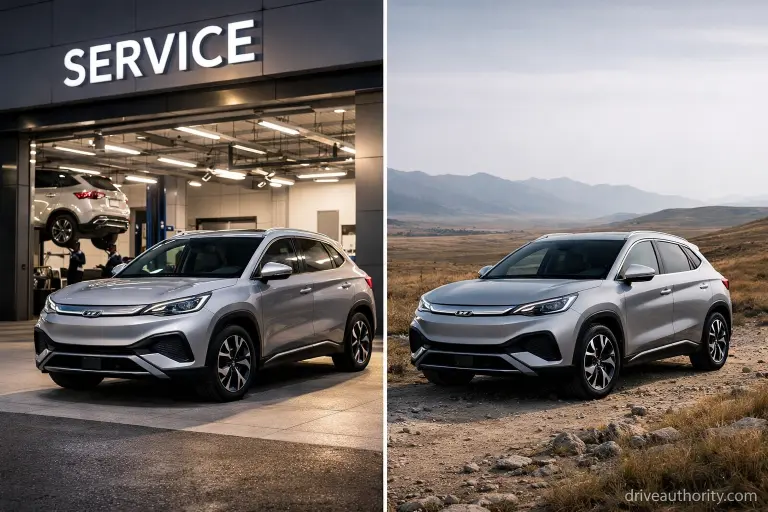
2. After-sales network immaturity: The number of dealers capable of performing warranty work and diagnostics. For a brand with 80 UK dealers covering a fleet of tens of thousands of vehicles, the arithmetic of response time and appointment availability is unfavourable. This is a structural problem, not a model-specific one.
3. Parts availability delays: For body panels, some trim components, and specific mechanical parts, Chinese EV brands with immature UK parts supply chains have generated documented owner waiting times that exceed what buyers expect from mainstream manufacturers.
4. ADAS calibration weaknesses: Active safety system performance — lane keeping, automatic emergency braking, and driver monitoring — is quantified by Euro NCAP’s Safety Assist subscore. The gap between top-performing Chinese EVs and Tesla is measurable. Furthermore, in urban environments with poor lane markings, the gap between Chinese and established-market ADAS systems is wider than the headline scores suggest.
5. Residual value deterioration: Chinese EVs lose value faster than Japanese and Korean rivals at comparable price points. This is not a quality verdict — it reflects brand recognition, charging network association, and consumer uncertainty about long-term parts support. However, it affects the total cost of ownership calculation significantly.
Software Instability: The Most Widely Reported Complaint
Software problems are the single most consistent complaint across Chinese EV owner communities in the UK and Australia in 2026. However, the severity varies so sharply by brand that the category needs to be broken down by manufacturer to be useful.
GWM ORA Funky Cat: The Worst Software Launch of Any Western-Market Chinese EV
The GWM ORA Funky Cat had the most extensively documented software problems of any Chinese EV launched in Western markets in recent years. Early 2022–2023 UK deliveries experienced infotainment system freezes requiring full reboots, incomplete OTA update rollouts that left some vehicles on outdated firmware for months, and navigation system errors including incorrect road data and route calculation failures. The digital instrument cluster was additionally reported to malfunction on cold starts in early production builds.
GWM’s response was OTA-based, which is the appropriate approach for software issues. Nevertheless, the pace of improvement was slower than owners expected, and several UK owners experienced multiple freeze events before stable firmware was pushed. For 2024 and 2025 production ORA vehicles, the software position has improved substantially. The specific concern for buyers in 2026 is used examples with 2022–2023 build dates — these should be verified with a diagnostic scan to confirm current firmware status before purchase.
BYD DiLink and MG Infotainment: Different Problems, Different Severity
BYD’s DiLink infotainment system runs on an Android base and is genuinely mature for the Chinese market. In UK and Australian deployments, the most commonly reported issue is an occasional system freeze requiring a reboot — not a consistent fault, but one that appears across UK owner forum reports for Atto 3 and early Seal deliveries. OTA updates from late 2024 onwards have reduced the frequency significantly. Moreover, the DiLink’s responsiveness and interface design are consistently rated positively by reviewers once the freeze issue is discounted.
MG’s infotainment approach is different in a meaningful way. The MG4’s native system is simpler and therefore less prone to complex failure modes. Most UK MG4 owners default to Apple CarPlay or Android Auto for navigation, effectively bypassing the native map quality issue. That workaround functions well in practice. However, it is a workaround rather than a solution — buyers who need reliable native navigation without a phone should be aware of this trade-off before committing.
After-Sales Network Gaps: Where the Real Long-Term Risk Lives
The biggest risk with a Chinese EV in 2026 is not the battery or the motor — it is after-sales network immaturity. A brand with fewer than 80 dealers in a country cannot provide reliable warranty support for the fleet it has already sold. The arithmetic does not work. And once after-sales support becomes difficult, the warranty that was a key purchase justification becomes effectively unreliable.

How the Numbers Compare Across Brands
BYD operates approximately 100 dealers in the UK as of early 2026 — an increase from the 60-odd at its 2022 launch, but still well below the scale required to service a growing registered fleet without meaningful wait times. MG operates approximately 180 UK dealers, which provides meaningfully better geographic coverage and appointment availability. Toyota’s UK network runs to over 400 dealers. That gap is not trivial when a fault requires physical inspection or a warranty part needs fitting.
In Australia, the picture is similar. BYD has expanded to approximately 150 dealers nationally, concentrated in capital cities and major regional centres. For buyers in regional areas, the nearest BYD dealer may be a 2–4 hour drive. Conversely, MG’s Australian network is broader, and Toyota and Hyundai dealer coverage extends to towns where Chinese brand presence does not yet exist.
The Aiways Example: What Happens When a Brand Exits
Aiways provides the clearest case study of after-sales network risk in Western markets. The brand launched the U5 and U6 models in the UK and European markets, then effectively withdrew its commercial operations as financial pressures mounted in its Chinese parent company. Consequently, UK and European Aiways owners face a genuine parts and warranty support problem — dealers that took on the franchise have in some cases stopped supporting Aiways vehicles, and the parts supply chain for this brand in Western markets is materially compromised.
This scenario is not specific to Aiways. It represents the structural risk that applies to any Chinese EV brand with a thin Western market footprint and uncertain long-term financial commitment to the region. Before purchasing any Chinese EV brand that is not BYD or MG in Western markets, verify that the manufacturer has published a clear after-sales service commitment, that dealer appointments are available within a reasonable distance, and that the brand has been operating continuously in your market for at least 3 years.
Parts Availability and Repair Wait Times
Parts availability is a practical extension of the after-sales network problem. However, it deserves separate treatment because it affects different ownership scenarios differently — and because the data on wait times is more specific than the headline network size figures suggest.
UK owner communities for BYD, MG, and GWM ORA report a consistent pattern for specific fault categories. Mechanical and drivetrain parts — motors, inverters, battery management components — are generally available within standard timelines, typically 1–3 weeks. Body panels, trim components, and some sensors are where extended wait times have been documented. Owner reports across UK BYD and GWM forums cite wait times of 8–16 weeks for specific body panel replacements following minor collision damage, compared to 2–4 weeks for equivalent parts from Toyota or Volkswagen.
Why Parts Delays Are Worse After Accidents Than After Mechanical Faults
The parts supply chain distinction matters because collision repair is the most common event requiring parts for most car owners in Western markets. Insurance companies and body shops have well-established supply relationships with Toyota, Volkswagen, and BMW. For Chinese EV brands, those relationships are newer and the alternative parts (non-OEM) market has not yet developed. As a result, a minor accident that would take 2 weeks to repair in a Toyota may take 6–12 weeks in a BYD — not because the damage is worse, but because the parts supply chain is thinner.
This has a secondary financial effect: insurance premiums for Chinese EVs reflect, in part, the higher repair cost resulting from longer parts delays and lower availability of trained body shops. Specifically, comprehensive insurance quotes for BYD Atto 3 and MG4 are running 12–22% higher than for Hyundai Ioniq 5 and Kia EV6 in the UK market as of 2026, according to comparison data from leading UK aggregators.
ADAS and Active Safety: The Safety Assist Gap
Active safety — lane keeping assist, automatic emergency braking, adaptive cruise control, and driver monitoring — is where Chinese EVs show a measurable gap against the best Western-market alternatives in 2026. The data comes directly from Euro NCAP’s Safety Assist testing programme, which scores these systems under standardised conditions.
| Brand / Model | Euro NCAP Year | Safety Assist Score | Overall Score | Assessment |
|---|---|---|---|---|
| Tesla Model 3 Juniper | 2023 | 98% | 91% · 5★ | Reference benchmark |
| BYD Seal | 2023 | 80% | 85% · 5★ | Competitive · gap closing |
| GWM ORA Funky Cat | 2023 | 72% | 80% · 5★ | Adequate · behind leaders |
| BYD Atto 3 | 2022 | 73% | 81% · 5★ | Adequate · older system |
| MG4 Electric | 2022 | 69% | 76% · 5★ | Weakest of this group |
The 29-percentage-point gap between MG4’s Safety Assist score (69%) and Tesla Model 3’s (98%) is the clearest single-number summary of where Chinese EVs most consistently fall short on measurable safety performance. Notably, MG4’s crash structure is genuinely good — it scores 82% on Adult Occupant Protection. The weakness is in the software-intensive ADAS systems, not in the physical vehicle architecture.
For buyers who rarely use motorway driver assistance features and do most driving in urban areas with attentive driving, this gap is less operationally significant. However, for buyers who depend on lane-centering, adaptive cruise, or automatic emergency braking as a meaningful part of their daily driving, the gap between a BYD Seal (80% Safety Assist) and a Tesla Model 3 (98%) translates to real differences in system behaviour on UK and Australian roads. BYD’s DiPilot suite performs well on clearly marked motorways and poorly on unstructured urban roads — which is the honest characterisation of where the gap is most felt.
Residual Value: The Hidden Financial Problem
Residual value is the most under-discussed problem with Chinese electric cars — and the one with the largest financial impact on total cost of ownership for most buyers. Chinese EVs depreciate faster than their Korean and Japanese rivals at equivalent price points. The data is consistent enough to treat as a planning assumption rather than an uncertainty.
BYD Atto 3 retains approximately 38–42% of its original value at 3 years in the UK market, based on CAP HPI and Auto Trader used pricing data from early 2026. By contrast, Hyundai Ioniq 5 retains approximately 48–53% at the same age, and a Toyota bZ4X retains approximately 45–49%. The difference is meaningful. On a £36,000 Atto 3, the 10-percentage-point additional depreciation versus an Ioniq 5 represents approximately £3,600 in additional value lost over three years — more than the annual fuel saving the EV provides for many buyers.
Why Chinese EV Residuals Are Lower — and Whether That Will Change
Three forces are driving faster depreciation. First, brand recognition in Western used-car markets is lower for Chinese brands — buyers are less willing to pay a premium for a used BYD than a used Hyundai at equivalent mileage. Second, uncertainty about long-term parts and software support for used Chinese EVs suppresses demand. Third, the rapid pace of technology improvement in Chinese EV models accelerates perceived obsolescence — a 2022 BYD Atto 3 is noticeably behind a 2025 BYD Seal in software maturity, creating a strong disincentive to buy older examples at high prices.
Whether this changes over time depends primarily on dealer network expansion and brand familiarity accumulation. In Norway, where Chinese EVs have been sold in volume for longer, BYD residuals are closer to Western brand equivalents. Consequently, the current UK and Australian residual value penalty is likely to compress over 5–8 years as the used market matures. However, for a buyer financing a Chinese EV today on a 3-year PCP, the residual value assumption embedded in the monthly payment calculation carries this current penalty — and that is a real cost, not a hypothetical future one.

Brand-by-Brand Problem Profile
The five problem categories do not affect all Chinese EV brands equally. Here is where each major brand’s documented problems are concentrated, based on owner community data, media reviews, and institutional survey evidence available as of May 2026.
Primary Problems: Software and Residual Value
DiLink infotainment freeze on early builds (improving with 2024+ OTA updates). 12V auxiliary battery attention at higher mileage (4–6 years) — common across EVs, not BYD-specific. Charging port cable retention on some early Atto 3 units. After-sales network adequate but below established-brand depth. Residual values are the main financial risk. Battery and motor reliability: strong based on available data. For detailed long-term figures, see our BYD reliability at 5 years analysis.
Primary Problems: NVH, ADAS, and Older Platform Wear
MG4: wind noise from door seals at motorway speeds, occasional infotainment navigation sync errors, Safety Assist score of 69% (the weakest of this group in Euro NCAP testing). MG ZS EV: road noise, rear door rattle at higher mileage, older heat pump specification affecting cold-weather range on earlier variants. MG4 build quality is better than ZS EV. Dealer network broader than BYD. For detailed MG-specific fault patterns, see our MG ZS EV problems after 50,000 km article.
Primary Problem: Software (Improving on 2024+ Builds)
The most documented software problems of any Chinese EV in Western markets on 2022–2023 production. Infotainment freezes, OTA update failures, navigation errors, and instrument cluster instability on cold starts were all widely reported in UK media and owner forums. 2024+ production substantially better. Crash safety (80% overall Euro NCAP) is not the issue. The concern for used buyers is 2022–2023 examples — verify firmware, check OTA update history, and confirm diagnostic scan is clean before purchase. After-sales network is thin in some regions.
Primary Problem: Brand Continuity and Parts Availability
Aiways has effectively withdrawn from active Western commercial operations. Parts availability for UK and European owners is materially compromised. Dealers who took on the franchise have in some cases ceased Aiways support. Warranty coverage from a brand with uncertain Western continuity is not a meaningful ownership protection. Used Aiways vehicles carry a genuine long-term ownership risk that no other Chinese EV brand in Western markets currently matches. Do not buy one at any price unless you are prepared to own a vehicle with no viable manufacturer support.
Who Should Not Buy a Chinese EV in 2026
Most articles on Chinese EVs focus on who should buy one. This section takes the opposite position — because telling buyers who should not buy is more useful than generic enthusiasm.
Do Not Buy a Chinese EV If…
- You live more than 60 minutes from a dealer for your chosen brand — warranty and service logistics will be significantly harder than you expect
- You plan to finance on a 3-year PCP — the residual value assumption in the payment calculation is likely to be lower than for Korean and Japanese rivals, affecting monthly costs
- You regularly depend on ADAS features (lane centering, adaptive cruise) for long daily commutes — the Safety Assist gap is most felt in exactly this use case
- You are considering an Aiways, or any Chinese brand that launched in your market fewer than 3 years ago — brand continuity risk is not priced into the purchase at the time of sale
- You need to buy used and cannot verify current firmware status and OTA update history — early-build software problems on some models are significant and not always disclosed
- You are considering a GWM ORA Funky Cat with a 2022–2023 build date without a pre-purchase diagnostic scan
A Chinese EV Makes Sense If…
- You have home charging and primarily drive urban and suburban routes — the use case that matches the EV’s strengths and avoids the ADAS gap in less relevant scenarios
- You are buying a BYD or MG outright (not on PCP) — avoiding the residual value risk embedded in finance product calculations
- You are within 30–40 minutes of a dealer with demonstrated capacity for prompt warranty appointments
- You prioritise low running costs over resale value — the operational economics of Chinese EVs are competitive; it is the exit economics that carry the penalty
- You are buying a 2024 or later BYD Seal or MG4 — where the software and build quality improvements are most clearly documented
- You have verified dealer availability, after-sales response times, and parts supply capability for your specific model before committing
Verdict
The common problems with Chinese electric cars in 2026 are not what most buyers expect. Battery failure is not the dominant risk. Motor breakdown is not the leading complaint in owner communities. The problems that most consistently affect day-to-day ownership are software quality on specific models, after-sales network depth across the category, parts availability for collision repairs, ADAS calibration gaps compared to the best Western alternatives, and residual value loss that changes the total cost of ownership calculation.
Of these five categories, after-sales network immaturity is the one with the most serious long-term consequences. A software problem can be fixed with an OTA update. A parts delay resolves eventually. However, a brand that exits your market — or that simply cannot staff enough service capacity for its registered fleet — leaves you holding a warranty that exists only on paper. That risk is real for specific brands today and cannot be dismissed as theoretical.
FAQ: Common Problems With Chinese Electric Cars in 2026
What are the most common problems with Chinese electric cars?
The five documented problem categories are software instability (most widely reported, worst on GWM ORA 2022–2023 builds), after-sales network gaps (BYD operates ~100 UK dealers, insufficient for its registered fleet depth), parts availability delays for collision repairs (owner-reported 8–16 week waits on some models), ADAS calibration weaknesses (MG4 scored 69% on Euro NCAP Safety Assist vs 98% for Tesla Model 3), and faster-than-average residual value loss (BYD Atto 3 retains approximately 38–42% at 3 years vs 48–53% for Hyundai Ioniq 5). Battery and motor reliability are not the dominant complaint categories in owner survey data.
Are Chinese electric car batteries reliable?
Based on available data, yes — for mainstream brands. BYD’s Blade Battery LFP chemistry has a strong track record on fire safety and long-term capacity retention. Five-year owner data from Norway and China shows 88–92% capacity retention at 100,000–120,000 km under normal conditions. MG uses CATL-supplied cells — the same manufacturer that supplies BMW, Volkswagen, and Tesla Standard Range. Battery failure is not the leading fault category in UK or Australian Chinese EV owner communities. The problems that most affect ownership satisfaction are software, after-sales, and parts supply — not battery degradation or failure.
Do Chinese electric cars have software problems?
Some do, significantly. GWM ORA Funky Cat 2022–2023 builds had the most documented software problems of any Chinese EV in Western markets — infotainment freezes, OTA update failures, and navigation errors were widely reported. BYD’s DiLink had occasional freeze events on early builds, improving substantially with 2024+ OTA updates. MG4’s simpler infotainment architecture has fewer complex failure modes, though most UK owners supplement it with CarPlay or Android Auto for navigation. For any used Chinese EV, verifying current firmware status and OTA update history before purchase is essential. Software problems that do not show in a test drive can be significant in daily use.
Are Chinese EV after-sales and servicing reliable in the UK?
It varies by brand. MG’s ~180 UK dealers provide adequate geographic coverage for most buyers. BYD’s ~100 UK dealers represent thinner coverage for a growing registered fleet, and appointment wait times have been a consistent owner complaint. GWM ORA’s UK dealer network is more limited still. For comparison, Toyota operates over 400 UK dealers. The practical consequence is longer waits for routine service appointments and, for buyers in non-urban areas, a significant drive to the nearest authorised service point. Before purchasing any Chinese EV, confirm the nearest dealer location and ask about current appointment availability for routine service and warranty work.
Do Chinese electric cars hold their value?
Chinese EVs depreciate faster than Korean and Japanese rivals at comparable price points in current UK and Australian markets. BYD Atto 3 retains approximately 38–42% of its original value at 3 years, compared to approximately 48–53% for Hyundai Ioniq 5 at the same age. On a £36,000 purchase, that gap represents approximately £3,600–4,000 in additional value loss over three years. Three factors drive this: lower brand recognition in the used market, uncertainty about long-term parts and software support, and the rapid pace of model improvement accelerating obsolescence of older examples. For buyers financing on PCP, the residual value assumption embedded in the monthly payment calculation carries this penalty — confirm the guaranteed minimum future value figure before committing.
Which Chinese EV has the fewest problems?
Based on documented owner community data and institutional survey evidence, BYD Seal (2024+ production) has the strongest problem profile among Chinese EVs in Western markets. Euro NCAP overall score of 85%, Safety Assist of 80%, improving software stability from 2024+ OTA updates, and the strongest battery safety record in the category (Blade Battery LFP, nail penetration test passed without thermal event). The trade-offs are residual value and a thinner dealer network than established brands. MG4 Electric is the second-strongest option — broader dealer network, acceptable safety scores, but a 29-point gap on Safety Assist versus Tesla and some NVH limitations at motorway speeds. For the full model-by-model breakdown, see our best Chinese EVs 2026 comparison.
Should I avoid buying a used Chinese EV?
Not categorically — but used Chinese EVs require more specific due diligence than used Japanese or Korean EVs. The key checks are: confirm current firmware and OTA update status (especially for 2022–2023 GWM ORA and early BYD Atto 3); verify dealer network availability in your area for ongoing service and warranty work; run a pre-purchase diagnostic scan; and check that the brand has maintained continuous UK operations (ruling out Aiways, which has effectively exited). A 2024+ BYD Seal or MG4 with confirmed firmware status and a nearby dealer is a reasonable used purchase. An early Aiways U5 or 2022 ORA Funky Cat without a diagnostic scan carries risks that are not proportionate to the price saving.
- Euro NCAP — Safety Assist subscores for BYD Seal (2023), BYD Atto 3 (2022), MG4 Electric (2022), GWM ORA Funky Cat (2023), and Tesla Model 3 Juniper (2023) used as reference benchmark. All scores from official published test results.
- CAP HPI — UK residual value data for BYD Atto 3, Hyundai Ioniq 5, and Toyota bZ4X at 36 months / 36,000 miles. Figures from early 2026 used car market pricing analysis.
- UK and Australian owner community forum data — BYD Owners Club UK, GWM ORA UK Forum, MG Owner Forum Australia — for model-specific fault patterns, OTA update experience, and service wait time reports cited in the software and after-sales sections.
- UK motor insurance aggregator comparison data (2026) — for Chinese EV insurance premium differentials versus Korean and Japanese equivalents at comparable trim levels.
- BYD, MG, and GWM UK dealer network figures — confirmed from manufacturer UK dealer locator tools, May 2026. Toyota UK dealer figure from Toyota UK press data.