
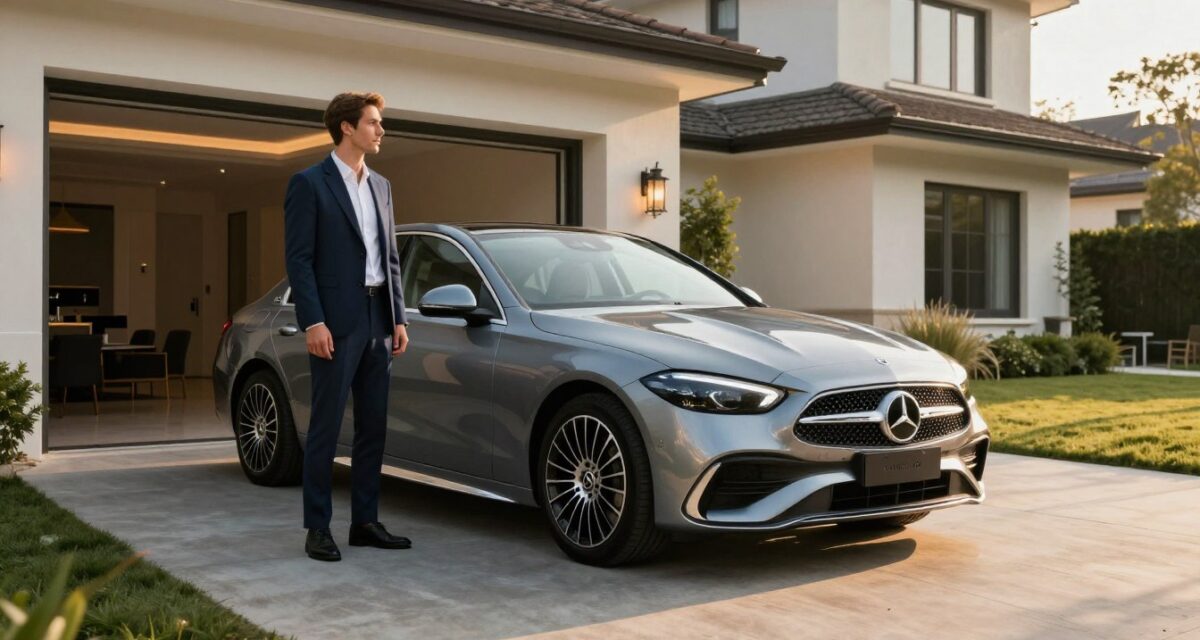
A buyer can see a large sedan in a showroom and still wonder if it will fit a garage. Will it carry passengers comfortably? The C-Class Electric raises both questions, and the answers depend on more than its outside footprint.
I look at exterior size, passenger comfort, parking fit, and storage as separate parts of a useful comparison. Each can shape daily use in a different way. A sedan may fit a parking space but still feel tight in the back.
Today, the most useful information is the kind you can check against your own needs. I’ll keep the figures tied to their stated specifications, rather than treat them as U.S. EPA range or pricing claims. Your own experience in the seats and at the wheel matters, too.
Move from that everyday question to the electric sedan’s exact dimensions.
Mercedes C-Class EV Size Comparison: Key Dimensions
The standard electric C-Class measures 192.2 inches from end to end. Its wheelbase is 116.6 inches, measured between the centers of the front and rear wheels.
Overall Length, Width, and Height
The sedan is 74.5 inches wide without mirrors and 59.2 inches tall. The width figure leaves out the mirrors, and no mirror-to-mirror measurement is listed.
Those specs help describe the vehicle’s basic footprint, but they do not tell you how much room sits inside. They also cannot answer whether a specific garage or parking space will feel easy to use.
Wheelbase and the China Long-Wheelbase Model
Wheelbase means the distance between the centers of a vehicle’s front and rear wheels. It can help explain how a sedan is laid out, but it does not set rear-seat room by itself.
The China long-wheelbase model is a separate version. It measures 195.9 inches long, 77.8 inches wide, and 59.4 inches tall, with a 120.1-inch wheelbase.
Do not treat those China dimensions as measurements for a standard or U.S. model. The longer body and wheelbase belong to that market-specific version.
A listed vehicle weight is 2,460 kilograms, or about 5,423 pounds. That figure is not a substitute for a market-specific curb-weight specification.
In automotive specs, cubic measurements describe volume, not the car’s outside dimensions. I would keep those figures separate when making a mercedes-benz class comparison or checking a model’s full specs.
Use these measurements as a baseline, then compare the sedan with the closest named electric rival.
How the Electric C-Class Compares With the BMW i3
Parked side by side, the C-Class Electric takes up more length than the BMW i3. It is longer, wider, and taller, with a longer wheelbase.
Exterior Footprint
The C-Class Electric measures 192.2 inches long, 74.5 inches wide, and 59.2 inches tall. Its wheelbase is 116.6 inches.
The BMW i3 measures 187.4 inches long, 74.5 inches wide, and 58.3 inches tall. Its wheelbase is 114.1 inches.
That makes the electric Mercedes 4.8 inches longer, 1.1 inches wider, and 0.9 inches taller. Its wheelbase is 2.5 inches longer.
In plain terms, the two vehicles occupy similar compact executive sedan territory, but they use their footprints differently. One is a larger sedan, while the BMW i3 has a shorter body.
Size Does Not Guarantee More Rear Room
Outside measurements cannot show exactly how much useful space each cabin gives passengers. Seat shape, floor height, front-seat position, and cabin layout all affect comfort.
The BMW i3 comparison is useful for exterior size, but I would not turn those figures into a claim about rear comfort. A longer wheelbase does not ensure more knee room in every seat position.
The official BMW i3 cargo-volume figures are not available here, so I cannot name a trunk-volume winner. That would require matching cargo measurements for both vehicles.
The mercedes-benz c-class vs. BMW i3 comparison answers the footprint question, not every practical one. Both are sedans with different layouts and performance goals.
Shift from their outside footprints to how the electric C-Class differs from its gasoline namesake.
How the Electric C-Class Differs From the Gas C-Class
The electric C-Class shares its name with the gas model, but it is a separate vehicle rather than a battery version of the same platform. The C-Class Electric is a battery-electric vehicle built on the MB.EA platform.
It uses a battery and electric motors. A gas C-Class may use an inline-4 turbo engine, and some gasoline models use mild hybrid systems. Those are different ways to make and deliver power.
Mercedes-Benz makes EVs, but the brand itself is not an EV. It sells battery-electric vehicles alongside gas-powered and hybrid models. A hybrid uses both an electric motor and an engine, while a mild hybrid offers limited electric help.
For a fair gas-versus-electric comparison, I would check four things:
- Powertrain type and how it sends power to the wheels
- Fuel stops or charging needs for your usual trips
- Body dimensions for the same model year
- Cargo layout, including separate storage areas
These checks matter because the C-Class name does not mean the two vehicles share the same body or engine. The available details do not support a precise size difference from the gas C-Class.
The next useful comparison is where the electric C-Class sits relative to the larger E-Class.
C-Class vs. E-Class: What Changes?
The simplest distinction is that the C-Class is the more compact Mercedes sedan, while the E-Class sits a step up in size and positioning. The C-Class is a compact executive sedan, and the E-Class is a larger midsize sedan.
How the Two Sedans Are Positioned
That difference in role helps explain why shoppers may compare a C-Class with a Mercedes-Benz E-Class. The E-Class is aimed at buyers seeking a larger luxury sedan, while the C-Class sits lower in the range.
The electric C-Class is described as closer in outside size to a gas E-Class than its C-Class name might suggest. That description gives useful context, but it does not provide a numerical size gap.
For a fair comparison, I would match body style and model year before drawing conclusions. A sedan and a wagon do not offer the same shape, and model dimensions can change over time.
Why Their Dimensions Need a Same-Year Check
No same-year E-Class measurements are given for a direct numerical comparison. I would not use measurements from another year to claim an exact difference.
Searches for C-Class vs. E-Class or C-Class E-Class comparisons can mix model years and markets. Some pages compare the gas C-Class with the gas E-Class, while others compare the electric C-Class with a gasoline car.
The same care applies to searches such as vs. Mercedes-Benz E-Class, vs. E-Class, and C-Class vs. Mercedes-Benz E-Class. I would check the model year, body style, and market listed with each set of figures.
A luxury sedan’s badge tells you where it sits in the range, not whether its back seat fits your family. That takes a real sit test.
Model badges set expectations, but seat comfort depends on the actual front and rear cabin.
How Much Passenger Room Is in the Cabin?
A long body does not automatically mean generous space for the person sitting behind the driver. The C-Class Electric seats five, but rear-seat fit depends on the driver’s position and each passenger’s shape.
Front-Seat Comfort and Features
Available front-seat features include heating, ventilation, and massage. They can make a long drive more comfortable, but they are not all guaranteed on every version.
I would check the exact seat features on the model you are considering. A feature listed as available may depend on the trim or selected options.
Rear-Seat Fit for Adults
A six-foot tester fit in the rear, but had less knee and foot room than expected. In that limited personal impression, the BMW i3 seemed roomier despite its smaller exterior.
That is one person’s experience, not a universal measurement or a promise about every seating position. The front seat setting can change the space available behind it.
During a visit, I would make these four checks:
- Set the driver’s seat to your normal position first.
- Sit behind that exact seat setting.
- Check whether your feet fit under the front seat.
- Try any child seat or booster your family uses.
The driver’s position is easy to overlook when a showroom car has its seats set for display. Check it before deciding whether an adult or child can sit comfortably in the rear.
Once the seating needs are clear, check whether luggage and small items have dedicated storage.
How Much Trunk and Frunk Capacity Does It Have?
The electric C-Class has useful storage at both ends, but the rear trunk and frunk should be assessed separately. The trunk is listed at 470 liters, about 16.6 cubic feet.
Rear Trunk Volume
The trunk is the main rear storage area for bags and other larger items. Its listed capacity gives a helpful starting point, but the shape of the opening also affects what fits.
I would check whether your usual suitcase, stroller, or grocery load fits through the opening. A volume number cannot show the shape of the space or how easily you can reach inside.
Front Storage and Combined Capacity
The frunk is listed at 101 liters, about 3.6 cubic feet, in two specifications. Another specification lists the frunk at 107 liters, so that figure varies across listings.
Using the 101-liter figure, the trunk and frunk add up to 571 liters, or about 20.2 cubic feet. That combined capacity counts two separate spaces.
The number does not mean the car has one uninterrupted cargo area. The rear trunk and front frunk are divided by the cabin and vehicle structure.
For a real-life check, I would bring the items you carry most often. That can show whether the trunk opening works for bulky gear and whether the frunk suits smaller items.
The capacity figures describe volume, but access and shape matter too. A large item may fit the total volume and still fail to fit through an opening.
Cargo volume gives one part of day-to-day practicality; the next test is whether the car fits your parking space.

Will It Fit Your Garage and City Parking?
A 192.2-inch sedan can fit on paper while still making a tight garage awkward to use. A 240-inch clear garage depth leaves 47.8 inches beyond the car’s nominal length.
That remainder does not account for a wall, door movement, stored items, or walking access. Not every U.S. garage is 20 feet deep, and the depth you can use may be less than the room’s full measure.
The stated width leaves out the mirrors, and a mirror-to-mirror width is not provided. Measure your actual garage opening and usable width rather than relying on the body-width figure alone.
Before a test drive, I would check these points:
- Measure the clear garage depth.
- Measure the narrowest opening, including door trim.
- Account for storage, shelves, and space to walk.
- Consider the turning path into the garage or parking spot.
The last check matters in a city garage with a sharp entry or nearby posts. A car can fit inside yet prove difficult to turn into place.
After the parking test, consider whether the available power and chassis features suit your driving.
Does Size Affect Performance and Handling?
The launch C400 4MATIC pairs a sizable sedan body with brisk electric performance. It has two motors, 482 horsepower, and 590 pound-feet of torque.
C400 4MATIC Power and Acceleration
Mercedes gives the C400 4MATIC a 0-to-62-mph time of 3.9 seconds. That figure describes the launch model, not every future version.
The rear motor supplies most of the drive and uses a two-speed transmission. Its two gears are meant to support both quick acceleration and efficient driving.
The front motor can mechanically disconnect when it is not needed. This can reduce energy use while the rear motor continues to move the vehicle.
Those power figures describe how the model can perform, but body size alone does not set how it feels on the road. Tire choice and chassis tuning also shape the drive.
Suspension and Rear-Wheel Steering
An optional Comfort and Agility Package includes adaptive air suspension and 4.5 degrees of rear-wheel steering. Those features are options, not standard equipment.
At low speeds, the rear wheels steer opposite the front wheels to help the car turn. At higher speeds, they steer in the same direction as the front wheels.
The air suspension can change how the car responds to the road. A back-to-back test drive is still the best way to judge comfort and handling for yourself.
For me, the useful test is to drive the car over the roads I use most. A quick route around a dealership may not reveal how the steering and suspension feel on a longer trip.
Performance is only part of the ownership picture, so compare the battery and charging figures next.
How Do Range and Charging Compare?
The BMW i3 has the higher published WLTP range and peak charging rating in the figures available here. WLTP range is a test rating, not a U.S. EPA estimate.
One launch-spec listing gives the C-Class Electric a 94.3-kilowatt-hour battery and 473-mile WLTP range. Another lists 85- or 94-kilowatt-hour batteries and up to 497 miles WLTP.
The Mercedes figures vary across specifications, and no EPA range is provided. I would not treat either WLTP figure as a U.S. range estimate.
The BMW i3 is listed with a 108.7-kilowatt-hour battery and 559-mile WLTP range. Its peak charging rate is listed at 400 kilowatts, compared with 330 kilowatts for the Mercedes.
Stated 10-to-80-percent charging times are 22 minutes for the Mercedes and about 21 minutes for the BMW. Peak rates do not mean either car holds that speed throughout a charging stop.
Both cars support vehicle-to-load, which lets the vehicle supply power to an outside device. The BMW also supports vehicle-to-home and vehicle-to-grid features.
For a U.S. road trip, I would check four things:
- Compatible DC fast-charging stops along the route
- The car’s charging curve, not just its peak rate
- Route elevation and expected weather
- Your preferred range buffer between stops
The best plan depends on the route and charging network, not just a range label. Fuel stops are simple to compare, but electric trips need charging stops that suit the car.
With the technical differences clear, separate confirmed versions from models that are only anticipated.

Which C-Class Electric Models Are Confirmed?
The confirmed debut model is the C 400 4MATIC electric, not a full range of already announced U.S. trims. Other versions remain possibilities rather than confirmed U.S. models.
Was There a 2023 Mercedes C-Class EV?
No 2023 C-Class EV is identified in the model information discussed here. A listing that uses a past model year does not establish that Mercedes sold that version.
Search results can mix model years, markets, and gas-powered cars. I would read the full model name and check whether the listing refers to a battery-electric vehicle.
What Does the 2027 Mercedes-Benz C-Class EV Name Refer To?
A 2027 label may describe a model year or a listing title. By itself, it does not confirm that a U.S. version is available or on sale.
Single-motor versions, wagons, and performance variants have been described as future possibilities. I would not treat them as confirmed U.S. models without a clear announcement.
The confirmed model is the C 400 4MATIC electric. The name does not mean every trim or body style has been announced for every market.
Terms such as “Mercedes-Benz class” can also appear in broad listings, rather than as a complete model name. For a 2026 Mercedes-Benz or later listing, check the exact vehicle and market before assuming the details apply to the electric sedan.
Model identity is clearer than the U.S. sales calendar, so check what is known about timing and price separately.
What Are the U.S. Price and Release Details?
The global debut and production start are known, but a U.S. sale date and price are not established here. No U.S. MSRP, starting price, or on-sale date is provided.
The C-Class Electric debuted on April 20, 2026. Production began in July 2026, with production outside China based in Kecskemét, Hungary.
When Is the 2027 Mercedes C-Class Release Date?
A specific 2027 Mercedes C-Class release date in the United States is not provided. The global debut and production start do not set a U.S. dealer arrival date.
That distinction matters when a listing uses a 2027 model label. A model-year name alone does not confirm that U.S. sales have started.
I would avoid treating a global production milestone as a promise of local delivery. The U.S. on-sale date is a separate detail.
What Is Known About Mercedes C-Class EV Pricing?
A Mercedes C-Class Electric price, 2027 Mercedes C-Class price, and 2026 Mercedes C-Class Electric price or MSRP are not provided. No starting price is confirmed for U.S. buyers.
I would not estimate a price from another market or substitute an overseas figure. Taxes, equipment, and local pricing can differ, and no U.S. figure is stated here.
When U.S. sales details are announced, the dealer’s listing should show the exact trim, model year, and MSRP. Those details will also clarify whether a quoted price includes selected options.
Use the confirmed specifications and your own space needs to decide what to verify with a dealer when U.S. details become available.
Conclusion
My practical verdict is that the electric C-Class looks most convincing for buyers who value its sedan footprint and useful two-part storage. It is larger outside than the BMW i3, but exterior size alone does not promise generous rear-seat room.
The trunk and frunk offer useful listed capacity, though the frunk figure varies. I would measure the space where you plan to park and sit in the rear with the driver’s seat set to your normal position.
Then check the U.S. specification and physically test the spaces that matter before deciding. A few minutes with a tape measure and a real seat test can answer questions that badges and listings cannot.
FAQ
What’s the difference between Mercedes C and E-Class?
Is Mercedes-Benz an EV?
What are the dimensions of the 2027 Mercedes-Benz C-Class EV?
Is the Mercedes C class the lowest class?
How much will the 2027 Mercedes-Benz C-Class EV cost?
