🏁 2026 Verdict Snapshot
The BYD vs Tesla debate has moved well past hype. Both brands now sell real vehicles to real buyers across North America, and the gap between them — in price, technology, and ownership experience — is both smaller and more specific than most coverage admits. This 2026 comparison cuts through the marketing to give you a clear, data-grounded answer across pricing, real-world range, charging infrastructure, technology, reliability, and five-year ownership costs.
Brand Positioning & 2026 Market Strategy
BYD’s Vertical Integration & Blade Battery Advantage
BYD’s core competitive advantage is control of its supply chain at a depth no Western automaker has matched. The company manufactures its own Blade LFP (lithium iron phosphate) battery cells, electric motors, power semiconductors, and even the steel used in battery casings. This vertical integration translates directly into lower production costs and faster iteration — both of which benefit the buyer at the point of purchase.
The Blade Battery design packs prismatic cells directly into the pack structure, eliminating the module layer. This architecture contributes meaningfully to both thermal safety and structural rigidity. For buyers in colder climates — relevant to Canada and northern U.S. states — LFP chemistry does carry a real-world trade-off: reduced range efficiency at temperatures below 20°F (−7°C). That’s a factual consideration, not a dealbreaker. See our BYD reliability after 3 years analysis for long-term ownership feedback.
Tesla’s Software Ecosystem & Supercharger Network
Tesla’s moat in 2026 is not hardware — it’s ecosystem lock-in. The Supercharger network now covers over 3,000 locations across the U.S. and Canada, with V3 chargers delivering up to 250 kW and V4 stations hitting up to 500 kW at select locations as of late 2025. For drivers who regularly travel interstate or cross-country, this network removes the planning friction that still affects BYD and other brands relying on third-party CCS infrastructure.
On the software side, Tesla’s over-the-air update cadence means a 2023 Model 3 in 2026 is meaningfully different from the car that left the factory. Features, range optimization, and interface improvements arrive without a dealer visit.
Global Expansion & U.S./Canada Market Presence
Tesla operates manufacturing in Fremont, California and Gigafactory Texas, giving its vehicles USMCA compliance and access to the federal EV tax credit (up to $7,500 for eligible buyers). BYD vehicles assembled in China face a 100% tariff in the U.S. market and a 100% surtax in Canada effective since October 2024. This tariff reality is the single most important pricing factor in the 2026 BYD vs Tesla comparison for North American buyers — it effectively doubles BYD’s list price at the border. BYD did file legal challenges to U.S. tariffs in early 2026, but the tariffs remain in effect as of the time of writing.
Model Lineup & Pricing Comparison
Entry-Level, Mid-Range & Performance Models
The 2026 Tesla Model Y (Juniper refresh) starts at $34,990 for the base RWD trim, with the Long Range AWD at $43,990 and Performance at $51,990. These prices reflect current U.S. MSRP. BYD’s Seal is its most direct competitor to the Model Y globally; its pre-tariff base is approximately $35,000, but post-tariff effective U.S. pricing is not commercially viable for most buyers.
Incentives, Tax Credits & Real Transaction Prices
Federal EV tax credits of up to $7,500 apply to eligible Tesla Model 3 and Model Y variants meeting MSRP and income thresholds. BYD vehicles assembled in China do not qualify. Canadian provincial incentives vary — Quebec and British Columbia each offer up to CAD $7,000 and CAD $4,000 respectively for qualifying vehicles. Always verify current caps and income requirements before assuming eligibility.
| Model | Brand | U.S. Price (MSRP) | Battery (kWh) | EPA/WLTP Range | 0–60 mph |
|---|---|---|---|---|---|
| Model Y RWD | Tesla | $34,990 | ~60 kWh (usable) | 337 mi (EPA) | 6.5 sec |
| Model Y Long Range AWD | Tesla | $43,990 | ~75 kWh (usable) | 326 mi (EPA) | 4.2 sec |
| Model Y Performance | Tesla | $51,990 | ~75 kWh (usable) | 277 mi (EPA) | 3.5 sec |
| Model 3 RWD | Tesla | $38,990 | ~60 kWh (usable) | 272 mi (EPA) | 5.8 sec |
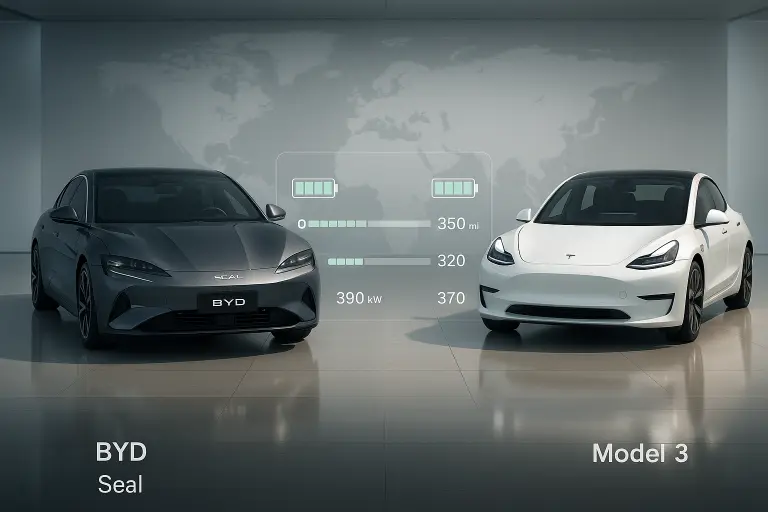
| BYD Seal (base, pre-tariff) | BYD | ~$35,000 ⚠️ | 82.5 kWh | ~290 mi (est. EPA-equiv.) | 5.9 sec |
| BYD Atto 3 | BYD | ~$33,000 ⚠️ | 60.5 kWh | ~220 mi (est. EPA-equiv.) | 7.3 sec |
| BYD Dolphin | BYD | ~$26,000 ⚠️ | 44.9 kWh | ~220 mi (est. EPA-equiv.) | 7.0 sec |
⚠️ BYD pre-tariff global price shown. Add 100% tariff for U.S. effective pricing. Not eligible for federal EV tax credit.
Pros & Cons — BYD vs Tesla (Quick Scan)
Tesla Pros
- Best charging network in North America (3,000+ stations)
- Strong OTA software improvements post-sale
- Established resale value and depreciation track record
- Qualifies for U.S. federal EV tax credit (up to $7,500)
- 200+ U.S. service centers + mobile service
- Higher energy density cells = more range per kg
Tesla Cons
- Build quality inconsistencies still noted in reviews
- No Apple CarPlay / Android Auto
- FSD requires subscription ($99/mo) to activate
- Firm ride quality on some Model Y variants
- Higher entry price vs BYD in non-tariff markets
BYD Pros
- Blade LFP battery: superior thermal safety, longer cycle life
- Longer battery warranty: 8 yr / 155,350 mi on Seal
- Generous standard spec (panoramic roof, Dynaudio audio)
- Lower pre-tariff price globally
- Strong Euro NCAP safety scores (5-star)
- Premium interior materials at mid-range price
BYD Cons
- 100% tariff makes U.S. pricing uncompetitive (2026)
- OTA update cadence lags Tesla significantly
- Thin North American service network
- Resale values in North America unestablished
- LFP range loss in cold climates (-20–30% below 20°F)
- DiPilot ADAS less capable than Tesla FSD
Real-World Range, Efficiency & Charging
Real-World Range vs Claimed Range
EPA ratings for Tesla vehicles typically come within 5–10% of real-world results under mixed driving conditions. The Model Y Long Range AWD commonly delivers 295–315 miles in temperate conditions. BYD’s WLTP figures run 15–20% higher than equivalent EPA results in practice — meaning the Seal’s 354-mile WLTP figure translates to roughly 280–295 miles under North American driving conditions. That’s still competitive at its price point, but the label gap matters when planning long trips.
Cold-weather range loss is more pronounced in LFP chemistry than in Tesla’s NMC cells. Drivers in Minnesota, Alberta, or Ontario can expect 20–30% range reduction at sustained sub-freezing temperatures with BYD, versus 15–25% for Tesla. Neither disqualifies either vehicle for cold-climate use, but BYD buyers in northern markets should pre-condition the battery when possible. Our EV range vs advertised range guide covers this topic in depth.
DC Fast Charging Speeds & 10–80% Times
The 2026 BYD Seal supports up to 150 kW DC fast charging — completing a 10–80% cycle in approximately 37 minutes on a compatible charger. Tesla’s V3 Superchargers deliver up to 250 kW peak, with the Model Y completing a 10–80% charge in approximately 25–30 minutes. V4 stations at select U.S. locations now support up to 500 kW, though current Model Y hardware caps at 250 kW. For most daily use cases the speed gap is irrelevant, but on a long interstate drive Tesla’s advantage is real.
Charging Network Access & Reliability
Tesla’s Supercharger network — now open to non-Tesla CCS vehicles via Magic Dock at select stations — remains the best-developed charging infrastructure in North America by station density, speed consistency, and uptime. BYD’s CCS standard gives access to Electrify America, EVgo, and ChargePoint, but independent audits consistently show higher failure rates and longer wait times at third-party networks versus Tesla’s own stations. For more on day-to-day charging costs, see our public EV charging cost breakdown.
Technology, Software & Driver Assistance
Infotainment & Over-the-Air Updates
Tesla’s 15.4-inch landscape touchscreen (16-inch on Performance Model Y) runs virtually every vehicle function in software. OTA updates arrive regularly and materially expand functionality years after purchase. BYD’s DiLink infotainment runs on a customized Android layer and is capable and feature-rich — the Seal’s 15.6-inch fixed HD screen is class-leading at its price point. But BYD’s OTA update cadence and depth of post-sale improvement does not yet match Tesla’s pace, and BYD is notably phasing out its rotating screen due to customer feedback, signaling a more conservative approach to software-first design.
ADAS & Autonomous Driving Capabilities
Tesla’s Autopilot handles highway lane centering and adaptive cruise as standard. Full Self-Driving (FSD, Supervised), available for $99/month, has expanded significantly in 2025–2026 with neural network improvements covering urban intersections and unprotected turns in supported regions. BYD’s DiPilot system handles highways competently but lacks the breadth of FSD’s continuously updated scenario coverage. For buyers who value driver assistance technology as a long-term investment, Tesla has a meaningful lead that is widening with each software release.
User Experience & App Ecosystem
Tesla’s mobile app integrates remote climate, charging monitoring, software updates, and service booking in a single polished platform. BYD’s companion app covers the basics — remote lock, climate pre-conditioning, charge monitoring — but third-party smart home and energy management integration is less developed for North American buyers.
Reliability, Battery Longevity & Ownership Costs
Battery Degradation & Warranty Coverage
Tesla warrants battery and drive unit to retain at least 70% capacity for 8 years / 100,000 miles on Model Y Long Range AWD, and 8 years / 120,000 miles on Performance variants. Real-world aggregated owner data suggests Tesla NMC packs average under 10% degradation at 100,000 miles under normal charging habits. BYD’s Blade Battery on the 2026 Seal carries an 8-year / 155,350-mile battery warranty — longer coverage than Tesla’s — and LFP chemistry is generally more cycle-stable. BYD’s North American long-term fleet data is more limited, but global ownership reports from markets where BYD has been sold longer show strong battery longevity.
Maintenance & Service Network
Both EVs eliminate oil changes and traditional transmission service. Meaningful cost differences emerge in software service costs (Tesla’s FSD subscription is recurring), tire wear patterns, and out-of-warranty repair access. Tesla’s service network in the U.S. and Canada exceeds 200 locations, with mobile service covering many common fixes. BYD’s North American service infrastructure is developing but remains thinner — a critical factor for buyers outside major metros.
Insurance & Depreciation Trends
Tesla Model 3 and Model Y insurance costs average $1,800–$2,600 annually in the U.S. based on aggregated industry data, depending on state and driver profile. BYD models carry similar insurance profiles on paper, though some insurers with limited claims history rate them higher. Tesla Model Y holds approximately 55–65% residual value at three years — strong for the EV segment. BYD’s residual values in North American markets are not yet established, which creates resale uncertainty buyers should factor in. See our EV insurance cost comparison for 2026 for current rate benchmarks.
| Cost Category | Tesla Model Y LR AWD (5-yr est.) | BYD Seal (5-yr est., pre-tariff market) |
|---|---|---|
| Purchase price (after U.S. federal credit where applicable) | ~$36,490 | ~$35,000 (no U.S. credit) |
| Electricity (15,000 mi/yr, avg $0.14/kWh) | ~$5,250 | ~$5,600 |
| Maintenance (5 years) | ~$1,800–$2,500 | ~$1,500–$2,200 |
| Insurance (5 years, U.S. average) | ~$9,000–$13,000 | ~$9,500–$14,000 (estimated) |
| Estimated 5-yr depreciation | ~$15,000–$18,000 | ~$16,000–$22,000 (estimated) |
| Estimated 5-yr total cost | ~$67,500–$75,000 | ~$67,600–$79,000 |
For a deeper line-by-line breakdown, see our full 5-year BYD vs Tesla vs MG ownership cost analysis.
Safety Ratings & Build Quality
Crash Test Performance
The 2026 Tesla Model Y (Juniper) carries 5-star overall NHTSA ratings. The BYD Seal achieved 5-star Euro NCAP in 2023 testing with strong adult occupant protection scores. U.S. NHTSA testing for BYD models available in North America is more limited; buyers should verify which specific variant has current U.S. safety ratings before purchase.
Structural Engineering & Battery Protection
BYD’s Blade Battery integration contributes to body rigidity, and the flat prismatic cells are less prone to puncture-triggered thermal events than cylindrical cell formats. Tesla’s newer Juniper Model Y builds use a structural battery pack design where the cells form part of the floor, similarly improving rigidity. Both represent genuine advances over earlier EV architectures.
Interior Materials & Assembly Quality
Tesla’s 2026 Juniper Model Y refresh improved interior material quality and ride comfort compared to earlier builds. Panel gap consistency has improved in Gigafactory Texas production. BYD’s Seal interior — with Nappa leather, dual 15.6-inch screen, and Dynaudio 12-speaker audio as standard — punches above its weight on material quality at its global price point. Neither brand matches the fit-and-finish of German luxury EVs, but both are competitive in their price segments.
BYD vs Tesla by Buyer Type
BYD vs Tesla for Cold Climates (Canada, Northern U.S.)
BYD vs Tesla for Long Road Trips
BYD vs Tesla for City Commuters
BYD vs Tesla for Families
Which Brand Is Better for You? (Decision Framework)
The answer to “BYD vs Tesla” depends less on which is objectively better and more on which fits your ownership profile. Here’s a clear breakdown.
🟢 Choose Tesla if you:
- Drive 200+ miles routinely between charges
- Travel interstate frequently in the U.S. or Canada
- Value software updates and FSD capabilities
- Want the strongest resale value predictability
- Need reliable service access outside major cities
- Qualify for the U.S. federal EV tax credit
- Live in a cold climate with regular sub-freezing temps
🔵 Choose BYD if you:
- Are purchasing in a market where tariffs don’t apply
- Do primarily urban or short-range commuting
- Prioritize battery cycle longevity over software features
- Want the longer battery warranty (8 yr / 155K mi)
- Live near a BYD-certified service center
- Are comfortable with a newer brand’s support ecosystem
Quick Decision Checklist
- Do you regularly drive 250+ miles in a single day? → Tesla has the network edge.
- Are you in the U.S. and subject to BYD’s 100% tariff? → Tesla’s post-credit price is more competitive.
- Do you live in a cold climate below 20°F regularly? → Tesla has lower cold-weather range loss.
- Is software and OTA improvement important long-term? → Tesla leads clearly.
- Are you buying primarily for urban commuting under 60 miles/day? → BYD’s chemistry and spec hold up well.
- Is long-term resale value a priority? → Tesla has established North American residuals; BYD does not yet.
- Do you want a longer battery warranty? → BYD’s 8yr/155K warranty beats Tesla’s coverage by mileage.
BYD vs Tesla: 5-Year Cost Calculator
Enter your driving profile below to estimate and compare your real five-year ownership cost for a Tesla Model Y Long Range AWD versus a BYD Seal (in markets where tariffs don’t apply).
⚡ 5-Year Ownership Cost Estimator
Estimates based on: Tesla Model Y LR AWD $43,990 base / BYD Seal $35,000 (pre-tariff). Tesla efficiency 4.0 mi/kWh; BYD Seal 3.8 mi/kWh. Maintenance: Tesla $2,100 / BYD $1,850 (5yr avg). Depreciation: Tesla 40% / BYD 48% (est.). Results are estimates only — individual costs vary by location, usage, and insurance profile.
Real-World Performance Data
Beyond spec sheets, independent road tests and aggregated real-world data paint a more nuanced picture of how these two brands perform under actual driving conditions.
Highway Efficiency: What Independent Tests Show
In highway efficiency testing conducted at a steady 70 mph, the Tesla Model Y Long Range AWD consistently returns approximately 3.8–4.1 miles per kWh (mi/kWh) — translating to roughly 285–308 miles of real-world highway range from its usable ~75 kWh pack. The BYD Seal's 82.5 kWh pack delivers approximately 3.6–3.9 mi/kWh at similar speeds, yielding around 295–320 miles of highway range. At interstate speeds, the two vehicles are closely matched on range despite BYD's larger pack — because the Seal carries more weight (2,150 kg vs Model Y's ~2,040 kg).
Charging Session Real-World Performance
Data from aggregated owner charging logs and independent EV media tests shows the Model Y Long Range typically reaches its 250 kW peak for approximately 3–5 minutes before stepping down, with the 10–80% window averaging 27–32 minutes on a V3 Supercharger. The BYD Seal reaches its 150 kW DC peak more consistently across a broader state-of-charge window, averaging 34–40 minutes for 10–80%. In practice, over a 400-mile road trip requiring two charging stops, Tesla saves approximately 15–20 minutes of total charging time.
Battery Degradation: Aggregated Owner Data
Based on community-sourced data aggregated from hundreds of Tesla Model Y owners, average battery capacity retention at 100,000 miles is approximately 91–94% when the vehicle is charged to 80–90% daily. BYD's LFP chemistry in global markets shows similar or slightly better retention figures — LFP cells are less sensitive to high-SOC storage, meaning BYD owners who charge to 100% daily face less degradation risk than equivalent Tesla NMC owners. This is a genuine structural advantage for BYD's battery chemistry that extends to the U.S. market regardless of tariffs. See our EV battery longevity guide for the full chemistry comparison.
What If U.S. Tariffs Are Removed? A Strategic Scenario
⚠️ Hypothetical Analysis — Tariffs Currently in Effect (Q1 2026)
The following is a forward-looking scenario analysis. The 100% U.S. tariff and 100% Canadian surtax on Chinese-assembled EVs are in effect as of the time of writing. This section models what the competitive landscape would look like if those tariffs were reduced or eliminated.
If U.S. and Canadian tariffs on Chinese-assembled EVs were reduced to pre-2024 levels (approximately 25%), BYD's transaction price landscape would shift dramatically. A BYD Seal at its global base of ~$35,000 plus a 27.5% tariff (the pre-escalation rate) would land at approximately $44,500 before destination — still higher than today's global price, but within range of the Tesla Model Y LR AWD at $43,990. With BYD's longer battery warranty, comparable range, and premium standard spec, this scenario creates genuine price competition.
If tariffs were removed entirely, BYD's $35,000 Seal would undercut Tesla's comparable offering by nearly $9,000 before any credits — and BYD could potentially manufacture in North America to qualify for EV credits under a renegotiated trade framework. Tesla's response would almost certainly be renewed price cuts, accelerated software feature releases, and expanded Supercharger access incentives. The competitive pressure would benefit consumers significantly.
The strategic implication: Tesla's North American dominance in the EV market is partly structural (Supercharger network, software) and partly policy-dependent (tariff protection). Buyers evaluating a 5–7 year ownership horizon should understand that the tariff environment could change, affecting both BYD's market position and Tesla's pricing behavior. For context on BYD's broader global strategy, see our analysis of Chinese EV purchase decisions in 2026.
FAQs — BYD vs Tesla
Is BYD more reliable than Tesla in 2026?
Based on available owner feedback and third-party data, BYD's Blade Battery shows strong long-term cycle stability, and the Seal has received positive reliability marks in markets where it has been sold longer. Tesla has well-documented body assembly inconsistencies but strong drivetrain reliability. Neither brand has a definitive overall reliability lead in North American markets as of 2026.
Which has better battery technology — BYD or Tesla?
BYD's Blade LFP battery leads on thermal safety and long-term cycle durability, with a longer warranty (8yr/155K mi vs Tesla's 8yr/100–120K mi). Tesla's NMC and 4680 cells lead on energy density, enabling longer range in a comparable pack size. For high-mileage buyers focused on longevity, BYD's LFP has a structural advantage. For maximum range per charge, Tesla's chemistry currently wins.
Does Tesla still have the charging advantage in 2026?
Yes — significantly in North America. Tesla now operates over 3,000 Supercharger locations in the U.S. and Canada, with V3 (250 kW) and V4 (up to 500 kW) stations. Third-party CCS networks available to BYD have improved but show higher failure rates in independent benchmarks. For any driver who travels beyond major metro areas regularly, Tesla's charging infrastructure remains a meaningful practical advantage.
Which brand holds its value better over five years?
Tesla Model Y retains approximately 55–65% of its value at three years — among the stronger figures in the EV segment. BYD's residual values in North American markets are not yet established due to limited sales history and the tariff environment. For buyers who plan to trade or sell within five years, Tesla carries materially lower depreciation risk in the U.S. and Canada.