Over the past 24 months, Chinese electric vehicles have gone from automotive curiosity to legitimate market disruptors—yet most North American buyers still can’t answer one critical question: Are these cars actually worth considering, or are they just low-cost alternatives with hidden compromises?
The confusion isn’t accidental. Contradictory reviews, geopolitical noise, and rapid brand evolution make it nearly impossible to separate hype from reality.
For North American buyers, the question isn’t whether Chinese electric vehicles are technologically competitive—it’s whether they are realistically accessible and supportable.
This guide cuts through speculation and specs to focus on ownership reality—not theoretical value.
Here’s what you actually need to know.
Direct Answer
Chinese electric vehicles are globally competitive in quality, range, and safety—but for most North American buyers, they are not practical purchases in 2026 due to tariffs, limited availability, and weak service networks.
The real issue isn’t product quality—it’s whether you can legally buy, insure, service, and resell one where you live.
What This Problem Really Is
The question around Chinese electric vehicles isn’t about engineering capability anymore. BYD’s Blade Battery technology—or closely related LFP designs supplied by BYD—is used in select Tesla models in certain markets. NIO’s battery-swap infrastructure operates reliably where officially deployed across China and parts of Europe. MG and Polestar (Geely-owned) have earned 5-star Euro NCAP ratings.
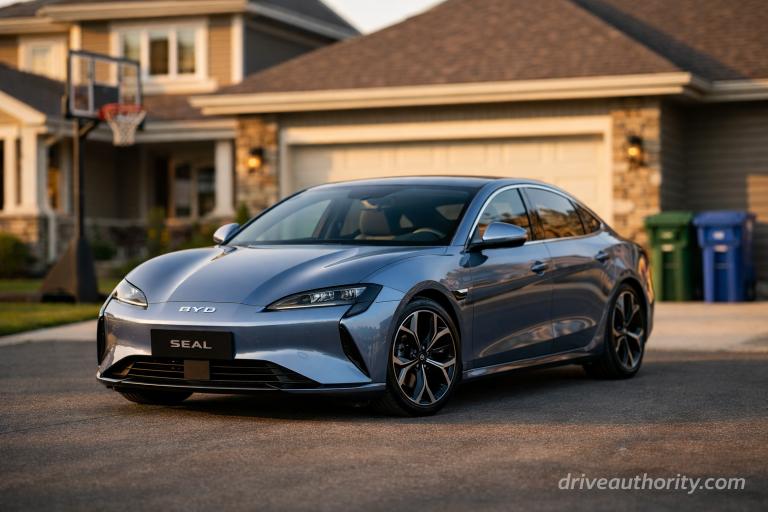
The real problem is one of market access and post-purchase ecosystem. If you’re in Vancouver or Detroit, you’re not comparing a BYD Seal to a Tesla Model 3 on equal footing—you’re comparing a widely available, serviceable Tesla to a BYD you likely can’t buy new, can’t easily insure, and can’t service at a nearby certified shop.
Even in Europe, where Chinese EVs are surging, the primary friction isn’t quality—it’s buyer uncertainty around resale value, parts availability, and whether these brands will still have North American presence in five years. That uncertainty becomes your financial risk, not just a feature comparison.
Why Most People Misunderstand It
The biggest misconception is that “Chinese EV” means “cheaper but worse.” That was true in 2018. It’s not true in 2026.
The myth: Chinese EVs are cheaper because they’re worse.
The reality: The price gap isn’t a quality discount—it’s a structural advantage. They’re cheaper because of massive domestic scale, vertical integration (many manufacturers produce their own batteries), and intense competition in the world’s largest EV market.
BYD sold more EVs globally than Tesla in Q4 2023, based on available market data. NIO’s ES8 offers 300+ miles of range and luxury interiors that rival Audi. The MG4 consistently outsells the Volkswagen ID.3 in Europe. These aren’t bargain-bin products—they’re competitive alternatives that happen to come from Chinese manufacturers.
What does matter: regulatory approval, dealer networks, and warranty enforceability in North America. A $35,000 MG4 sounds appealing until you realize there’s no official MG dealer within 500 miles of your home, and your insurance company quotes you 40% higher premiums because they have no crash repair cost data.
Buyers confuse “available in China” with “available to me.” They’re not the same market reality.
Secondary Factors (Not the Main Cause)
These factors influence perception—but they rarely determine ownership outcomes on their own.
Brand perception still plays a role. Many North American buyers associate Chinese manufacturing with lower quality, even though their iPhone, laptop, and half their home appliances are Chinese-made. This bias fades with exposure, but it slows adoption.
Geopolitical concerns around data privacy and tariffs create uncertainty. The U.S. imposed 100% tariffs on Chinese EVs in 2024, and Canada followed with 25% tariffs, effectively pricing most Chinese EVs out of competitiveness even if they were officially imported.
Charging infrastructure compatibility is a minor issue. Most Chinese EVs sold internationally support CCS or NACS (Tesla) charging standards, so they work with North American chargers in markets where available—but this varies by model and market.
For example, data privacy concerns rarely affect daily ownership—but resale value and insurance costs do.
How to Tell If This Affects You
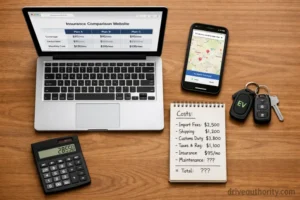
You should care about Chinese electric vehicles if:
- You live in Canada (particularly BC or Ontario) where some Chinese EV brands like Polestar have official presence and BYD is exploring entry
- You’re tracking the used EV market and want to understand why certain imported models (MG, BYD) appear at steep discounts
- You travel or work internationally and want to understand what’s driving the global EV shift outside North America
- You’re watching the EV price war and wondering why Chinese EVs are so cheap compared to Western rivals
- You’re considering imported or gray-market vehicles and need to weigh the risks
You should not prioritize Chinese EVs if:
- You need a car you can buy, insure, and service locally in the next 90 days
- You prioritize resale value and brand recognition for financing approval
- You’re uncomfortable with regulatory or political uncertainty around Chinese imports
If you fall into both categories, default to availability and serviceability over theoretical value.
Practical, Safe Next Steps
These recommendations prioritize legal compliance, financial risk reduction, and service access—not theoretical value.
Availability — If you’re in the U.S.: Chinese EVs are not realistically available for purchase in 2026 due to tariffs and lack of official distribution. Focus on established brands (Tesla, Ford, Hyundai, Chevrolet) unless you’re specifically sourcing a used import and fully understand the insurance, parts, and legal implications. Check which electric cars to avoid before committing.
Availability — If you’re in Canada: Polestar—while owned by Geely (a Chinese automaker), operates as a global brand with manufacturing across multiple countries—is your most accessible Chinese EV option, with official dealerships and warranty support. BYD may enter the market in 2026-2027, but confirm availability in your province before planning. MG has limited presence in select markets. Review common problems with Chinese EVs to set realistic expectations.
Insurance & Compliance — For gray-market or imported models: Contact your insurance provider before purchase. Many insurers refuse coverage or charge prohibitive premiums for non-federalized vehicles. Verify parts availability through independent EV repair shops. Understand that warranty claims may require international shipping or travel.
Cost Reality — Compare total cost of ownership: A $28,000 imported MG4 isn’t cheaper than a $40,000 Chevy Bolt EUV if you’re paying 50% more for insurance, have no local service center, and face 30% depreciation in year one. Calculate monthly EV ownership costs realistically.
Policy Risk — Track regulatory changes: Canadian federal policy, provincial incentives, and U.S. tariff structures shift frequently. If you’re betting on Chinese EV access improving, follow Transport Canada’s approved vehicle list and NHTSA compliance updates.
For international buyers or expats: If you’re moving between North America and Asia/Europe, understand that a Chinese EV purchased abroad may not be street-legal or insurable when you relocate. Verify legality of Chinese car ownership in your state.
When to Consider Expert Help
If you’re seriously exploring a Chinese EV purchase—whether new, used, or imported—consult an automotive import specialist or customs broker who understands federal motor vehicle safety standards (FMVSS in the U.S., CMVSS in Canada). They can clarify whether a specific model can be legally registered and insured in your jurisdiction.
For buyers in Canada near official Polestar or potential BYD dealerships, a test drive and financing consultation will reveal real-world ownership costs better than online research. Ask about warranty transferability and certified repair shop proximity.
Final Takeaway
Chinese electric vehicles are no longer the “low-cost alternative”—they’re globally competitive products that most North American buyers simply can’t access yet due to regulatory barriers, tariff structures, and limited distribution networks. The quality debate is mostly settled; the availability and serviceability debate is not.
If you’re in Canada and Polestar or BYD enter your market officially, they’re worth evaluating alongside Tesla, Hyundai, and Ford. If you’re in the U.S., they remain a future possibility, not a present option.
The smarter question isn’t “Are Chinese EVs good?”—it’s “Can I actually buy, insure, and service one where I live?” Answer that first, and the rest becomes straightforward.
For most North American buyers in 2026, Chinese electric vehicles are a future opportunity—not a practical present-day choice.
This conclusion reflects current regulatory, insurance, and service realities—not speculation about future policy shifts.
For North American buyers ready to purchase now, explore the best EVs under $40,000 or compare affordable electric cars for 2026 to see what’s actually available in your market today.
Frequently Asked Questions
Are Chinese electric vehicles reliable long-term?
Reliability varies by manufacturer. BYD and NIO have strong track records in their home markets with battery warranties matching or exceeding Tesla. MG (SAIC) shows mixed results depending on model. BYD’s 3-year reliability data suggests competitive durability, but North American data is limited due to low sales volume.
Can I buy a Chinese EV in the United States?
Not easily. The 100% tariff on Chinese EVs and lack of NHTSA-certified models make direct purchase nearly impossible. Polestar (Geely-owned, but manufactured globally) is the exception. Used imports exist but face registration and insurance challenges.
How do Chinese EVs compare to Tesla?
In China and Europe, BYD and NIO compete directly with Tesla on range, technology, and price. Detailed BYD vs. Tesla comparison shows comparable or superior value in markets where both are available. In North America, Tesla’s service network and charging infrastructure provide significant practical advantages.
Why are Chinese electric cars so cheap?
Lower labor costs, vertical integration (many Chinese EV makers produce their own batteries), massive domestic scale, and government subsidies all contribute. Full breakdown of Chinese EV pricing explains the cost structure.
Are Chinese EVs safe in crashes?
Many Chinese EVs earn top Euro NCAP and C-NCAP safety ratings. BYD’s Blade Battery design reduces fire risk. Chinese EV crash test results show performance comparable to Western brands, though NHTSA and IIHS data for North America is sparse.
Will Chinese EVs ever be sold in the U.S. officially?
Possibly, but not before 2027–2028 unless trade policy shifts significantly. Any official entry would require U.S. manufacturing, federal certification, and localized service infrastructure—all substantial investments Chinese manufacturers would need to justify based on market access certainty.