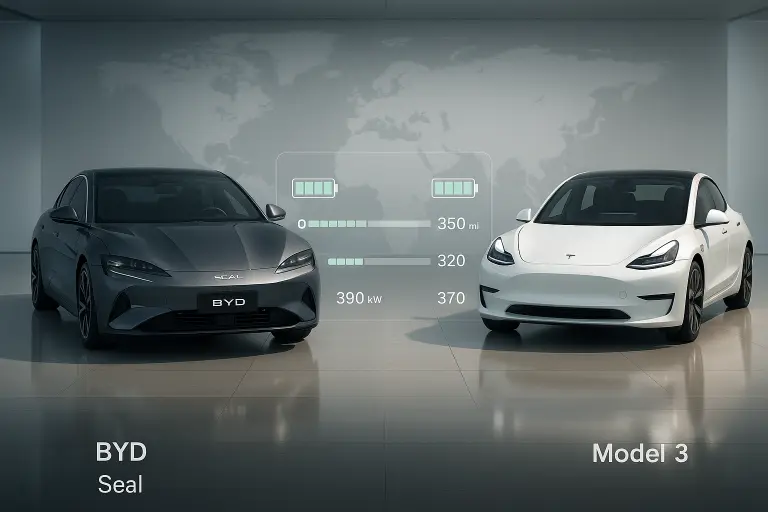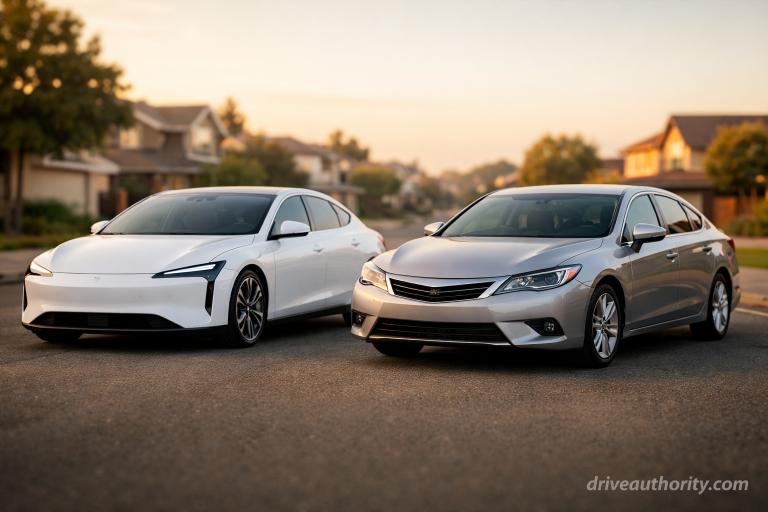
The Chinese EV vs Japanese hybrid reliability debate is one of the most important questions long-term car buyers face in 2026. When you’re buying a car you intend to keep for a decade or longer, the purchase price is almost the least important number. Maintenance bills, battery replacement costs, software support windows, and resale value erosion — these are the figures that decide whether your investment holds up or quietly bleeds you dry. Both Chinese electric vehicles and Japanese hybrid cars offer compelling efficiency and lower running costs than a conventional combustion engine. But when you look out past the five-year mark and toward 150,000 or 200,000 miles, which powertrain actually delivers on its long-term promise?
This guide runs a rigorous, data-driven comparison of Chinese EV vs Japanese hybrid long-term reliability. We examine battery chemistry, mechanical failure patterns, real-world ownership costs, depreciation, and the risks that don’t show up in a showroom brochure. Whether you’re a high-mileage commuter, a cautious 12-year keeper, or a buyer weighing market availability, you’ll find a clear framework here to guide your decision. For independent context, Consumer Reports’ EV and hybrid reliability data and J.D. Power’s Vehicle Dependability Study are both useful external references that inform much of the industry-wide analysis cited throughout this article.
Jump To Section
What Defines Long-Term Reliability in the Chinese EV vs Japanese Hybrid Debate?
Before comparing Chinese EV vs Japanese hybrid reliability head-to-head, it helps to define what long-term reliability actually means in 2026. It is not a single metric — it’s an ecosystem of interdependent variables. A car can have an impeccable mechanical track record but still fail you at year eight because its software is orphaned, or its battery chemistry degrades faster in your climate. Understanding what actually drives long-term ownership outcomes requires separating three distinct dimensions.
Mechanical Durability vs Software Longevity
Hybrid drivetrains combine a petrol engine, a generator, an electric motor, and a relatively small battery pack. There are more moving parts than a pure EV, but those parts are mature — Toyota’s Hybrid Synergy Drive, for example, has over two decades of continuous refinement. Failure data across high-mileage hybrid fleets is extensive and well-understood. Chinese EVs, by contrast, have far fewer mechanical components — the electric drivetrain eliminates the combustion engine, transmission, and exhaust system entirely. What they introduce instead is software risk. Over-the-air (OTA) update architecture, battery management system (BMS) complexity, and brand-specific software ecosystems create a new failure category that traditional reliability surveys don’t fully capture.
In 2026, software longevity is no longer a secondary concern — it is a primary reliability dimension. A brand that exits a market or discontinues model support can effectively strand a vehicle’s feature set mid-life. This is a risk that doesn’t exist in the same way for a mechanical hybrid.
Chinese EV vs Japanese Hybrid Battery Degradation Rates (Real-World 8–10 Year Data)
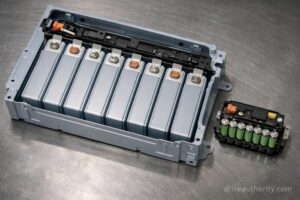
Battery chemistry is the single most important determinant of long-term EV value. In the Chinese EV vs Japanese hybrid reliability comparison, chemistry diverges sharply. LFP (Lithium Iron Phosphate) chemistry, dominant in Chinese EVs from BYD and increasingly from other manufacturers, degrades more slowly in real-world cycling than NMC (Nickel Manganese Cobalt) chemistry. LFP cells are also more thermally stable, which matters enormously in hot climates. Real-world data from 8–10 year-old LFP fleet vehicles shows average capacity retention above 85% at 120,000 miles — a significant improvement over first-generation NMC packs, which could dip below 75% in similar conditions.
Japanese hybrid battery packs use Nickel-Metal Hydride (NiMH) or, in newer models, lithium-ion chemistry. They are smaller (typically 1–2 kWh vs 40–80 kWh in a pure EV) and are rarely depleted to the extremes that accelerate degradation. Toyota hybrid battery longevity data across taxi fleets worldwide consistently shows high-mileage packs surviving well beyond 200,000 miles with minimal capacity loss.
Chinese EV vs Japanese Hybrid: Maintenance Frequency and Failure Points
Chinese EVs have genuinely lower routine maintenance demands — no oil changes, no timing belts, no spark plugs. The primary scheduled service involves brake fluid, cabin filters, and tire rotation. However, out-of-warranty repairs can be expensive if parts must be sourced internationally. Japanese hybrids require conventional engine maintenance plus hybrid-system inspections, but benefit from a globally distributed parts network and decades of mechanic familiarity.
Key Takeaways – Reliability Dimensions
- Software longevity is now a first-class reliability risk for EVs — not just battery and mechanical wear.
- LFP battery chemistry in Chinese EVs shows strong real-world degradation performance past 8 years.
- Japanese hybrid packs, while smaller, benefit from extremely conservative charge cycling that extends longevity.
- Parts availability outside China remains a real constraint for Chinese EV owners in many markets.
Chinese EV vs Japanese Hybrid: How Chinese EVs Stack Up on Reliability
The rapid ascent of Chinese EV manufacturers has been one of the defining automotive stories of the 2020s. When comparing Chinese EV vs Japanese hybrid reliability, the Chinese side of the equation has shifted dramatically — these brands are no longer the cheap, low-tech alternatives they were perceived to be five years ago. Yet they carry real long-term ownership risks that deserve clear-eyed analysis.
Manufacturing Quality in Leading Chinese Brands
The gap between Chinese EV build quality and established global automakers has narrowed substantially. BYD’s manufacturing processes — backed by its vertical integration in battery production — now meet or exceed Euro NCAP build quality benchmarks. NIO competes directly with premium European EVs on fit, finish, and material quality. XPeng positions itself as a technology-first manufacturer, with advanced autonomous driving hardware baked into its base specifications. An objective analysis of Chinese EV quality shows consistent improvement in J.D. Power initial quality equivalents across recent model years.
That said, quality is not uniform across all Chinese brands. The headline manufacturers earn high marks; the long tail of smaller Chinese EV producers — many of which entered the market during the 2020–2023 subsidy boom — tell a more mixed story. Brand selection matters enormously when assessing long-term reliability for a Chinese EV purchase.
Battery Technology Advantages (Blade Battery, LFP Dominance)
BYD’s Blade Battery architecture represents a genuine engineering advancement — a structural LFP pack that passes nail penetration tests without thermal runaway, has a lower weight-to-capacity ratio than earlier LFP designs, and integrates into the vehicle floor to improve rigidity. The broader industry trend toward LFP chemistry across Chinese EVs is a long-term reliability tailwind. LFP cells charge faster from low state-of-charge without the degradation penalty NMC cells incur, and they perform well across a wide temperature range with appropriate thermal management. For owners in moderate climates, an LFP-based Chinese EV bought in 2024 or 2025 should retain strong capacity well into its second decade. See also: how long EV batteries last in real-world conditions.
Software-Centric Architecture: Benefit or Liability?
Chinese EV manufacturers have built their vehicles around software-defined architecture from the ground up — OTA updates, centralized vehicle computers, and deeply integrated infotainment and ADAS systems. In the short term, this is a clear advantage: features improve post-purchase, bugs get patched remotely, and the ownership experience evolves over time. The long-term concern is software abandonment. When a manufacturer stops supporting a model, the OTA pipeline closes. Locked features may degrade or become non-functional. And in markets where the brand lacks a strong service network, software issues may be difficult to diagnose or resolve outside of official channels. This risk is manageable for buyers in markets where Chinese brands have committed dealer infrastructure — it is a meaningful concern for buyers in markets where the brand is new or has thin representation.
Real-World Issues Emerging After 5–8 Years
As the first major wave of Chinese EVs — particularly early MG, BYD, and Geely models sold in Europe and Southeast Asia — crosses the 5–8 year threshold, patterns are emerging. The most commonly reported long-term issues include suspension wear in urban driving cycles, infotainment system latency and occasional unit failures, and — in a minority of higher-mileage NMC-equipped models — battery capacity falling below 80% before the 8-year mark. Parts availability outside China remains inconsistent; sourcing a replacement body panel or specialist sensor in markets with limited brand penetration can take weeks. Common problems reported in Chinese EVs give a useful baseline for what owners are experiencing in real-world use.
| Issue Category | Reported Frequency (5–8 yr fleet data) | Severity |
|---|---|---|
| Battery degradation >15% before 8 yrs (NMC models) | ~18% of cases | Medium – High |
| Infotainment/software faults | ~22% of cases | Low – Medium |
| Suspension/chassis wear (urban cycles) | ~14% of cases | Medium |
| Charging port/connector issues | ~9% of cases | Low |
| Powertrain (motor/inverter) faults | ~4% of cases | High (rare) |
| Parts availability delay (>2 weeks) | ~30% of OOW repairs | Medium |
Who Should Choose a Chinese EV?
- Buyers in markets where the brand has established dealer and service networks
- Urban or suburban commuters with predictable, moderate annual mileage
- Those who plan to keep the vehicle 7–10 years and can tolerate some software obsolescence risk
- Buyers who prioritize lower running costs and are comfortable with a newer brand’s track record
- Tech-forward owners who value OTA improvements and advanced ADAS features
Not ideal for: High-mileage highway drivers in markets with thin service networks, or buyers who need absolute resale value certainty.
Chinese EV vs Japanese Hybrid: The Case for Japanese Hybrid Longevity
Japanese hybrid technology is the most thoroughly validated powertrain in automotive history. In any Chinese EV vs Japanese hybrid reliability comparison, the hybrid side benefits from a dataset orders of magnitude larger than anything available for Chinese EVs — Toyota alone has sold over 20 million hybrid vehicles globally. But maturity also means the technology is incremental rather than transformative, and in an era of rapid EV advancement, “proven” and “current” are not always synonymous.
20+ Years of Hybrid System Evolution
Toyota’s Hybrid Synergy Drive (HSD) first entered production in the 1997 Prius and has been continuously refined ever since. The core principle — a power-split device that seamlessly blends petrol engine and electric motor output, with regenerative braking recovering energy into the hybrid battery — remains unchanged. What has changed is efficiency, refinement, and reliability. Fifth-generation HSD in current Camry and RAV4 Hybrid models achieves fuel economies that rival Chinese EV running costs in markets with high electricity prices. Honda’s e:HEV system takes a different approach — running primarily on the electric motor at most speeds, using the petrol engine as a generator — and has established a strong reliability record of its own. The Toyota Camry’s hybrid system exemplifies the maturity this technology has reached.
Hybrid Battery Longevity Data (10–15 Year Records)
The hybrid battery longevity story is quietly remarkable. Tokyo taxi fleets running Toyota hybrids have documented vehicles accumulating over 300,000 km with original battery packs. Real-world replacement rate data from insurance and fleet companies in Japan, the US, and Europe consistently shows hybrid battery replacement before 200,000 km occurring in fewer than 10% of vehicles. When replacement is needed, the cost has fallen significantly: a Toyota hybrid battery replacement now averages $1,500–$2,500 in most markets, compared to $4,000–$8,000 for a major EV battery service. This cost structure radically changes the long-term total cost of ownership calculus.
Mechanical Complexity: Double Systems = Double Risk?
The intuitive concern about hybrids is that combining two powertrains doubles the failure surface area. In practice, this concern is only partially validated by data. The petrol engine in a hybrid is operated differently from a conventional unit — it runs closer to its optimal efficiency band, experiences less cold-start cycling, and is periodically rested on electric power — which actually extends engine longevity in many real-world use cases. The electric motor components are low-maintenance and durable. The main mechanical vulnerabilities in high-mileage hybrids are transmission wear (in conventional automatic-hybrid combinations), engine coolant system maintenance, and inverter reliability — the latter being a noted failure point in older HSD systems that Toyota has substantially addressed in post-2018 models.
Long-Term Maintenance Patterns: Chinese EV vs Japanese Hybrid Over 150,000 Miles
A Japanese hybrid at 150,000 miles requires everything a conventional petrol car requires — plus periodic hybrid system health checks. Oil changes, spark plugs, coolant flushes, and transmission fluid services all apply. The net effect is that hybrid 10-year maintenance costs, while lower than a conventional petrol car, are meaningfully higher than a pure EV. The Chinese EV vs Japanese hybrid maintenance gap is real: Chinese EVs eliminate the entire engine service schedule. The tradeoff is the near-elimination of catastrophic, unplanned repair events: hybrid drivetrains rarely fail suddenly. They degrade gradually and signal their condition clearly. For those interested in broader reliability context, see EV vs hybrid vs plug-in hybrid comparisons across the full ownership cycle.
| Year | Typical Hybrid Maintenance Event | Estimated Cost (USD) |
|---|---|---|
| Years 1–3 | Standard service (oil, filters, rotate) | $300–$600/yr |
| Years 4–6 | Above + spark plugs, brake fluid, cabin air | $500–$900/yr |
| Years 7–10 | Above + coolant flush, transmission fluid | $600–$1,100/yr |
| Year 10–15 | Above + potential hybrid battery health service | $700–$2,500/yr (battery event) |
Best for Conservative Long-Term Ownership
- Buyers who prioritize resale value certainty and brand recognition
- High-mileage highway drivers (20,000+ miles/year) where hybrid efficiency peaks
- 12+ year keepers who value a globally supported parts network
- Buyers in markets with limited EV charging infrastructure
- Those who want proven reliability data rather than extrapolated projections
Mileage threshold: Japanese hybrids generally outperform equivalent Chinese EVs on total cost beyond 150,000 miles in markets with higher electricity costs.
Chinese EV vs Japanese Hybrid: Full Head-to-Head Reliability Comparison
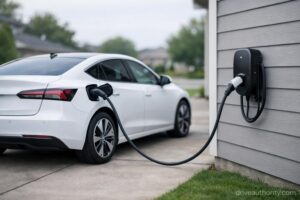
Chinese EV vs Japanese Hybrid: 10-Year Cost of Ownership Breakdown
| Factor | Chinese EV | Japanese Hybrid |
|---|---|---|
| Battery lifespan | LFP: ~85–90% capacity at 100k miles. NMC: ~75–82%. 8-yr warranty standard on major models. | NiMH/Li-ion hybrid pack: >90% capacity typical at 150k miles. Replacement rate <10% before 200k km. |
| Powertrain durability | Excellent electric motor longevity. Inverter/BMS are primary long-term risk components. | Extensively validated. Engine longevity excellent. Inverter improvements post-2018 address older weak point. |
| Maintenance cost (10 yrs) | $3,000–$5,500 (excl. major battery event) | $6,000–$9,500 (includes full engine maintenance schedule) |
| Resale value (10 yrs) | 20–35% of original value. High variance by brand and market trust. | 35–50% of original value. Toyota/Honda brand premium supports resale consistently. |
| Warranty coverage (2026 avg) | Battery: 8 yrs/100k miles. Powertrain: 5–8 yrs depending on brand. | Hybrid system: 8–10 yrs on major components. Petrol drivetrain: standard 3–5 yr manufacturer warranty. |
| Software risk | Medium-High. OTA-dependent architecture. Brand exit risk in thin markets. | Low. Minimal software dependency. Infotainment may age, but powertrain is not software-dependent. |
| Parts availability | Medium in established markets. Low in emerging/thin-representation markets. | Excellent globally. Decades of supply chain maturity. Aftermarket parts widely available. |
| Fuel/energy cost (10 yrs, avg use) | $4,500–$7,000 (electricity, varies by rate) | $9,000–$14,000 (petrol at current prices) |
| Overall 10-yr TCO estimate | $25,000–$35,000 (vehicle + energy + maintenance + depreciation) | $28,000–$42,000 (vehicle + energy + maintenance + depreciation) |
Chinese EV vs Japanese Hybrid Reliability Scorecard (Weighted Model)
The scorecard below weights five reliability dimensions by their long-term ownership impact. Battery durability accounts for 30% of the total weight given its outsized effect on both functionality and resale value. Mechanical wear (25%), parts and service access (20%), software risk (15%), and resale confidence (10%) complete the model.
Chinese EV — Reliability Score
Battery Durability (30%) 8.0/10
Mechanical Wear (25%) 8.5/10
Parts & Service (20%) 5.5/10
Software Risk (15%) 5.0/10
Resale Confidence (10%) 5.5/10
Weighted Total: 6.9 / 10
Japanese Hybrid — Reliability Score
Battery Durability (30%) 8.5/10
Mechanical Wear (25%) 7.5/10
Parts & Service (20%) 9.5/10
Software Risk (15%) 9.0/10
Resale Confidence (10%) 8.5/10
Weighted Total: 8.5 / 10
Key Takeaways – Chinese EV vs Japanese Hybrid Head-to-Head
- Chinese EVs win on energy running cost — the gap is real and meaningful over 10 years.
- Japanese hybrids win on parts availability, software risk, and resale value — consistently and by wide margins.
- Total 10-year cost of ownership in the Chinese EV vs Japanese hybrid comparison is actually competitive in markets with cheap electricity.
- The Chinese EV advantage shrinks in high-electricity-cost markets and where service networks are thin.
Chinese EV vs Japanese Hybrid Reliability: Which Is Right for Your Ownership Profile?
Urban Commuter (Low Mileage Driver)
For a driver covering 8,000–12,000 miles per year in a city, the Chinese EV is a strong contender. Low mileage means battery degradation accumulates slowly, the software support window extends relative to distance driven, and the absence of engine oil changes matters more on a per-month cost basis. Home charging overnight minimizes reliance on public infrastructure. If the brand has a solid service center presence in the city, the long-term ownership case is genuinely compelling. The monthly cost of owning an EV in an urban setting often undercuts any hybrid equivalent.
High-Mileage Highway Driver (20,000+ miles/year)
This is where the Japanese hybrid earns its most decisive advantage. At 20,000 miles per year, a hybrid reaches 200,000 miles in 10 years — a threshold most Chinese EVs haven’t been on the road long enough to validate. Hybrid battery cycling in highway use is extremely gentle (the pack rarely depletes fully), engine operating conditions are nearly ideal, and the drivetrain faces its most favorable use profile. Public charging dependency on long highway runs also weighs against the pure EV, though this calculus improves as infrastructure density rises. See: EV range anxiety explained for a fuller picture of charging infrastructure realities.
Long-Term 12+ Year Keeper
For someone intending to keep a car 12 years or longer, the Japanese hybrid wins on risk profile almost unconditionally. Parts availability, mechanical familiarity, a globally proven service network, and zero software obsolescence risk combine to make the hybrid the rational choice. The Chinese EV is a 2026 product — nobody has lived with one for 12 years yet. If you are a 12-year keeper, you are essentially trusting projections. The hybrid’s data is actual, not extrapolated.
Emerging Market vs Developed Market Buyer
In developed markets where Chinese brands have established dealer networks — the UK, Australia, much of Western Europe — the gap between Chinese EV and Japanese hybrid in service accessibility is narrowing fast. In emerging markets with thin Chinese brand presence, the hybrid’s global parts network remains a decisive practical advantage. For buyers in Africa, Latin America, and South and Southeast Asia outside brand strongholds, a Toyota or Honda hybrid backed by decades of local parts distribution may simply be more reliable in a practical, day-to-day sense regardless of what the engineering data says.
Chinese EV vs Japanese Hybrid: Depreciation & Resale Value Trends (2026)
Market Trust & Brand Perception
Resale value is partly engineering and partly psychology. In most Western markets, Chinese EV brands are still earning trust — which means their used car pricing reflects an uncertainty premium regardless of actual condition. A well-maintained BYD Atto 3 at five years old cannot command the same proportion of its new price that an equivalent Toyota hybrid can, simply because the used car buyer pool is smaller and brand confidence thinner. This is changing — but it is the current reality. In contrast, Chinese domestic and Southeast Asian markets are showing Chinese EV resale values recovering faster as brand trust is embedded in local consumer culture.
Battery Health Impact on Resale
Battery health certificates — third-party assessments of remaining state-of-health for an EV battery — are becoming standard practice in used EV transactions in Europe and Australia. A Chinese EV with a documented 88% battery state of health at 60,000 miles can command a meaningful premium over one without certification. As this infrastructure matures, the resale discount Chinese EVs face will gradually compress. Japanese hybrid batteries, being smaller and cycling more conservatively, rarely become a resale concern. For those researching the used EV market, BYD reliability after 3 years and BYD reliability after 5 years offer useful reference points.
| Resale Milestone | Chinese EV (% of new price) | Japanese Hybrid (% of new price) |
|---|---|---|
| Year 3 | 48–58% | 60–70% |
| Year 5 | 35–46% | 50–60% |
| Year 8 | 22–35% | 38–50% |
| Year 10 | 18–28% | 32–44% |
Projections assume average mileage, moderate climate, and established-market resale conditions. Ranges are wide because brand-to-brand variance within both categories is significant.
Chinese EV vs Japanese Hybrid: Risk Analysis – What Could Go Wrong?
Regulatory Risk (Battery Recycling Laws 2026)
European and US battery recycling regulations are tightening significantly in 2025–2027. EV owners may face mandatory end-of-life battery disposal costs, and regulations around battery health disclosure in used EV sales are intensifying. Japanese hybrid batteries, being smaller and already subject to well-established take-back programs, face a lower regulatory burden. Chinese EV manufacturers selling in Europe are required to comply with EU Battery Regulation provisions — costs that may eventually feed through to ownership in ways not yet fully priced in.
Software Obsolescence
This is the risk most EV buyers underestimate. A Chinese EV purchased today is dependent on its manufacturer for OTA updates, BMS calibration patches, and — in some cases — features that are software-licensed rather than hardware-enabled. If the manufacturer exits a market, updates stop. If the brand is acquired or restructured, software support timelines become uncertain. This isn’t hypothetical — several smaller Chinese EV brands that entered European markets in 2021–2023 have already reduced or ended local operations. Electric cars to avoid in 2026 flags specific models with thin support infrastructure.
Supply Chain & Geopolitical Exposure
Chinese EVs exist at the intersection of several active geopolitical fault lines — US tariffs (currently at elevated levels), European Union anti-subsidy investigations, and ongoing tensions over semiconductor supply chains. These forces affect parts pricing, import costs for specialist components, and potentially brand presence in specific markets. Japanese hybrids are manufactured across globally distributed supply chains with decades of resilience engineering — Toyota and Honda have navigated the 2011 Tohoku earthquake, the 2020 chip shortage, and multiple supply disruptions. Their supply chains are simply more stress-tested. For an overview of current market conditions, see why Chinese EVs are gaining ground in Europe despite these headwinds.
FAQs – Chinese EV vs Japanese Hybrid Long-Term Reliability
Are Chinese EVs reliable long term?
Leading Chinese EV brands like BYD and NIO demonstrate strong mechanical reliability at the 5–7 year mark, with LFP battery chemistry showing excellent degradation performance. Long-term reliability beyond 10 years is not yet fully validated by real-world data. Service network quality and software support continuity are the key variables that determine whether “strong at 5 years” translates to “reliable at 12 years.”
Do Japanese hybrids last longer than electric cars?
In terms of validated data, yes — currently. Toyota hybrids have documented 200,000+ mile lifespans in fleet use. Chinese EVs lack equivalent long-term datasets. That said, electric drivetrains have fewer mechanically wearing components, so longevity projections for current-generation LFP EVs are genuinely competitive. The honest answer is that hybrids have proven it; EVs project it.
Which has lower maintenance cost over 10 years?
Chinese EVs have materially lower 10-year maintenance costs — typically $3,000–$5,500 versus $6,000–$9,500 for Japanese hybrids — because they eliminate engine oil, spark plugs, timing components, and transmission servicing. However, an out-of-warranty EV battery event can narrow or reverse this advantage depending on the severity and timing.
How long do EV batteries last in 2026?
Current-generation LFP batteries in Chinese EVs are projected to retain 80%+ capacity past 150,000 miles under normal use conditions. Real-world 8–10 year data from early LFP fleet vehicles is consistent with these projections. NMC chemistry (used in some premium models) degrades faster, particularly in hot climates or with frequent DC fast charging. Battery technology in 2026 is meaningfully better than 2018–2020 packs. Full EV battery lifespan data here.
Is hybrid battery replacement expensive?
Far less expensive than an EV battery replacement. A Toyota or Honda hybrid battery replacement in 2026 typically costs $1,500–$2,500 for a full OEM replacement, with refurbished units available from $800–$1,400. Because the packs are small (1–2 kWh) and cycling is conservative, most hybrid batteries never need replacement within a 10-year ownership window.
Which is better for 200,000 miles?
At 200,000 miles, the Japanese hybrid holds a strong advantage on proven data and parts availability. High-mileage hybrid data from taxi fleets and Uber/Lyft driver communities globally provides extensive validation. Chinese EV data at 200,000 miles is sparse — the cars are simply not old enough in sufficient numbers to generate reliable conclusions. The hybrid is the lower-risk choice at this mileage threshold in 2026.
Are Chinese EVs improving in reliability?
Yes, meaningfully. Year-over-year quality improvements across BYD, NIO, and XPeng are documented in independent assessments and owner surveys. Build quality, software stability, and after-sales service are all measurably better in 2024–2026 models than in 2019–2022 models. The reliability trajectory is positive — but trajectory and destination are not the same thing. Chinese car reliability in 2025 provides a useful baseline for the current state of play.
Final Verdict – Chinese EV vs Japanese Hybrid: Which Is More Reliable Long Term?
This Chinese EV vs Japanese hybrid comparison does not resolve to a single winner — it resolves to a decision framework. The long-term reliability question is not one of absolute quality but of fit-to-ownership-context.
Decision Matrix
| Your Profile | Better Choice |
|---|---|
| Urban commuter, <12,000 miles/year, established-market buyer | Chinese EV ✅ |
| High-mileage driver, 20,000+ miles/year | Japanese Hybrid ✅ |
| 12+ year keeper, maximum risk aversion | Japanese Hybrid ✅ |
| Buyer in emerging market with thin brand service | Japanese Hybrid ✅ |
| Tech-forward buyer, 7–8 year ownership window | Chinese EV ✅ |
| Maximum resale value protection | Japanese Hybrid ✅ |
| Minimum 10-year running cost | Chinese EV (market-dependent) ✅ |
Japanese hybrids lead on the dimensions that matter most to risk-averse, long-term buyers: proven real-world longevity data, globally distributed parts and service access, software independence, and stable resale value. These are not marginal advantages. In markets where trust in Chinese brands is still being established, they are decisive.
Chinese EVs lead on running cost efficiency, mechanical simplicity, and technology trajectory. For a buyer in the right market, with the right usage profile, and a willingness to accept that some long-term risk is being extrapolated rather than proven, a current-generation LFP-based Chinese EV from a major brand is a rational long-term ownership choice — and that was not something that could be said as confidently even three years ago.
The gap is narrowing. But in 2026, if the question is purely “which is more reliable long term,” the data still points to the Japanese hybrid — while acknowledging that Chinese EVs are closing the distance faster than most observers predicted.
For more context on buying decisions in this space, explore the best Chinese EVs in 2026, review EV vs hybrid vs plug-in hybrid tradeoffs, and use our ownership cost tools to model your specific scenario before committing.