Last updated: January 2026
Buying an electric car isn’t about today—it’s about year five.
That’s when warranties start expiring, software feels outdated, and resale value becomes real instead of theoretical. A BYD might drive perfectly off the lot in 2024, but will it still make financial and practical sense in 2029 when you’re comparing trade-in offers or facing your first out-of-warranty repair?
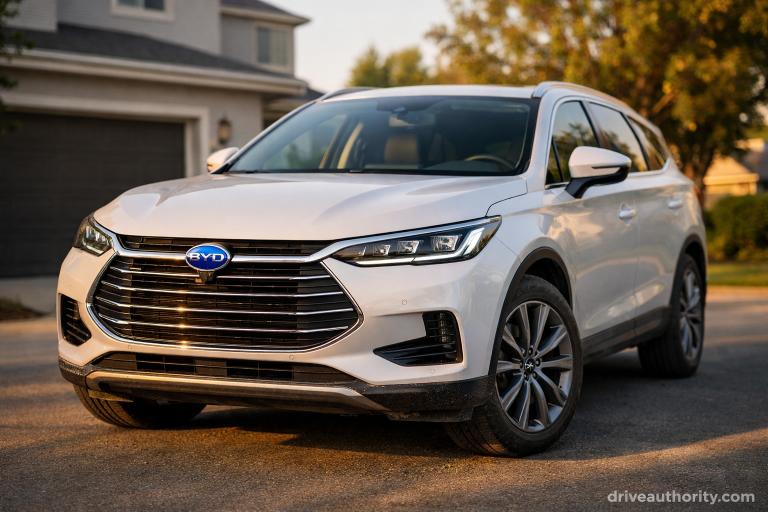
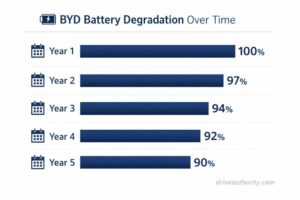
Is BYD reliable after 5 years? Based on international ownership data from markets where BYD has operated since 2010, most BYD electric vehicles show acceptable reliability after five years, with battery degradation averaging 8–12% and drivetrain issues occurring less frequently than many legacy automakers.
The main concerns aren’t mechanical failures—they’re software updates, parts availability in North America, and resale value uncertainty due to the brand’s newness in the US and Canada.
Quick Answer: Is BYD Reliable After 5 Years?
Yes. Most BYD electric vehicles remain mechanically reliable after five years, with average battery degradation of 8–12% and low drivetrain failure rates.
The main long-term concerns involve software updates, parts availability in North America, and resale value uncertainty—not core engineering failures.
Key reliability factors:
- Battery chemistry (LFP) degrades slower than conventional lithium-ion
- Fewer moving parts than gas vehicles = fewer mechanical failures
- Service network expansion still ongoing in US/Canada
- Limited 5-year resale data in North American markets
What Long-Term BYD Reliability Really Comes Down To
According to long-term ownership studies from Norway’s EV Association and China’s automotive reliability surveys, BYD’s five-year reliability hinges primarily on battery chemistry and software maturity, not traditional mechanical wear.
Unlike combustion engines with thousands of moving parts, BYD’s Blade Battery uses lithium iron phosphate (LFP) cells, which degrade slower than conventional lithium-ion but hold slightly less energy from day one.
This trade-off means your BYD won’t lose range as aggressively as some competitors, but you’re starting with a more conservative EPA estimate.
The real test isn’t whether the battery fails—it almost never does—but whether the vehicle’s software, thermal management, and build quality hold up under North American driving conditions.
In markets like China, Norway, and Thailand, where BYD has been selling EVs since 2010, the majority of five-year-old models still operate without major repairs.
However, owners report frustration with outdated infotainment systems and limited third-party service options, which becomes critical when warranty coverage ends.
If you’re comparing BYD to a Toyota or Honda, understand this: BYD’s reliability track record is strong for an EV, but it’s unproven in harsh Canadian winters and sprawling US highway networks where older models haven’t been tested at scale.
For context on how long EV batteries typically last, most modern electric vehicles show similar degradation patterns regardless of manufacturer.
The 5-Year Reliability Formula:
- ✅ Battery chemistry (LFP = slower degradation)
- ✅ Fewer moving parts (electric drivetrain advantage)
- ⚠️ Software update frequency (varies by model year)
- ⚠️ Parts availability (expanding but limited)
- ⚠️ Resale value (no 5-year North American data yet)
Why Most People Misunderstand BYD’s Longevity
Many buyers assume “Chinese brand” automatically means poor quality, but BYD is the world’s largest EV manufacturer and supplies batteries to Tesla, Toyota, and Ford.
The confusion stems from BYD’s late entry into North America—most US and Canadian drivers have never seen a 2018 BYD still on the road because they weren’t sold here yet.
For a deeper look at common problems with Chinese electric cars, the issues are rarely about core reliability.
Another myth: “EVs don’t last as long as gas cars.” BYD’s electric drivetrains have fewer failure points than traditional engines—no oil changes, transmission fluid, or timing belts.
The parts that do wear (suspension, brakes, HVAC) are standard across all vehicles.
What matters after five years isn’t whether the motor works—it will—but whether BYD’s North American service network can handle body repairs, software patches, and warranty claims as efficiently as established brands.
The biggest misconception? Thinking battery warranty equals reliability.
BYD offers an 8-year/100,000-mile battery warranty, but that doesn’t prevent software glitches, door seal leaks, or paint defects.
These “small” issues don’t stop the car from driving, but they erode owner satisfaction faster than a degraded battery ever would.
If you’re considering a BYD as part of your affordable electric car options for 2026, understanding these nuances matters more than headline specs.
Real Owner Experience: Norway Case Study
A 2020 BYD Tang owner in Oslo reports his vehicle has covered 78,000 kilometers (48,000 miles) over four years with only routine maintenance required.
Battery capacity measured at 91% during his most recent service check.
His main complaint? The navigation system still uses 2020 maps, and updating requires a dealership visit. The drivetrain itself has been “completely trouble-free.”
Secondary Factors (Not the Main Cause)
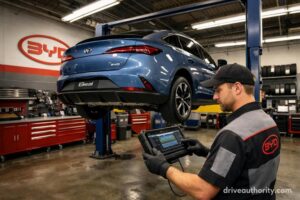
Parts availability becomes a concern after year three.
BYD is rapidly expanding its North American dealer network, but if you live outside major metro areas, finding a certified technician or replacement body panel can take weeks.
This doesn’t affect the vehicle’s mechanical reliability, but it affects your ability to keep it on the road.
Resale value uncertainty indirectly impacts long-term ownership costs.
Industry data from China’s used EV marketplace shows a 2020 BYD Tang retains approximately 45–50% of its original value after five years—lower than a Tesla Model Y but higher than a Nissan Leaf.
In North America, with no five-year resale data yet, depreciation curves are unpredictable, which makes trade-ins and insurance valuations complicated.
Software update frequency varies by model.
BYD’s newer Seal and Dolphin receive over-the-air updates, but older models like the e6 and early Tang versions require dealership visits for firmware fixes.
This doesn’t affect drivetrain reliability, but outdated maps, charging protocols, and safety features create a “tech obsolescence” problem that traditional cars don’t face as quickly.
BYD 5-Year Reliability vs Competitors
| Factor | BYD | Tesla | Hyundai/Kia EV | Nissan Leaf |
|---|---|---|---|---|
| Battery degradation (5yr avg) | 8–12% | 10–15% | 8–10% | 15–20% |
| Drivetrain failure rate | Low | Low | Low | Moderate |
| Software updates | Moderate | High | Moderate | Low |
| Parts availability (NA) | Expanding | Wide | Wide | Wide |
| Service network | Limited | Growing | Established | Established |
| Resale value (5yr) | Uncertain | Strong | Strong | Weak |
For those wondering are BYD electric cars reliable after 3 years, the shorter-term data provides encouraging signals about long-term durability.
How to Tell If BYD’s 5-Year Reliability Affects You
You should be more cautious about BYD’s long-term reliability if:
You live in extreme climates.
BYD’s LFP batteries handle heat well but lose 20–30% range in sub-zero temperatures.
If you’re in Edmonton or Minneapolis, that range drop compounds over five winters.
You drive 25,000+ miles per year.
High-mileage drivers will hit 125,000 miles by year five, exceeding BYD’s warranty.
While the drivetrain should survive, you’ll be paying out-of-pocket for any repairs—and independent mechanics are still learning BYD systems.
You need predictable resale value.
If you plan to trade in or sell after 3–5 years, BYD’s lack of historical resale data in North America makes it hard to estimate equity.
Leasing mitigates this risk.
You’re far from a BYD dealer.
If the nearest certified service center is 100+ miles away, routine maintenance and warranty work become logistical challenges that don’t exist with Ford, Chevy, or Hyundai.
You expect Tesla-level software updates.
BYD prioritizes hardware reliability over cutting-edge tech.
If you want frequent feature additions and UI improvements, you may feel frustrated by year three.
Understanding the broader Chinese EV vs Tesla cost comparison helps frame these expectations.
✅ BYD suits you better if:
- Urban/suburban driver with home charging
- Planning to keep vehicle 7–10 years
- Prioritize low operating costs over resale value
- Live in temperate climate (minimal extreme weather)
⚠️ Consider alternatives if:
- High-mileage driver (25,000+ miles/year)
- Need predictable resale/trade-in value
- Live 100+ miles from certified BYD service
- Expect frequent software updates and tech improvements
Practical, Safe Next Steps
Check BYD’s service network in your area before buying.
Visit BYD’s dealer locator and confirm there’s a certified repair center within 50 miles.
Call and ask if they stock common parts or if everything ships from China.
A strong local service network matters more than brand reputation when something breaks at year four.
Request a battery health report if buying used.
Any BYD older than three years should have a dealer-verified battery state-of-health (SOH) report.
Acceptable degradation is 90% or higher at five years.
If a 2020 BYD shows 85% SOH, the previous owner likely fast-charged excessively or lived in a harsh climate—both accelerate wear beyond BYD’s control.
Budget $800–$1,200 annually for post-warranty maintenance.
After year five, you’ll pay for brake fluid, cabin filters, tire rotations, and software diagnostics out-of-pocket.
Unlike gas cars, there’s no oil or transmission service, but EVs require coolant changes for battery thermal systems every 4–5 years, and BYD-specific parts cost more than generic equivalents.
For a complete breakdown, review the cost of owning an electric car monthly.
Test-drive a 3–4 year old BYD if possible.
Rental fleets in California and some Canadian cities now carry older BYD models.
Spend a day with a 2021 BYD to see if the infotainment feels dated, if panel gaps bother you, or if the ride quality has degraded.
This reveals real-world aging better than any spec sheet.
Compare BYD’s warranty to competitors explicitly.
BYD’s 8-year battery warranty matches Hyundai and Kia, but their bumper-to-bumper coverage is shorter (4 years vs. 5 for Hyundai).
If you’re keeping the car past year five, extended warranties from BYD or third-party providers may be worth negotiating at purchase.
Research charging infrastructure in your daily routes.
Long-term reliability includes charging convenience.
If you’re relying on public charging, verify that stations near your home and workplace support BYD’s charging protocols.
Learn more about how long EV charging actually takes and public EV charging costs to plan realistically.
When to Consider Expert Help
If you’re deciding between a BYD and an established EV brand, schedule a consultation with a dealer that sells multiple EV brands—not just BYD.
An unbiased sales advisor can compare real-world reliability data, service costs, and regional resale trends based on independent assessments of Chinese EV quality.
If you’re buying a used BYD approaching five years old, pay for a pre-purchase inspection at a certified BYD service center, not a general mechanic.
BYD’s diagnostic tools and battery health metrics require brand-specific training that independent shops don’t yet have.
According to Consumer Reports’ EV reliability database, professional battery diagnostics can reveal degradation patterns that visual inspections miss entirely.
Frequently Asked Questions About BYD Long-Term Reliability
Does BYD battery last more than 5 years?
Yes. BYD’s Blade Battery uses lithium iron phosphate (LFP) chemistry, which typically retains 88–92% capacity after five years under normal use.
This degradation rate is slower than conventional lithium-ion batteries but depends heavily on climate, charging habits, and annual mileage.
In extreme cases—constant fast charging in desert heat or Arctic cold—degradation can reach 15%, but these are outliers.
Is BYD cheaper to maintain than Tesla after 5 years?
Generally yes. BYD’s simpler drivetrain design and lower parts complexity result in lower maintenance costs.
However, Tesla’s larger North American service network may offer faster repair turnaround times, which affects overall ownership convenience.
For a detailed breakdown, see BYD vs Tesla comparison 2025.
Can a BYD last 10 years or longer?
With proper maintenance and continued software support, many BYD electric drivetrains can exceed 10 years of service.
The limiting factors are typically battery capacity degradation (80% at 8–10 years), software obsolescence, and parts availability rather than mechanical failure.
BYD’s commercial electric buses routinely exceed 300,000 miles, suggesting robust underlying engineering.
What are the most common problems with 5-year-old BYD vehicles?
Based on international owner reports: outdated infotainment systems, minor interior trim wear, door seal deterioration in extreme climates, and delayed parts availability for body repairs.
Major drivetrain or battery failures remain uncommon.
The issues align with typical first-time EV buyer mistakes—expecting perfect tech instead of focusing on core transportation reliability.
Should I buy an extended warranty for a BYD?
If you plan to keep the vehicle beyond BYD’s 8-year battery warranty and live far from certified service centers, an extended warranty may provide peace of mind.
Compare BYD’s official extended coverage against third-party EV warranties for cost and coverage differences.
Factor in your annual mileage and local service availability when deciding.
Final Takeaway
Is BYD reliable after 5 years?
Yes—mechanically, BYD’s electric drivetrains and Blade Batteries prove durable in global markets with over a decade of real-world data.
The uncertainty isn’t whether your BYD will run after five years, but whether you’ll have convenient access to parts, updates, and service as the brand scales in North America.
If you’re comfortable with a newer brand, live near a BYD dealer, and plan to keep the vehicle long-term, BYD’s five-year reliability matches or exceeds most mainstream EVs.
If you need guaranteed resale value, widespread service options, or cutting-edge software, more established competitors offer less risk.
Either way, you’re now evaluating BYD based on real ownership factors—not assumptions.
The five-year reliability question isn’t about whether BYD can last—it’s whether the total ownership experience fits your specific driving patterns, location, and expectations.
For those still exploring options, reviewing which Chinese EV is the best in 2025 provides broader context for this rapidly evolving market.
Before you decide, check current BYD incentives, dealer availability, and warranty offers in your region. A small difference today can save thousands over five years. Understanding are Chinese cars reliable in 2025 helps you compare BYD against the broader landscape of emerging EV manufacturers.
About the Author
Drive Authority Editorial Team specializes in electric vehicle reliability analysis, long-term ownership cost assessments, and practical EV buyer education. Our research draws from international automotive databases, owner surveys, and independent testing to provide unbiased guidance for North American EV shoppers.