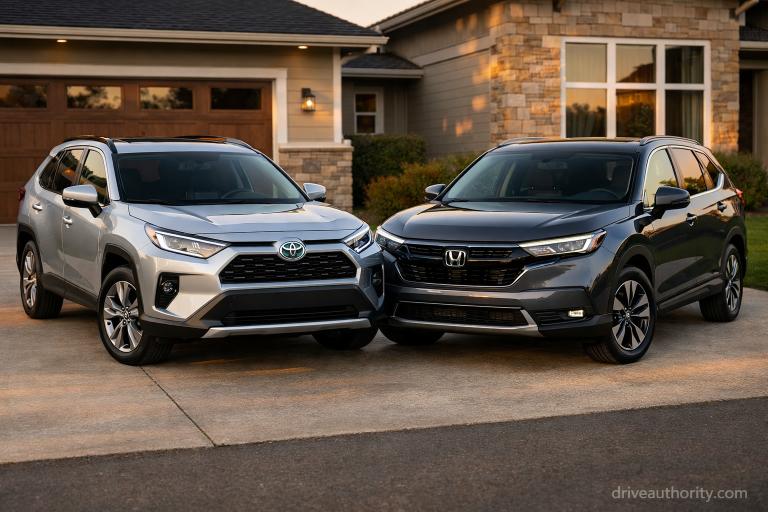
Few matchups in the compact SUV segment generate more debate than Toyota RAV4 vs Honda CR-V — and in 2026, both vehicles have never been closer in capability, technology, and real-world value. Rather than asking which one is better built, the more useful question is which one is better for your commute, your family, and your five-year financial picture. Both earn top marks; what separates them are the trade-offs.
This comparison covers every dimension that matters to real buyers: pricing by trim, hybrid fuel economy versus EPA ratings, cargo and passenger dimensions, technology, safety, reliability data, and a full 5-year total cost of ownership breakdown. No fluff, no manufacturer spin — just the numbers and the context to make them useful.
The Toyota RAV4 wins on hybrid efficiency, resale value, and off-road versatility. The Honda CR-V wins on interior space, rear passenger comfort, ride quality, and tech usability. For most families, the RAV4 Hybrid is the smarter long-term financial choice — but the CR-V is a genuinely better car to live with day to day if efficiency is not your primary concern.
Toyota RAV4 vs Honda CR-V: Pricing and Trim Comparison
On paper, the two SUVs are priced similarly. In practice, you get meaningfully different features at each price point — and the hybrid pricing gap has narrowed considerably in 2026, making the efficiency math more compelling than ever.
Toyota RAV4 Trim Levels and MSRP (2026)
The RAV4 continues to offer one of the broadest trim ladders in the segment, ranging from the value-focused LE up to the premium XSE and the trail-capable TRD Off-Road. All hybrid trims now include AWD as standard, eliminating a previous friction point for efficiency-focused buyers.
| Trim | Powertrain | MSRP (est.) | AWD |
|---|---|---|---|
| LE | 2.5L Gas, 203hp | $30,900 | Optional |
| XLE | 2.5L Gas, 203hp | $33,500 | Optional |
| XLE Premium | 2.5L Gas, 203hp | $36,200 | Optional |
| Hybrid LE | Hybrid, 219hp | $33,800 | Standard |
| Hybrid XLE | Hybrid, 219hp | $36,400 | Standard |
| Hybrid XSE | Hybrid, 219hp | $39,100 | Standard |
| TRD Off-Road | 2.5L Gas, 203hp | $38,500 | Standard |
Honda CR-V Trim Levels and MSRP (2026)
The CR-V offers a cleaner, shorter trim ladder. The EX-L and Touring trims represent strong value with generous standard equipment, and the Sport Hybrid has become the segment’s most natural competitor to the RAV4 Hybrid.
| Trim | Powertrain | MSRP (est.) | AWD |
|---|---|---|---|
| LX | 1.5T Gas, 192hp | $30,200 | Optional |
| EX | 1.5T Gas, 192hp | $33,000 | Optional |
| EX-L | 1.5T Gas, 192hp | $36,200 | Optional |
| Sport Touring | 1.5T Gas, 192hp | $38,700 | Optional |
| Sport Hybrid | e:HEV Hybrid, 204hp | $34,800 | Standard |
| Sport Hybrid EX-L | e:HEV Hybrid, 204hp | $38,100 | Standard |
| Sport Hybrid Touring | e:HEV Hybrid, 204hp | $41,200 | Standard |
Hybrid and AWD Pricing Differences
The hybrid premium has compressed considerably in 2026. On the RAV4, moving from the XLE gas to the Hybrid XLE adds approximately $2,900 — and in return, you gain AWD standard, 16 more MPG combined, and meaningfully better low-speed torque. Similarly, the CR-V’s Sport Hybrid undercuts the Sport Touring gas trim by $600 while delivering superior fuel economy. In both cases, therefore, the hybrid is now the more rational financial choice at comparable trim levels, especially for buyers covering more than 12,000 miles annually. See our full analysis of EV vs hybrid vs plug-in hybrid for context on where these powertrains sit in the broader market.
Incentives and Financing
Both RAV4 Hybrid and CR-V Hybrid models may qualify for state-level clean vehicle incentives depending on your market. Neither qualifies for the federal EV tax credit as conventional hybrids, but several states offer rebates of $500–$2,500. Toyota Financial Services and Honda Financial Services routinely offer 0–1.9% APR promotions on hybrid trims during model changeover periods — worth checking before you negotiate.
Toyota RAV4 vs Honda CR-V: Engine Options, Hybrid Efficiency, and Performance
This is where the two SUVs diverge most meaningfully. Toyota’s hybrid system is more mature, more efficient, and more proven at scale. Honda’s turbocharged gas engine offers a more traditional driving character, while the e:HEV hybrid system prioritizes smoothness over ultimate efficiency.
Gas Engine Specs and Horsepower
The RAV4’s 2.5-litre naturally aspirated four-cylinder produces 203 horsepower — modest, but torque delivery is linear and predictable. Honda’s 1.5-litre turbocharged four-cylinder produces 192 horsepower but generates peak torque of 192 lb-ft from lower in the rev range, giving it a more responsive feel in everyday driving. Neither will set any stopwatch records, but both are more than adequate for real-world use.
Hybrid Powertrain Efficiency — 2026 EPA Ratings
| Model | Engine | HP | City MPG | Hwy MPG | Combined |
|---|---|---|---|---|---|
| RAV4 Gas (FWD) | 2.5L NA | 203 | 27 | 35 | 30 |
| RAV4 Gas (AWD) | 2.5L NA | 203 | 25 | 33 | 28 |
| RAV4 Hybrid (AWD) | 2.5L Hybrid | 219 | 41 | 38 | 39 |
| CR-V Gas (FWD) | 1.5T Turbo | 192 | 28 | 34 | 30 |
| CR-V Gas (AWD) | 1.5T Turbo | 192 | 27 | 32 | 29 |
| CR-V Hybrid (AWD) | 2.0L e:HEV | 204 | 37 | 34 | 36 |
The RAV4 Hybrid’s efficiency advantage over the CR-V Hybrid is genuine and consistent — roughly 3 MPG combined under typical driving conditions. At 15,000 miles annually with gas at $3.50/gallon, that translates to approximately $200–$250 per year in fuel savings, or $1,000–$1,250 over five years. Not transformative on its own, but compounded with better resale value, it makes a compelling case.
Real-World Fuel Economy vs EPA Estimates
User-reported data from fuel tracking apps consistently shows both hybrids outperforming their EPA ratings in city driving — where regenerative braking recovers the most energy — and slightly underperforming on sustained highway runs above 70 mph. Notably, RAV4 Hybrid owners commonly report 42–46 MPG in urban conditions. Similarly, CR-V Hybrid owners achieve 38–42 MPG in comparable driving patterns. Both results, however, exceed expectations for non-plug-in hybrids at this price point.
AWD Capability and Towing Capacity
The RAV4 Hybrid uses an electric motor on the rear axle to deliver AWD — a mechanically decoupled system that is both more efficient and more responsive on slippery surfaces than a traditional transfer case. The CR-V Hybrid uses a similar dual-motor setup. In towing, the RAV4 rates at 3,500 lbs while the CR-V is rated at 1,500 lbs — a significant gap for buyers who occasionally tow boats, trailers, or equipment.
Efficiency winner: Toyota RAV4 Hybrid — 39 MPG combined versus 36 MPG for the CR-V Hybrid, plus a 3,500 lb tow rating that the CR-V cannot approach.
RAV4 vs CR-V: Interior Space, Cargo Capacity, and Comfort
Interior dimensions are where the CR-V consistently earns its family-SUV reputation. Honda has prioritized passenger space and rear seat comfort in ways that measurably affect daily usability — particularly for families with rear-seated passengers who care about leg room.
Passenger Dimensions
| Measurement | RAV4 | CR-V | Advantage |
|---|---|---|---|
| Front Headroom | 37.7 in | 40.0 in | CR-V +2.3″ |
| Front Legroom | 41.0 in | 42.0 in | CR-V +1.0″ |
| Rear Headroom | 38.9 in | 39.2 in | CR-V +0.3″ |
| Rear Legroom | 37.8 in | 40.9 in | CR-V +3.1″ |
| Cargo Behind 2nd Row | 37.5 cu ft | 39.3 cu ft | CR-V +1.8 cu ft |
| Max Cargo (seats folded) | 69.8 cu ft | 76.5 cu ft | CR-V +6.7 cu ft |
| Total Passenger Volume | 98.9 cu ft | 105.9 cu ft | CR-V +7.0 cu ft |
What the Numbers Mean in Practice
The CR-V’s 3.1-inch rear legroom advantage is consequently the difference between comfortable and cramped for adult rear passengers on longer journeys. A standard infant/toddler car seat fits easily in both; however, a rear-facing infant seat in the CR-V still leaves meaningful front-seat legroom. The RAV4, while not a small vehicle, nonetheless has a noticeably less generous rear seat — particularly for taller passengers sitting behind taller drivers.
On cargo, furthermore, the CR-V’s advantage is real. A large stroller, a folded jogging stroller, airport luggage for a family of four — all fit more easily in the CR-V’s wider, deeper cargo area. Additionally, the RAV4’s cargo floor sits slightly higher in hybrid trims due to battery packaging, thereby reducing practical cargo depth.
Rear Seat Flexibility and Family Usability
Both SUVs offer 60/40 split-folding rear seats. The CR-V adds a sliding rear seat on most trims — allowing you to trade cargo space for legroom dynamically. The RAV4 does not offer a sliding rear bench, which is a genuine usability gap for families who frequently reconfigure the cabin.
Material Quality and Cabin Design
At comparable trim levels, the CR-V’s interior feels slightly more premium — soft-touch surfaces are more consistently applied, the dashboard design is more cohesive, and the fit between panels is tighter. The RAV4’s cabin is durable and well-organized but has a more utilitarian character. Neither is in luxury SUV territory, but if interior ambiance influences your daily satisfaction, the CR-V has a meaningful edge.
Space winner: Honda CR-V — more rear legroom, more cargo volume, a sliding rear seat, and a more refined interior at comparable trim levels.
Toyota RAV4 vs Honda CR-V: Technology and Infotainment
Both SUVs have made meaningful technology upgrades in 2026, but they take different approaches — Toyota prioritizing physical control retention, Honda pushing toward a cleaner, more integrated digital interface.
Infotainment Screen and Interface
| Feature | RAV4 | CR-V |
|---|---|---|
| Infotainment Screen | 10.5″ touchscreen (XLE+) | 9.0″ touchscreen (all trims) |
| Wireless Apple CarPlay | Standard (XLE+) | Standard (all trims) |
| Wireless Android Auto | Standard (XLE+) | Standard (all trims) |
| Digital Instrument Cluster | 7″ (XLE+), 12.3″ (Hybrid XSE) | 7″ (EX+) |
| OTA Software Updates | Yes (connected trims) | Yes (EX+) |
| Wi-Fi Hotspot | Optional | Standard (EX+) |
| Heated Front Seats | XLE Premium+ | EX-L+ |
| Heated Steering Wheel | XLE Premium+ | EX+ |
| Ventilated Front Seats | Not available | Touring only |
| Panoramic Moonroof | XLE Premium+ | EX+ |
| Wireless Phone Charger | XLE Premium+ | EX+ |
Interface Usability and Apple CarPlay
Toyota’s larger 10.5-inch screen is sharper and more visually impressive; however, the underlying Toyota Connected Services interface — beyond CarPlay/Android Auto — remains less intuitive than Honda’s redesigned home screen. Honda’s approach of putting CarPlay and Android Auto front-and-center at startup suits daily use better than Toyota’s layered menu structure. Consequently, for buyers who use the native navigation and connected features rather than CarPlay, the CR-V’s UX is meaningfully cleaner. That said, both systems are perfectly adequate for the majority of drivers.
OTA Updates and Connectivity
Both manufacturers now offer over-the-air software updates for navigation maps and connected services on higher trims. Toyota’s implementation is more mature, with a longer track record of reliable delivery. Honda’s system is newer; nevertheless, it has been well-received in its rollout across the 2024–2026 CR-V lineup.
RAV4 vs CR-V: Safety Ratings and Driver Assistance Systems
Both SUVs are among the safest vehicles in the compact segment — but the story is more nuanced than headline ratings suggest. Active safety performance varies meaningfully at different speeds and in different scenarios.
Toyota Safety Sense vs Honda Sensing
| Feature | RAV4 | CR-V |
|---|---|---|
| Pre-Collision System (AEB) | Standard (all) | Standard (all) |
| Pedestrian Detection | Standard | Standard |
| Adaptive Cruise Control | Standard | Standard |
| Lane Centering Assist | Standard | Standard |
| Blind Spot Monitoring | XLE+ (standard) | EX+ (standard) |
| Rear Cross-Traffic Alert | XLE+ | EX+ |
| Safe Exit Assist | Not available | Standard (EX+) |
| Parking Sensors (front) | XLE Premium+ | EX+ |
| Surround View Camera | Hybrid XSE only | Sport Touring+ |
Crash Test Ratings — NHTSA and IIHS
Both vehicles achieve strong crash test performance. Specifically, the RAV4 Hybrid carries a 5-star overall NHTSA rating, while the CR-V similarly earns top IIHS ratings in most categories. According to the IIHS vehicle ratings database, Honda’s CR-V earns Top Safety Pick+ status — a standard it has maintained consistently since 2021. Toyota’s RAV4 also earns TSP+ on most trims when equipped with specific headlight configurations, making both SUVs among the safest choices in the compact segment.
Adaptive Cruise and Lane-Keeping Performance
In real-world testing, Honda Sensing’s lane centering assist is consistently rated as more natural and less intrusive than Toyota Safety Sense’s implementation — a difference that becomes particularly evident on longer highway drives. TSS is effective but has a slightly more reactive, correction-heavy character. Neither system approaches the fluidity of a hands-free system, but Honda’s delivers a more relaxed experience for the driver.
Toyota RAV4 vs Honda CR-V: Reliability and Long-Term Ownership
Reliability is where the Toyota name still carries its most durable advantage — though Honda has closed the gap significantly over the past three model generations.
Historical Reliability Data
The RAV4 has ranked in the top quartile of compact SUV reliability surveys for fifteen consecutive years. Consumer Reports’ annual vehicle reliability survey consistently places the RAV4 at or near the top of the compact SUV segment. The CR-V’s reliability story is strong but has a more varied track record — earlier turbocharged 1.5T engines (2017–2020) were subject to oil dilution concerns in cold climates, an issue Toyota has addressed more confidently with its naturally-aspirated architecture. Post-2021 CR-V models have a significantly cleaner reliability record.
Hybrid Battery Durability
Toyota’s hybrid battery technology is the most proven in the industry. As a result, RAV4 Hybrid batteries have demonstrated exceptional longevity in real-world ownership, with very few documented capacity failures under 200,000 miles. Honda’s e:HEV system is newer but, nevertheless, is based on a mature underlying architecture used in Accord and Insight hybrids since 2018. For detailed battery longevity data, see how long EV and hybrid batteries last.
Warranty Coverage Comparison
| Coverage | RAV4 | CR-V |
|---|---|---|
| Basic Coverage | 3 yr / 36,000 mi | 3 yr / 36,000 mi |
| Powertrain | 5 yr / 60,000 mi | 5 yr / 60,000 mi |
| Hybrid Battery | 10 yr / 150,000 mi | 8 yr / 100,000 mi |
| Corrosion Perforation | 5 yr / unlimited | 5 yr / unlimited |
| Roadside Assistance | 2 yr / unlimited | 3 yr / unlimited |
Toyota’s 10-year/150,000-mile hybrid battery warranty is a genuine differentiator — it outlasts Honda’s equivalent by 2 years and 50,000 miles, and it provides meaningful reassurance for buyers planning long-term or high-mileage ownership. This is particularly relevant if you are considering buying a used RAV4 Hybrid, where the remaining warranty period still provides substantial coverage.
Common Issues Reported by Owners
The most frequently reported RAV4 concerns are minor: infotainment responsiveness on early 2024–2025 units (addressed via software update), and occasional wind noise from the A-pillar seal at highway speeds. CR-V concerns are similarly minor on 2025–2026 models — some owners report hesitation in the 1.5T powertrain in cold weather, and occasional CarPlay connectivity resets. Neither vehicle has significant powertrain or structural reliability concerns in current model years.
RAV4 vs CR-V: Maintenance and Repair Costs Compared
Scheduled maintenance costs for both vehicles are low by segment standards — hybrids in particular benefit from regenerative braking reducing brake wear significantly. The 5-year maintenance picture favors hybrids in both lineups.
5-Year Scheduled Maintenance Costs
| Category | RAV4 Gas | RAV4 Hybrid | CR-V Gas | CR-V Hybrid |
|---|---|---|---|---|
| Oil Changes (5 yr) | $350 | $350 | $400 | $400 |
| Tire Rotation | $200 | $200 | $200 | $200 |
| Brake Service | $600 | $180 | $600 | $180 |
| Cabin / Air Filter | $180 | $180 | $180 | $180 |
| Spark Plugs (5 yr) | $180 | $180 | $160 | $160 |
| Misc / Fluids | $250 | $200 | $250 | $200 |
| 5-Year Total | $1,760 | $1,290 | $1,790 | $1,320 |
Insurance Cost Differences
Insurance premiums for the RAV4 and CR-V are broadly comparable — typically within $100–$200 per year of each other for equivalent driver profiles and coverage levels. The RAV4 tends to insure slightly cheaper on entry-level trims; the CR-V’s higher replacement part costs for the turbocharged engine and more complex interior trim can push premiums marginally higher on upper trims. For a full insurance breakdown, see our guide to best cheap car insurance for new drivers in 2026. For a detailed monthly cost picture, see cost of owning a car per month in the US.
5-Year Total Cost of Ownership — Toyota RAV4 vs Honda CR-V
This is the section most buyers should spend the most time with. The sticker price tells you very little about what a vehicle actually costs to own. Depreciation, fuel, insurance, and maintenance together dwarf the purchase price difference between trims over a five-year period.
| Category | RAV4 Hybrid XLE | CR-V Sport Hybrid EX-L |
|---|---|---|
| Purchase Price (est.) | $36,400 | $38,100 |
| Fuel Cost (5 yr, $3.50/gal) | $6,700 | $7,300 |
| Scheduled Maintenance | $1,290 | $1,320 |
| Insurance (5 yr, est.) | $8,200 | $8,600 |
| Depreciation (5 yr, est.) | $13,100 | $15,800 |
| Estimated 5-Year Total | $65,690 | $71,120 |
Choosing the CR-V Hybrid over the RAV4 Hybrid could therefore cost you approximately $5,430 more over five years — or roughly $90 per month. That gap is driven primarily by superior RAV4 resale value retention and marginally lower fuel costs. Specifically, the RAV4 Hybrid consistently commands 55–62% of its original value at three years and 45–52% at five years. The CR-V Hybrid, while retaining value well by Honda standards, nonetheless trails the RAV4 by approximately 4–6 percentage points. For a comprehensive cost analysis framework, see our total cost of ownership calculator guide.
Cost Per Mile and Scenario Analysis
Low-mileage scenario (8,000 mi/yr): The RAV4’s hybrid fuel savings shrink, narrowing the TCO gap to approximately $3,200 over five years. The CR-V’s better interior and ride quality may justify the premium for buyers who drive less and care more about the day-to-day experience.
High-mileage scenario (20,000 mi/yr): The RAV4 Hybrid’s efficiency advantage compounds significantly. At 20,000 miles annually, the fuel cost differential reaches approximately $900/year — and the powertrain’s proven durability at high mileage makes it the clear financial choice for commuters and road-trip drivers alike.
Hybrid Break-Even Analysis
At current fuel prices and interest rates, the RAV4 Hybrid pays back its premium over the gas RAV4 in approximately 2.8 years at 15,000 miles annually. The CR-V Hybrid’s break-even is approximately 3.4 years at the same mileage. For buyers planning to keep their SUV 4+ years, both hybrid trims represent compelling value over their gas equivalents.
Buyer tip: If you plan to own for 5+ years and drive 15,000+ miles annually, the RAV4 Hybrid XLE is likely the most financially efficient compact SUV in this segment. If you plan to own 3–4 years or drive under 10,000 miles annually, the CR-V’s comfort advantage may outweigh the cost gap.
RAV4 vs CR-V: Driving Experience and Ride Quality
Both the Toyota RAV4 vs Honda CR-V conversation and the test-drive experience tend to produce the same conclusion: the CR-V feels better to drive in typical suburban and highway conditions, while the RAV4 offers a more capable, planted feel in adverse conditions.
Steering Feel and Suspension Comfort
The CR-V’s independent rear suspension delivers a more composed, supple ride over broken pavement and expansion joints — the kind of surface texture that dominates urban and suburban driving. In contrast, the RAV4’s suspension is tuned for a slightly firmer, more controlled character that pays dividends on gravel roads, light trails, and high-speed highway sweepers. For city driving, therefore, the CR-V’s softer setup is unambiguously more comfortable, while the RAV4’s firmness becomes an asset when conditions turn rough.
Road Noise and Cabin Quietness
At highway speed, the CR-V maintains a quieter cabin — wind and tire noise are better suppressed on most CR-V trims than on equivalent RAV4 configurations. Toyota has improved acoustic materials on Hybrid XSE and upper trims, but the CR-V Touring and EX-L remain class leaders for cabin refinement at this price point.
Acceleration and Merging Confidence
The RAV4 Hybrid’s electric torque delivery makes it the faster vehicle off the line — 0–60 mph in approximately 7.4 seconds versus the CR-V Hybrid’s 7.8 seconds. Accordingly, in real-world merging and highway passing situations, the RAV4 Hybrid’s response feels more immediate and confidence-inspiring. The CR-V Hybrid’s e:HEV system, by contrast, prioritizes smoothness over urgency — which suits relaxed driving but can feel slightly hesitant when decisive acceleration is needed.
Who Should Choose the Toyota RAV4?
The RAV4 makes the most compelling case for buyers who prioritize long-term financial efficiency over daily comfort refinements. Furthermore, it is the only vehicle in this comparison capable of genuine light towing — a meaningful differentiator for active families.
RAV4 vs CR-V: Best-Fit Profile for the RAV4
- Prioritize fuel economy and plan to drive 15,000+ miles per year
- Plan to keep the vehicle 5–8 years and value resale return
- Occasionally tow — boats, trailers, ATVs — up to 3,500 lbs
- Want AWD performance on unpaved roads, snow, or light trails
- Value the most proven hybrid system and longest battery warranty
- Want a more upright, command-position seating feel
- Have tall adult passengers who regularly use the rear seat
- Frequently reconfigure cargo and passenger space
- Value interior refinement and cabin quietness above efficiency
- Drive primarily in urban conditions where ride quality matters most
Drivers Seeking Proven Resale Value
The RAV4’s resale value is one of the strongest in the compact SUV segment. On average, a three-year-old RAV4 Hybrid retains 58–64% of its original MSRP — several points above the CR-V Hybrid in most markets. For buyers who replace vehicles every 3–5 years, this difference compounds significantly in total ownership cost. See also: Chinese EV vs Japanese hybrid comparison for context on where these vehicles sit in the broader efficiency landscape.
Who Should Choose the Honda CR-V?
In contrast to the RAV4’s efficiency-first profile, the CR-V is engineered around passenger comfort and daily livability. Consequently, it earns a stronger recommendation for families who measure quality of life in the cabin rather than cents per mile at the pump.
RAV4 vs CR-V: Best-Fit Profile for the CR-V
- Regularly carry adult rear passengers who need real leg room
- Want more cargo volume for family road trips, sports equipment, or airport runs
- Value a quieter, more refined cabin environment on daily commutes
- Prefer a softer ride for urban and suburban driving
- Want a sliding rear seat for flexible cabin configuration
- Drive fewer than 10,000 miles per year (TCO gap narrows significantly)
- Need to tow anything heavier than a small trailer
- Drive high annual mileage and want maximum fuel savings
- Plan to keep the vehicle long-term and want the best resale return
- Require a capable AWD system for regular off-pavement driving
Families Wanting More Rear Legroom
With 40.9 inches of rear legroom versus the RAV4’s 37.8 inches, the CR-V genuinely accommodates adults in the back seat in a way that the RAV4 does not match. For families who frequently carry three or more passengers — or who regularly drive with grandparents, tall friends, or colleagues in the rear — this 3.1-inch advantage is not a specification footnote. It is a daily comfort difference that is immediately perceptible on any drive longer than 30 minutes.
FAQs — Toyota RAV4 vs Honda CR-V
This is one of the most competitive head-to-heads in automotive retail — and the honest answer is that you cannot make a wrong choice. Both the Toyota RAV4 and Honda CR-V represent the high-water mark of the compact SUV segment. Ultimately, the decision comes down to which set of trade-offs aligns with your actual driving life.
On the financial side, the RAV4 Hybrid wins convincingly: better fuel economy, lower 5-year TCO, superior resale value, a longer battery warranty, and proven reliability at scale. For drivers covering real miles, planning long-term ownership, or needing genuine towing capacity, the RAV4 Hybrid XLE is therefore the most defensible purchase in the segment.
However, the CR-V wins the livability argument: more rear legroom, more cargo space, a sliding rear seat, a quieter cabin, and a more refined interior at comparable trim levels. For families who spend their miles on comfortable commutes and road trips with passengers in the back, moreover, the CR-V’s advantages are felt every single day.
“Buy the RAV4 for the numbers. Buy the CR-V for the experience. Both decisions are defensible — and both will serve you well.”You drive 12,000+ miles/year, plan to own 5+ years, need to tow, want maximum efficiency and resale value, or need AWD performance beyond pavement.
You regularly carry adult rear passengers, value cargo flexibility and cabin refinement, prefer a smoother urban ride, or plan a 3–4 year ownership cycle.
Pricing, specifications, and fuel economy figures are estimates based on 2026 model year data and may vary by region, trim configuration, and dealer. Always verify current pricing and ratings with your local dealer before making a purchase decision.