Direct Answer: It Depends on Two Variables
In the UK and EU markets in 2026, buying a Chinese EV can be financially advantageous—but only under specific conditions.
The decision hinges on:
- Your ownership horizon (3–4 years vs 5–7 years vs 8+ years)
- Your tolerance for resale value uncertainty (depreciation risk)
When Chinese EVs win financially:
- Short ownership cycles (3–4 years) where upfront savings outweigh depreciation risk
- High annual mileage (20,000+ km/year) where fuel savings compound quickly
- Access to strong local warranty support (BYD, MG networks in UK/EU) — learn more about BYD reliability after 3 years of real-world use
When established hybrids still win:
- Long ownership (8+ years) where predictable resale matters
- Risk-averse buyers who prioritize brand longevity over innovation
- Markets with thin Chinese EV service infrastructure
The biggest financial wild card isn’t battery failure—it’s depreciation volatility.
This analysis will show you:
- Real total cost of ownership (TCO) models for BYD Seal, MG4 vs Toyota Corolla Hybrid, Honda CR-V Hybrid
- Depreciation scenario modeling (optimistic/base/stress cases)
- Exact inflection points where financial advantage shifts
- A decision matrix mapping risk tolerance to ownership horizon
We’re using transparent assumptions, real 2019–2024 depreciation data, and falsifiable math—not marketing claims.
What “Financially Smart” Actually Means in 2026
Financial analysis of buying a Chinese EV in 2026 requires evaluating six core cost variables:
1. Purchase Price After Incentives
Chinese EVs typically offer 15–30% lower entry prices than Japanese hybrids in equivalent segments. Understanding why Chinese electric cars are so cheap helps contextualize this pricing advantage.
- UK plug-in grant ended 2022, but company car BIK rates favor EVs (2% vs 25–30% for hybrids)
- EU markets vary: France offers €5,000–7,000 EV bonuses; Germany’s subsidy ended but company car tax advantages remain
2. Depreciation Curve
This is the dominant variable in 5-year TCO.
- Established brands (Toyota, Honda) show 38–42% depreciation over 5 years (UK market data)
- Chinese EVs show higher variance: 45–60% depending on brand maturity
- Battery chemistry matters: LFP-equipped models (BYD Seal) may age differently than NMC
3. Battery Longevity & Chemistry Risk
- LFP (Lithium Iron Phosphate): Lower energy density, longer cycle life (3,000–5,000 cycles), slower degradation
- NMC (Nickel Manganese Cobalt): Higher energy density, faster degradation in some thermal profiles
- Warranty standard: 8 years/160,000 km for most Chinese EVs in EU
- Hybrid batteries: Proven longevity (Toyota hybrids routinely exceed 15 years), but smaller capacity
For comprehensive battery lifespan data, see our guide: How long do EV batteries last?
4. Insurance & Parts Availability
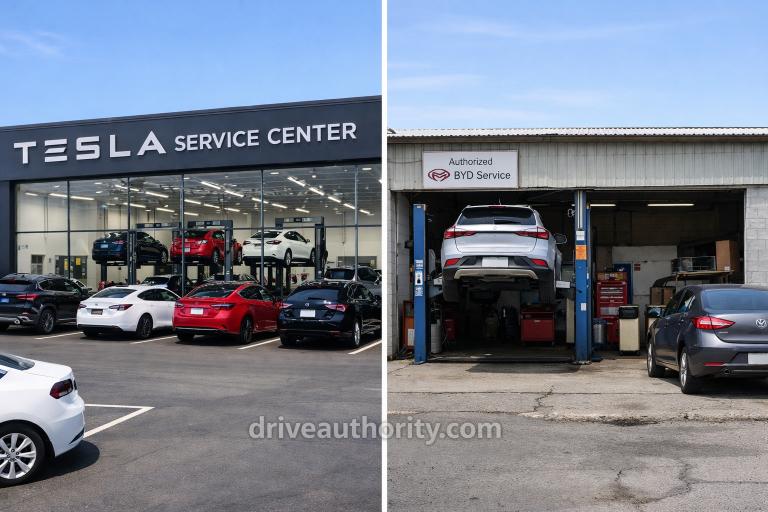
- Chinese EV insurance premiums in UK currently 10–18% higher than equivalent hybrids (repair ecosystem still maturing)
- MG has 150+ UK dealers; BYD expanding rapidly (50+ UK dealers by end 2026)
- Parts lead times improving but not yet at Toyota/Honda levels
Compare competitive insurance rates: Best cheap car insurance for new drivers in 2026
5. Energy vs Fuel Costs
- UK electricity: ~28p/kWh (home charging); ~70p/kWh (rapid public charging)
- UK petrol: ~£1.45/liter (January 2026)
- EV efficiency: ~3.5 mi/kWh average; Hybrid: ~55–65 MPG combined
- At 15,000 km/year, cost delta: ~£600–900/year favoring EVs (home charging assumed)
For detailed breakdowns, see our guides on public EV charging costs and home EV charging setup.
6. Regulatory & Tariff Exposure
- EU anti-subsidy investigation into Chinese EV imports concluded with 10–38% provisional tariffs (October 2024)
- Final tariffs negotiated down to 7–15% for most brands (BYD, Geely)
- UK not bound by EU tariffs post-Brexit; bilateral trade framework in place
- ZEV mandate requires 80% of new car sales to be zero-emission by 2030 (UK); 100% by 2035 (EU)
These six variables create different financial outcomes depending on how you weight them.
The Decision Matrix: Risk Tolerance × Ownership Horizon
Financial decisions aren’t made by “average buyers”—they’re made by individuals with specific risk profiles and time horizons.
Instead of generic personas, we use a 2-axis decision framework:
Axis 1: Risk Tolerance
- Risk-averse: Resale predictability and brand longevity matter most
- Risk-neutral: Willing to accept moderate depreciation variance for upfront savings
- Risk-seeking: Early adopter premium acceptable; innovation outweighs resale certainty
Axis 2: Ownership Horizon
- Short (3–4 years): Depreciation matters, but compounding energy savings don’t accumulate yet
- Medium (5–7 years): Depreciation stabilizes; energy savings compound; battery warranty still active
- Long (8+ years): Beyond typical warranty; brand ecosystem strength dominates
Decision Matrix Summary
| Risk Profile | 3–4 Years | 5–7 Years | 8+ Years |
|---|---|---|---|
| Risk-Averse | Toyota Corolla Hybrid | Toyota Corolla Hybrid | Toyota Corolla Hybrid |
| Risk-Neutral | BYD Seal (if depreciation <52%) | BYD Seal or MG4 | Honda CR-V Hybrid (safer) |
| Risk-Seeking | MG4 or BYD Seal | BYD Seal | Uncertain (data insufficient) |
For detailed model comparisons, see: MG4 vs BYD Dolphin budget EV comparison
Now let’s prove this with actual models.
Total Cost of Ownership Models (5-Year & 7-Year)
We model four real vehicles available in UK/EU markets:
Chinese EVs:
- BYD Seal (RWD, 82.5 kWh LFP battery, £45,695 UK list price)
- MG4 (51 kWh, £26,995 UK list price)
Japanese Hybrids:
- Toyota Corolla Hybrid (1.8L, £30,530 UK list price)
- Honda CR-V Hybrid (2.0L, £42,255 UK list price)
Modeling Assumptions (Transparent & Falsifiable)
Shared Assumptions:
- Annual mileage: 15,000 km (9,320 miles)
- Ownership period: 5 years and 7 years modeled separately
- UK market pricing and energy costs (Jan 2026)
- Home charging access for EVs (80% of charging done at home rate)
Energy Costs:
- EV home charging: £0.28/kWh
- EV public charging: £0.70/kWh (assume 20% of total)
- Petrol: £1.45/liter
- EV efficiency: 3.5 mi/kWh (BYD Seal), 4.0 mi/kWh (MG4)
- Hybrid efficiency: 58 MPG (Corolla), 48 MPG (CR-V)
Insurance:
- EV premium: +15% vs equivalent hybrid (UK market average 2025-2026)
Maintenance:
- EV: £200/year (no oil changes, brake wear reduced by regen)
- Hybrid: £450/year (oil changes, brake service, dual powertrain complexity)
Depreciation Scenarios (This Is The Critical Variable):
We model three depreciation scenarios based on 2019–2024 UK market data (CAP HPI residual value analysis):
| Scenario | Chinese EV (5yr) | Japanese Hybrid (5yr) |
|---|---|---|
| Optimistic | 42% | 38% |
| Base Case | 52% | 40% |
| Stress Case | 62% | 42% |
Why this range matters:
If Chinese EVs depreciate at 52% vs 40% for hybrids, that’s a £5,000–7,000 difference in resale value—enough to erase upfront savings and energy cost advantages.
Model 1: BYD Seal vs Toyota Corolla Hybrid (5-Year TCO)
| Cost Category | BYD Seal (Base Case) | Toyota Corolla Hybrid |
|---|---|---|
| Purchase Price | £45,695 | £30,530 |
| Insurance (5yr) | £6,200 | £5,400 |
| Energy/Fuel (5yr) | £2,100 | £5,850 |
| Maintenance (5yr) | £1,000 | £2,250 |
| Depreciation (52% vs 40%) | -£23,761 | -£12,212 |
| 5-Year Resale Value | £21,934 | £18,318 |
| Total Cost of Ownership | £33,061 | £25,712 |
Base case result: Toyota Corolla Hybrid wins by £7,349 over 5 years.
But here’s the inflection point analysis:
Optimistic Scenario (42% depreciation for BYD):
- BYD Seal TCO: £29,261
- BYD wins by £3,549
Stress Scenario (62% depreciation for BYD):
- BYD Seal TCO: £37,461
- Toyota wins by £11,749
Critical insight:
At 15,000 km/year over 5 years, BYD Seal only wins financially if depreciation stays below 48%. Every 5% of additional depreciation costs ~£2,285 in lost resale value.
Model 2: MG4 vs Toyota Corolla Hybrid (5-Year TCO)
| Cost Category | MG4 (Base Case) | Toyota Corolla Hybrid |
|---|---|---|
| Purchase Price | £26,995 | £30,530 |
| Insurance (5yr) | £5,800 | £5,400 |
| Energy/Fuel (5yr) | £1,800 | £5,850 |
| Maintenance (5yr) | £1,000 | £2,250 |
| Depreciation (52% vs 40%) | -£14,037 | -£12,212 |
| 5-Year Resale Value | £12,958 | £18,318 |
| Total Cost of Ownership | £20,637 | £25,712 |
Base case result: MG4 wins by £5,075 over 5 years.
Inflection point:
MG4’s lower entry price creates more depreciation buffer. It remains cheaper than Corolla Hybrid even if depreciation hits 60% (TCO: £22,637).
MG4 breaks even with Corolla at 68% depreciation—a scenario only likely if the brand exits the UK market.
For real-world MG ownership experiences, read: Are MG cars reliable? An honest review
Model 3: Extended Ownership (7-Year TCO)
At 7 years, energy savings compound further, but depreciation stabilizes.
BYD Seal vs Corolla (7-year, base depreciation):
- BYD Seal TCO: £38,500
- Corolla TCO: £30,100
- Corolla still wins by £8,400
MG4 vs Corolla (7-year):
- MG4 TCO: £24,200
- Corolla TCO: £30,100
- MG4 wins by £5,900
Key finding:
The MG4’s lower entry price makes it financially resilient across time horizons. The BYD Seal only makes financial sense for buyers who:
- Can secure optimistic resale values (specialist buyers, private sale)
- Drive >20,000 km/year (energy savings compound faster)
- Value the premium driving experience beyond pure TCO
Calculate your specific ownership costs: Cost of owning an electric car monthly
Battery Longevity: What We Actually Know vs What We Infer
Proven Data (2016–2024 Fleet Studies)
LFP Battery Degradation (BYD, CATL chemistries):
- Real-world degradation: 5–8% after 5 years / 100,000 km
- Cycle life testing: 3,000–5,000 full cycles before reaching 80% capacity
- At 15,000 km/year, that’s 13–20 years of use before hitting warranty threshold
- Proven: LFP chemistry is durable in moderate climates (UK/EU)
NMC Battery Degradation (older Chinese EVs, some European models):
- Real-world degradation: 8–12% after 5 years
- More sensitive to thermal stress (hot climates degrade faster)
- Proven: NMC degrades faster but offers higher energy density
Hybrid Battery Longevity (Toyota, Honda NiMH and Li-ion):
- Toyota hybrids routinely exceed 200,000–300,000 km with original battery
- Replacement cost if needed: £1,000–2,500 (smaller capacity than EVs)
- Proven: Hybrid batteries outlast the vehicles they’re in
Engineering Inference (Not Yet Proven at Scale)
Solid-state battery adoption:
- Timeline: 2027–2030 for mass production (Toyota, BYD both investing)
- If solid-state batteries reach market by 2028, current LFP/NMC vehicles may face accelerated depreciation
- Uncertain: Rate of technology transition
Software-defined vehicle longevity:
- Chinese EVs (BYD, NIO) offer OTA updates extending vehicle lifespan
- Risk: If manufacturer discontinues support, vehicle value craters
- Uncertain: 10-year software support commitment strength
Unknown Risks
8+ year resale market maturity:
- We don’t yet have deep used EV markets for Chinese brands in EU
- Will buyers pay £12,000 for a 7-year-old BYD Seal with 8% battery degradation?
- Data gap: Insufficient transaction history
Verdict:
Battery failure is not the financial risk. Depreciation uncertainty is.
For more on Chinese EV quality concerns, see: Common problems with Chinese EVs
Regulatory & Tariff Landscape (2026 UK/EU Context)
EU Anti-Subsidy Tariffs
What happened:
- October 2024: EU imposed provisional tariffs (10–38%) on Chinese EV imports (official EU Commission decision)
- November 2024: Negotiations reduced final tariffs to 7–15% for compliant manufacturers
- BYD: 17% final tariff
- Geely (parent of Polestar, Volvo): 19.3%
- SAIC (MG Motor): 35.3% (highest)
Financial impact:
- MG4 prices increased £1,800–2,500 in EU markets (absorbed partially by SAIC)
- BYD absorbed most tariff costs to maintain market share
- Net effect: Slower price decline, but Chinese EVs still 10–20% cheaper than European equivalents
UK Post-Brexit Position
UK is not bound by EU tariffs.
- Bilateral trade negotiations ongoing
- Current UK policy: Welcoming Chinese EV investment (BYD factory under discussion)
- Result: UK pricing more competitive than EU for Chinese EVs
ZEV Mandate Pressure
Both UK and EU have aggressive zero-emission vehicle targets:
- UK: 80% of new sales zero-emission by 2030
- EU: 100% by 2035
This creates structural support for EV adoption—including Chinese brands that help manufacturers meet quotas.
Regulatory risk assessment:
Low for UK/EU through 2030. Chinese brands are embedded in meeting climate targets.
The Real Financial Risk Isn’t What You Think
Common Misconception: “Chinese EV batteries will fail”
Reality: LFP batteries in BYD vehicles are proving more durable than early NMC chemistries. Battery failure is not the dominant financial risk.
For a comprehensive quality analysis, read: Are Chinese EVs high quality? A clear objective analysis
Actual Financial Risk: Resale Market Liquidity
The question isn’t: “Will the battery last?”
The question is: “Will there be buyers in 2029 for a 2026 Chinese EV?”
Three scenarios:
Scenario A: Brand Maturity Achieved (Optimistic)
- BYD, MG become household names like Kia/Hyundai did (2010–2020 trajectory)
- Used EV market deepens; financing products emerge
- Depreciation stabilizes at 42–48%
- Chinese EVs win on TCO across most segments
Scenario B: Niche Acceptance (Base Case)
- Chinese EVs gain 15–20% market share but remain “value” brands
- Resale buyers cautious; depreciation stays 50–55%
- TCO advantage exists only for short-term ownership or high-mileage drivers
Scenario C: Brand Consolidation (Stress Case)
- Trade tensions escalate; tariffs increase
- Some brands exit EU market (precedent: Great Wall Motors, Haval)
- Service network collapses; parts availability craters
- Depreciation exceeds 60%
- Financial catastrophe for early adopters
Which scenario is most likely?
Based on current infrastructure investment (BYD factory commitments, dealer network expansion), Scenario B (base case) is most probable through 2030.
Learn more: Why Chinese EVs are taking over Europe
Decision Framework: When to Buy Chinese EV in 2026
You Should Buy a Chinese EV (MG4 or BYD Seal) If:
✅ Ownership horizon: 3–5 years
Depreciation risk is time-bound; you exit before uncertainty compounds
✅ Annual mileage: 15,000+ km
Energy savings compound; payback period shortens
✅ Access to home charging
Public charging costs (£0.70/kWh) erase 60% of fuel savings advantage
✅ Risk-neutral or risk-seeking profile
You accept 50–55% depreciation as the cost of innovation and upfront savings
✅ Strong local dealer network
MG has 150+ UK dealers; BYD expanding to 50+ by end 2026. Service infrastructure matters more than brand nationality
✅ Company car benefit-in-kind optimization
2% BIK rate (EV) vs 25–30% (hybrid) creates £2,000–4,000/year tax advantage for company car drivers
Avoid common pitfalls: First-time EV buyer mistakes
You Should Buy a Japanese Hybrid If:
✅ Ownership horizon: 7+ years
Predictable depreciation (38–42%) and proven longevity matter more than upfront savings
✅ Risk-averse profile
You prioritize resale certainty and brand ecosystem maturity
✅ No home charging access
Without home charging, EV fuel cost advantage drops from £900/year to £200/year
✅ Low annual mileage (<10,000 km/year)
Energy savings don’t compound enough to overcome depreciation risk
✅ Resale value is critical
You need liquid used market and predictable residual value for financing
Compare powertrain options: EV vs Hybrid vs Plug-in Hybrid
The Financial Tipping Point
At 15,000 km/year over 5 years:
- MG4 wins if depreciation stays below 68% (highly likely)
- BYD Seal wins if depreciation stays below 48% (requires optimistic resale market)
- Toyota Corolla Hybrid wins if you value certainty over maximum savings
At 20,000+ km/year: Energy savings compound faster; both MG4 and BYD Seal become financially compelling even at 55% depreciation
FAQ – Buying a Chinese EV in 2026 (UK/EU)
Are Chinese EVs reliable long-term?
Battery reliability is proven (LFP chemistry shows 5–8% degradation over 5 years). The financial risk is depreciation volatility, not mechanical failure. BYD and MG offer 7–8 year warranties comparable to established brands.
For specific reliability data: Is BYD reliable after 5 years?
Which depreciates less: Chinese EV or Japanese hybrid?
Japanese hybrids depreciate 38–42% over 5 years (UK market data). Chinese EVs currently depreciate 50–60% due to brand maturity and resale market uncertainty. This gap is the dominant TCO variable.
Is insurance more expensive for Chinese EVs?
Yes. UK insurance premiums for Chinese EVs are 10–18% higher than equivalent hybrids due to repair ecosystem maturity and parts availability. This gap is narrowing as dealer networks expand.
Will EU tariffs increase Chinese EV prices further?
Final EU tariffs (7–17% for most brands) are now in place. Further increases are unlikely unless trade tensions escalate. UK is not bound by EU tariffs and may negotiate separate framework.
Which is cheaper to maintain: EV or hybrid?
EVs cost ~£200/year (no oil changes, reduced brake wear from regen). Hybrids cost ~£450/year (oil changes, dual powertrain servicing). Over 5 years, EVs save £1,250 in maintenance.
Should I buy Chinese EV for company car tax savings?
Yes, if you’re a UK company car driver. 2% BIK rate (EV) vs 25–30% (hybrid) creates £2,000–4,000/year tax advantage. This alone can justify Chinese EV purchase even with higher depreciation.
Final Verdict – Is Buying a Chinese EV in 2026 Financially Smart?
In UK/EU markets, buying a Chinese EV in 2026 is financially advantageous for specific buyer profiles—but not universally.
Clear Winners:
MG4 (budget segment):
- Wins on TCO across 3–7 year ownership even with 55–60% depreciation
- Low entry price creates depreciation buffer
- Recommendation: Strong buy for risk-neutral buyers with 3–5 year horizons
BYD Seal (premium segment):
- Wins only if depreciation stays below 48% OR annual mileage exceeds 20,000 km
- Requires optimistic resale market assumption
- Recommendation: Buy if you value driving experience and accept resale uncertainty
Toyota Corolla Hybrid / Honda CR-V Hybrid:
- Win for risk-averse buyers, long ownership (8+ years), and those prioritizing resale certainty
- Recommendation: Default choice if predictability matters more than maximum savings
See our comprehensive rankings: Best Chinese EV 2026 real-world comparison
The Real Decision Variable Isn’t Technology—It’s Time Horizon and Risk Tolerance
If you’re buying a car in 2026, battery failure is no longer the risk. Depreciation volatility is.
Before buying:
- Calculate your actual annual mileage (energy savings only matter if you drive enough)
- Confirm home charging access (public charging erases 60% of cost advantage)
- Check local dealer network strength (MG: 150+ UK dealers; BYD: expanding)
- Stress-test your ownership horizon (3–4 years favors Chinese EVs; 8+ years favors hybrids)
- Model depreciation scenarios (use this article’s TCO framework with your local pricing)
Chinese EVs in 2026 are no longer “experiments”—they’re engineering-competitive, financially viable options for specific use cases.
But they’re not universally superior. Choose based on your risk profile and ownership horizon, not brand nationality.
For broader market context: Chinese electric cars: prices, brands, pros & cons