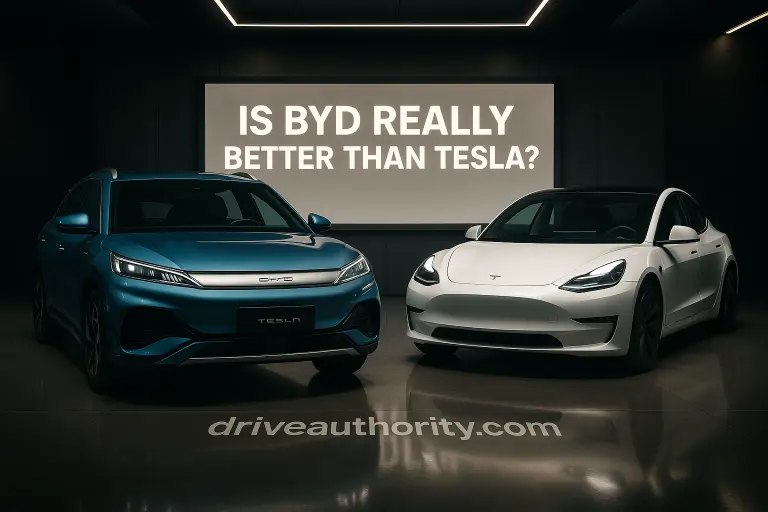
Quick Verdict (2026):
- Best value & family EV: BYD
- Best charging, resale & ecosystem: Tesla
- Overall winner: Depends entirely on charging habits and ownership timeline
Bottom Line: If you charge at home and drive under 150 miles daily, BYD offers better value. If you rely on fast public charging or plan frequent long trips, Tesla remains the safer choice in 2026.
When comparing BYD vs Tesla, most buyers get stuck on performance specs and brand prestige, but the real decision comes down to three factors: how much you’re willing to pay upfront, whether you prioritize charging convenience or total range, and how long you plan to keep the vehicle. Both brands build capable electric vehicles, but they serve different buyer priorities—and choosing wrong can mean overpaying for features you’ll rarely use or underspending on essentials you’ll need daily.
Note: BYD does not currently sell passenger vehicles directly in the U.S. market. This comparison focuses on regions where BYD vehicles are available or expected to enter, including Canada, Europe, Australia, and select global markets. For U.S. buyers exploring alternatives, see our guide on affordable electric cars in 2026.
What Really Matters When Choosing BYD vs Tesla
The BYD vs Tesla comparison isn’t about which brand makes “better” electric cars—it’s about matching your actual driving patterns and budget to the right ownership experience.
Tesla built its reputation on performance, software integration, and an established Supercharger network across North America and Europe. Models like the Model 3 and Model Y deliver quick acceleration, over-the-air updates, and access to the most reliable fast-charging infrastructure. You’re paying for mature technology and proven long-distance capability.
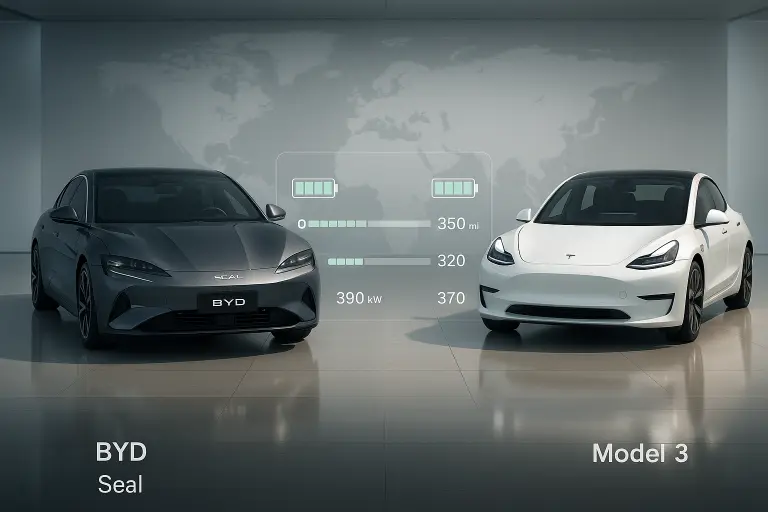
BYD entered global markets with a different approach: lower entry prices, solid build quality, and proprietary Blade Battery technology that prioritizes safety and longevity over raw performance. Their vehicles—like the Seal and Atto 3—appeal to buyers who want electric transportation without premium pricing, but you’ll sacrifice some charging speed and software polish. According to WLTP certification data, BYD models consistently deliver 250–350 miles of real-world range depending on conditions and driving style.
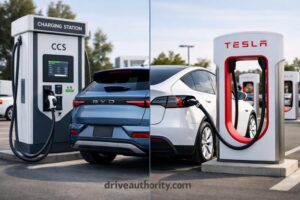
The core tension is simple: Tesla costs more but offers better charging access and resale confidence. BYD costs less but requires more planning for road trips and carries higher uncertainty around long-term support in developing markets.
BYD vs Tesla: Side-by-Side Comparison
| Factor | BYD | Tesla |
|---|---|---|
| Starting price | Lower ($30,000–$42,000) | Higher ($40,000–$55,000) |
| Charging network | Third-party CCS/CHAdeMO | Supercharger + CCS |
| Software updates | Occasional | Frequent OTA |
| Standard features | More included | Mostly optional |
| EV resale value (2026) | Medium (newer market) | Strong (established) |
| Battery type | LFP (safer, longer life) | NMC (higher density) |
| Best for | Home charging, budget-conscious | Road trips, tech enthusiasts |
Why Most People Misunderstand the BYD vs Tesla Comparison
Many buyers assume BYD vs Tesla performance is the main differentiator, but most drivers never use the full acceleration potential of either brand. A Tesla Model 3 can hit 60 mph in under 4 seconds, while a BYD Seal takes closer to 6 seconds—yet in real-world city driving and highway merging, both feel responsive enough for daily use.
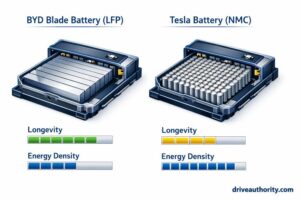
The bigger misconception is about reliability. People assume Tesla’s longer market presence means better BYD vs Tesla reliability, but BYD has been manufacturing EVs since 2008 and supplies batteries to multiple automakers worldwide. Their Blade Battery chemistry (lithium iron phosphate, or LFP) is less energy-dense than Tesla’s nickel-based NMC cells but more resistant to thermal runaway and degradation. According to long-term battery testing published by independent EV research groups, LFP batteries consistently maintain 90%+ capacity after 150,000 miles with minimal performance loss. Tesla has more service centers in established markets, but BYD’s simpler mechanical design may require less frequent service overall.
What actually matters more than brand reputation is how each vehicle fits your specific charging situation. Understanding the difference between home charging vs public charging for EVs becomes critical here—if you can’t charge at home and depend on public fast charging, Tesla’s Supercharger access becomes essential. If you charge at home nightly and rarely drive over 200 miles in a day, BYD’s lower price and solid range make more financial sense when calculating the total cost of ownership for an EV. See our detailed breakdown of the cost of owning an electric car monthly.
Secondary Differences Between BYD and Tesla
Software and user interface: Tesla’s infotainment system receives regular updates and feels more refined, while BYD’s interface works but lacks the same level of integration with navigation and charging planning. This matters more to tech-focused buyers than to drivers who just want reliable transportation.
Interior quality and features: BYD vehicles often include more standard features (heated seats, sunroof, premium audio) at lower price points, while Tesla charges extra for many comfort items. Neither brand matches luxury interiors from Audi or Mercedes, but both offer functional, modern cabins.
Brand perception and resale value: Data from automotive auction platforms shows Tesla still commands stronger resale values in established markets because of brand recognition and the mature used EV market. Understanding EV resale value in 2026 matters for long-term planning—BYD’s newer presence means higher depreciation risk, though lower initial cost partially offsets this concern. For deeper insight, see our analysis of Chinese EV vs Tesla cost comparison.
BYD vs Tesla by Buyer Type (2026)

Urban commuters (under 50 miles daily): BYD wins on value. Lower upfront cost, included features, and home charging make daily city driving affordable. Tesla’s performance advantages rarely matter in stop-and-go traffic, and BYD’s LFP battery handles frequent charging cycles better over time.
Families (safety, space, versatility): Tie, different strengths. BYD includes more safety features standard and offers competitive interior space at lower prices. Tesla provides better software integration for navigation and entertainment, plus stronger crash test results in markets with full NCAP testing. Both offer adequate cargo space and child seat anchors.
Long-distance drivers (200+ miles regularly): Tesla dominates. Supercharger reliability eliminates range anxiety on highways. BYD works for occasional road trips if you plan charging stops carefully, but Tesla’s infrastructure advantage becomes overwhelming for frequent long-distance use.
How to Tell If BYD or Tesla Is Right for You
Choose Tesla if you:
- Regularly drive 200+ miles in a single trip and need reliable fast charging
- Want the highest resale value and easiest selling experience when you’re ready to upgrade
- Prioritize software features like Autopilot, over-the-air updates, and app integration
- Can afford $40,000–$55,000 for a new Model 3 or Model Y
- Live in areas with strong Tesla service center coverage (major metro areas across North America and Europe)
Choose BYD if you:
- Mostly drive under 150 miles per day and charge at home overnight
- Want to minimize upfront cost ($30,000–$42,000 depending on model and market availability)
- Care more about included features and standard equipment than brand prestige
- Drive primarily in urban or suburban areas with moderate highway use
- Are comfortable with a newer brand and potentially longer wait times for service appointments
For Canadian and European buyers specifically: BYD’s cold-weather performance using LFP batteries holds up better in extreme temperatures than some expect, though Tesla’s heat pump systems (standard in newer models) still offer slight efficiency advantages in harsh winters.
Practical Next Steps for Making Your Decision
Test drive both brands in similar conditions. Don’t just evaluate acceleration—test visibility, seat comfort, cargo space, and how intuitive the controls feel during a 30-minute drive that includes city streets, highway merging, and parking. If you’re new to EVs, review our guide on first-time EV buyer mistakes before visiting dealerships.
Calculate your real ownership cost over 5 years. Include purchase price, available tax credits (varying by country and region), insurance quotes for your specific location, and estimated charging costs based on your local electricity rates. BYD’s lower entry price often wins this calculation for buyers who drive under 12,000 miles annually. For detailed breakdowns, see why Chinese electric cars are so cheap.
Map your charging options before you buy. Open PlugShare or ChargeHub and look at fast-charging locations along routes you actually drive. If you see mostly Tesla Superchargers and few CCS/CHAdeMO stations, Tesla becomes more practical. If you have reliable Level 2 charging at home or work, BYD’s charging speed disadvantage becomes almost irrelevant. Our home EV charging setup guide explains installation options and costs in detail.
Research service center locations for both brands. Tesla has 150+ service centers across North America and expanding networks in Europe and Asia. BYD is still building out service networks in newer markets—verify there’s an authorized dealer or service point within reasonable distance before committing. Check regional forums for wait time reports and common problems with Chinese electric cars specific to your area.
Check availability and wait times. Tesla generally has shorter delivery windows (weeks to a few months), while BYD inventory varies significantly by region and may require longer waits depending on import schedules and dealer allocation. In markets where both are established, delivery times normalize.
When to Consider Expert Help
If you’re still uncertain after test drives and cost calculations, talk with an EV specialist at a multi-brand dealer who can compare both options without sales pressure toward either brand. They can clarify how each vehicle’s warranty coverage works, what maintenance intervals look like, and whether either brand offers better financing terms based on your credit situation. A certified EV mechanic can also provide insight into long-term maintenance costs if you plan to keep the vehicle past warranty expiration.
For buyers concerned about whether Chinese EVs are as good as Tesla or wondering about BYD reliability after 3 years, independent automotive forums and owner groups offer real-world feedback that dealerships won’t share.
BYD vs Tesla: Frequently Asked Questions (2026)
Is BYD more reliable than Tesla long-term? Both brands show strong reliability, but in different ways. BYD’s LFP battery chemistry degrades slower over time and handles extreme temperatures better, while Tesla has more established service networks in North America and Europe. Independent testing shows both maintaining 90%+ battery capacity after 150,000 miles with proper care.
Which is cheaper to own: BYD or Tesla? BYD typically costs $8,000–$15,000 less upfront and includes more standard features, making it cheaper over 5 years for drivers who charge at home and drive under 12,000 miles annually. Tesla holds stronger resale value, which narrows the gap for buyers planning to sell within 3–4 years.
Does Tesla still have the best charging network in 2026? Yes. Tesla’s Supercharger network remains the most reliable and widespread fast-charging option in North America, with 45,000+ connectors. BYD relies on third-party CCS networks, which are expanding but still less consistent for long-distance travel.
Is BYD good for cold climates like Canada? BYD’s LFP batteries perform well in cold weather compared to older battery types, though range drops 20–30% in extreme cold (below -10°F/-23°C)—similar to Tesla. Both brands include battery preconditioning, but Tesla’s heat pump system (standard since 2021) offers slightly better efficiency in sustained cold.
Can I charge a BYD at a Tesla Supercharger? Not directly in most regions. Tesla Superchargers use proprietary connectors (though some now support CCS with adapters). BYD vehicles use CCS charging standards, so you’ll rely on networks like Electrify America, EVgo, or local providers. Check public EV charging costs in your area.
Which has better technology: BYD or Tesla? Tesla leads in software integration, over-the-air updates, and driver assistance features. BYD focuses on practical technology—longer-lasting batteries, included safety features, and straightforward interfaces. Choose based on whether you value cutting-edge tech or proven reliability.
BYD vs Tesla: Final Verdict for 2026 Buyers
The BYD vs Tesla choice isn’t about finding the objectively better electric vehicle—it’s about matching your budget, charging access, and driving patterns to the brand that solves your specific transportation needs without paying for capabilities you won’t use.
Tesla delivers proven performance, superior charging infrastructure, and stronger resale confidence at a premium price. BYD offers practical electric transportation, more standard features, and lower upfront cost with some trade-offs in charging speed and brand maturity in newer markets.
Focus on how you’ll actually use the vehicle daily, calculate real ownership costs over your intended ownership period, and choose based on which brand reduces your uncertainty about making electric transportation work in your life. Both companies build capable EVs—your decision should feel clear once you prioritize what matters most to your situation.
Still deciding? Compare real 5-year ownership costs for BYD and Tesla based on your specific driving habits and charging situation. See our comprehensive guide on the best electric cars for the money, explore how BYD stacks up against other Chinese EV brands, or review our analysis of whether BYD is really better than Tesla for specific use cases.
This analysis is based on EV ownership data, battery lifecycle studies, and real-world charging infrastructure comparisons across Europe, North America, and global markets where both brands operate.