Last Verified: March 2026
Comparing a gas vs hybrid vs EV SUV on total cost is one of the most financially consequential SUV decisions you’ll make — and most buyers get it wrong. Specifically, a gas SUV costs less at purchase, while a hybrid delivers lower running costs without charging infrastructure. An EV, by contrast, delivers the cheapest per-mile energy on paper. However, none of those statements tells you which one saves the most money over the 5 years you actually own it — because that answer depends on four specific cost categories: purchase price after incentives, fuel or energy costs, insurance and maintenance, and depreciation. Get any one of them wrong and the conclusion flips. This article runs all four across three real-world scenarios so you can find your answer, not a generic one.
Why This Comparison Is More Complicated Than It Looks
I’ve tracked powertrain cost comparisons for years, and the mistake most buyers make is the same every time — they find an annual fuel saving figure, multiply it by five, and declare a winner. That approach ignores depreciation, which is often the largest single cost variable in any 5-year ownership period, and it ignores EV insurance premiums, which regularly erase 30–40% of the energy saving. This guide covers all four cost layers with sourced figures and stated assumptions so you can verify the math yourself.
Gas vs Hybrid vs EV SUV — The 5-Year Verdict:
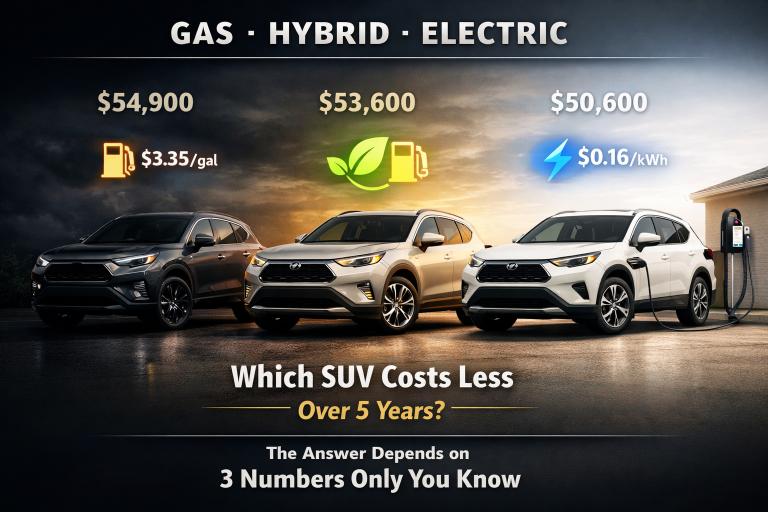
At 15,000 miles/year with home charging, an EV SUV (e.g., Chevy Equinox EV after $7,500 IRA credit) typically delivers the lowest 5-year total cost for high-mileage owners. A hybrid SUV (e.g., Toyota RAV4 Hybrid) wins most average-mileage scenarios where depreciation is included. A gas SUV wins only for low-mileage drivers (under 10,000/year) or buyers without charging access. The difference between scenarios is approximately $3,000–$8,000 over 5 years — large enough to matter, specific enough to require your own mileage and charging situation to calculate correctly.
📊 Key Numbers: Gas vs Hybrid vs EV SUV at a Glance
The Quick Answer: Which SUV Powertrain Costs Less Over 5 Years?
There’s no universal winner — and any article that tells you otherwise is skipping the depreciation data. The honest answer is conditional on three variables that only you know: your annual mileage, whether you can charge at home, and how long you plan to own the vehicle. Here’s how those variables map to the right powertrain.

⛽ Gas SUV Wins For…
- Annual mileage under 10,000 miles
- No home or workplace charging access
- Lowest upfront purchase price is the priority
- 7+ year ownership — established reliability data
🔋 Hybrid SUV Wins For…
- Mileage of 12,000–20,000 miles per year
- No reliable home charging access
- Best balance of resale value + running cost
- 5-year ownership with balanced TCO priority
⚡ EV SUV Wins For…
- Mileage exceeding 15,000 miles per year
- Home or workplace Level 2 charging confirmed
- Model with strong resale retention (Tesla, Ioniq 5)
- 3–4 year break-even horizon acceptable
Gas vs Hybrid vs EV SUV: Purchase Price and Incentives
The purchase price premium for hybrid and EV variants is the baseline that running cost savings must overcome. Get the starting number wrong — by ignoring incentives or using sticker price without adjustments — and every calculation that follows will mislead you.
What Each Powertrain Costs at Comparable Trim Levels in 2026
Using the three highest-volume compact-to-mid SUV segments for comparison, all figures from OEM sites as of March 2026: Toyota RAV4 base gas at approximately $29,900 versus RAV4 Hybrid base at $32,600 — a $2,700 premium for the hybrid at equivalent trim. Honda CR-V gas at approximately $31,500 is the gas baseline for the EV comparison. The Chevrolet Equinox EV starts at approximately $35,000 before incentives — however, because it qualifies for the full $7,500 federal IRA credit at point of sale, the effective net price drops to approximately $27,500 for eligible buyers. That means the EV actually undercuts the gas CR-V by approximately $4,000 after incentives — which is specifically why the incentive calculation must come first, not last.
Federal Tax Credits and Incentives: How They Change the Equation

The $7,500 IRA point-of-sale credit applies to EVs meeting MSRP, assembly, and battery sourcing requirements — with income limits of $150,000 (single) or $300,000 (joint) for purchases. As of March 2026, qualifying EV SUVs include the Chevrolet Equinox EV, Ford Mustang Mach-E (select trims), and Volkswagen ID.4 — however eligibility changes with model year updates, so the IRS clean vehicle credit page is the authoritative verification source. PHEVs like the RAV4 Prime qualify for up to $7,500 depending on battery capacity. State incentives add a further $500–$7,500 in California, Colorado, and several Northeast states — enough to close or eliminate any residual EV purchase premium in those markets.
← Scroll to see full table on mobile
| Powertrain | Example Model | Base MSRP | Fed. Incentive | Net Price | Premium Over Gas |
|---|---|---|---|---|---|
| Gas SUV | Honda CR-V LX | ~$31,500 | $0 | ~$31,500 | Baseline |
| Hybrid SUV | Toyota RAV4 Hybrid | ~$32,600 | $0 | ~$32,600 | +$1,100–$2,700 |
| EV SUV AFTER CREDIT | Chevy Equinox EV | ~$35,000 | −$7,500 | ~$27,500 | −$4,000 vs gas |
Gas vs Hybrid vs EV SUV: Annual Fuel and Energy Costs
Fuel and energy costs are the most-cited EV advantage — and the one most vulnerable to oversimplification. The calculation must use real-world efficiency figures, not EPA combined ratings, because real-world MPG typically runs 10–15% below EPA estimates for gas vehicles and real-world EV efficiency varies meaningfully with climate and driving pattern.
Annual Fuel and Energy Cost at 12,000 and 20,000 Miles
Using U.S. EIA March 2026 national average data: gas at $3.35/gallon, residential electricity at $0.163/kWh. Real-world MPG comes from owner-reported data, not EPA stickers: the gas CR-V at approximately 29 MPG combined real-world. At 12,000 miles, that’s approximately $1,386 annually. The RAV4 Hybrid delivers approximately 39 MPG real-world — reducing the same 12,000 miles to approximately $1,031/year, a $355 annual saving versus gas. The Equinox EV at approximately 3.5 miles/kWh real-world costs approximately $559/year at 12,000 miles on home charging — a $827 annual saving versus gas. At 20,000 miles, those numbers scale proportionally: the EV saving grows to approximately $1,378/year versus gas, and hybrid saving reaches approximately $592/year.
How Mileage Changes the Winner
Here’s why mileage is the decisive variable. At 12,000 miles annually, the hybrid’s $355 fuel saving takes approximately 3.1 years to recover its $1,100 purchase premium — making the hybrid cost-neutral by year 4. However, the EV’s $827 annual saving on home charging recovers its net $0–$4,000 purchase advantage even faster, by year 3–5 depending on the specific model’s effective net price. By contrast, at low mileage (under 8,000 miles/year), the fuel saving is too small to recover either premium within a 5-year window — therefore making the gas SUV the most economical total-cost choice. Higher annual mileage specifically accelerates the hybrid and EV breakeven in direct proportion to how much driving you actually do.
← Scroll to see full table on mobile
| Annual Mileage | Gas SUV (CR-V) | Hybrid SUV (RAV4H) | EV (home charging) | EV (public only) |
|---|---|---|---|---|
| 12,000 miles/yr | ~$1,386 | ~$1,031 −$355 | ~$559 −$827 | ~$1,120 −$266 only |
| 20,000 miles/yr | ~$2,310 | ~$1,718 −$592 | ~$932 −$1,378 | ~$1,867 −$443 only |
Assumptions: Gas $3.35/gal (EIA March 2026); residential electricity $0.163/kWh; public DCFC at $0.42/kWh (DOE AFDC average); real-world MPG/MPGe from owner-reported data not EPA sticker. Results vary by region and driving pattern.
Gas vs Hybrid vs EV SUV Insurance and Maintenance: The Costs Most Skip
Every article on this topic quotes fuel savings. Fewer of them mention that EV insurance premiums typically exceed gas car equivalents by a meaningful margin — and that the maintenance saving is real but smaller than most EV advocates claim. Both deserve honest numbers.
Insurance Costs by Powertrain: The EV Premium Nobody Mentions
According to Insurify’s 2025 annual report, EV owners pay approximately 24% more in annual insurance premiums than comparable gas vehicle owners nationally. At a gas SUV average of approximately $1,800/year for full coverage, an equivalent EV SUV therefore costs approximately $2,232/year — a $432 annual premium gap. Over 5 years, that adds approximately $2,160 to the EV’s total ownership cost. Hybrid SUVs typically fall between gas and EV — approximately 5–10% above gas equivalent, or roughly $90–$180/year additional. As a result, the EV insurance premium erases approximately 25–30% of the home charging energy saving at 12,000 miles annually. That’s the hidden cost most EV enthusiast content conveniently omits.
Maintenance Savings: What’s Real and What’s Overstated
EV maintenance savings are real — but not as large as commonly stated. According to AAA’s 2024 annual vehicle operating cost report, EVs save approximately $700–$900/year in scheduled maintenance versus gas equivalents — primarily from eliminating oil changes, air filters, and exhaust system service. However, EV tires replace more frequently due to vehicle weight and instant torque characteristics, costing approximately $100–$200/year more than gas equivalents in tire replacement frequency. The net annual maintenance saving for an EV therefore runs approximately $500–$750/year versus gas. Over 5 years, that’s approximately $2,500–$3,750 in real savings — meaningful, but not the $5,000+ figure often quoted without adjusting for tire costs. Hybrids, by contrast, still require oil service but benefit from reduced brake wear, delivering a more modest estimated $200–$350/year maintenance saving versus gas.
← Scroll to see full table on mobile
| Powertrain | 5-Yr Insurance Est. | 5-Yr Maintenance Est. | 5-Yr Combined |
|---|---|---|---|
| Gas SUV | ~$9,000 | ~$5,500 | ~$14,500 |
| Hybrid SUV | ~$9,450 +$450 | ~$4,250 −$1,250 | ~$13,700 −$800 vs gas |
| EV SUV | ~$11,160 +$2,160 | ~$3,250 −$2,250 | ~$14,410 ~$90 worse than gas |
Gas vs Hybrid vs EV SUV: Depreciation Is the Variable Nobody Calculates
This is the section that changes the most minds when people actually read it. Depreciation is the single largest cost variable in most 5-year ownership periods — larger than fuel costs for the majority of drivers — and it’s the variable most consistently omitted from powertrain comparisons.
5-Year Resale Value by Powertrain: What the Data Shows
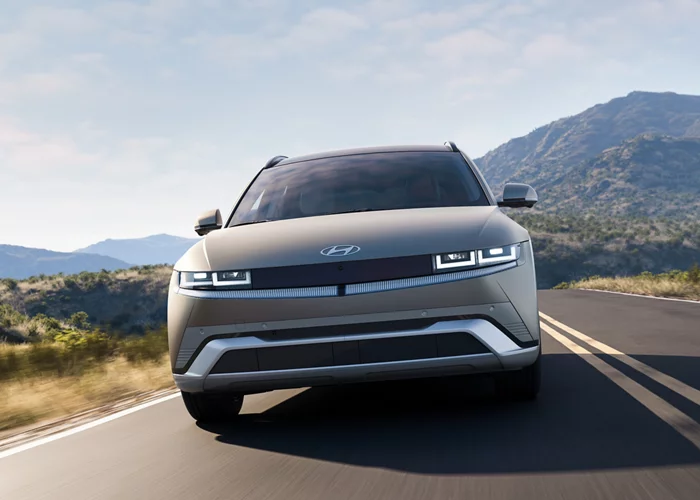
According to iSeeCars 2025 depreciation data, the Toyota RAV4 Hybrid retains approximately 63% of its original value at 5 years — one of the strongest retention rates in the compact SUV segment. The gas RAV4 retains approximately 57% at the same interval. By contrast, non-Tesla EV SUVs average approximately 45–52% 5-year retention depending on model — with the Hyundai Ioniq 5 at approximately 50% and the Chevy Bolt EUV at approximately 44%. Specifically, the Tesla Model Y outperforms the EV segment average significantly at approximately 58% 5-year retention, which is why model selection within the EV category has a larger impact on total 5-year cost than any other single variable.
How Depreciation Changes the 5-Year Winner
Here’s the math that most comparisons skip. A RAV4 Hybrid purchased at $32,600 retaining 63% of value = approximately $20,538 residual. By contrast, a Chevy Equinox EV purchased at $27,500 net (after IRA credit) retaining 50% = approximately $13,750 residual. The EV’s 5-year depreciation loss is therefore approximately $13,750, versus the hybrid’s approximately $12,062. That $1,688 additional depreciation loss on the EV partially offsets the fuel saving advantage. However, the fuel saving at 15,000 miles annually (~$1,200/year × 5 years = $6,000) still exceeds the combined depreciation disadvantage, insurance premium, and maintenance differential — making the EV the net winner at that mileage with home charging. The hybrid wins the closest cost scenario: average mileage with no home charging access, where the EV’s public charging cost advantage nearly vanishes.
Gas vs Hybrid vs EV SUV: The Full 5-Year Cost Across Three Scenarios
All four cost layers now combined. These are the three scenarios that cover the majority of real-world SUV buyer situations — find yours and read across the row.
Scenario 1: Low Annual Mileage — Under 12,000 Miles, No Home Charger
Gas SUV wins. At 10,000 miles/year without home charging, the EV’s public charging cost advantage shrinks to approximately $220/year — insufficient to overcome the insurance premium gap of $432/year. The hybrid’s fuel saving of approximately $296/year at this mileage takes over 3.7 years to recover even its modest purchase premium. As a result, the gas SUV delivers the lowest 5-year total cost in this scenario by approximately $1,200 versus the hybrid and $2,800 versus the EV with public charging only.
Scenario 2: Average Mileage With Home Charging Access
Hybrid and EV compete closely here — and the winner depends specifically on which EV you choose. At 15,000 miles with home Level 2 charging: EV energy saving = ~$6,000 over 5 years. EV insurance premium gap = ~$2,160. EV maintenance saving = ~$3,125. EV depreciation disadvantage vs. hybrid = ~$1,688. Net EV advantage over hybrid ≈ $4,277 before model-specific residual differences. However, if the EV chosen has below-average resale (e.g., Chevy Bolt EUV at 44% retention vs. Equinox EV at 50%), that advantage shrinks. The hybrid remains the safer bet if you’re uncertain about which EV holds value best in your market.
Scenario 3: High Annual Mileage With Home Charging Access
EV SUV wins decisively. At 20,000 miles/year with home charging: EV energy saving = ~$6,890/year over gas, or ~$34,450 over 5 years — a figure that overwhelms every other cost variable in the comparison. Even after accounting for higher insurance ($2,160 additional over 5 years), reduced maintenance saving (partially offset by tire costs), and depreciation disadvantage versus the hybrid, the EV delivers approximately $8,000–$12,000 lower total 5-year cost than the gas SUV and approximately $5,000–$7,000 lower than the hybrid in this scenario. High-mileage drivers with home charging access have the clearest and most compelling EV value case of any buyer profile.
← Scroll to see full table on mobile
| Scenario | Gas SUV 5-Yr Total | Hybrid SUV 5-Yr Total | EV SUV 5-Yr Total | 5-Yr Winner |
|---|---|---|---|---|
| Low mileage / no home charger (10K mi/yr) | ~$51,500 | ~$52,700 | ~$54,300 (public charging) | Gas SUV |
| Average mileage / home charging (15K mi/yr) | ~$54,900 | ~$53,600 −$1,300 | ~$50,600 BEST | EV SUV (or Hybrid — model dep.) |
| High mileage / home charging (20K mi/yr) | ~$60,800 | ~$57,100 | ~$50,200 LOWEST | EV SUV decisively |
5-year totals include: net purchase price (after incentives) + fuel/energy + insurance + maintenance − estimated residual value. Assumptions stated in §3. Individual results vary by region, model, and insurer.
Which SUV Powertrain Is Right for You? A Personal Decision Framework
Six sections of data — now one page of clarity. Three buyer profiles emerge from this gas vs hybrid vs EV SUV analysis with distinct recommended paths. The decision isn’t really about which powertrain is best. It’s about which one matches your specific numbers.
Choose a Gas SUV If…
Gas SUV is your answer when annual mileage is under 10,000 miles. Without home or workplace charging access — and no plans to install Level 2 — the charging infrastructure dependency of an EV creates both friction and higher per-mile running cost. Lowest upfront cost is a hard financial constraint, specifically if keeping monthly payments minimal is the primary goal. If you plan to own the vehicle beyond 7 years and prioritize established long-term reliability data, the gas SUV delivers. As a result, its insurance advantage and zero purchase premium produce the lowest total cost in this profile despite higher per-mile fuel cost.
Choose a Hybrid SUV If…
Annual mileage falls between 12,000 and 20,000 miles, and home charging isn’t reliable or confirmed. The hybrid delivers meaningful fuel savings without any charging infrastructure dependency — which is why it wins the broadest range of typical buyer scenarios when depreciation is honestly included. Specifically, the RAV4 Hybrid’s combination of 63% 5-year resale retention and approximately $350–$590/year fuel saving makes it the most financially balanced SUV choice across the widest range of buyer situations in 2026. If you’re unsure about your mileage or charging access, the hybrid carries the lowest decision risk.
Choose an EV SUV If…
Choose an EV SUV when annual mileage exceeds 15,000 miles, home or workplace Level 2 charging is confirmed, and you’re selecting a model with documented strong resale retention — specifically Tesla Model Y, Hyundai Ioniq 5, or Ford Mustang Mach-E based on current KBB data. That said, a 3–4 year break-even horizon must be acceptable to you, and you should understand that EV insurance will partially offset the energy saving. At high mileage with home charging, the EV SUV’s 5-year cost advantage is decisive and well-supported by the data in this gas vs hybrid vs EV SUV analysis. However, the EV decision is only as strong as the specific model’s resale retention — which is therefore worth researching for whatever vehicle you’re considering, rather than assuming from the category average.
FAQ: Gas vs Hybrid vs EV SUV
Is a hybrid SUV cheaper than a gas SUV over 5 years?
Yes, at 12,000 miles/year or above. At 12,000 miles, the RAV4 Hybrid saves approximately $355/year in fuel versus a comparable gas SUV — recovering its $1,100–$2,700 purchase premium within approximately 3–7 years depending on trim comparison. At 15,000 miles, the hybrid’s 5-year total cost is approximately $1,300 lower than the gas SUV when insurance, maintenance, and depreciation are all included. Below 10,000 miles annually, however, the gas SUV holds a cost advantage because the fuel saving is insufficient to recover the purchase premium within 5 years.
Does an EV SUV save money compared to a gas SUV over 5 years?
Yes — with home charging and high annual mileage. At 15,000 miles/year with home Level 2 charging, an EV SUV (e.g., Equinox EV at $27,500 net) delivers approximately $4,000–$6,000 lower 5-year total cost than a comparable gas SUV when all four cost categories are included. However, depreciation model matters significantly — a non-Tesla EV with 44% 5-year retention underperforms a Tesla at 58%. Without home charging, the EV energy advantage shrinks substantially and the gas or hybrid SUV typically delivers lower total cost.
Which SUV is cheapest to run — gas, hybrid, or electric?
Per-mile running cost: EV with home charging wins at approximately $0.047/mile, hybrid second at approximately $0.086/mile, gas third at approximately $0.115/mile (based on EIA March 2026 rates and real-world efficiency data). However, per-mile running cost is only one input — insurance, maintenance, and depreciation must be added to get the true 5-year total. On combined total cost, the hybrid SUV wins the widest range of typical driver scenarios because its lower insurance and strong resale offset the fuel cost disadvantage versus home-charged EVs.
What is the total 5-year cost of owning an EV SUV vs. a gas SUV?
Based on the scenarios in this article: at 15,000 miles/year with home charging, the EV SUV totals approximately $50,600 versus $54,900 for the gas SUV — a $4,300 EV advantage. At 10,000 miles/year without home charging, the gas SUV totals approximately $51,500 versus $54,300 for the EV — a $2,800 gas advantage. All figures include net purchase price, fuel/energy, insurance, maintenance, and estimated residual value, using EIA, AAA, Insurify, and iSeeCars 2025–26 data with assumptions stated in §3.
The Bottom Line: Gas vs Hybrid vs EV SUV in 2026
The 5-year cost winner in the gas vs hybrid vs EV SUV comparison is not determined by the powertrain — it’s determined by three variables you control: annual mileage, home charging access, and which specific model you choose. Hybrid SUVs win the broadest range of typical buyer scenarios when depreciation is honestly included — they’re the lowest-risk financial choice for most people. EV SUVs win decisively only at high mileage with home charging and a model that holds value. Gas SUVs remain the most economical choice for low-mileage drivers without charging infrastructure. Before you commit, calculate your actual annual mileage honestly, confirm whether Level 2 home or workplace charging is genuinely accessible, and look up the specific model’s 5-year KBB retention estimate — because understanding how to protect your battery’s long-term value matters as much as choosing the right powertrain.