Last Verified: March 2026
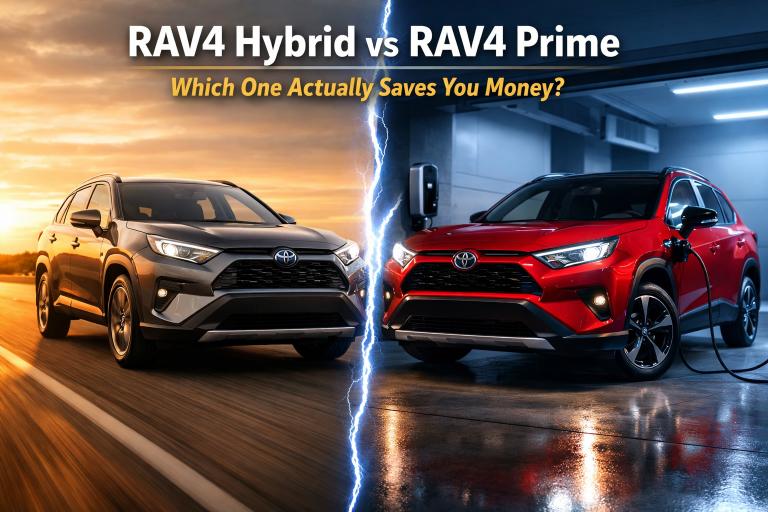
The Toyota RAV4 Hybrid vs RAV4 PHEV question comes up in my inbox constantly — and the confusion is understandable. Both wear the same badge, sit in the same showroom, and look nearly identical from the outside. However, they serve fundamentally different buyer profiles, have meaningfully different cost structures, and require completely different daily routines to get the most out of them. Choosing the wrong one is an expensive mistake that plays out every month for the next five years.
Why This Comparison Matters More Than It Looks
This article compares the RAV4 Hybrid and RAV4 Prime PHEV across every dimension that actually affects your ownership experience: purchase price and after-incentive cost, fuel economy and electric-only range, total running costs, charging logistics, and — most importantly — which specific buyer each model is designed for. Admittedly, most comparison articles stop at the spec sheet. What I’ve tried to do here is connect those specs to real-world use patterns so the verdict is actually useful to you, not just informative in the abstract.
Toyota RAV4 Hybrid vs RAV4 PHEV — Quick Answer:
The RAV4 Hybrid is the right choice for buyers who want maximum simplicity, no charging requirements, lower upfront cost (~$32,575 base MSRP), and proven hybrid reliability with no behaviour change. The RAV4 Prime PHEV is better for buyers with daily home charging access, a sub-40-mile round-trip commute, and who want up to 42 miles of EPA electric-only range — plus a potential federal tax credit that can materially reduce the ~$44,490 starting price. If you can’t charge at home regularly, the Prime’s advantages largely disappear and the Hybrid becomes the financially superior choice.
Quick Verdict: Which RAV4 Should You Buy?
I get this question at least twice a week from readers who’ve already committed to the RAV4 lineup. My answer is always the same: it depends entirely on one thing — whether you can charge at home every day. That single variable determines which model delivers its promised value and which one simply costs you more for benefits you’ll rarely use.
RAV4 Hybrid: Best for Simplicity-First Buyers
The RAV4 Hybrid is for buyers who want Toyota’s best-in-class hybrid efficiency with zero added complexity. No charger to install, no plug routine to build, no concern about running out of EV miles. It starts significantly lower than the Prime, costs less to insure in most markets, and delivers exceptional real-world MPG regardless of how or where you drive.
RAV4 Prime: Best for Short-Commute Charging Households
By contrast, the RAV4 Prime PHEV is for buyers who drive a predictable short-to-medium commute and can reliably charge at home or at work. In that specific scenario, the Prime can significantly reduce your fuel spend. It also delivers a notably more engaging drive — its 302 hp combined output is more than 80 hp above the Hybrid.
✅ Choose the RAV4 Hybrid if…
- You have no access to home or workplace charging
- Your daily mileage is unpredictable or primarily highway
- Lower upfront cost is the priority ($32,575 vs. $44,490+)
- You want zero behaviour change from a gas car routine
✅ Choose the RAV4 Prime if…
- You have a home charger or reliable Level 2 workplace access
- Your daily round-trip is consistently under 40 miles
- You want EV-mode driving without a full EV commitment
- Federal tax credit eligibility reduces your effective price gap
Powertrain Explained: How They Actually Differ Under the Hood
Both vehicles use Toyota’s hybrid technology — however the similarity ends there. The underlying architecture, battery size, and how each system delivers power are fundamentally different. Understanding this difference takes about two minutes and makes every other comparison point in this article make sense.
How the RAV4 Hybrid (HEV) Works
The RAV4 Hybrid is a self-charging hybrid — meaning it never needs a plug. The small battery pack charges entirely through regenerative braking and the combustion engine. The engine acts as a generator during deceleration and at appropriate load points. The electric motor assists at low speeds and during acceleration, however there is no meaningful electric-only driving mode. Specifically, the system can creep forward on electricity at very low speeds in parking lots — but this is not a real EV mode. The combined system produces 219 horsepower, delivers eAWD through a rear-mounted electric motor, and requires no changes to your fueling routine whatsoever.
How the RAV4 Prime PHEV Works
The RAV4 Prime is a plug-in hybrid. It carries a significantly larger 18.1 kWh battery pack that must be charged externally to access full electric-only capability. When charged from a wall outlet, it delivers up to 42 miles of EPA electric-only range — with the combustion engine staying off entirely. As a result, short daily commuters who charge every night can drive on electricity the majority of the time. The engine kicks in primarily for longer trips or highway stretches beyond the battery range.
Here’s the reassurance point most articles miss: when the Prime’s battery is depleted, it operates exactly like the RAV4 Hybrid. The combustion engine takes over and the hybrid system manages the remaining charge autonomously. That said, gas-only fuel economy is slightly lower than the Hybrid’s — because the Prime is heavier. The combined system output is 302 horsepower, which is 83 hp more than the Hybrid. That power difference makes the Prime noticeably more responsive in everyday driving — a fact that surprises most buyers who expect the two to feel identical.
| Spec | RAV4 Hybrid (HEV) | RAV4 Prime (PHEV) |
|---|---|---|
| Battery capacity | 1.6 kWh (NiMH) | 18.1 kWh (Li-ion) LARGER |
| Plug-in charging required? | No SIMPLER | Yes — to access EV mode |
| EV-only driving range | None (brief low-speed assist only) | 42 mi EPA EV CAPABLE |
| Combined system output | 219 hp | 302 hp +83 HP |
| AWD system | eAWD (rear electric motor) | eAWD (rear electric motor) STANDARD |
Fuel Economy & Electric Range: The Numbers That Actually Matter
Here’s the finding that surprises almost every buyer I talk to: on gas alone — without any charging — the RAV4 Hybrid frequently delivers better real-world fuel economy than the heavier RAV4 Prime. That’s not a typo. It’s the most important efficiency nuance in this entire comparison, and it changes the value calculation entirely depending on how you plan to drive.
MPG Comparison: Hybrid vs. Prime on Gas
The RAV4 Hybrid is rated at 41 city / 38 highway / 40 MPG combined by the EPA. These figures hold up well in real-world conditions, per EPA fueleconomy.gov owner-reported data. Real-world combined averages in mixed driving typically land around 38–42 MPG. Highway driving at 70–75 mph pulls closer to 36–38 MPG. By contrast, the RAV4 Prime on gas-only (battery depleted) is rated at 38 city / 35 highway / 36 MPG combined — lower than the Hybrid in every category. The reason is weight: the Prime carries approximately 550 lbs more from its larger battery pack. That weight penalty costs efficiency when the engine is doing all the work alone.
What that means for you: if you drive long highway trips regularly and charge infrequently, you’re paying the Prime’s higher purchase price to get lower MPG than the base Hybrid. Therefore, the Prime’s efficiency advantage only materialises when you’re actually using the electric mode.
RAV4 Prime EV Range: What You Can Realistically Expect
The RAV4 Prime’s EPA-rated 42 miles of electric range is achievable — in warm weather, at moderate speeds, with minimal HVAC use. Real-world range in cold climates (below 20°F) typically drops to approximately 28–34 miles. That’s still enough for most suburban commuters. However, it’s worth knowing before you assume 42 miles is your daily number. Specifically, buyers whose round-trip commute is under 35 miles will cover the majority of weekday driving on electricity — if they charge every night. That’s the profile where the Prime’s economics become genuinely compelling.
The Prime’s MPGe rating of 94 MPGe reflects efficiency when operating on electricity. Use this figure to compare your electricity cost per mile against your gasoline cost per mile at local rates. For most U.S. markets, driving on the Prime’s electric mode costs approximately 40–55% less per mile than running on gasoline. As a result, the payback math works clearly for regular-charging commuters — however it depends on maintaining the daily charging habit. Our guide to EV and PHEV charging times covers how to plan around a Level 1 or Level 2 setup.
| Efficiency Metric | RAV4 Hybrid (HEV) | RAV4 Prime (PHEV) |
|---|---|---|
| EPA City MPG | 41 MPG HIGHER | 38 MPG (gas-only) |
| EPA Highway MPG | 38 MPG HIGHER | 35 MPG (gas-only) |
| EPA Combined MPG (gas) | 40 MPG BETTER GAS MPG | 36 MPG (gas-only) |
| EPA EV-Only Range | None | 42 mi EPA EV MODE |
| MPGe (electric mode) | N/A | 94 MPGe WHEN CHARGED |
| Real-world hwy at 70–75 mph | ~36–38 MPG | ~33–35 MPG (gas-only) |
Price, Trims & Total Cost of Ownership
The price gap between these two vehicles is real and significant. However, it’s not as simple as the sticker difference suggests — because the Prime is eligible for a federal tax credit that can substantially change the math. Here’s what the numbers actually look like when you run them honestly.
MSRP and Trim-Level Price Gap
The 2026 RAV4 Hybrid starts at approximately $32,575 for the XLE trim. The comparable RAV4 Prime starts at approximately $44,490 for the XSE trim — a gap of roughly $11,900 at base. Admittedly, some of that premium buys additional standard features on the Prime (the XSE includes a panoramic roof, JBL audio, and larger wheels that don’t appear on the Hybrid until higher trims) — however the majority of the premium is attributable to the larger battery pack and powertrain hardware.
The federal Inflation Reduction Act tax credit is the variable that changes this calculation most. As of Q1 2026, the RAV4 Prime is listed on the IRS qualified vehicle list as eligible for up to $7,500 in federal tax credit. Verify current eligibility, income caps, and MSRP thresholds at IRS.gov before purchase — eligibility rules have changed multiple times since 2023. If the full credit applies, the effective price gap narrows to approximately $4,400. That’s a figure the Prime’s fuel savings can realistically overcome within 3–4 years for the right buyer.
Fuel and Charging Savings: Payback Period Reality Check
For a buyer who charges the Prime at home every night and drives approximately 12,000 miles per year with a daily round-trip under 40 miles, estimated annual fuel savings versus the Hybrid run approximately $700–$1,100 per year — depending on local electricity and gasoline prices. At that savings rate and after the $7,500 credit, the Prime reaches financial payback in approximately 4–6 years relative to buying the Hybrid outright. That’s a reasonable ownership horizon for most buyers who plan to keep the vehicle.
However, here’s the honest caveat: the buyer who never breaks even is the one who buys the Prime thinking it will save money but then rarely charges it. Without regular charging, you’re paying the Prime’s $11,900 premium to drive a heavier vehicle that gets slightly worse gas MPG than the Hybrid. I’ve spoken with multiple Prime owners in this exact situation, and the regret is consistent. The charging habit is not optional — it’s the product. For a full breakdown of EV and PHEV running costs by scenario, our monthly EV ownership cost guide runs the complete arithmetic.
| Cost Factor | RAV4 Hybrid (HEV) | RAV4 Prime (PHEV) |
|---|---|---|
| Base MSRP (2026) | ~$32,575 LOWER | ~$44,490 |
| After federal tax credit | ~$32,575 (no credit) | ~$36,990 (if $7,500 applies) NARROWED GAP |
| Est. annual fuel cost (12K mi) | ~$1,300–$1,550 | ~$400–$700 (w/ regular charging) LOWER |
| 5-yr fuel savings vs Hybrid | — | ~$3,500–$5,500 (if regularly charged) |
| Break-even vs. Hybrid | — | ~4–6 years (after credit, w/ daily charging) |
Charging the RAV4 Prime: What Owners Actually Need to Know
Most RAV4 Prime comparison articles skip this section entirely. That’s a significant omission — because the charging logistics of PHEV ownership are the factor that determines whether the Prime delivers on its promise or sits in your driveway costing you extra for very little return. Here’s what you need to know before you commit.
How Long Does It Take to Charge the RAV4 Prime?
On a standard Level 1 household outlet (120V), the RAV4 Prime takes approximately 12 hours to charge from depleted to full. That’s overnight charging territory. It works if you consistently arrive home with a depleted battery — however it’s inconvenient if your schedule is irregular. On a Level 2 home charger (240V), charge time drops to approximately 2.5 hours from empty. As a result, Level 2 home installation is strongly recommended for Prime owners. It’s the difference between a mildly awkward routine and a completely painless one.
One critical limitation many buyers discover only after purchase: the RAV4 Prime does not support DC fast charging. Unlike full EVs, the Prime accepts AC charging only — at Level 1 or Level 2 speeds. Therefore, public DC fast chargers at highway rest stops are not usable for the Prime. Charging on the road means Level 2 AC stations only. These are available but less ubiquitous than DC fast chargers at highway locations. Our home EV charging setup guide covers Level 2 EVSE installation and recommended hardware for PHEV owners. Typical installation runs approximately $500–$1,200 all-in, including the EVSE unit and electrician labour.
Does the RAV4 Prime Work Without Charging at Home?
Yes — completely. This is the reassurance point that removes most PHEV anxiety for buyers who are hesitant about the charging requirement. When the Prime’s battery is depleted, the vehicle operates as a conventional hybrid, managing the remaining battery charge automatically through regenerative braking and engine assist. You lose the EV-mode advantage, however you retain a capable, efficient SUV with Toyota’s proven hybrid reliability.
The fuel economy difference between a regularly-charged Prime and an uncharged one is significant, however. A Prime owner who charges every night can expect approximately $400–$700 per year in annual fuel costs for 12,000 miles of typical mixed driving. The same Prime owner who never charges will spend closer to $1,500–$1,800 annually — above what the RAV4 Hybrid costs to run, because of the Prime’s added weight. That gap illustrates precisely why the charging habit is the product, not an accessory feature.
RAV4 Hybrid vs. Prime: Which One Fits Your Life?
Every article on this topic gives you specs. What I try to give readers is honest scenario matching. The right answer is entirely about your specific daily life — not which vehicle is technically superior in isolation.
When the RAV4 Hybrid Is the Smarter Buy
Choose the RAV4 Hybrid if your daily mileage is unpredictable or predominantly highway. It’s also the right call if your parking situation makes home charging impractical or impossible. Specifically, high-mileage drivers covering 18,000–25,000 miles per year will find the Hybrid’s superior gas MPG more valuable than the Prime’s occasional EV mode. Admittedly, the Hybrid is the less exciting choice. However, it delivers exactly what it promises to the widest range of buyers — with no conditions attached and no behaviour change required.
When the RAV4 Prime Justifies the Premium
Choose the RAV4 Prime if you have a home charger or reliable workplace Level 2 access, your daily round-trip is under 40 miles, and you plan to own the vehicle for at least 5 years. The Prime genuinely changes the ownership experience for this buyer profile — quieter commutes on electricity, lower annual fuel spend, and a noticeably more responsive drive. By contrast, if even one of those three conditions doesn’t apply, the Prime’s premium becomes hard to justify against a Hybrid that costs $11,900 less at base.
Still on the Fence? Do This First
Spend one week tracking your actual daily mileage before deciding. If your round-trip commute is under 35 miles and you park at home with a standard outlet, the Prime is a serious candidate. Start with Level 1 overnight charging and evaluate whether the routine fits your life. The Prime’s break-even timeline is real — however only for buyers who use it as designed.
FAQ: Toyota RAV4 Hybrid vs RAV4 PHEV
Is the RAV4 Prime worth the extra cost over the RAV4 Hybrid?
Yes — conditionally. The Prime is worth the premium for buyers who have home charging access, a daily round-trip commute under 40 miles, and plan to own the vehicle for 5+ years. In that scenario, annual fuel savings of $700–$1,100 combined with the federal tax credit (up to $7,500 if eligible) can narrow the effective price gap to approximately $4,000–$5,000, which the fuel savings recover within 4–6 years. However, buyers who cannot charge regularly will find the Hybrid delivers better value — because the Prime’s added weight costs fuel economy without the benefit of EV miles.
Can you drive the RAV4 Prime without ever plugging it in?
Yes — the RAV4 Prime operates as a conventional hybrid when not plugged in, identical in function to the standard RAV4 Hybrid. The system manages the battery charge automatically through regenerative braking and the combustion engine. However, fuel economy without regular charging drops to approximately 36 MPG combined — lower than the Hybrid’s 40 MPG combined — because the Prime carries extra weight from its larger battery pack. As a result, owners who never charge pay more upfront and get worse gas efficiency than if they’d bought the Hybrid instead.
Does the RAV4 Prime qualify for the federal tax credit?
As of Q1 2026, the RAV4 Prime is listed on the IRS qualified clean vehicle list and is eligible for up to $7,500 in federal tax credit under the Inflation Reduction Act, subject to buyer income caps and MSRP thresholds. However, eligibility rules for battery sourcing, assembly location, and income limits have changed multiple times since 2023 — always verify your specific vehicle and income situation directly at IRS.gov or with the dealer before purchase. The point-of-sale credit option means eligible buyers can apply the discount directly at the dealership rather than waiting for a tax return.
Which gets better real-world MPG — RAV4 Hybrid or RAV4 Prime?
It depends entirely on how you use them. The RAV4 Hybrid delivers better real-world gas-only efficiency at 40 MPG combined EPA versus the Prime’s 36 MPG combined on gas alone — because the Hybrid is lighter. However, a Prime owner who charges every night and drives a short commute can cover the majority of weekday miles on electricity at the equivalent of approximately 94 MPGe — dramatically cheaper than either vehicle’s gas cost per mile. Therefore, the Hybrid wins if you drive primarily on gas; the Prime wins if you drive primarily on electricity through regular charging.
The RAV4 Hybrid and RAV4 Prime are both excellent vehicles — however they’re excellent for different people. The Hybrid delivers 40 MPG combined with zero added complexity, at a starting price that remains among the most competitive in the segment. The Prime delivers genuine EV-mode commuting for buyers who charge regularly — turning a capable SUV into something that rarely visits a gas station. Know which category you’re in. Make the decision based on your charging access and your commute, not on the more impressive spec sheet. That distinction is the entire article in one sentence.