The best SUVs under $30k in 2026 represent the strongest value proposition in recent automotive history. Competitive pricing pressure, hybrid drivetrain democratisation, and the near-universal standardisation of advanced safety technology have all converged to push more family-relevant capability below the $30,000 threshold than any previous model year. Families no longer need to compromise on safety credentials, fuel economy, or interior practicality to stay within a $30,000 budget. However, not every model in this segment earns its place equally.
This guide compares the top picks across five buyer categories — best overall, best hybrid, safest, best AWD, and best for cargo space — with full comparison tables, 5-year ownership cost modelling, and a buyer checklist to match your specific situation to the right vehicle.
For EV alternatives in a similar price bracket, see our affordable electric cars 2026 smart buys and traps guide. For hybrid vs EV total cost comparisons, our EV vs hybrid vs plug-in hybrid breakdown covers the financial decision in detail.
What to Expect From SUVs Under $30,000 in 2026
The sub-$30,000 SUV segment has matured significantly. In 2026, buyers can realistically expect standard safety technology, hybrid options, and practical family-sized interiors at prices that would have delivered far less three years ago. However, some limitations persist — and understanding them avoids disappointment at the dealership.
Compact vs Subcompact SUVs in This Price Range
Most of the best SUVs under $30k in 2026 fall into two segments. Subcompact SUVs — such as the Honda HR-V and Chevrolet Trailblazer — typically start below $26,000 and offer better fuel economy and urban agility. Compact SUVs — including the Toyota RAV4, Honda CR-V, and Kia Sportage — start closer to $27,000–$29,500. These deliver more rear legroom, cargo volume, and towing capacity, making them better suited to growing families. Both segments are represented in this guide, with compact SUVs dominating the top recommendations due to their superior long-term practicality.
Standard Safety Features (ADAS Level 2 Assist Systems)
Automatic emergency braking, lane departure warning, lane-keeping assist, and adaptive cruise control are now standard or near-standard on base trims across most SUVs in this segment. This is a meaningful shift from 2022–2023, when ADAS was frequently an add-on package. In 2026, families buying in this range can realistically expect a full basic ADAS suite without upgrading trim. Blind spot monitoring and rear cross-traffic alert are common additions, though not yet universal at base pricing. Always verify the specific trim’s feature list rather than assuming model-level specifications apply.
Hybrid & Fuel-Efficient Options Emerging Under $30k
Hybrid drivetrains have meaningfully crossed the $30,000 threshold for the first time in 2026. The Toyota RAV4 Hybrid and Hyundai Tucson Hybrid both have trims available at or near $30,000 with qualifying incentives. These represent the most compelling long-term value propositions in the segment — their fuel savings frequently exceed the hybrid premium within 24–36 months at average mileage. For a deeper cost breakdown, our total cost of ownership calculator guide models exactly where the break-even falls for your annual mileage.
AWD Availability vs Front-Wheel Drive Tradeoffs
AWD adds $1,400–$2,200 to the base price in most models and reduces fuel economy by 1–3 MPG. For families in regions with significant winter snowfall or unpaved rural access, the premium is well justified. For urban and suburban families in mild climates, FWD represents better value — modern front-wheel drive compact SUVs handle light rain and moderate inclines confidently. Most models in this guide offer AWD as an option on their entry trim; availability at base price varies by manufacturer.
Segment Overview — SUVs Under $30k in 2026
| Segment | Price Range | Key Strength | Typical Cargo Volume | Hybrid Available Under $30k? |
|---|---|---|---|---|
| Subcompact SUV | $23,000–$27,500 | Fuel economy, urban agility | 23–30 cu ft | Limited |
| Compact SUV | $27,000–$29,999 | Family space, towing, practicality | 33–40 cu ft | Yes (select models) |
| Compact Hybrid SUV | $28,500–$30,000 | Fuel savings, long-term value | 33–38 cu ft | Yes |
How We Ranked the Best SUVs Under $30k in 2026
Every model was evaluated against five criteria weighted for family ownership priorities.
Safety Ratings & Crash Test Scores
The NHTSA safety ratings database and IIHS results form the primary safety benchmark. Models without at least a 5-star NHTSA overall rating or an IIHS Top Safety Pick designation were excluded. Front crash prevention performance — specifically pedestrian collision avoidance — received additional weighting, as this is the scenario most relevant to family urban driving patterns. For a broader overview of how safety ratings work, see our crash test results and safety ratings explained guide.
Fuel Economy & Real-World MPG
EPA combined MPG provides the baseline, but real-world owner-reported figures were cross-referenced throughout. Models with consistent real-world figures within 8% of EPA combined were rated higher than those showing significant gaps between rated and actual fuel consumption — a discrepancy that materially affects 5-year fuel cost projections.
Reliability & Warranty Coverage
Consumer Reports SUV reliability data and J.D. Power Initial Quality Study scores provided the reliability baseline. Warranty coverage — particularly powertrain warranty length and transferability — was also evaluated, as it directly affects ownership risk and resale value. Models with 5-year/60,000-mile powertrain coverage or better scored higher than those offering only 3-year/36,000-mile basic terms.
Interior Space & Family Practicality
Rear passenger legroom, cargo volume behind the second row, LATCH child seat access quality, and second-row flexibility were all assessed. Models with rear legroom below 37 inches were rated lower for larger family suitability.
5-Year Total Cost of Ownership
Purchase price, insurance, fuel costs at 15,000 miles annually, scheduled maintenance, and 5-year depreciation were modelled for each recommendation. A vehicle with a lower sticker price but higher depreciation and fuel costs can be more expensive over five years than a slightly pricier model with better residual value. This metric changes most buying decisions when buyers examine it carefully.
Best SUVs Under $30k in 2026 — Top Smart Family Picks
Best Overall
Toyota RAV4 LE — Best Overall SUV Under $30k in 2026
Why It’s a Smart Family Pick
The Toyota RAV4 LE is the benchmark in this segment: strongest long-term reliability record, best cargo capacity, and the highest resale value retention of any compact SUV at this price point. Starting at $29,400, it sits at the top of the under-$30k range — but its 5-year total ownership cost is frequently lower than cheaper rivals due to superior depreciation performance and the lowest unscheduled maintenance frequency in the segment.
Key Specs
- Engine: 2.5L 4-cylinder, 203 hp
- MPG: 27 city / 35 highway / 30 combined (FWD)
- Cargo Space: 37.6 cu ft behind rear seats; 69.8 cu ft maximum
- Safety Suite: Toyota Safety Sense 2.5+ standard — AEB, lane centering, adaptive cruise, blind spot monitor
- Warranty: 3 yr/36k basic; 5 yr/60k powertrain
- AWD Available: Yes (+$1,400)
Pros & Cons
- ✅ Best-in-class resale value (55–60% retained after 5 years)
- ✅ Most comprehensive standard ADAS suite in segment
- ✅ Largest cargo volume of any compact SUV under $30k
- ⚠️ Base infotainment screen smaller than some rivals
- ⚠️ Interior materials feel budget-level at base trim
- ⚠️ Powertrain feels adequate rather than refined at highway speed
Estimated 5-Year Net Ownership Cost: ~$31,650
Purchase ($29,400) + fuel (~$8,750) + insurance (~$7,500) + maintenance (~$3,200) − resale value (~$17,200). Despite the higher starting price, this is among the lowest net 5-year figures in the segment.
Best Hybrid
Hyundai Tucson Hybrid SE — Best Hybrid SUV Under $30k
Fuel Savings vs Gas Model Comparison
The Tucson Hybrid SE starts at $29,750 — approximately $3,000 above the base Tucson gas model. At 15,000 miles annually and $3.50/gallon, its 38 MPG combined versus the gas model’s 26 MPG saves approximately $820 per year in fuel. The hybrid premium recovers in roughly 3.7 years at average mileage — well within the typical 5-year ownership window. For families driving 20,000+ miles annually, the break-even drops below 2.5 years.
Real-World MPG vs EPA Rating
Owner-reported real-world Tucson Hybrid figures consistently run 36–40 MPG combined, closely tracking the EPA 38 MPG rating. In predominantly urban driving with frequent stop-start conditions, real-world figures can reach 42–44 MPG — particularly cost-effective for the suburban family driving patterns most buyers in this segment follow.
Long-Term Reliability Outlook
Hyundai’s hybrid system uses a proven parallel architecture, backed by a 10-year/100,000-mile powertrain warranty — the strongest coverage in the segment. However, Hyundai’s overall reliability scores trail Toyota’s in independent assessments. Buyers who prioritise maximum long-term reliability should note that the RAV4 Hybrid is available near $30,000 in some markets with incentives. For comparative hybrid drivetrain longevity data, our Chinese EV vs Japanese hybrid reliability guide provides relevant benchmark context.
Best for Safety
Honda CR-V EX — Best SUV Under $30k for Safety
Advanced Driver Assistance Systems
The Honda CR-V EX starts at $29,900 and includes Honda Sensing as standard across all trims. This suite encompasses collision mitigation braking, lane departure warning, lane-keeping assist, adaptive cruise with low-speed follow, road departure mitigation, and traffic sign recognition. Notably, the CR-V’s forward collision avoidance system received top scores in IIHS vehicle-to-pedestrian testing in 2025 — the most practically important safety benchmark for families in school zones and residential streets.
Crash Test Performance
The 2026 CR-V carries IIHS Top Safety Pick+ designation and a 5-star NHTSA overall rating. Its small overlap front test score is rated Good — the highest possible — and side impact and roof strength ratings are similarly top-rated. For families buying primarily on safety credentials, the CR-V is the strongest performer in the sub-$30,000 segment.
Family-Friendly Safety Features
Standard features include a rear seat reminder system, a right-side blind spot camera display in the instrument cluster, and a rearview camera with dynamic guidelines. LATCH child seat access is rated above average by Consumer Reports, with accessible lower anchors and good clearance for installation without seat back interference.
Best AWD
Mazda CX-5 AWD — Best AWD SUV Under $30k
Snow & Light Off-Road Capability
The Mazda CX-5 2.5L AWD starts at $29,500. Its i-ACTIV AWD uses predictive torque distribution — acting before wheel slip is detected rather than after. In independent winter driving assessments, the CX-5 AWD consistently outperforms competitors at this price on snow-covered inclines and mixed-surface transitions. For families in northern climates or with unpaved driveway access, it is class-leading in all-weather confidence.
Fuel Economy Tradeoffs
The AWD penalty is modest: 26 MPG combined versus 27 MPG for the FWD variant. At 15,000 annual miles, the AWD version costs approximately $100–$140 more per year in fuel — a marginal tradeoff for the traction confidence and the CX-5’s class-leading interior quality delivered at the base price.
Best Cargo & Space
Kia Sportage LX — Best SUV Under $30k for Cargo & Space
Rear Legroom & Cargo Volume
The Kia Sportage LX starts at $27,990 and delivers 41.3 inches of rear legroom — the most in the compact SUV segment under $30,000. This makes it the practical choice for families with taller teenagers or regular adult rear passengers. No three-row option exists at this price point in the compact segment; buyers needing three rows should evaluate models at higher price points.
Behind the second row, the Sportage offers 39.6 cu ft — second only to the RAV4 in this segment. With rear seats folded, total cargo volume reaches 74.1 cu ft, the highest in the compact SUV segment under $30,000. For families who regularly transport sports equipment, prams, or bulky weekly loads, this is a meaningful practical advantage. The Sportage LX also undercuts most competitors by $1,500–$1,900 while delivering more space — the strongest value-per-dollar pick for space-prioritising families.
For buyers considering whether an SUV or an EV better suits their family needs, our best EVs under $40,000 guide covers the next tier up.
Full Model Comparison — Best SUVs Under $30k in 2026
| Model | Starting Price | MPG (Combined) | Cargo (2nd Row Up) | AWD at Base? | Powertrain Warranty | IIHS Rating |
|---|---|---|---|---|---|---|
| Toyota RAV4 LE | $29,400 | 30 MPG | 37.6 cu ft | Optional +$1,400 | 5 yr/60k | Top Safety Pick+ |
| Hyundai Tucson Hybrid SE | $29,750 | 38 MPG | 38.0 cu ft | Standard | 10 yr/100k | Top Safety Pick+ |
| Honda CR-V EX | $29,900 | 30 MPG | 39.2 cu ft | Optional +$1,500 | 5 yr/60k | Top Safety Pick+ |
| Mazda CX-5 AWD | $29,500 | 26 MPG | 30.9 cu ft | Standard | 5 yr/60k | Top Safety Pick+ |
| Kia Sportage LX | $27,990 | 29 MPG | 39.6 cu ft | Optional +$1,500 | 5 yr/100k | Top Safety Pick |
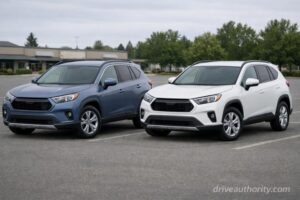
Gas vs Hybrid SUVs Under $30k — Which Is Smarter for Families?
The hybrid question is the most consequential financial decision for families in this segment. The answer depends on annual mileage, local fuel prices, and planned ownership duration.
Fuel Savings Over 5 Years
At 15,000 annual miles and $3.50/gallon, a 30 MPG gas SUV costs approximately $1,750 per year in fuel. A 38 MPG hybrid costs approximately $1,382 — a $368 annual saving. At 20,000 miles, the saving reaches $490 per year. Over five years at 15,000 miles, the hybrid consequently saves approximately $1,840 — partially but not fully recovering the typical $2,500–$3,500 hybrid premium.
Upfront Cost vs Long-Term Value
The hybrid break-even improves significantly when resale value is included. Hybrid SUVs in 2026 retain 5–8% more of their value at five years than comparable gas models. Combined, fuel savings and improved resale value make the hybrid equal or better total value for buyers keeping their vehicle five or more years. For shorter ownership — under three years — the gas model is generally more economical.

Maintenance & Reliability Differences
Modern hybrid systems from Toyota and Hyundai require no additional routine maintenance compared to their gas counterparts. No separate hybrid battery service, no additional fluid changes, no hybrid-specific wear items in the scheduled service interval. Furthermore, regenerative braking extends brake pad life significantly: hybrid drivers typically replace brake pads at 80,000–120,000 miles versus 40,000–70,000 miles for gas equivalents — saving $300–$600 over a typical ownership period. For long-term EV and hybrid battery reliability data, our how long do EV batteries last guide provides relevant context on battery longevity expectations.
Gas vs Hybrid — 5-Year Cost Comparison (15,000 mi/yr, $3.50/gal)
| Cost Category | Gas SUV (30 MPG) | Hybrid SUV (38 MPG) |
|---|---|---|
| Annual fuel cost | $1,750 | $1,382 |
| 5-year fuel cost | $8,750 | $6,910 |
| Brake service (5 yrs) | $500–$700 | $150–$300 |
| Hybrid premium (purchase) | — | +$2,500–$3,500 |
| Resale advantage (5 yr) | — | +$1,200–$2,000 |
| Net 5-yr cost difference | Gas ~$400–$1,200 cheaper at 15k mi/yr; roughly equal at 20k+ mi/yr | |
Safety & Family Features That Matter in 2026
Safety technology standardisation has accelerated rapidly across the budget SUV segment. Below are the features that matter most for families — and what to verify before committing to a specific trim level.
Blind Spot Monitoring & Lane Centering
Blind spot monitoring with rear cross-traffic alert is now standard on most trim levels in this segment. Active lane centering — which steers the vehicle back toward the lane centre rather than simply alerting the driver — varies more. The Honda CR-V, Toyota RAV4, and Hyundai Tucson all include active lane centering as standard at base trim. The Mazda CX-5 and Kia Sportage offer it but may require a higher trim at the entry price point. Always verify specific trim specifications rather than assuming model-level features apply universally.
Rear Seat Reminder Systems
Rear occupant alert systems — which remind drivers to check the rear seat before exiting — are standard on the Kia Sportage, Hyundai Tucson, and Honda CR-V. The RAV4 LE does not include rear occupant alert as standard at base trim. For families with young children, this is a meaningful safety differentiator that warrants explicit verification at the point of purchase.
⚠️
Always verify trim-level specs directly. Model-level feature summaries — including on manufacturer websites — frequently list features available on higher trims. Confirm the specific base trim’s feature sheet before visiting a dealer.
Digital Instrument Clusters & Infotainment
Digital instrument clusters and 8-inch or larger touchscreen infotainment systems are standard across all five recommended models at base trim. Apple CarPlay and Android Auto connectivity is wired-standard on all; wireless connectivity varies by model and trim. The Kia Sportage leads the segment on infotainment quality at the base price, with a 12.3-inch touchscreen integrated into a curved display architecture that punches well above the vehicle’s price point.
Child Seat Compatibility & LATCH Access
LATCH access quality varies significantly between models that nominally offer the system. The Honda CR-V and Kia Sportage receive top Consumer Reports LATCH access ratings — lower anchors are reachable without tools and without significant seat back interference. The RAV4 and Tucson receive good ratings. The CX-5’s lower anchors are partially recessed and require more effort to access. If child seat installation frequency is a regular requirement, prioritise the CR-V or Sportage on this dimension.
Real-World Ownership Costs for Budget SUVs
Over five years, insurance, maintenance, depreciation, and fuel collectively dwarf the purchase price difference between models in this segment. The sticker price tells only part of the story.
Insurance Premium Trends
Compact SUVs in this segment carry average annual insurance premiums of $1,350–$1,850 depending on driver profile, location, and coverage level. The Toyota RAV4 and Kia Sportage tend to insure at the lower end of this range due to lower repair costs and strong parts availability. Obtaining insurance quotes before purchase is essential — premiums can vary by $400–$600 annually between models at the same sticker price. Our best cheap car insurance for new drivers 2026 guide covers how to minimise this cost.
Maintenance & Repair Frequency
Toyota and Honda models consistently show the lowest unscheduled repair frequency in Consumer Reports and J.D. Power reliability studies. Kia and Hyundai have improved substantially since 2020 but still trail Toyota and Honda on long-term unscheduled repair rates. Mazda occupies a strong mid-field position — better than the Korean brands historically, slightly below Toyota and Honda. Scheduled maintenance costs are broadly comparable across all five models: $600–$900 annually for standard service intervals.
Depreciation Rates After 3–5 Years
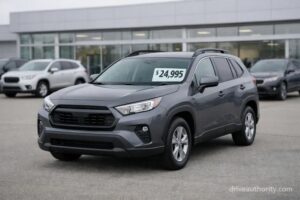
Depreciation is the largest single ownership cost in this segment, typically representing 45–55% of original value over five years. Toyota leads: the RAV4 retains approximately 58% of its value after five years, above the segment average of 50–52%. The Kia Sportage and Hyundai Tucson Hybrid both show improving residual value trends as brand perception strengthens.
Resale Value Stability
Resale value stability favours Toyota and Honda strongly. Both brands benefit from large certified pre-owned programs that support used market prices. Kia and Hyundai’s improving reliability track record is beginning to translate into more stable used market pricing, but a meaningful gap versus Toyota and Honda persists. For buyers who anticipate selling within five years, the RAV4 or CR-V provides the most predictable exit value.
Who Should Buy an SUV Under $30k in 2026?
First-Time Family Buyers
Families purchasing their first dedicated family vehicle will find the best value in the Toyota RAV4 LE or Honda CR-V EX. Both offer the safety credentials, reliability track record, and resale stability that first-time buyers need most. The total cost of ownership over five years is predictable and well-documented by large owner populations.
Urban Commuting Families
Urban families who prioritise fuel economy should look at the Hyundai Tucson Hybrid SE. Its hybrid efficiency delivers measurable savings in stop-start urban conditions, and its slightly smaller footprint makes city parking more manageable. It is the most cost-effective option for purely urban family driving without AWD requirements — and its 10-year powertrain warranty provides exceptional peace of mind.
Budget-Conscious Buyers Avoiding Sedans
Buyers stepping up from a sedan who want maximum feature value per dollar should evaluate the Kia Sportage LX at $27,990. It undercuts all other recommendations by $1,500–$1,900 while delivering more rear legroom and cargo volume than most competitors. The 5-year/100,000-mile powertrain warranty provides a strong reliability backstop. The tradeoff is slightly lower resale value retention versus Toyota and Honda — acceptable for buyers who plan to keep the vehicle for the full warranty period. For a comparison of budget options across fuel types, our best electric cars for the money guide covers the EV side of the equation.
When to Consider Certified Pre-Owned Instead
A 2-year-old certified pre-owned RAV4 or CR-V with 20,000–25,000 miles typically prices at $24,000–$26,500 in 2026 — $3,000–$5,000 below the equivalent new base trim, with the steepest depreciation already absorbed. CPO programs from Toyota and Honda include comprehensive inspection standards, limited additional warranty coverage, and roadside assistance. For budget-conscious buyers who can manage without the new-vehicle warranty, CPO represents superior value per dollar. The one exception is buyers planning 10+ years of ownership: the full factory warranty term and known service history of a new vehicle justify the premium in that case.
Buyer Decision Checklist — Best SUVs Under $30k in 2026
- ✅ Maximum reliability + resale value → Toyota RAV4 LE
- ✅ High annual mileage + fuel savings priority → Hyundai Tucson Hybrid SE
- ✅ Safety is the non-negotiable priority → Honda CR-V EX
- ✅ Winter climate or rural access required → Mazda CX-5 AWD
- ✅ Maximum cargo and space on a tighter budget → Kia Sportage LX
- ⚠️ Planning to sell within 2–3 years → consider certified pre-owned instead
- ⚠️ Driving under 10,000 miles/year → gas model more economical than hybrid
FAQs — Best SUVs Under $30k in 2026
The Toyota RAV4 LE is the best overall SUV under $30k in 2026 for most families. It combines the strongest long-term reliability record, the most comprehensive standard safety suite, and the best resale value in the compact segment. At $29,400, it delivers the lowest net 5-year ownership cost of any model in this guide despite its higher starting price.
Yes — the Hyundai Tucson Hybrid SE starts at $29,750 with AWD standard and a 10-year powertrain warranty, delivering 38 MPG combined. The Toyota RAV4 Hybrid is also available under $30,000 with qualifying regional incentives. Both represent compelling long-term value for families driving 15,000+ miles annually, with fuel savings recovering most of the hybrid premium within 3–4 years.
The Honda CR-V EX leads for safety at this price point. It holds IIHS Top Safety Pick+ designation, earns the highest pedestrian collision avoidance scores in the segment, and includes Honda Sensing as standard on all trims — providing a complete ADAS suite without requiring a trim upgrade. The Toyota RAV4 LE and Hyundai Tucson Hybrid also carry Top Safety Pick+ ratings.
Yes — AWD is available on all five recommended models. It is standard on the Mazda CX-5 AWD and Hyundai Tucson Hybrid SE at base trim pricing. On the Toyota RAV4, Honda CR-V, and Kia Sportage, AWD is an option adding $1,400–$1,500 to the base price. All AWD systems in this segment are on-demand rather than full-time, prioritising fuel economy in normal conditions.
The Kia Sportage LX leads on total cargo volume with 74.1 cu ft maximum and 39.6 cu ft behind the rear seats — the highest in the compact SUV segment under $30,000. Its $27,990 starting price also makes it the most affordable high-cargo option in this guide. The Toyota RAV4 follows closely at 69.8 cu ft maximum.
Toyota and Honda models in this segment are among the most reliably documented long-term vehicles in any price category. The RAV4 and CR-V regularly appear in 10-year low-cost ownership analyses. Kia and Hyundai have improved significantly since 2020 and back their vehicles with strong warranty coverage. Mazda sits in a strong mid-field position. For maximum long-term reliability confidence, Toyota or Honda remain the benchmarks.
For buyers planning 5–10+ years of ownership, new provides the full factory warranty and known service history. For buyers planning to sell within 4–5 years, a 2-year-old certified pre-owned RAV4 or CR-V at $24,000–$26,500 absorbs the steepest depreciation and typically represents better value per dollar, especially when CPO programs include comprehensive inspection and additional warranty coverage.
Final Verdict
The best SUVs under $30k in 2026 are genuinely capable family vehicles — not compromises. Safety technology standardisation, hybrid drivetrain democratisation, and intense competitive pricing have all converged to push more real family value below the $30,000 threshold than any previous model year. However, the right choice depends entirely on which ownership dimension your family prioritises most.
For safety-first families, the Honda CR-V EX is the strongest recommendation. For maximum long-term reliability and resale confidence, the Toyota RAV4 LE is the clear answer. For high-mileage families who want fuel costs controlled, the Hyundai Tucson Hybrid SE delivers the best 5-year return. For northern climates requiring genuine AWD confidence, the Mazda CX-5 leads the segment. For families on a tighter budget who need maximum interior space, the Kia Sportage LX offers the strongest value per dollar.
Regardless of which model fits your priorities, the consistent recommendation is the same: calculate the 5-year total ownership cost before deciding — not just the sticker price. A $500 saving at purchase that costs $2,000 more in depreciation is not a saving at all. The models in this guide are recommended precisely because their total ownership story makes them the smartest family picks available under $30,000 in 2026.
Further Reading
Affordable Electric Cars 2026 — Smart Buys and Traps
Cost of Owning a Car Monthly — Running Cost Breakdown
Best Cheap Car Insurance for New Drivers 2026
EV vs Hybrid vs Plug-In Hybrid — Full Financial Comparison
Best EVs Under $40,000 in 2026
This article is for informational purposes. Prices, specifications, and market conditions vary by region and are subject to change. Always consult local dealers, insurers, and independent advisors before making a vehicle purchase decision. Safety ratings reflect data available at time of publication.