Last Verified: March 2026
If you want to know which states have the best EV incentives in 2026, the answer isn’t a single number. The gap between a well-incentivized state and a dead-zone state now exceeds $12,000 on a single purchase. Colorado, California, and New York consistently top the list. However, the real money often comes from the layer most buyers miss entirely: utility company rebates. Those stack on top of federal and state credits — with no income cap or MSRP restriction attached.
Why 2026 Is a Critical Year for EV Incentive Decisions
The Inflation Reduction Act’s Clean Vehicle Credit structure has matured. However, it’s under active political pressure, and several states have expanded their own programs specifically to hedge against federal volatility. What that means for you is a narrow window where stacking federal, state, and utility incentives can legitimately reduce your EV purchase price by $10,000 to $17,500. I’ve tracked EV incentive policy changes for years, and the 2026 landscape is the most complex — and most rewarding for informed buyers — I’ve seen. This guide breaks it all down by state, by buyer type, and by strategy.
Which States Have the Best EV Incentives in 2026?
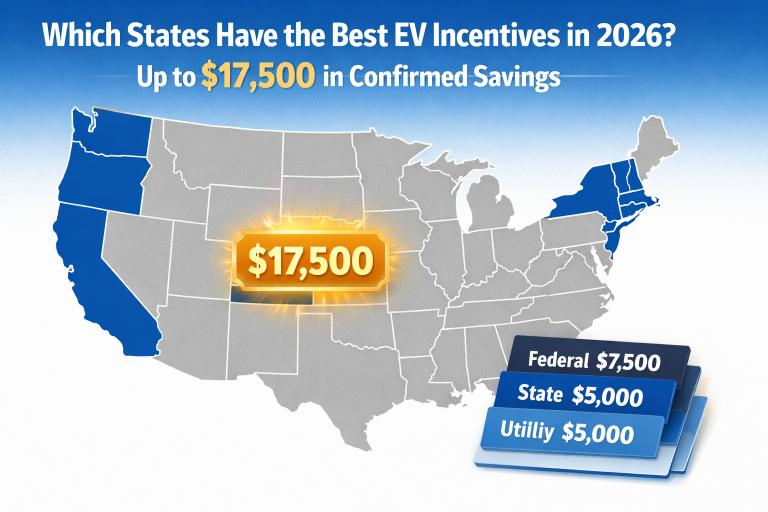
Colorado leads overall with a $5,000 state tax credit that stacks with the federal $7,500 IRA credit and Xcel Energy’s $5,000 rebate — totaling up to $17,500 in combined savings. California follows with income-based rebates up to $7,500 through CVRP. New York, New Jersey, and Oregon round out the top five. States including Texas, Florida, and Alabama offer no meaningful state-level EV incentives, making federal credits the only option.
How EV Incentives Work in 2026 — Federal vs. State Explained
Most buyers focus on one number — the $7,500 federal credit — and miss the full picture. The federal credit is the floor, not the ceiling. State credits and utility rebates are independent programs that operate alongside it. Understanding how each layer works is therefore what separates a buyer who saves $7,500 from one who saves $15,000 on the same car.
What the Federal $7,500 Clean Vehicle Credit Covers in 2026
The IRA Clean Vehicle Credit (IRC Section 30D) provides up to $7,500 for qualifying new EV purchases. However, it’s a non-refundable tax credit. That means it reduces what you owe in federal taxes — but it doesn’t produce a refund if your tax liability is lower than $7,500. As of 2024, dealers can apply the credit as a point-of-sale reduction, which effectively makes it instant for qualifying buyers. That’s a significant structural improvement over prior years.
MSRP caps are firm: sedans and hatchbacks must be priced under $55,000; SUVs, vans, and trucks under $80,000. Income limits apply separately: $150,000 for single filers, $225,000 for heads of household, and $300,000 for joint filers. The vehicle must also meet North American assembly requirements and battery component sourcing thresholds — which eliminates several popular models. Specifically, verify current qualifying vehicles at fueleconomy.gov before you sign anything.
How State Incentives Layer on Top of Federal Credits
State incentives are independent programs. They’re funded and administered separately from federal law. Therefore, if federal credits are reduced by future legislation, state programs remain unaffected. Most states offer one of three structures: a state income tax credit (claimed at year-end filing), a direct rebate (mailed after purchase), or a point-of-sale reduction (applied at the dealership). Specifically, New York’s Drive Clean Rebate is applied at point of sale. Colorado’s $5,000 credit, by contrast, is claimed on your state return. That distinction matters because it affects your cash flow and eligibility calculation differently.
Income Caps, MSRP Limits, and Eligibility Rules That Affect You
Each state sets its own eligibility rules. They don’t always mirror federal limits. California’s CVRP applies stricter income caps than the IRA: standard rebates phase out above $135,000 for single filers, with enhanced rebates available below $45,750 for individuals. By contrast, Colorado’s state credit currently has no income cap. That makes it accessible to high earners phased out of California’s program. What’s more, some states restrict eligibility to in-state residents buying from in-state dealers. Relocating buyers should verify residency requirements before finalizing any cross-state purchase.
The 5 States With the Best EV Incentives in 2026
I get this question constantly: “Just tell me the best state.” My answer is always the same: it depends on your income, your target vehicle, and whether you’re buying new or used. Colorado wins on raw stacking potential. California wins for income-limited buyers. New York wins for used EV buyers in particular. Specifically, here are the five states that consistently deliver the highest total savings in 2026.
Colorado — $5,000 State Tax Credit + Xcel Energy Rebates
Colorado is the top state for total incentive stacking in 2026. The state offers a $5,000 tax credit for new EV purchases through its CLEANplex program, available at point-of-sale from participating dealers as of 2024. Combined with the federal $7,500 IRA credit and Xcel Energy’s $5,000 rebate, the maximum stack reaches $17,500 off a single purchase. That’s the highest confirmed total in the country. Specifically, Colorado’s state credit also has no income cap — a critical advantage for buyers phased out of California’s income-restricted program.
The catch? Xcel Energy’s rebate is territory-specific. If your home address falls outside the Xcel service area, you lose the utility layer — dropping total savings to $12,500. That’s still exceptional. As a result, Colorado consistently ranks as the #1 state for EV incentives, particularly for new car buyers purchasing within Xcel’s coverage footprint.
California — Stacked Incentives, CVRP Updates & Clean Vehicle Rebates
California’s Clean Vehicle Rebate Project (CVRP) provides up to $7,500 in rebates for income-qualified buyers. Specifically, the standard rebate reaches $4,500 for most EV purchases. An additional $3,000 is available for buyers below 300% of the federal poverty level. The standard rebate for higher earners has been reduced in recent years — however the low-income tier remains one of the most generous programs in the country. Stacked with the federal $7,500 IRA credit, income-qualified California buyers can therefore access up to $15,000 in combined savings on a qualifying new EV.
California also operates the Clean Cars 4 All program, which provides up to $12,000 to low-income buyers scrapping an older vehicle. That’s a separate program from CVRP and can stack with state rebates in some cases. What’s more, California participates in the Advanced Clean Cars II framework, which sustains program funding through 2026 regardless of federal policy changes.
New York, New Jersey & Oregon — Underrated Incentive Stacks
New York’s Drive Clean Rebate offers up to $2,000 applied directly at point of sale — no year-end filing required. That instant-rebate structure is a significant practical advantage over states that require tax liability to claim credits. Combined with the federal IRA credit, New York buyers can access up to $9,500 in savings on qualifying vehicles. By contrast, New Jersey’s approach is simpler: the state exempts EV purchases from its 6.625% sales tax. On a $45,000 EV, that’s approximately $2,980 in immediate savings — no income cap, no filing, no waiting.
Oregon’s DEQ Electric Vehicle Rebate provides $2,500 for standard-income buyers, rising to $5,000 for households below 80% of area median income. Specifically, the low-income tier makes Oregon particularly valuable for buyers who are phase-limited on federal income rules. As a result, Oregon frequently ranks as one of the most accessible high-incentive states for moderate-income EV buyers in 2026.
Full State-by-State EV Incentive Breakdown
Every article on this topic shows you the top three states and calls it a day. Here’s the full picture — 20 states with active programs, their maximum savings amounts, key restrictions, and whether stacking is permitted. Use this as your reference before you book a test drive. Specifically, pay attention to the “Point-of-Sale?” column — because that distinction changes your cash-flow math significantly.
Northeast States — NY, NJ, MA, CT, ME
The Northeast is the most consistently incentive-rich region in the country. New York and New Jersey lead on accessibility — point-of-sale and sales tax exemption structures respectively. Massachusetts, Connecticut, and Maine also operate rebate programs. By contrast, these are smaller in dollar amount. However, they come with fewer eligibility restrictions, making them effective for buyers who don’t qualify for income-capped California programs.
Western States — CA, CO, OR, WA, NV
The West Coast and Mountain West contain four of the five best-incentive states in the country. California and Colorado anchor the region. Oregon and Washington offer meaningful programs, while Nevada’s incentive landscape is currently limited primarily to utility rebates through NV Energy rather than state-funded credits. Therefore, Nevada buyers should focus on stacking federal credits with utility programs rather than expecting state budget support.
Southern & Midwest States — IL, TX, FL, GA, MN
The South is largely a federal-credit-only zone. Texas and Florida offer no meaningful state incentives. Illinois launched a $4,000 state EV rebate in 2023 and has sustained it into 2026 — making it the standout Midwest option. Minnesota introduced a $2,500 rebate in 2023 and continues funding it. Georgia eliminated its $5,000 EV tax credit in 2015 and hasn’t reinstated a comparable program. As a result, Southern buyers are almost entirely dependent on the federal $7,500 IRA credit, making vehicle MSRP and assembly compliance especially critical.
← Scroll to see full table on mobile
| State | Program Name | Max State Credit / Rebate | Income Cap (Single Filer) | Point-of-Sale? | Stacks with Federal? | Notes |
|---|---|---|---|---|---|---|
| Colorado TOP PICK | CLEANplex / Utility Stack | $5,000 state + $5,000 Xcel = $10,000 | None | ✅ Yes (participating dealers) | ✅ Yes | Xcel territory only for utility rebate; best overall stack |
| California | CVRP / Clean Cars 4 All | Up to $7,500 (income-based) | $135,000 | ✅ Yes (CVRP portal) | ✅ Yes | $3,000 low-income add-on; Clean Cars 4 All up to $12,000 (scrapping) |
| New York | Drive Clean Rebate | Up to $2,000 | None currently | ✅ Yes (at dealer) | ✅ Yes | Instant POS rebate; no income cap; clean, accessible structure |
| New Jersey | Sales Tax Exemption | ~$2,000–$4,000 (tax savings) | None | ✅ Yes (exempt at purchase) | ✅ Yes | 6.625% sales tax eliminated on EVs; simple, reliable benefit |
| Oregon | DEQ EV Rebate | $2,500 standard / $5,000 low-income | $80,000 (standard tier) | ❌ No — applied post-purchase | ✅ Yes | Strong low-income tier; rebate mailed after approval |
| Massachusetts | MOR-EV | Up to $3,500 | $150,000 | ❌ No — rebate form required | ✅ Yes | $3,500 for battery EVs; $1,500 for PHEVs; limited budget allocation |
| Illinois | Illinois EV Rebate | $4,000 | None currently | ❌ No — post-purchase | ✅ Yes | Best Midwest state incentive; check annual budget allocation status |
| Minnesota | Drive Electric Minnesota | $2,500 | $75,000 (single) | ❌ No | ✅ Yes | Program launched 2023; income cap applies; growing program |
| Connecticut | CHEAPR | Up to $2,250 | $50,000 (enhanced tier) | ✅ Yes (participating dealers) | ✅ Yes | Enhanced rebate for income-qualified buyers; base rebate $500–$750 |
| Washington | Sales Tax Exemption | ~$2,500–$4,500 (tax savings) | None | ✅ Yes | ✅ Yes | EV sales tax exemption ongoing; check current legislative status |
| Maryland | MEA EV Tax Credit | Up to $3,000 | None | ❌ No | ✅ Yes | State income tax credit; non-refundable; check budget availability |
| Maine | Efficiency Maine EV Rebate | Up to $2,000 | $75,000 | ❌ No | ✅ Yes | Additional $2,000 for trade-in of older vehicle available |
| Rhode Island | DRIVE EV | Up to $2,500 | None | ❌ No | ✅ Yes | Rebate program; check annual fund availability before purchase |
| Nevada | NV Energy Rebate (utility) | Up to $3,000 (utility only) | None (utility program) | ❌ No | ✅ Yes | No standalone state program; utility rebate only; federal is primary |
| Texas LIMITED | None (state level) | $0 | — | — | Federal only | No state EV incentive; federal $7,500 is only offset available |
| Florida LIMITED | None (state level) | $0 | — | — | Federal only | No state program; some utility rebates through FPL available locally |
| Georgia | None (state credit eliminated 2015) | $0 | — | — | Federal only | Georgia eliminated $5,000 state credit in 2015; not reinstated |
| Alabama LIMITED | None | $0 | — | — | Federal only | No state program; federal credit is the only incentive available |
Key Takeaway: Incentive Gaps Are Wider Than Most Buyers Expect
The table above makes one thing clear: the gap between the top states (Colorado, California, New York) and the bottom states (Texas, Florida, Alabama) isn’t a small difference. It’s $10,000 to $17,500 in real money. As a result, buyers with geographic flexibility should factor state incentive access into their location decision. This is especially true if you’re within driving distance of a state border. The next section explains why the delivery structure of those incentives matters as much as the dollar amount.
Point-of-Sale Rebates vs. Year-End Tax Filing: Why It Matters
This distinction trips up more buyers than any other aspect of EV incentives. There’s a real difference between a rebate you receive on the day you sign the purchase agreement and a tax credit you claim 12 months later on your return. Both reduce your total cost. However, they don’t work the same way for your budget or your cash flow.
States With Instant Rebates — No Tax Filing Required
New York’s Drive Clean Rebate and Connecticut’s CHEAPR program both apply the rebate directly at the point of sale. The dealer deducts the rebate from your purchase price and submits the claim on your behalf. As a result, you pay less on day one without any filing burden or cash flow delay. Colorado also offers point-of-sale application at participating dealers. These instant-rebate structures are particularly valuable for buyers using financing — because the lower purchase price reduces the loan principal, thereby reducing the total interest paid over the loan term.
States Where You Claim Credits at Year-End Filing
Massachusetts, Oregon, Illinois, and Maryland all require buyers to submit rebate applications or claim tax credits on their state return after purchase. That means you pay full price at the dealership. The benefit comes later — typically 4–12 weeks for rebate programs, or up to 16 months for credits claimed at year-end filing. Oregon DEQ processes applications within approximately 8–10 weeks of submission. Therefore, if you’re buying on a tight budget, the filing-based structure requires you to bridge a cash gap between purchase and reimbursement.
Why This Distinction Changes Your Buying Strategy
If two states offer similar dollar amounts but one applies the benefit instantly and the other requires year-end filing, the instant-rebate state is mathematically better for most buyers. Here’s the thing: tax credits are subject to your actual tax liability. Point-of-sale rebates are not. If your state tax liability is only $2,000 and the state credit is $3,000, you leave $1,000 on the table — because non-refundable credits don’t generate a refund for unused amounts. Point-of-sale rebates don’t have this limitation. As a result, buyers with lower tax liabilities should specifically target point-of-sale or direct-rebate structures over non-refundable tax credit programs.
Utility Company EV Incentives — The Hidden Layer Most Buyers Miss
Every article on this topic covers federal and state credits. Almost none of them cover utility rebates in any real depth. That’s a major gap — because in several states, the utility rebate equals or exceeds the state credit, and it often comes with fewer restrictions. I’ve watched buyers leave $3,000 to $5,000 on the table simply because they didn’t know to ask their electricity provider about EV programs before purchase.
Top Utility Programs by State — Xcel, PG&E, ConEd, and Others
Xcel Energy’s EV rebate in Colorado is the gold standard — $5,000 for new EVs purchased by customers in their service territory. Pacific Gas & Electric (PG&E) in California offers rebates up to $1,000 for home charger installation plus time-of-use rate discounts. Consolidated Edison (ConEd) in New York provides up to $500 in charging bill credits for new EV owners. Nashville Electric Service (Tennessee) offers a $250 rebate — modest, however useful in a state with no other incentives. The critical step is to call your specific utility company directly before purchase, because rebate availability and amounts change quarterly.
Home Charger (EVSE) Rebates and Installation Subsidies
Separate from vehicle rebates, most major utilities also offer rebates on Level 2 home charger hardware and professional installation. Specifically, PG&E and Southern California Edison both provide up to $1,000 toward a qualified Level 2 charger and installation. Xcel Energy offers up to $500 for charger hardware. These rebates also stack with the federal 30C Alternative Fuel Vehicle Refueling Property Credit, which covers 30% of home charger and installation costs (up to $1,000 for individuals). As a result, a qualified buyer in California or Colorado can reduce home charger costs by 50–70% through combined utility and federal credits.
Time-of-Use Rate Plans That Cut EV Charging Costs Long-Term
Beyond rebates, utility time-of-use (TOU) rate plans are arguably the most underused financial tool available to EV owners. By shifting charging to off-peak hours — typically 9 PM to 6 AM — you pay electricity at 30–60% less per kWh than standard residential rates. On a 300-mile-range EV driven 15,000 miles per year, that reduction saves approximately $300–$600 annually on charging costs. Because that benefit compounds every year of ownership, the 5-year value of a TOU plan can exceed $1,500. No additional application, filing, or qualification is required.
Used EV Incentives by State — The $4,000 Federal Credit + State Add-Ons
The used EV market is where some of the best incentive opportunities exist in 2026 — and most buyers don’t realize it. The federal used clean vehicle credit is worth up to $4,000. Several states layer additional rebates on top. Income caps on used vehicle programs are also more accessible than new-vehicle thresholds. As a result, buyers who can’t qualify for the full new-vehicle federal credit due to income or MSRP limits sometimes find the used EV route produces better net savings.
Federal Used Clean Vehicle Credit — Eligibility in 2026
The federal used EV credit (IRC Section 25E) provides the lesser of $4,000 or 30% of the vehicle’s sale price. The vehicle must be at least two model years old and priced at $25,000 or less. It must also be purchased from a licensed dealer — not a private sale. Income caps are set at $75,000 for single filers and $150,000 for joint filers. Those thresholds are meaningfully lower than new-vehicle limits. As a result, moderate-income buyers who are ineligible for the full new-vehicle credit may qualify fully for the used credit. The credit became applicable at point-of-sale starting in 2024, so qualifying buyers can take it as an immediate price reduction.
States That Stack Additional Credits on Used EVs
California’s Clean Vehicle Assistance Program offers used EV rebates of up to $5,000 for income-qualified buyers — one of the most generous state-level used EV programs in the country. Colorado’s state credit applies to used EVs through the EV Tax Credit for Used Vehicles, providing $2,500 for qualifying purchases. New York’s Drive Clean Rebate extends to used EVs with a $1,000 point-of-sale benefit. Oregon’s DEQ rebate program covers pre-owned EVs at the same $2,500 / $5,000 income tier structure as new vehicles. Therefore, a California income-qualified buyer purchasing a used EV priced under $25,000 could access up to $9,000 in combined federal and state benefits.
Best States to Buy a Used EV for Maximum Savings
California leads for income-qualified used EV buyers. The CVAP program’s $5,000 rebate combined with the federal $4,000 credit produces the highest accessible stack in the country. Colorado is the best option for used EV buyers without income restrictions — the state credit is available regardless of income level. New York and Oregon follow, combining accessible income thresholds with reliable program funding. Admittedly, the $25,000 price cap on the federal used credit limits options in the current market. However, it still covers a wide range of used Nissan Leafs, Chevrolet Bolts, and first-generation Teslas.
EV Incentives for Businesses, Fleets & Commercial Buyers
Business buyers operate under a completely different incentive structure than individuals — and it’s significantly more generous. The Section 45W commercial clean vehicle credit doesn’t have the same MSRP caps or income limits that constrain personal-use credits. However, it requires the vehicle to be used for business purposes, which creates both opportunity and compliance responsibility. Here’s what commercial buyers need to know.
Section 45W Commercial Clean Vehicle Credit Explained
The Section 45W credit covers up to $7,500 for light-duty commercial EVs. For medium and heavy-duty commercial vehicles, it rises to up to $40,000. Because this is a business credit, it’s not subject to the MSRP caps that restrict personal-use credits. A $90,000 commercial van qualifies where a $90,000 personal EV sedan would not. The vehicle must be used predominantly for business purposes. The credit reduces business income tax liability — not personal tax. Therefore, businesses with significant tax liability can extract the full credit value.
State-Level Fleet EV Programs Worth Knowing
California’s Clean Off-Road Equipment (CORE) Voucher program provides significant incentives for commercial vehicles and fleet replacements. Vouchers range from $10,000 to $150,000 depending on vehicle category. Colorado offers a commercial EV tax credit that mirrors the personal credit structure. New York’s NYTVIP (Truck Voucher Incentive Program) covers medium and heavy commercial EVs. Specifically, fleet managers operating in California, Colorado, or New York should evaluate commercial programs before defaulting to personal-credit structures for business-use purchases.
How to Stack Business and Personal-Use Credits Legally
For a sole proprietor or small business owner, the choice between Section 30D (personal) and Section 45W (commercial) depends on vehicle use. If a vehicle is used more than 50% for business, the 45W commercial credit typically produces a better outcome. It avoids MSRP caps. However, a vehicle claimed under 45W cannot simultaneously claim the 30D personal credit. Consult a tax professional before purchase to structure the claim correctly. The IRS audits vehicle credit claims — and mixed personal/business use without proper documentation is a known audit trigger.
States With No EV Incentives — And What That Means for Buyers
Let’s be direct: if you live in Texas, Florida, or Alabama, the federal $7,500 IRA credit is your primary — and often only — financial incentive to buy an EV. That’s a meaningful gap compared to buyers in Colorado or California. However, “no state incentive” doesn’t mean EV ownership makes no financial sense. It means your savings calculation looks different, and your vehicle choice matters more.
Which States Have Eliminated or Reduced Incentives in 2026
Georgia eliminated its $5,000 EV income tax credit in 2015. The state has not reinstated a comparable program. It currently levies an annual EV registration fee of $200 — effectively an anti-incentive. Several other states, including Indiana and Kansas, have similarly declined to create EV incentive programs. As a result, those states impose EV-specific registration fees that partially offset ownership savings. Tennessee, Missouri, and Oklahoma fall into the same category. By contrast, Michigan — the traditional home of U.S. auto manufacturing — launched a modest EV rebate pilot in 2024, signaling a policy shift that may expand in 2026–2027.
Can You Still Save in a Non-Incentive State?
Yes — but the math changes. In Texas or Florida, the federal $7,500 credit remains available for qualifying new EVs. Combined with lower fuel costs and reduced maintenance expenses, EV total cost of ownership over 5 years still outperforms comparable gas vehicles in most scenarios. Specifically, at $0.13/kWh average electricity costs in Texas, charging is cheaper than most states. The absence of state incentives narrows the upfront savings gap. However, it doesn’t eliminate the long-term economic case for EV ownership. In practice, the 5-year cost advantage of an EV over a gas equivalent still holds even without state incentive support.
Is Registering Your Vehicle in Another State Legal?
No — not if you’re a bona fide resident of a non-incentive state. Registering a vehicle in another state to claim that state’s incentives while living and primarily driving in Texas or Florida is tax fraud. Specifically, programs like California’s CVRP explicitly require proof of California residency and purchase from a California dealer. However, if you’re genuinely relocating or purchasing property in a high-incentive state, timing your EV purchase to coincide with legal residency establishment is a legitimate strategy. That said, get qualified tax and legal advice before attempting any cross-state incentive strategy.
How to Maximize Your EV Incentive Stack in 2026
This is the mistake I’ve watched hundreds of buyers make: they claim the federal credit, skip the state program because the application seems complicated, and completely ignore the utility rebate. The result is leaving $3,000 to $8,000 in legitimate savings unclaimed. Therefore, here is the three-layer stacking framework I walk through with every buyer I advise.
The Step-by-Step EV Incentive Stacking Framework
Your 2026 EV Incentive Stacking Checklist
- Step 1 — Verify federal credit eligibility: Confirm your vehicle qualifies (assembly, battery sourcing), check your income against the $150K / $300K thresholds, and confirm your tax liability covers the credit amount
- Step 2 — Research your state’s current program: Visit your state energy office or NCSL database — confirm the program has active funding, check the income and MSRP caps, and determine whether it’s point-of-sale or post-purchase
- Step 3 — Call your utility company before purchase: Ask specifically about new EV purchase rebates, EVSE / home charger installation rebates, and time-of-use rate plan enrollment
- Step 4 — Time your purchase strategically: State rebate budgets deplete mid-year; Q1 purchases typically face the least competition for program funds
- Step 5 — Document everything: Keep the purchase agreement, utility enrollment confirmation, and state rebate application copies — IRS and state audits on EV credits have increased since 2023
- Step 6 — File the federal credit correctly: Use IRS Form 8936; ensure the dealer-applied point-of-sale reduction is reflected correctly — double-claiming the same credit is an audit risk
Timing Your Purchase to Capture Maximum Credits
State rebate programs often operate on annual budget allocations that run out before December. California’s CVRP has suspended intake multiple times due to fund exhaustion. Massachusetts’s MOR-EV program has done the same. Therefore, Q1 purchases (January through March) carry the lowest risk of encountering a depleted program. By contrast, Q4 purchases in high-demand states frequently face waitlists or program suspensions. If you’re planning an EV purchase in 2026, start your state and utility research in January — before you visit any dealership. That sequence matters.
Common Mistakes That Disqualify Your EV Incentive Claim
❌ Mistakes That Cost You Credits
- Buying a vehicle that doesn’t meet assembly or battery sourcing rules for the federal credit
- Exceeding income thresholds — even by $1 above the cap eliminates eligibility
- Purchasing from a non-participating dealer for state point-of-sale programs
- Missing the rebate application window (most states have 90–180 day post-purchase deadlines)
- Double-claiming federal and state credits without confirming they’re stackable
- Failing to maintain business-use documentation for Section 45W commercial claims
✅ Actions That Protect Your Claims
- Verify vehicle eligibility at fueleconomy.gov before visiting any dealership
- Confirm your AGI for the prior tax year before relying on income eligibility
- Get written confirmation from the dealer of any point-of-sale incentive applied
- Submit state rebate applications within 30 days of purchase — don’t wait
- Enroll in your utility’s TOU plan within the first 30 days of ownership
- Keep all documentation for 7 years in case of IRS or state audit
EV Incentive Changes Coming in Late 2026 and Beyond
Honestly, this is the section that should make you move faster than you planned to. Federal EV incentives are under active legislative pressure in 2026. Several Republican-led budget proposals have targeted IRA clean vehicle credits for reduction or elimination. However, none have passed as of this writing. The policy risk is real and documented. Here’s what’s confirmed, what’s at risk, and what it means for your purchase timing.
Federal Credit Phase-Out Risks and IRA Policy Uncertainty
The IRA Clean Vehicle Credit has no built-in sunset date. However, it’s subject to repeal or modification through reconciliation legislation. Budget reconciliation requires only a simple Senate majority — meaning the credit could be changed without a 60-vote threshold. The most recent Republican budget framework proposed eliminating the personal EV credit in 2025. That provision was removed from the final bill. As a result, the credit remains intact for 2026. However, legislative risk is now the highest it has been since the IRA passed in 2022. Buyers planning a 2026–2027 purchase should factor that risk into their timing decision.
State Programs Expanding in 2026 — Confirmed Updates
Colorado has confirmed its $5,000 state credit through the current legislative session with no expiration before 2028. Illinois expanded its EV rebate program budget allocation in early 2026, specifically to accommodate growing demand. Minnesota is piloting an enhanced $3,500 rebate for low-income buyers in 2026 — up from the $2,500 base program launched in 2023. By contrast, California’s CVRP has faced budget pressure, with enhanced low-income tiers dependent on annual appropriations that require legislative renewal. As a result, Colorado’s incentive structure is the most stable and predictable in the country for 2026 and beyond.
What to Do If You’re On the Fence About Buying Now
If you’re genuinely undecided between purchasing in 2026 and waiting until 2027, the calculus is clear. The federal credit is confirmed for 2026. It’s at legislative risk for 2027 and beyond. Several state programs have confirmed funding through 2026 but uncertain renewals. Utility rebate programs are the most stable long-term — however individual rebate amounts can change quarterly. That said, waiting for the “perfect” EV while incentives shrink is one of the most common and expensive mistakes in this category. If you’ve identified a qualifying vehicle and your financials support the purchase, 2026 is the lower-risk year.
Tools and Resources to Check Your State’s Current EV Incentives
The biggest mistake buyers make at this stage is relying on third-party summaries — including this one — without verifying against official sources. EV incentive data changes quarterly. Specifically, a program that had full funding in January may be suspended by April. Here’s how to verify before you sign.
Official Government and Utility Lookup Tools
The U.S. Department of Energy’s Alternative Fuels Station Locator at fueleconomy.gov maintains a current database of federal and state EV incentives, filterable by state, vehicle type, and buyer category. It’s the most reliable single source for current program status. The IRS Clean Vehicle Credit page (irs.gov) lists currently qualifying vehicle models. It’s updated when vehicles are added or removed from eligibility — check it specifically for your target vehicle, not just for the general credit structure. Your state energy office website is the authoritative source for funding status — specifically look for “program suspended” notices, which are common for high-demand programs mid-year.
How to Verify Incentive Eligibility Before You Sign
Before visiting a dealership, do three things: confirm your target vehicle’s VIN on the IRS qualifying list, verify your AGI from your prior-year return against income thresholds, and call your utility with your service address to ask about new EV purchase rebates. At the dealership: ask the finance manager which point-of-sale incentives they process directly. Get any applied credits documented in the purchase agreement — not just verbally confirmed. After purchase: submit state rebate applications within 30 days and enroll in your utility’s TOU plan within the same window.
Setting Incentive Alerts for Policy Changes
EV incentive policy changes faster than any print or web resource can track. Therefore, setting Google Alerts for “[your state] + EV rebate 2026” and “IRA clean vehicle credit” gives you real-time notification of material changes. The NCSL (National Conference of State Legislatures) EV incentive tracker is also a reliable source for state-level legislative changes, updated as bills are signed into law. Specifically for California, CVRP.cleanvehiclerebate.org shows real-time funding availability — a critical check before any California purchase.
Final Verdict — Which State Is Best for EV Buyers in 2026?
The right answer depends entirely on your situation. However, here’s the clearest recommendation I can give you, segmented by buyer profile: the best state for a high-income buyer is not the same as the best state for a moderate-income buyer purchasing used. Use the breakdown below to match your profile to the right choice.
By Buyer Profile: Where to Buy Your EV in 2026
🏆 Best State by Buyer Type
- High-income, new EV buyer: Colorado — no income cap on state credit, best total stack at $17,500 in Xcel territory
- Moderate-income, new EV buyer: Oregon or New York — income caps accessible, point-of-sale or fast rebate structure
- Low-income, new EV buyer: California — CVAP and Clean Cars 4 All offer the highest low-income tier benefits nationally
- Used EV buyer, any income: California (CVAP $5,000) or Colorado ($2,500 state credit) + federal $4,000
- Business / fleet buyer: California (CORE vouchers) or Colorado (commercial EV credit)
- No nearby incentive state: Texas, Florida — federal $7,500 + utility TOU plan is your only stack
📋 Quick Ranking: Top States for 2026
- #1 Colorado — highest total stack, no income cap, most stable program through 2028
- #2 California — best for low-income buyers; strongest used EV program
- #3 New York — point-of-sale simplicity; strong used EV benefit
- #4 Illinois — best Midwest option; $4,000 rebate, no income cap
- #5 Oregon — strong low-income tier; accessible income thresholds
- #6 New Jersey — sales tax exemption is simple, reliable, and income-unrestricted
FAQ: State EV Incentives 2026
Which state gives the most money back for buying an EV in 2026?
Colorado delivers the highest combined total at up to $17,500 — a $5,000 state tax credit, the federal $7,500 IRA credit, and a $5,000 Xcel Energy utility rebate for customers in Xcel’s service territory. Because Colorado’s state credit currently has no income cap, it’s accessible to buyers who are phased out of California’s income-restricted CVRP program. California leads for income-qualified buyers in the low-income tier, where combined state and federal benefits can reach $15,000 on a new vehicle.
Can I stack federal and state EV incentives together?
Yes — in virtually all states, federal and state EV credits are independent programs and fully stackable. They’re administered by separate agencies. No interaction rules prevent simultaneous claiming. However, income caps and MSRP limits apply separately to each program. You could qualify for the federal credit but not a state program — or vice versa — based on different threshold structures. Always verify each program’s eligibility rules independently before assuming you qualify for both.
Do used electric vehicles qualify for state EV incentives?
Several states extend incentives to used EV purchases. California offers up to $5,000 through CVAP for income-qualified buyers. Colorado provides a $2,500 state credit. New York applies a $1,000 Drive Clean Rebate. Oregon’s DEQ rebate program provides $2,500 to $5,000 depending on income tier. The federal used clean vehicle credit (Section 25E) covers up to $4,000 for vehicles under $25,000 from a licensed dealer, with income caps of $75,000 (single) and $150,000 (joint). Stacking federal and state used EV benefits can therefore produce $5,000 to $9,000 in combined savings in the top states.
What happens to EV incentives if the IRA is modified in 2026?
State-level EV programs are independent of federal legislation — if the IRA Clean Vehicle Credit is reduced or eliminated, state and utility rebates remain fully intact. However, the federal $7,500 credit would be lost or reduced for future purchases. As a result, buyers who are considering a 2026–2027 EV purchase and are concerned about federal policy risk should consider purchasing in 2026 while the credit is confirmed available. Colorado’s state credit is funded through 2028 regardless of federal changes. California’s CVRP operates on state appropriations that are also independent of federal law.
Which states have no EV incentives at all in 2026?
Texas, Florida, Alabama, and several other Southern states offer no meaningful state-level EV incentive programs in 2026. Georgia eliminated its $5,000 credit in 2015 and has not reinstated it. Buyers in these states are limited to the federal $7,500 IRA credit (for qualifying new vehicles) or the $4,000 used EV credit. Utility rebates through providers like Florida Power & Light (FPL) may partially offset the gap — however the amounts are typically $250–$500, significantly below what top-incentive states offer. The total savings gap between a Colorado buyer and a Texas buyer on the same vehicle can reach $10,000 or more.
The Bottom Line on State EV Incentives
The difference between the best and worst state for EV incentives in 2026 is real money. In Colorado, confirmed stackable benefits reach $17,500. In Texas or Florida, you get $0 at the state level. However, the federal credit remains universal for qualifying buyers regardless of state, and the utility layer is available to more owners than most people realize. Before you sign anything, therefore, run the three-step check: federal eligibility, state program status, and your utility’s current rebate offer. That 30 minutes of research could be worth more per hour than almost any other financial decision you make this year.