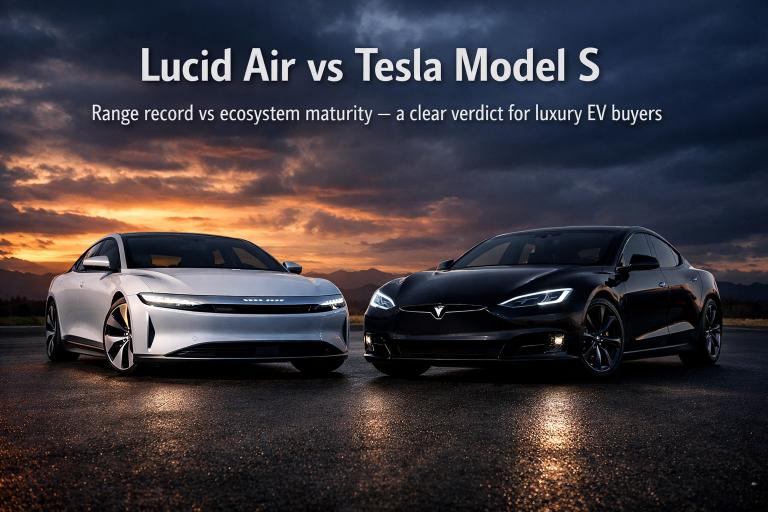
The luxury EV sedan segment changed overnight in early 2026 when Tesla discontinued the Model S. For the first time in over a decade, the vehicle that defined the category is no longer available new. If you’re shopping for a luxury electric sedan above $70,000 in April 2026, the real comparison is now Lucid Air vs Mercedes EQS vs BMW i7 — three fundamentally different approaches to the same question: what should a flagship electric sedan look and feel like?
Best Luxury EV Sedan 2026 — Quick Verdict: The Lucid Air Grand Touring ($114,900) wins on range (512 mi EPA — longest production sedan ever), efficiency (0.197 Cd), and interior space. The Mercedes EQS ($105,550+) wins on ride comfort, rear-seat luxury, and dealer network depth. The BMW i7 ($105,700+) wins on technology integration, rear entertainment, and brand ecosystem. None qualifies for the expired federal EV credit. The Lucid is the engineer’s choice, the Mercedes is the chauffeur’s choice, and the BMW is the executive’s choice.
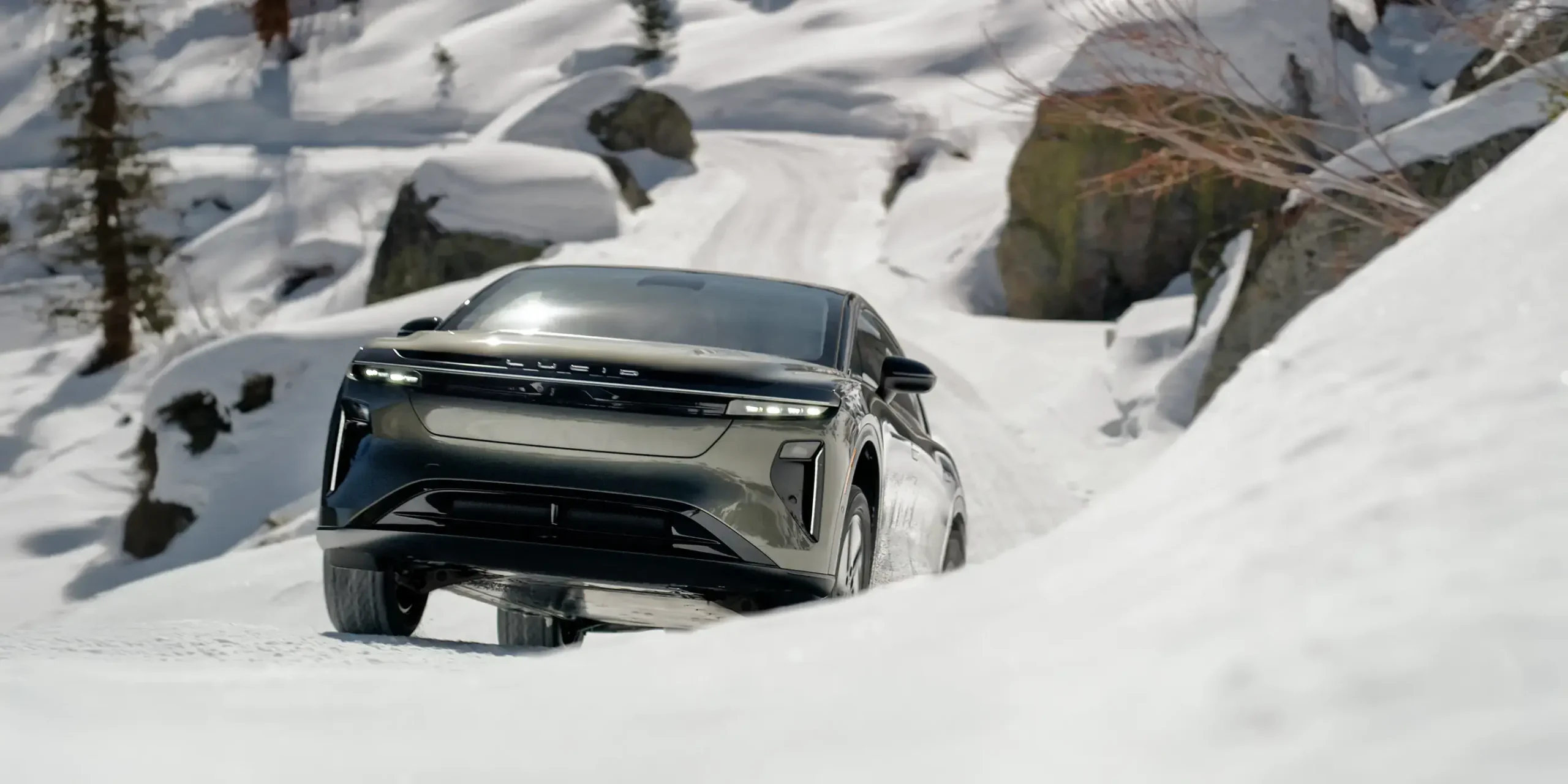
Full Spec Comparison: Lucid Air vs Mercedes EQS vs BMW i7
| Spec | Lucid Air Grand Touring | Mercedes EQS 450+ | BMW i7 xDrive60 |
|---|---|---|---|
| MSRP | $114,900 | $105,550 | $105,700 |
| EPA Range | 512 mi RECORD | 390 mi | 318 mi |
| Edmunds Tested Range | ~480 mi (est.) | 464 mi | ~290 mi |
| Horsepower | 819 hp MOST | 355 hp | 536 hp |
| 0–60 mph | 3.0 sec | 5.7 sec | 4.5 sec |
| Drag Coefficient | 0.197 Cd LOWEST | 0.20 Cd | 0.24 Cd |
| DC Fast Charge | 350 kW peak | 200 kW | 195 kW |
| Battery | 112 kWh (900V+) | 118 kWh (400V) | 105.7 kWh (400V) |
| Rear Legroom | ~40 in | 35.3 in | 44.4 in MOST |
| Cargo | 22 cu ft trunk + frunk | 22.2 cu ft | 18.7 cu ft |
| Recall Campaigns | 17 (2022–2026) MOST | ~8 | ~5 |
| U.S. Service Centers | ~30 | 380+ MOST | 340+ |
Range and Efficiency: Lucid’s Unmatched Lead
The Lucid Air Grand Touring at 512 miles EPA is not just ahead — it’s in a different category. The Mercedes EQS manages 390 miles (and Edmunds tested an impressive 464 in real-world driving). The BMW i7 trails at 318 miles. At sustained highway speeds of 75 mph, where all EVs lose 25–30% vs EPA, the Lucid delivers roughly 360–380 real-world miles, the EQS approximately 300–330, and the i7 roughly 220–250. That gap determines whether a cross-country trip requires one stop or three.
The efficiency architecture explains why. Lucid’s 900V+ platform with 0.197 Cd aerodynamics achieves approximately 4.5 mi/kWh — 10–15% better than the EQS despite a smaller battery. The EQS compensates with a massive 118 kWh pack. The i7 is the least efficient of the three, reflecting its focus on luxury over range optimization. For buyers whose primary use case is daily driving under 150 miles, all three are range-anxiety-free. For road-trippers, the hierarchy is decisive: Lucid, then EQS, then i7.
Interior and Luxury: Three Different Philosophies
This is where the three-way comparison becomes genuinely personal. Each car defines “luxury” differently — and the right answer depends entirely on which definition resonates with you.
The Lucid Air treats the cabin as a technology showcase wrapped in premium materials. The glass canopy roof, low dashboard, and extraordinary rear legroom (~40 inches) create a sense of space no competitor matches in a mid-size sedan footprint. Material quality at Grand Touring spec is segment-leading. The trade-off: Lucid’s software can be buggy — US News noted a mic failure requiring a service center reset, and the 17-recall campaign history (through March 2026) reflects a young company’s growing pains.
The Mercedes EQS is an electric S-Class — and that means the ride quality, NVH isolation, and seat comfort are the benchmarks. The optional 56-inch Hyperscreen spans the entire dashboard. Rear-seat legroom at 35.3 inches is adequate but the shortest of the three. The EQS’s strength is the sensation of traditional luxury: it feels like a $100,000+ car should, with no learning curve. Edmunds called it “supremely comfortable, quiet, and loaded.”
The BMW i7 is the executive suite on wheels. With 44.4 inches of rear legroom — the most of any car in this comparison — and an optional 31.3-inch rear Theatre Screen with Amazon Fire TV, the i7 is designed for passengers as much as drivers. The front cabin is quintessential BMW: iDrive 8 is the most intuitive luxury EV interface available, and build quality is impeccable. The trade-off: 318 miles of range and 195 kW charging make it the weakest road-tripper.
Charging and Infrastructure
All three now have NACS compatibility for Tesla Supercharger access (2026 models include adapters). The Lucid Air’s 350 kW peak — enabled by its 900V+ architecture — delivers 200 miles of range in approximately 12 minutes at a capable 350 kW station. The EQS peaks at 200 kW (10–80% in ~31 minutes). The i7 peaks at 195 kW (10–80% in ~34 minutes). On a 500-mile road trip, the Lucid stops once briefly; the EQS stops once for longer; the i7 stops twice.
The Mercedes and BMW advantages are their dealer networks: 380+ and 340+ U.S. service locations respectively, vs Lucid’s ~30. For charging convenience in daily use (Level 2 home charging), all three are identical — overnight on a 48A/240V wallbox fills any of them completely. The charging gap matters only on road trips, where Lucid’s speed advantage is offset by the fact that 350 kW stations are rarer than 200 kW ones in most U.S. corridors.
Ownership: Reliability, Service, and Resale
This is where the German brands’ decades of infrastructure become decisive. Mercedes has 380+ U.S. service centers with certified EV technicians. BMW has 340+. Lucid has approximately 30, concentrated in California, Florida, Texas, and New York. Consumer Reports rated the Lucid Air “well below segment average” in predicted reliability for 2025, citing its 17-recall campaign history. Mercedes and BMW’s EV reliability is rated average-to-above-average.
Resale data is telling: the EQS retains approximately 50–55% at 36 months, the i7 approximately 48–52%, and the Lucid Air approximately 35–40% (limited data). For a $114,900 Grand Touring, that means approximately $45,000–$55,000 more depreciation exposure over 3 years compared to an equivalently priced EQS. Lucid’s unlimited-mile battery warranty is a genuine counterpoint — stronger than both German brands’ mileage-capped warranties. But warranty value depends on the company’s long-term financial stability, which remains a legitimate consideration for a startup automaker.
What About the Tesla Model S?
Tesla discontinued the Model S in Q2 2026. Custom orders are closed; remaining inventory is priced at $111,380+ ($15,000 above previous MSRP). For buyers still considering one: the used market offers 2024–2025 Model S Long Range at $55,000–$75,000, which represents better value than paying the inflated closeout price. The Model S still offers the best software ecosystem (FSD, OTA updates, Supercharger native access) and strongest resale data of any EV sedan. However, it is now a used-only proposition. For our full analysis, see our best used Tesla guide.
Who Should Buy Which?
Choose the Lucid Air If…
- Range is your #1 priority — 512 miles is unmatched
- You value engineering purity and efficiency leadership
- Interior space and design innovation matter more than brand heritage
- You’re comfortable with a younger brand’s service network
- You plan to own 5+ years (unlimited-mile battery warranty)
Choose the Mercedes EQS If…
- Ride comfort and NVH isolation are the defining priorities
- You want the S-Class ownership experience — electrified
- Dealer network depth and service convenience matter
- Stronger resale value reduces 3-year ownership risk
- You want 390 miles of range without startup brand uncertainty
Choose the BMW i7 If…
- Rear passenger comfort is the primary purchase driver
- iDrive 8 and theatre screen technology are priorities
- You accept 318 miles as sufficient for your driving pattern
- BMW brand ecosystem and dealer network are valued
- Executive presence matters more than range records
FAQ: Best Luxury EV Sedans 2026
Is the Tesla Model S still available in 2026?
No. Tesla discontinued the Model S in Q2 2026 (announced January 2026 earnings call). Custom orders are closed. Remaining inventory is priced at $111,380+ — a $15,000 increase. The Model S is now a used-market proposition only. Used 2024–2025 models are available at $55,000–$75,000.
Which luxury EV has the longest range in 2026?
The Lucid Air Grand Touring at 512 miles EPA — the longest-range production sedan ever built. The Mercedes EQS follows at 390 miles (Edmunds tested 464 miles in real-world driving). The BMW i7 trails at 318 miles. At highway speeds (75 mph), expect 360–380 miles from the Lucid, 300–330 from the EQS, and 220–250 from the i7.
Lucid Air vs Mercedes EQS — which is better?
The Lucid Air wins on range (512 vs 390 mi), performance (819 vs 355 hp), charging speed (350 vs 200 kW), and efficiency. The EQS wins on ride comfort, rear-seat luxury, dealer network (380+ vs ~30 centers), reliability track record, and resale value. The Lucid is the technology leader; the EQS is the ownership-confidence leader.
Do luxury EVs qualify for the federal tax credit in 2026?
No — the $7,500 IRA credit expired September 30, 2025. None of these vehicles qualified anyway (MSRP exceeded the old $55K sedan cap). The OBBBA $10K/yr loan interest deduction applies only to U.S.-assembled vehicles — the Lucid Air (Arizona) qualifies; the EQS and i7 (Germany-assembled) do not.
Is the Lucid Air reliable?
Consumer Reports rated the Lucid Air “well below segment average” in 2025 predicted reliability, citing 17 recall campaigns from 2022–2026. Early owner feedback notes software bugs and sensor issues, though powertrain reliability is generally positive. The Lucid Air’s unlimited-mile battery warranty is stronger than both Mercedes and BMW. The honest assessment: impressive engineering, but the reliability track record is still developing.
What replaced the Tesla Model S?
Nothing from Tesla directly — the company is focusing on Model 3, Model Y, Cybertruck, and Optimus production. The luxury EV sedan segment is now led by the Lucid Air, Mercedes EQS, BMW i7, Porsche Taycan, and Audi e-tron GT. Used Model S vehicles remain available and offer the strongest software ecosystem of any EV sedan.
- Edmunds — EQS tested range (464 mi), pricing, expert reviews
- US News — Lucid Air 2026 review, pricing, trim analysis
- The Weekly Driver — Grand Touring buyer’s guide, recall data (17 campaigns)
- Cars.com — Model S discontinuation, price increase to $111,380+
- InsideEVs — Model S/X end of production confirmation
- Consumer Reports — Lucid Air reliability prediction