Last Updated: April 2026 — Products verified in stock, tax credit deadline confirmed, connector standards updated
The best EV charger for an apartment is the one that works with the outlets you actually have — not the one with the longest spec sheet. Over 30% of Americans rent, and most apartment parking spots have no dedicated electrical access at all. But most buildings do have standard 120V outlets near parking areas, and some have 240V dryer or laundry circuits. The right portable charger plugs into those existing outlets. No permanent installation. No electrician. It moves with you when you leave. This guide ranks the five best apartment-ready EV chargers in 2026 and tells you exactly which one fits your specific situation.

Best EV Chargers for Apartments 2026 — Quick Answer:
With 120V outlet access only, get a dual-voltage portable (Bokman) — it adds 3–5 miles/hour overnight from a standard wall plug, covering commutes under 40 miles/day. With 240V outlet access (dryer outlet, shared laundry), a Level 2 portable adds 15–30 miles/hour — a full overnight charge for any EV. The single best purchase for most apartment dwellers: a dual-voltage charger that works on both 120V and 240V, so you’re covered in your current building and any future one. A 30% federal tax credit (30C) on charger costs is available through June 30, 2026 in eligible census tracts.
The Apartment Charging Reality in 2026
Most apartment parking spots have no dedicated electrical access. The most common workaround: standard 120V outlets near parking areas — originally installed for engine block heaters, vacuums, or landscaping equipment. Some buildings have 240V outlets in shared laundry rooms, utility areas, or near dryer hookups. A portable EV charger plugs into these existing circuits. You own the charger, it goes with you when you move, and no permanent installation is required.
What you do need: permission from your landlord or building management to use an existing outlet for extended charging sessions. The easiest path is offering to cover electricity costs — approximately $20–$30/month for typical EV charging handles the objection before it’s raised.
If your building has no accessible outlets at all, your realistic options are public charging networks (ChargePoint, Electrify America, Tesla Supercharger), workplace charging, or chargers at businesses you already visit. For a full breakdown of all charging methods for renters, see our apartment EV charging strategy guide.
Level 1 vs Level 2: Which Do You Actually Need?
The right choice depends on your daily driving distance, not your anxiety about range. Most apartment dwellers are better served by Level 1 than they expect — and most guides oversell Level 2 for situations that don’t require it.
| Feature | Level 1 (120V) | Level 2 (240V) |
|---|---|---|
| Outlet Required | Standard wall outlet (NEMA 5-15) | Dryer / RV outlet (NEMA 14-50 or 6-20) |
| Power Output | 1.2–1.9 kW | 3.8–9.6 kW |
| Range Added Per Hour | 3–5 miles | 15–30 miles |
| Overnight (10 hrs) | 30–50 miles recovered | 150–300 miles recovered |
| Good For | Daily commutes under 40 miles | Any driving pattern |
| Installation Needed | None — standard wall plug | None if 240V outlet exists |
| Charger Cost | $150–$300 | $250–$600 |
Level 1 is genuinely sufficient for most apartment dwellers with commutes under 40 miles per day. A 10-hour overnight session on a standard 120V outlet recovers 30–50 miles. That covers the average American’s daily driving without any fast charging dependency. The best single investment for long-term flexibility: a dual-voltage portable charger that works on both 120V and 240V — you’re covered in your current building and any future one without buying twice.

Best EV Chargers for Apartments — Top Picks
This article contains affiliate links. DriveAuthority may earn a commission at no extra cost to you if you purchase through these links. Our recommendations are based on independent editorial evaluation — no manufacturer has paid to be featured here.
| Charger | Voltage | Amps | Speed | Cable | Best For |
|---|---|---|---|---|---|
| Bokman Dual-Voltage TOP PICK | 120V / 240V | 6–32A | ~25 mi/hr (L2) | 20 ft | Most versatile apartment pick |
| LEFANEV Level 2 | 240V | 16A | ~15 mi/hr | 25 ft | Budget Level 2 |
| 40A Portable NEMA 14-50 | 240V | 10–40A | ~30 mi/hr | 23 ft | Fastest portable |
| Lectron V-BOX 48A | 240V | 16–48A | ~37 mi/hr | 24 ft | Best wall-mount for small homes |
| ChargePoint Home Flex | 240V | 16–50A | ~37 mi/hr | 23 ft | Best smart charger with app control |
Bokman Dual-Voltage Portable EV Charger (120V / 240V)
The Bokman earns the top spot because it doesn’t require you to know which outlet you’ll have access to. It works on 120V standard wall outlets (Level 1) and 240V dryer outlets (Level 2) with adjustable amperage from 6A to 32A. That means it adapts to your current building and carries its value to the next one — unlike single-voltage chargers that become limited if your next apartment only has 120V access.
The 20-foot cable reaches from a hallway outlet or garage wall to most parking spots. IP67 waterproofing handles outdoor charging in rain, humidity, and covered garages without issue. Safety protections cover overtemperature, overvoltage, and ground fault. Includes a carry bag and NEMA adapters. For apartment dwellers who don’t know what electrical access they’ll have in 12 months, this is the one charger that remains useful in any scenario.
Not for you if: you have confirmed 240V access and want maximum speed — the 40A portable or Lectron V-BOX delivers faster charging in that scenario.
As an Amazon Associate, DriveAuthority earns from qualifying purchases. Price and availability subject to change.
LEFANEV Level 2 Portable EV Charger (2026 Upgraded, 3.5 kW)
If you have confirmed access to a 240V outlet and want the lowest-cost path to Level 2 speeds, this is it. The 2026 upgraded LEFANEV delivers 3.5 kW continuously — approximately 15 miles of range per hour. A 10-hour overnight session adds 150 miles, which covers virtually any daily driving pattern without needing a mid-week public charge.
The J1772 connector works with every non-Tesla EV. Tesla owners need a NACS-to-J1772 adapter (approximately $25–$50). ETL safety certified, 25-foot cable. It won’t win on amperage against higher-end units, but at this price it’s the most accessible entry point to real Level 2 speeds for renters with dryer outlet access.
Not for you if: your only outlet is 120V, or you need faster than 15 mi/hr — the Bokman or 40A unit is the better choice in those cases.
As an Amazon Associate, DriveAuthority earns from qualifying purchases.
40A Portable Level 2 EV Charger (NEMA 14-50, 9.6 kW)
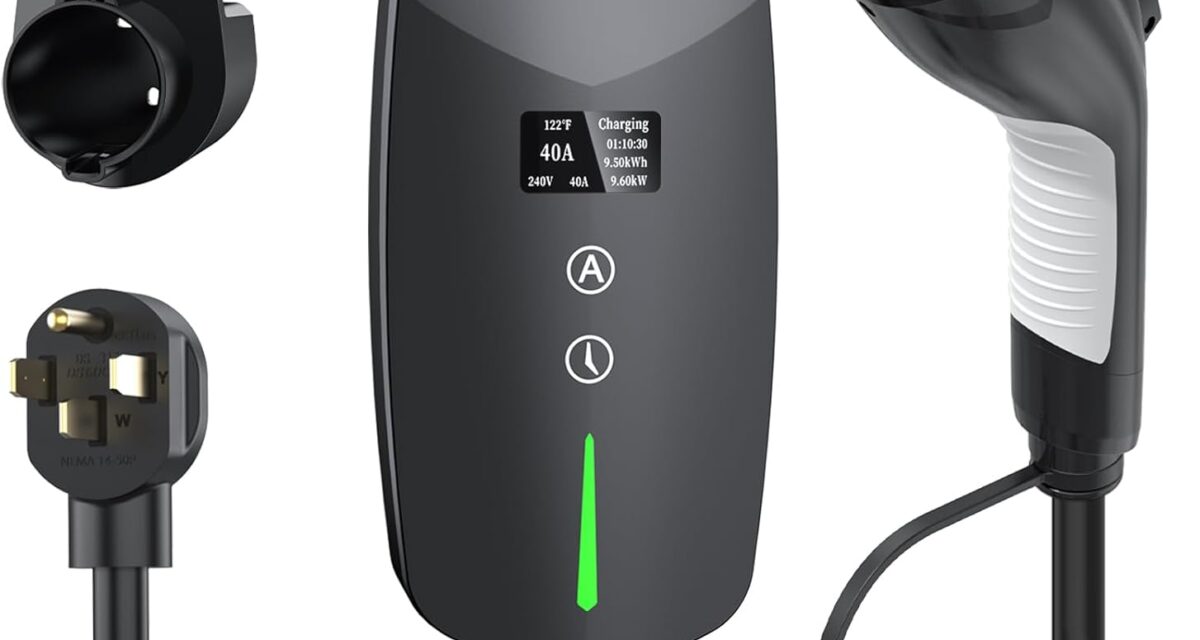
This is the fastest portable charger available for apartment and small-home use. At 40A / 9.6 kW from a NEMA 14-50 outlet, it adds approximately 30 miles of range per hour — a full charge for most EVs in 6–8 hours. Adjustable amperage (10A–40A) lets you dial back for lower-capacity circuits. A 2.4-inch TFT display shows real-time charging data: power output, charging time, and energy delivered. IP66 weatherproof for outdoor and open-garage installation. The 23-foot cable handles most parking-to-outlet distances.
One important check before ordering: a 40A charger requires a 50A circuit breaker. Verify your building’s dryer outlet is on a 50A breaker before purchasing — older buildings may have 30A circuits that limit you to a 24A charger instead.
Not for you if: your circuit is less than 50A — use the LEFANEV at a lower amperage setting instead.
As an Amazon Associate, DriveAuthority earns from qualifying purchases.
Lectron V-BOX Level 2 EV Charger (48A, WiFi)
If you own your home or have permission to mount a unit, the Lectron V-BOX delivers near-commercial charging speeds at a price well under $500. At 48A / 11.5 kW it adds approximately 37 miles of range per hour — enough to fully charge most EVs in under 8 hours. WiFi-enabled with app scheduling, real-time energy monitoring, and adjustable amperage (16–48A) to suit different circuit sizes.
The 24-foot cable accommodates garages, carports, and driveway installs. NEMA 4 outdoor rating means it handles rain and dust without issue. Lectron is consistently ranked among the top portable charger brands by independent review outlets — the wall-mount carries the same build quality. This is the best step up from portable for homeowners who want wall-charger speeds without the $1,200+ price of a premium hardwired unit.
Not for you if: you’re renting and can’t mount anything to the wall — the 40A portable delivers comparable speeds without any permanent attachment.
As an Amazon Associate, DriveAuthority earns from qualifying purchases.
ChargePoint Home Flex Level 2 EV Charger (50A, WiFi)
ChargePoint Home Flex is the charger recommended by more auto manufacturers than any other on this list. It integrates with the ChargePoint app — the same platform used across their public charging network — giving you scheduling, charge history, energy monitoring, and utility rate optimization in one place. Adjustable from 16A to 50A, it works hardwired or via NEMA 14-50/6-50 plug, and the 23-foot cable handles most home installations. UL listed. NEMA 3R rated for outdoor mounting.
The software is the genuine differentiator. You can set the charger to run only during off-peak electricity rate hours — a meaningful saving in states with time-of-use utility rates. For homeowners who want a single dashboard for home and public charging, and who will actually use the scheduling features, the premium price is justified. For buyers who just want to plug in and charge, the Lectron V-BOX at lower cost does the same job without the app layer.
Not for you if: you don’t plan to use scheduling features or utility rate optimization — pay less for the Lectron V-BOX instead.
As an Amazon Associate, DriveAuthority earns from qualifying purchases.
How to Choose: Connector, Cable Length, and Amperage
Check Your Car’s Connector Before Ordering
In 2026, the EV connector landscape has split. Most EVs through 2024 use J1772 for Level 2 home charging. But 2025+ models from Ford, GM, Rivian, Honda, and Hyundai ship with NACS — the same connector Tesla uses. All five chargers in this guide use J1772 connectors. If your car uses NACS (check your owner’s manual or charging port), you need a NACS-to-J1772 adapter for Level 2 home charging — available for $25–$50 on Amazon and from most automaker dealers.

Cable Length: The Most Overlooked Spec
Cable length matters more than amperage for apartment use. Your parking spot may be 15+ feet from the nearest outlet — add another 5 feet for routing around obstacles. Minimum useful length: 20 feet. Preferred: 25 feet. All five products in this guide meet the minimum. If your specific parking configuration requires more reach, an extension cord is not recommended for EV charging — it creates fire risk. A longer native cable charger is safer and available in most of these product lines at higher price tiers.
Amperage: Match to Your Circuit
Adjustable amperage protects older wiring. The rule: set your charger to no more than 80% of your circuit’s breaker capacity. On a 20A circuit, set to 16A maximum. On a 50A circuit, 40A is safe. Older buildings frequently have 20A or 30A dryer circuits rather than the 50A standard in newer construction. Running a 40A charger on a 30A circuit trips breakers and risks wiring damage. Verify the breaker rating in your building’s electrical panel before selecting a charger amperage.
120V Outlet Only Available
- Buy the Bokman dual-voltage — works now on 120V, ready for 240V later
- Commute under 40 miles/day: Level 1 overnight is sufficient
- Longer commute: supplement with public charging 1–2x per week
- Offer landlord $20–$30/month for electricity to pre-empt objections
- States with right-to-charge laws: CA, CO, FL, OR — landlord can’t refuse
240V Outlet Accessible
- Check outlet type: NEMA 14-50 (dryer), 6-20, or 10-30
- Verify breaker size before choosing charger amperage
- Commute any length: 15–30 mi/hr overnight handles everything
- NACS car? Buy J1772 charger + NACS-to-J1772 adapter ($25–$50)
- 30C tax credit covers 30% of costs — expires June 30, 2026
How to Talk to Your Landlord About EV Charging
Most landlords say no because they haven’t thought about it — not because they’re firmly opposed. A direct, solution-first approach works better than a rights-based one. Start with option A below and move down the list if needed.
- Option A — Use an existing outlet: Ask to use a parking area or laundry room outlet for overnight charging. Offer a flat $20–$30/month to cover electricity. This costs the landlord nothing and produces monthly income they didn’t have before.
- Option B — You fund the outlet: Offer to pay a licensed electrician to install a dedicated 240V outlet in your assigned parking space. The outlet stays with the property as a capital improvement. Landlords frequently agree to this.
- Option C — Shared building solution: Suggest a partnership with ChargePoint, Blink, or EverCharge for shared charging stations in the parking lot. These companies handle installation, maintenance, and billing — the landlord adds a tenant amenity at no cost.
States with formal right-to-charge laws prevent landlords from unreasonably denying EV charger installation in assigned parking spaces: California, Colorado, Florida, Hawaii, and Oregon have the strongest protections. Check your state’s current law at the DOE Alternative Fuels Data Center state policy database.

2026 Charger Tax Credit — Expires June 30
The credit applies to both the charger purchase price and any electrician charges for outlet installation. For a $300 charger plus $400 electrician cost, that’s $210 back. For the ChargePoint Home Flex plus installation, it could cover the full $1,000 maximum. File via IRS Form 8911 when submitting your 2026 tax return. For the complete incentive picture, see our full 2026 EV incentives guide.
FAQ: EV Chargers for Apartments 2026
Can you charge an EV in an apartment without installing anything?
Yes — with a portable charger plugged into an existing outlet. A portable Level 1 charger (120V) plugs into any standard wall outlet. A portable Level 2 charger (240V) plugs into a dryer or RV outlet where one exists. No permanent installation needed. You own the charger — it goes with you when you move. You need your landlord’s permission to use the building’s outlet for extended charging, not permission for the charger itself.
Is Level 1 charging enough for apartment dwellers?
For daily commutes under 40 miles, yes. A 10-hour overnight Level 1 session on a 120V outlet adds 30–50 miles — enough to cover the average American’s daily driving. If your commute is longer or you can’t charge every night, Level 2 (240V) or a combination with public charging is recommended. Don’t buy a Level 2 charger if you only have 120V access — it won’t work without the right outlet.
Do I need a NACS or J1772 charger?
Check your car’s charging port. J1772 is standard on most EVs through 2024. NACS (Tesla-style) is standard on Tesla vehicles and 2025+ models from Ford, GM, Rivian, Honda, and Hyundai. All five chargers in this guide use J1772. If your car uses NACS, buy a J1772 charger and add a NACS-to-J1772 adapter ($25–$50) — do not buy a NACS-native home charger unless you’re certain your car uses it.
What outlet do I need for Level 2 apartment charging?
NEMA 14-50 (the large four-prong dryer outlet, 240V / 50A) is the most common Level 2 outlet in residential settings. NEMA 6-20 (240V / 20A) also works at lower charging speeds. NEMA 10-30 (older three-prong dryer outlets) requires an adapter. Check your laundry room, parking area utility walls, or building maintenance closet. If unsure, the building maintenance team can identify the outlet type immediately.
Can my landlord refuse to let me install an EV charger?
In most states, yes — unless you’re in California, Colorado, Florida, Hawaii, or Oregon, which have right-to-charge laws that prevent unreasonable denial of charger installation in assigned parking spaces. For renters in other states, the most effective approach is framing the request as a property value improvement — offering to fund the outlet installation yourself, with the outlet remaining as a building improvement.
Is there still a tax credit for EV chargers in 2026?
Yes — the 30C Alternative Fuel Refueling Property Credit covers 30% of charger purchase and installation costs, up to $1,000. It expires June 30, 2026 with no extension announced. You must live in an eligible census tract (non-urban or low-income area). Check eligibility at the DOE 30C tool and file via IRS Form 8911 with your 2026 return. If you’re eligible, buy before the deadline — there is no indication this will be extended.
- U.S. Department of Energy — 30C charger credit eligibility and rules
- DOE Alternative Fuels Data Center — state right-to-charge laws
- Manufacturer product specifications cross-referenced with independent testing data from EVchargerreviews.net and CheapEVCharger
- Amazon verified customer reviews (4,000+ reviews across featured products)
- This article contains affiliate links. DriveAuthority earns a commission on qualifying Amazon purchases at no additional cost to you. No manufacturer has paid to be featured — editorial recommendations are independent.