
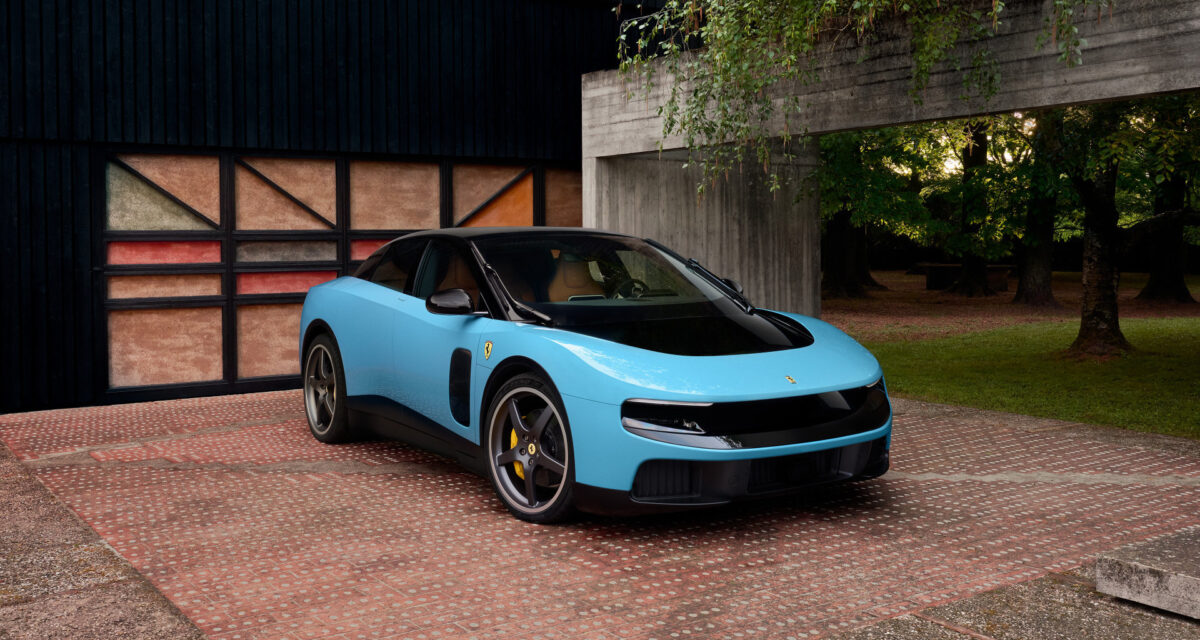
The Ferrari Luce is the most controversial Ferrari ever built. That is not opinion dressed up as a headline. It is a five-seat electric liftback with coach doors, an interior co-designed by the man who shaped the iPhone, and a price tag north of $640,000. There is no engine. No exhaust. The gated manual shifter that defined 1990s Ferraris would be conceptually impossible here. Even Ferrari’s own head of product marketing, Emanuele Carando, admitted publicly that customer reaction “is going to be very much mixed.”
He was underselling it. The Luce launched in Rome on May 25, 2026, and within hours, automotive forums split along predictable lines. Purists called it a betrayal. Design critics, on the other hand, called it a design object, not a car. Meanwhile, a few people who actually saw it in person said the craftsmanship was unlike anything they had touched in a production vehicle. All three camps are probably right, depending on what they think a Ferrari is supposed to be.
The Ferrari Luce is Ferrari’s first fully electric production car: a five-seat liftback with four motors producing 1,050 hp, a 122 kWh battery delivering over 530 km of WLTP range, and an interior designed by LoveFrom (Jony Ive and Marc Newson). It measures 5.02 metres long, weighs 2,260 kg, and hits 100 km/h in 2.5 seconds. Pricing starts at approximately €550,000 ($640,000). First deliveries begin October 2026 in Italy. The controversy is real: this car breaks with nearly every tradition that defined Ferrari for 77 years. Whether that matters depends on whether you think Ferrari’s identity lives in combustion engines or in something less tangible.
What the Ferrari Luce Actually Is
Strip away the controversy, and the Luce is essentially a large, fast, electric liftback. It measures 5.02 metres long, 2.0 metres wide, and 1.54 metres tall, which makes it five centimetres shorter in height than the Purosangue but roughly the same footprint. The wheelbase, meanwhile, stretches to 116.5 inches. It seats five people. Rear passengers enter through coach doors that hinge at the B-pillar, the same arrangement used on the Purosangue. Pull the handle and the door swings out electronically. Then a button inside swings it shut.
The body is constructed as two pieces: a black inner shell paired with a painted outer layer. Where a conventional car has a bonnet, the Luce instead has an aerodynamic wing that generates downforce. A second wing sits at the rear. Because the two shell pieces are physically separated, they create a visual tension that reads as either striking or strange depending on who you ask. Wheels are also staggered: 23-inch fronts, 24-inch rears.
Underneath sits a 122 kWh battery pack co-developed with SK On from 210 cells, assembled entirely in Maranello. The pack is structural, meaning it forms part of the chassis rather than simply sitting inside it. To produce both this car and future electrified models, Ferrari also built a dedicated e-building facility at its Maranello headquarters.
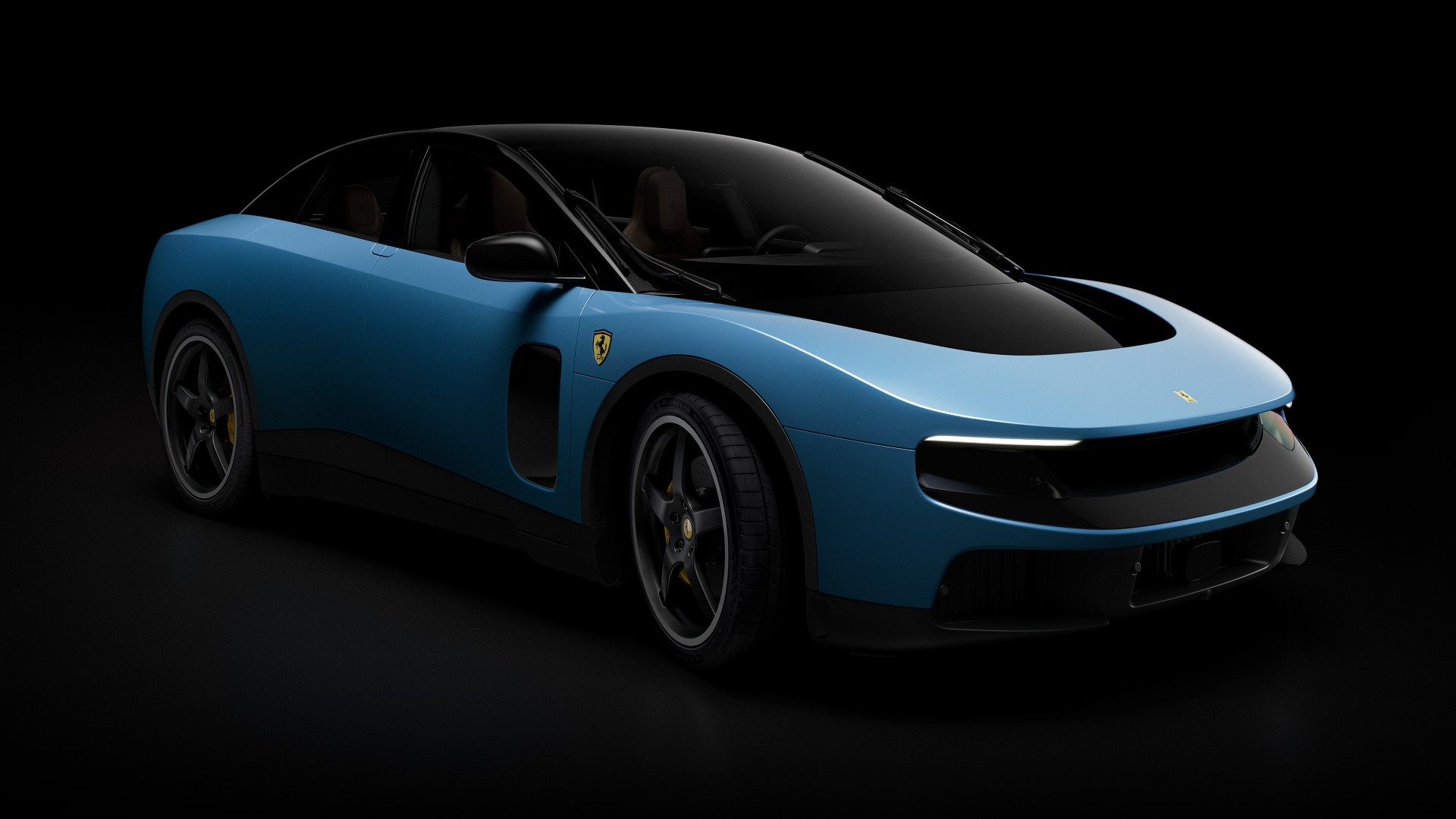
This is only the second four-door production Ferrari. The first was the Purosangue, which launched in 2022 and was itself controversial for being an SUV. However, the Purosangue at least had a V12 to pacify the traditionalists. The Luce has no such concession.
Ferrari Luce Specs: The Numbers That Matter
| Specification | Detail |
|---|---|
| Powertrain | Four permanent magnet synchronous motors (Halbach array) |
| Total output | 830 kW / 1,050 hp |
| Rear motors | 2 x 310 kW (416 hp each), up to 25,500 rpm |
| Front motors | 2 x 10⁵ kW (141 hp each), up to 30,000 rpm |
| Battery | 122 kWh NMC, 800V architecture, 210 cells (SK On) |
| WLTP range | 530+ km (approx. 330 miles) |
| Estimated real-world range (U.S.) | ~250-265 miles at highway speed, mild weather |
| Max charging speed | 350 kW DC |
| 10-80% charge time | Under 25 minutes (optimal conditions) |
| 0-100 km/h | 2.5 seconds |
| 0-200 km/h | 6.8 seconds |
| Top speed | 310 km/h (193 mph) |
| Curb weight | 2,260 kg (4,982 lbs) |
| Dimensions (L x W x H) | 5,020 mm x 2,000 mm x 1,540 mm |
| Wheelbase | 2,960 mm (116.5 in) |
| Wheels | 23-inch front, 24-inch rear (staggered) |
| Drag coefficient | 0.254 Cd (no active aero) |
| Doors | 4 (front conventional, rear coach/rear-hinged) |
| Seats | 5 |
| Price | ~€550,000 / ~$640,000 USD |
| First deliveries | October 2026 (Italy) |
A few figures stand out. First, the 0-200 km/h time of 6.8 seconds places the Luce alongside the LaFerrari in outright acceleration. Nevertheless, the weight penalty is enormous: at 2,260 kg, the Luce weighs roughly 700 kg more than a Ferrari 296 GTB. Similarly, the drag coefficient of 0.254, achieved without active aerodynamics, is respectable for a car this size but not class-leading. For comparison, a Hyundai Ioniq 6 achieves 0.21 Cd in a car that costs about $45,000.
The WLTP range of 530+ km, however, needs the same caveat we apply to every EV range claim. Using the standard WLTP-to-real-world conversion (WLTP x 0.75 for approximate EPA equivalent, then x 0.82 for highway), you get roughly 250-265 miles in mild weather at highway speed. In cold weather below freezing, on the other hand, expect closer to 190 miles. This matters more for a Ferrari than it does for a commuter EV, because buyers are likely to take this car on long drives through the Alps or across the Autobahn, not just to a grocery store and back.
The Design Controversy: Jony Ive, LoveFrom, and Why Purists Hate the Ferrari Luce
To shape the Luce inside and out, Ferrari hired LoveFrom, the San Francisco design studio founded by Sir Jony Ive and Marc Newson. Ive is the former Apple chief design officer responsible for the iMac, iPod, and iPhone. He has, however, never designed a car for production before. Newson has worked on jets, furniture, and watches, but likewise not cars at this scale.
That pedigree is exactly the problem for traditionalists. Pininfarina designed Ferraris from 1952 until 2014, a 62-year relationship that produced the 250 GTO, the Testarossa, the F40, and the Enzo. Ferrari’s visual identity was built in Turin, not San Francisco. Handing the most important Ferrari launch in a decade to a pair of industrial designers who made their names at Apple felt, to many longtime fans, like replacing a Michelin-starred chef with a molecular gastronomist. The ingredients might be better. The result tastes different in ways you did not ask for.
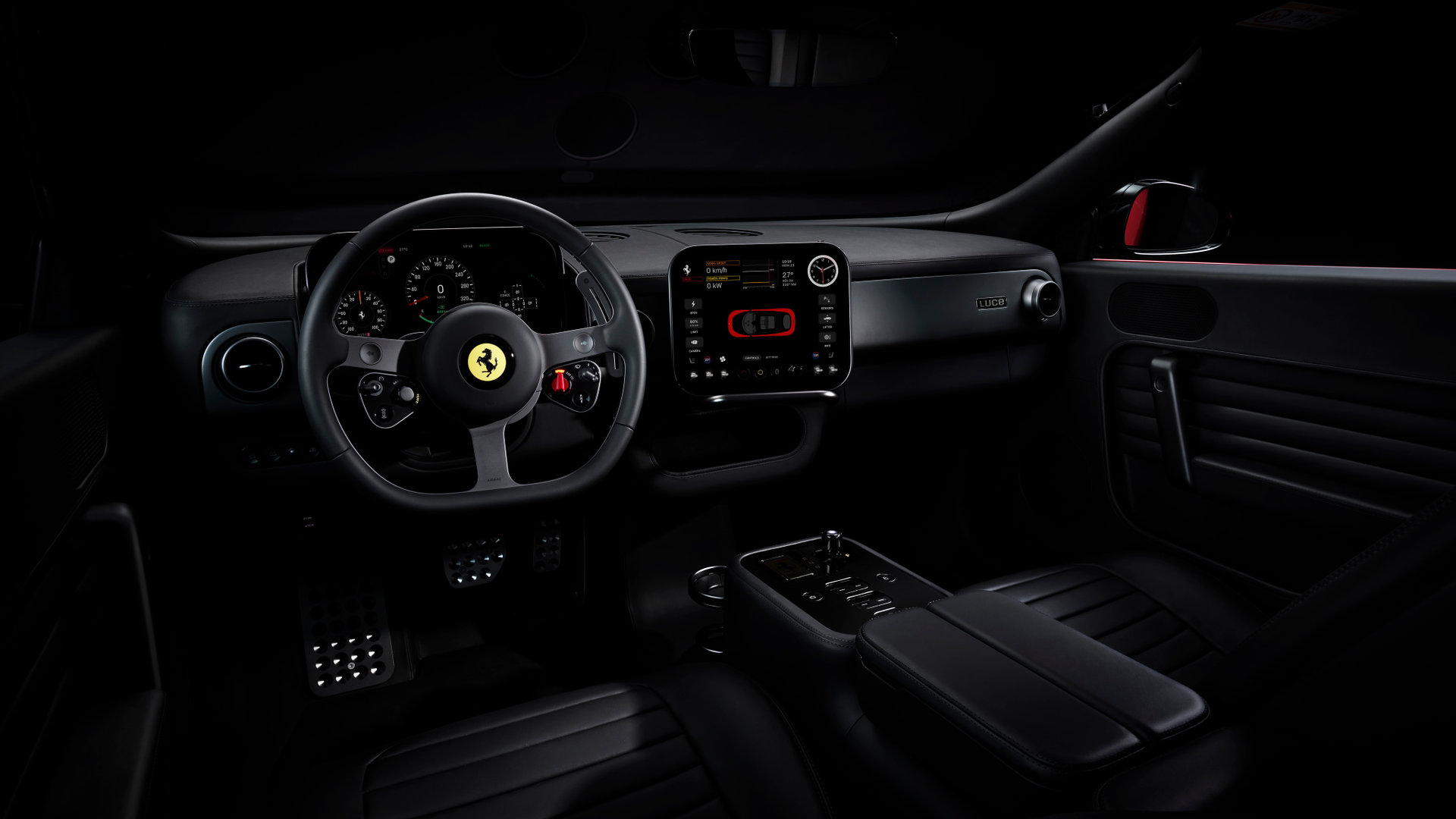
The exterior divides people sharply. That two-piece body construction, a black inner shell with a painted outer skin, creates a floating effect that some reviewers described as architectural and others called awkward. Traditional Ferraris use flowing, muscular lines from front to rear. The Luce uses flat surfaces, geometric tension, and deliberate visual breaks. It does not look like a Ferrari in any conventional sense. If that bothers you, it should, because Ferrari did it on purpose.
On forums, accordingly, the response has been harsh. GermanCarForum users wrote that the design was “good design philosophy, but not Ferrari… not sexy, not provocative, lacking drama.” On Opposite-Lock, reactions ranged from cautious admiration to open hostility. In addition, at least one prominent design critic called the interior “soulless” and compared it to a compact Honda. That comparison is unfair to both cars, but it nonetheless captures the emotional temperature.
Inside the Ferrari Luce: Where the Money Went
Whatever you think of the exterior, the interior is where LoveFrom spent most of its effort. On that front, even the critics have struggled to deny the execution.
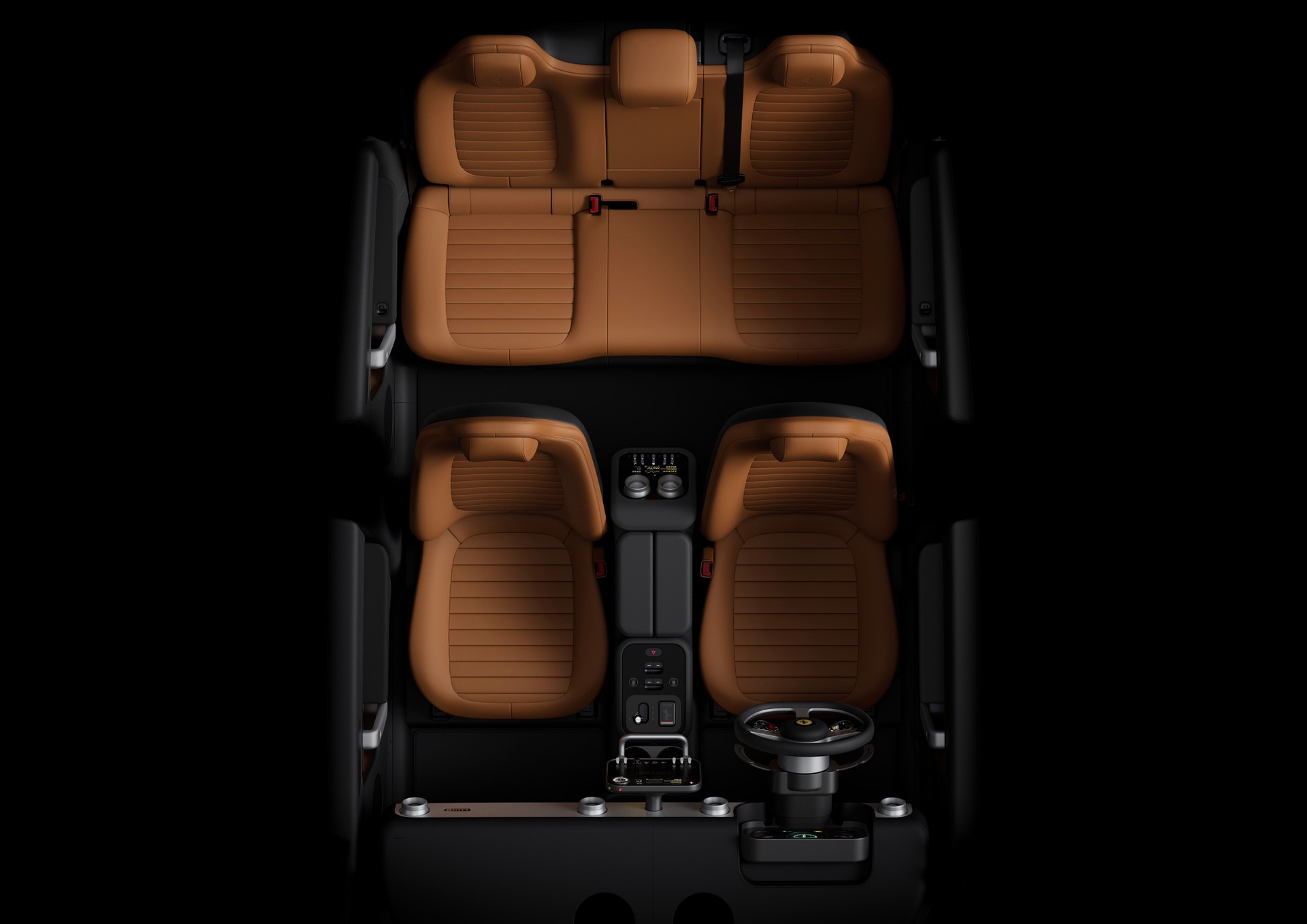
The central design decision was to reject large touchscreens. The entire industry has spent the last decade replacing physical buttons with iPad-sized displays. LoveFrom, however, went the other way. Every primary control is a physical button, dial, toggle, or switch, machined from a recycled aluminium alloy developed specifically for this car. Each button went through more than 20 rounds of testing with Ferrari’s own drivers to get the click weight, the sound, and the travel distance right. That level of obsession over a button is very Jony Ive. It is also very Ferrari.
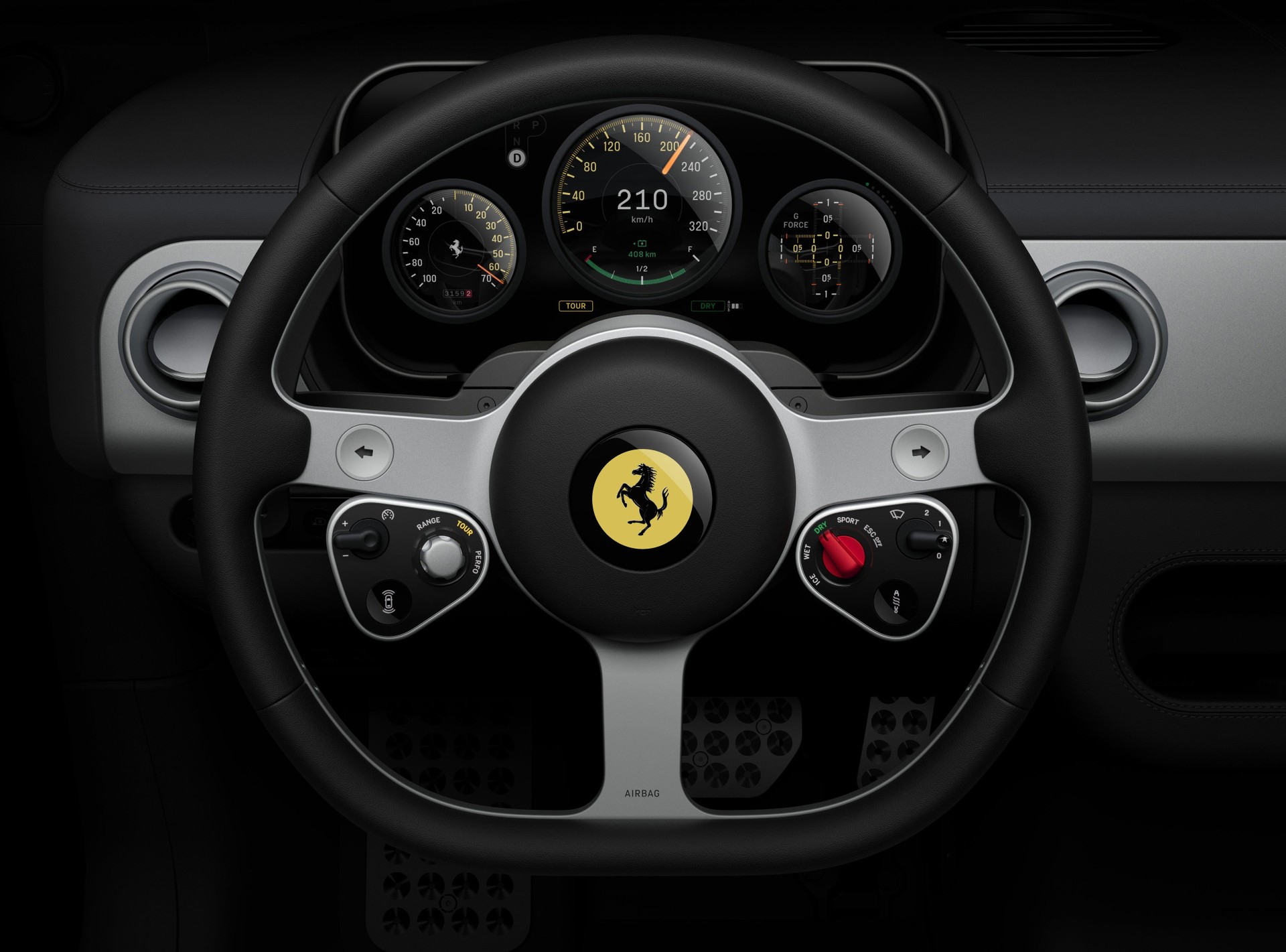
The instrument panel, in contrast to most modern EVs, is mounted on the steering column rather than the dashboard. As a result, it moves with the wheel, so your speed and battery data stay in the same relative position regardless of steering angle. The display combines analogue elements, including a physical needle on the speedometer, with two overlapping OLED screens. It is technically a digital instrument cluster. But it does not look or behave like one.
The key fob alone tells you what kind of car this is
LoveFrom designed a glass key fob with a colour-changing E Ink display that fades from yellow to black when docked in the centre console. A standard proximity fob would do the same job for a fraction of the cost. But that is the point. Ferrari and LoveFrom were not trying to build a sensible car. They were trying to build something people would want to hold and show to other people. You can call that design mastery or vanity depending on your relationship with $640,000.
Almost every surface the driver touches is aluminium, glass, or leather. Very little visible plastic anywhere. The three-spoke steering wheel alone combines recycled aluminium with an anodised finish, glass elements, and leather grips. It also houses the Manettino switch, torque-control paddles, and the binnacle as a single moving unit. Journalists who inspected the components in person at the Rome reveal reported tolerances measured in fractions of a millimetre.
The backseat actually works
Because there is no transmission tunnel running through the floor, the Luce offers a flat rear floor and genuine space for a fifth passenger. This is, of course, only possible in an EV architecture. In a traditional Ferrari, by contrast, the rear seats have always been ornamental, a place to throw a jacket rather than sit a human being. The Luce’s rear bench is not the roomiest in the luxury segment, but it nonetheless functions as advertised.
Performance and Range: What 1,050 HP Means Without an Engine
The Luce produces 830 kW from four permanent magnet synchronous motors, one at each wheel. The rear pair generates 620 kW (about 832 hp combined) at up to 25,500 rpm, while the front pair adds 210 kW (about 282 hp combined) at up to 30,000 rpm. Those RPM figures are not typos. Ferrari derived the motor design from its Formula One power units using a Halbach array configuration, which directs magnetic flux toward the stator to maximise torque density. In other words, it is the same technology running in the F1 cars, scaled and adapted for road use.
On paper, the result is straightforward: 0-100 km/h in 2.5 seconds, 0-200 km/h in 6.8 seconds, and a top speed of 310 km/h. Consequently, those numbers place the Luce in the same bracket as the LaFerrari, the SF90 Stradale, and the Porsche Taycan Turbo GT. The difference, though, is that the Luce achieves them while weighing nearly 5,000 lbs and carrying five seats.
Speed is not the same as excitement
Whether that straight-line speed translates to a rewarding driving experience is a question nobody outside Ferrari can answer yet. Electric torque delivery is instantaneous but, in many EVs, also one-dimensional. People love Ferrari V12s because of how the power arrives, not how much of it there is. The crescendo matters. So does the mechanical drama. A car that delivers all 1,050 hp in one flat shove from zero rpm may therefore be faster, but faster is not the same as more exciting. That is the problem the Luce has to solve, and so far we only have Ferrari’s word that they solved it.
Range in context
The 530+ km WLTP range figure will need to be tested independently. For context, WLTP typically runs 20-30% higher than the EPA equivalent, per data we track in our EV range methodology. A rough conversion: 530 km WLTP x 0.75 gives approximately 398 km, or about 247 miles on the EPA scale. At 70 mph highway in mild weather, expect another 15-18% reduction from that, so real-world highway range likely lands somewhere around 210-250 miles.
Charging at up to 350 kW on the 800V architecture means 10-80% in under 25 minutes. That is competitive with both the Porsche Taycan and the Hyundai Ioniq 5, which also use 800V systems. In practice, however, the limiting factor is finding a 350 kW charger. Most public DC fast chargers in the U.S. currently peak at only 150-250 kW.
The Sound Question: How Ferrari Faked It Without Faking It
Every electric supercar faces the same problem: the engine note is gone. Some manufacturers have simply ignored this. Others have piped in synthesised sounds through speakers, an approach that ranges from tolerable to embarrassing. Ferrari, by contrast, chose a third path.
Specifically, the Luce uses a precision accelerometer mounted at the centre of the rear axle to capture the actual vibration of the rotating electric components. That signal then passes through a filter, an equaliser, and an amplifier. Ferrari’s description: it works like an electric guitar amplifier. The raw vibration is real. The amplification merely shapes it into something audible and, presumably, interesting.
This is the smartest solution to the EV sound problem I have seen from any manufacturer. Think about it the way Ferrari does: an electric guitar does not produce sound on its own either. The vibrating string is real. The amplifier makes it audible. Nobody calls an electric guitar “fake.” Whether the Luce’s amplified whine can approach the emotional weight of a flat-plane V8 at 8,500 rpm is a separate question, and I am skeptical. But the engineering approach is honest, and you can turn it off if you disagree.
Price and Value: Who Actually Buys a $640,000 EV
At €550,000 (approximately $640,000 USD), the Luce is the most expensive production Ferrari at launch. For comparison, the SF90 Stradale hybrid starts around $575,000, while the Purosangue V12 starts at roughly $400,000. A Porsche Taycan Turbo GT, which occupies a similar performance bracket, starts around $230,000. In other words, the Luce costs nearly three Taycans.
Ferrari is not competing on value. It never has. Instead, the company’s entire business model depends on selling fewer cars at higher margins than any competitor. In Q1 2026, Ferrari reported revenue of €1.85 billion and confirmed full-year guidance of €7.5 billion. The stock trades at a P/E ratio that reflects a luxury goods company, not an automaker. As a result, Ferrari’s customers do not cross-shop with Tesla or Porsche on a spreadsheet. They buy because it is a Ferrari.
What happens when the badge is the only familiar thing
The question the Luce raises is whether “because it is a Ferrari” still applies when the car shares none of the traditional Ferrari attributes. There is no engine noise, no rear-wheel-drive purity, and no sense that the car is trying to kill you a little bit if you push too hard. What remains is the badge, the exclusivity, the craftsmanship, and performance numbers that compete with the best combustion Ferraris ever made. For the buyers who care about those things, that will be enough. For the buyers who fell in love with Ferraris because of what they sound like at 8,000 rpm, the badge alone will feel hollow.
Why the Ferrari Luce Matters Beyond Ferrari
Ferrari was the last major sports car manufacturer to go electric. Lamborghini already has the Revuelto plug-in hybrid. Porsche shipped the Taycan back in 2019. Aston Martin, Bentley, and Rolls-Royce have all committed to electric futures as well. Ferrari, however, held out longer than any of them.
That is why the Luce matters beyond Ferrari. When a company that built its entire mythology on the sound of a V12 at Fiorano decides the next chapter requires batteries, the argument about whether EVs belong in performance cars is functionally over. The Luce does not even need to be good for that to be true. Simply put, Ferrari deciding it was necessary says more than the car itself does.
Where the broader EV market stands
Broader EV market conditions, meanwhile, add pressure from the other direction. Global EV sales continue to grow, but the pace has slowed in key markets. In the U.S., for instance, the federal EV tax credit expired September 30, 2025. Battery costs have fallen to roughly $90-$110/kWh (BloombergNEF), although they have not yet reached the $70-$80/kWh threshold needed for price parity without subsidies. Ferrari itself has consequently revised its EV target from 40% of its lineup by 2030 down to 20%. Even Ferrari is hedging.
For buyers in the broader EV market, the Luce is therefore symbolic, not practical. Over time, the F1-derived motor design and structural battery architecture may eventually trickle down to more accessible cars. But the Luce itself will sell in tiny numbers to a customer base that has nothing in common with the average EV buyer.
Who Should Care About the Ferrari Luce (and Who Shouldn’t)
This car is relevant to you if:
- You are a current Ferrari collector considering whether to order, and you want an objective breakdown of what the Luce is before the dealer pressure starts
- You follow automotive design and want to understand why the Ive/Newson collaboration matters (or doesn’t)
- You are evaluating ultra-luxury EVs in the $500,000+ segment against the Porsche Taycan Turbo GT, the Rimac Nevera, or the upcoming Aston Martin and Bentley electrics
- You are interested in EV technology development, particularly F1-derived motor architecture and structural battery design
This car is not relevant to you if:
- You are shopping for a practical EV under $100,000. The Luce exists in a different economic universe
- You want a Ferrari that sounds and feels like a traditional Ferrari. This car does not do that, and Ferrari has been honest about it
- You are looking for the best EV for your money. At $640,000, the Luce is not even in the conversation on value grounds. A used hybrid or a Chevrolet Equinox EV at $34,995 will get you where you need to go for roughly 1/18th the price
Most people reading this will never buy a Ferrari Luce, and that includes me. But the reason to pay attention is not the car. It is the signal. When Ferrari goes electric, the last holdout has fallen. The remaining question is not whether EVs will replace combustion engines. It is how long the transition takes.
FAQ
How much does the Ferrari Luce cost?
Approximately €550,000, or about $640,000 USD at current exchange rates. That consequently positions it above the SF90 Stradale and also makes it the most expensive production Ferrari at launch since the LaFerrari.
What is the Ferrari Luce’s range and charging speed?
Over 530 km on the WLTP cycle from a 122 kWh battery. In practice, real-world U.S. highway range will likely sit around 250-265 miles in mild weather. In cold weather below 32F, however, expect closer to 190 miles. Charging tops out at 350 kW, so it can recover 70 kWh in about 20 minutes on a compatible fast charger.
Who designed the Ferrari Luce interior?
LoveFrom, the studio founded by Sir Jony Ive (former Apple chief design officer) and Marc Newson, in collaboration with Ferrari’s in-house Style Center led by Flavio Manzoni. Rather than using touchscreens, the interior relies on machined physical controls, recycled aluminium, glass, and leather.
How much horsepower does the Ferrari Luce have?
830 kW, or approximately 1,050 hp, from four permanent magnet synchronous motors using a Halbach array magnet configuration derived from Ferrari’s F1 power units. The rear motors spin at up to 25,500 rpm, while the front motors reach 30,000 rpm.
When will the Ferrari Luce be delivered?
First customer deliveries are scheduled for October 2026 in Italy. After that, global deliveries will extend into early 2027. CEO Benedetto Vigna also confirmed that the launch event is overbooked.
Is the Ferrari Luce a sedan?
Not exactly. Technically, it is a five-seat liftback. It measures 5.02 metres long with rear-hinged coach doors, and some therefore describe it as a cross between a shooting brake and a sedan. Ferrari avoids any of these labels, instead calling it a next-generation sports car. It is the second four-door Ferrari after the Purosangue.
How heavy is the Ferrari Luce?
2,260 kg (4,982 lbs). For comparison, a Tesla Model S Plaid weighs about 2,162 kg, while a Porsche Taycan Turbo GT weighs approximately 2,290 kg. The 122 kWh battery is also a structural part of the chassis, which partly offsets the weight by adding rigidity.
Does the Ferrari Luce make engine noise?
It has an optional sound system that captures real vibrations from the electric motors via an accelerometer at the rear axle, then amplifies them through a filter and equaliser. Ferrari describes it as working like an electric guitar amplifier. In short, it is not synthesised sound but rather amplified mechanical vibration. You can also turn it off entirely.
Final Verdict
The Ferrari Luce is the most controversial Ferrari ever made because it forces a question Ferrari has never had to answer before: what is a Ferrari when you take away the engine?
Nobody knows yet. On paper, the engineering is ambitious. F1-derived motors. A structural battery built in-house from 210 cells. An interior where every button was tested 20 times for the feel of the click. Performance numbers that match a LaFerrari. Craftsmanship that, by every credible account from people who touched the car in Rome, is extraordinary.
But this is still a 5,000-pound liftback that costs $640,000 and makes no sound unless you ask it to. For many Ferrari loyalists, that combination is therefore disqualifying regardless of execution. And their position is not irrational either. If you fell in love with Ferrari because of the flat-plane V8 at 8,500 rpm on a mountain road in Emilia-Romagna, then the Luce is not your car. Ferrari knows this. They built it anyway.
None of this controversy will hurt sales. Ferrari’s launch event is overbooked. By every indication, the order book is full. People who buy $640,000 cars are not the same people arguing on forums about what Enzo would have thought. The Luce will sell, it will be profitable, and those profits will fund the next generation of combustion Ferraris that the purists actually want. There is some irony in that.
Whether it is a good car is ultimately a question nobody can answer until independent testers drive it. What we can say, however, is that Ferrari has decided its future includes electric cars. The Luce is the proof, and it is already oversubscribed.
This article draws on confirmed specifications from Ferrari’s official reveal (May 25, 2026), verified technical details from Motor1, InsideEVs, and Electrek first-look coverage, design reporting from Dezeen and Wallpaper*, financial data from Ferrari’s Q1 2026 earnings report (CNBC, May 5, 2026), and pricing confirmed by Ferrari at €550,000. WLTP-to-real-world range conversions use the methodology documented in our EV cost comparison guide (WLTP x 0.75 for EPA approximation, then x 0.82 for highway conditions). Forum reactions sourced from GermanCarForum and Opposite-Lock threads published May 25-26, 2026. Weight comparisons for the Tesla Model S Plaid and Porsche Taycan Turbo GT sourced from manufacturer specifications. All data verified as of May 26, 2026.

1 Comment
Leave a Comment
You must be logged in to post a comment.
by far the most boring, soccer mom car ever made. This crap would only compete with a Chrysler Pacifica mini-wan. Any idiot that buys this , should get a gift card for a new white stick (you would have to be legally blind). I have owned a F403, 458 and a 488. I would never even look at this utterly butt-ugly crap. Time to bring Pinaferrini back in to the design.