Last Updated: May 2026 — Used market pricing from Cox Automotive/KBB, EPA range data, and battery recall status verified
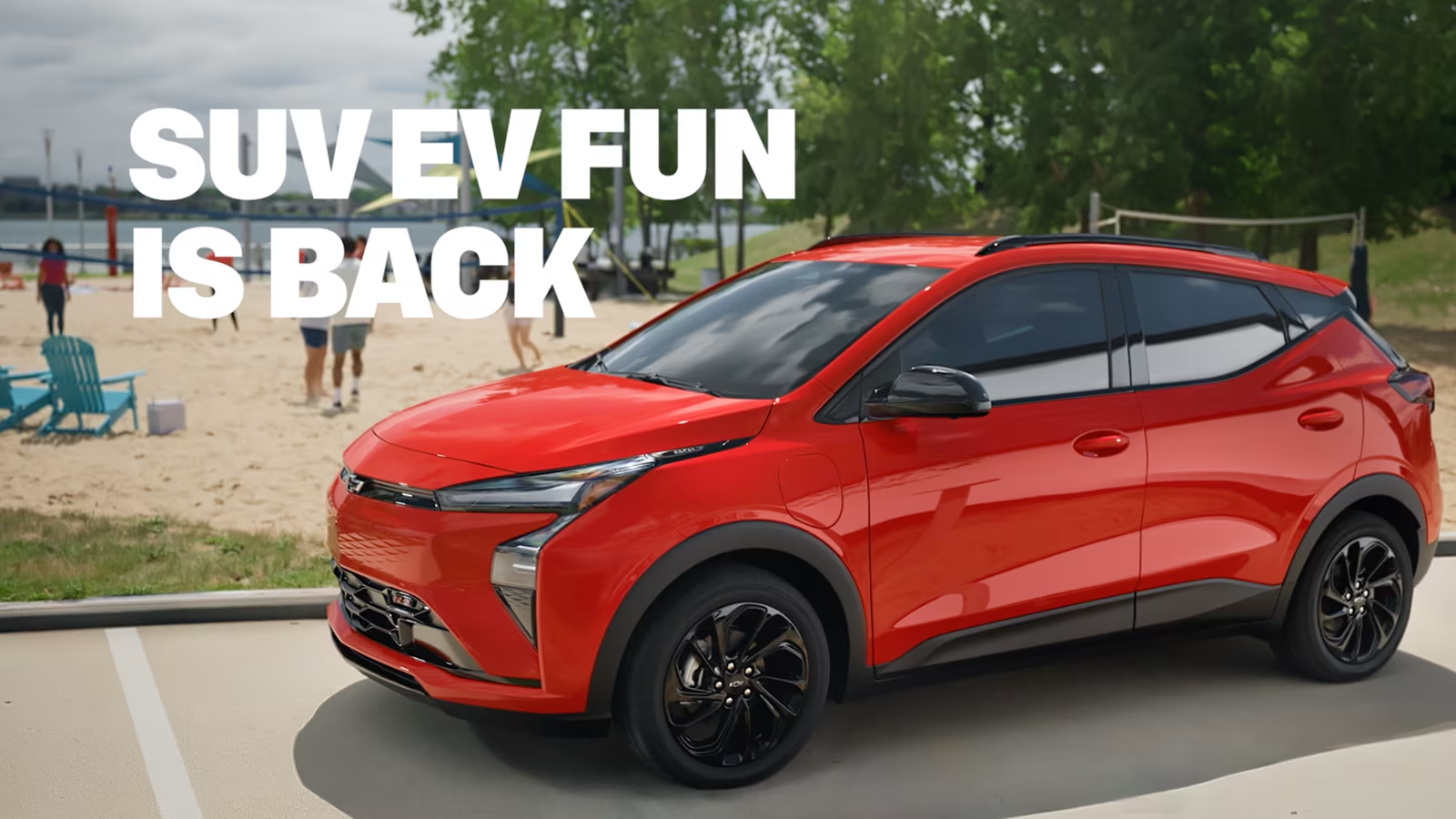
The Chevrolet Bolt EV was discontinued after the 2023 model year, but in 2026 it remains one of the most interesting used EV purchases available. This review is not about a new 2026 Bolt — there is no 2026 Bolt. It is about whether a 2021–2023 Bolt EV, available used for approximately $14,000–$20,000, still makes sense as a purchase decision when the EV market has moved significantly since the Bolt launched. The short answer is yes — but only for one specific type of buyer. The Bolt’s 55 kW DC fast charging limit is not a minor inconvenience: it is a binary filter that either removes it from your consideration set or is completely irrelevant to your ownership, depending entirely on whether you charge at home and avoid long road trips. For the right buyer, no other used EV at this price offers better value.
At its 2023 exit price of approximately $26,500 new, the Bolt was already the most affordable long-range EV in the US market. Two and a half years of depreciation — sharpened by the Tesla price cuts that collapsed used EV values broadly — has pushed well-maintained examples to $14,000–$20,000. A 259-mile EPA range, one-pedal driving, excellent urban maneuverability, and EV-level maintenance costs at a used compact-hatchback price is a combination that does not exist elsewhere in the market.
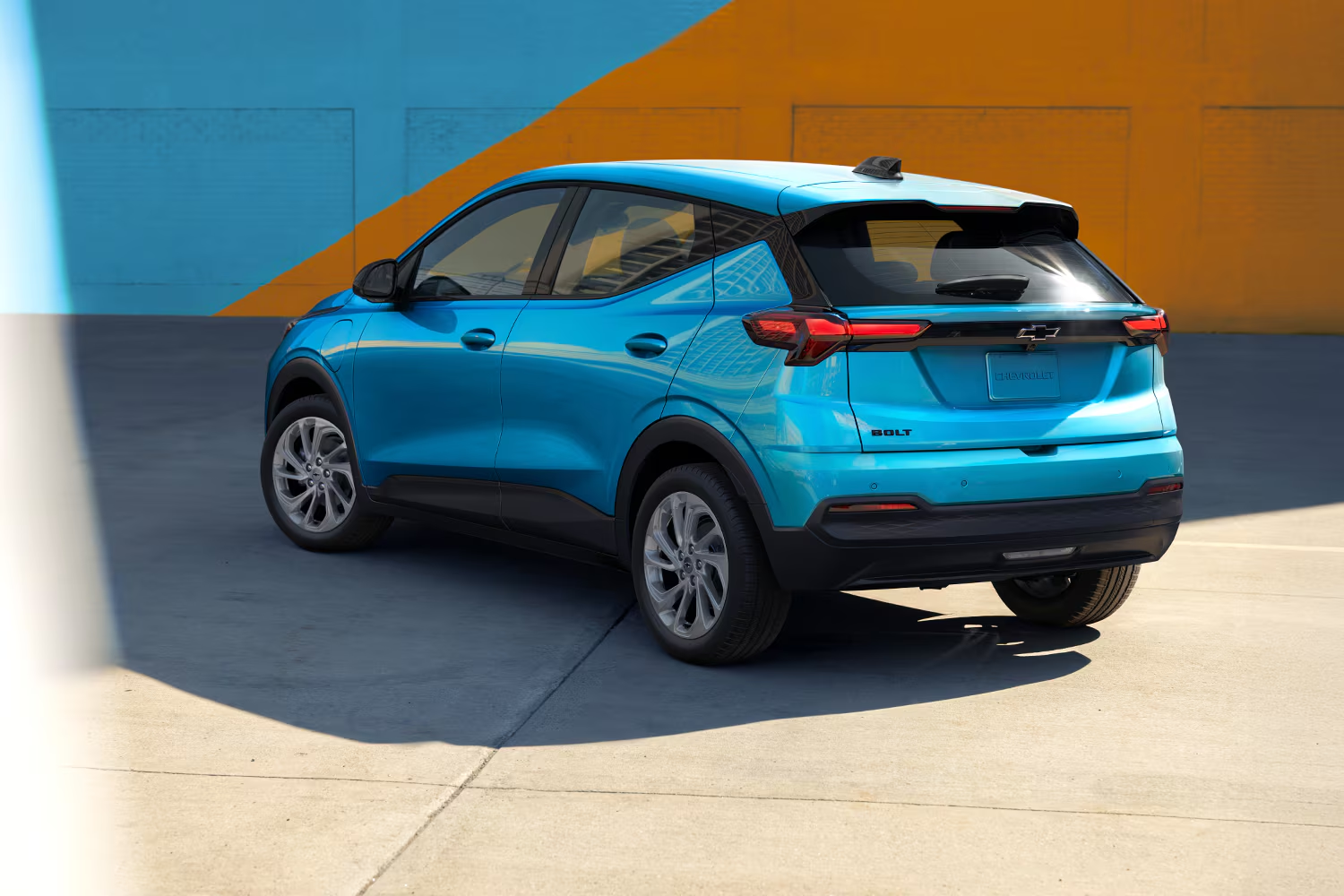
Chevrolet Bolt EV Review 2026 — Quick Answer
Buy it if: You have home charging access, drive under 150 miles per day, and primarily need a reliable urban or suburban commuter. At $14,000–$20,000 used, the Bolt delivers 259 miles of EPA range, genuine one-pedal driving, and EV maintenance savings that no other vehicle at this price can match. Don’t buy it if: You rely on DC fast charging more than occasionally — its 55 kW peak means a 10–80% charge takes approximately 60 minutes, versus 18 minutes for an 800V vehicle. On a road trip with limited charging options, that gap is the difference between a manageable stop and an hour-long wait at a grocery store parking lot. Battery recall note: 2020–2022 model years were subject to a battery fire recall; GM replaced batteries under warranty. Verify replacement status before purchasing any pre-2023 example.
Who the Bolt EV Is Still For in 2026
The profile of the ideal Bolt EV buyer in 2026 is specific, and it has not changed much since 2017. The vehicle was designed for urban and suburban commuters who charge at home, and that is still the only profile it serves well.
Home charger, daily commute under 100 miles
The Bolt’s 259 miles of range covers six average US commuting days on one charge. A Level 2 home charger replenishes the full battery overnight. The 55 kW DC charging limit is completely invisible. At $14,000–$20,000, the total 5-year ownership cost beats nearly any new or used alternative.
City driver, second car in a household
The Bolt’s 102-inch wheelbase and tight 34-foot turning circle make it the most maneuverable EV in the market at any price. As an urban runabout where DC fast charging is never needed, it is genuinely excellent. Cargo is 16.6 cu ft standard, 56.9 cu ft with seats down — more practical than it looks.
Occasional road trips (twice per year or fewer)
If you road trip rarely and accept 60-minute DC fast charging stops rather than 20-minute ones, the Bolt is still manageable. Plan charging stops at every 150–180 miles rather than 220+, use PlugShare to find reliable CCS stations, and budget extra time. Not comfortable, but workable for occasional use.
Regular road tripper, no home charging
Without home charging, you rely on public DC fast chargers — where 60-minute stops at 55 kW are genuinely painful and the cost advantage over gasoline nearly disappears. Without home charging and with regular long-distance driving, the Bolt EV is the wrong vehicle regardless of the purchase price.
Key Specs: What You’re Actually Getting
| Specification | 2022–2023 Chevrolet Bolt EV | vs Hyundai Ioniq 5 (2022, similar used price) |
|---|---|---|
| Used price range (2026) | ~$14,000–$20,000 BEST VALUE | ~$22,000–$28,000 |
| EPA range | 259 mi | 220–266 mi (trim dependent) |
| Battery (usable) | ~63 kWh (65 kWh gross) | 58 kWh / 77.4 kWh (trim dependent) |
| DC fast charging peak | 55 kW SLOW | 220 kW (800V) FAST |
| 10–80% charge time (DC fast) | ~60 minutes SLOW | ~18 minutes FAST |
| Level 2 (home) charge rate | 11.5 kW — adds ~40 mi/hour | 10.9 kW — similar |
| Drivetrain | Front-wheel drive, 200 hp, 266 lb-ft | RWD or AWD, 168–320 hp |
| 0–60 mph | ~6.5 seconds | ~5.1 seconds (LR RWD) |
| Heat pump | No MISSING | Yes |
| One-pedal driving | Yes (i-Pedal + regen paddle) GOOD | Yes (i-PEDAL mode) |
| Battery warranty | 8yr / 100K mi (or from recall replacement date) | 10yr / 100K mi |
| Cargo (rear seats up) | 16.6 cu ft COMPETITIVE | 27.2 cu ft |
Range and Real-World Performance
The 2022–2023 Bolt’s 259 miles of EPA range remains a strong figure in 2026 — it covers the equivalent of eight average US one-way commutes. In real-world conditions, the number drops as it does with any EV.
At 65 mph highway driving in moderate temperatures (60–75°F), expect approximately 215–230 miles of actual range — roughly 83–89% of EPA. At 75 mph, range drops to around 195–210 miles. Cold weather adds a further penalty: the Bolt lacks a heat pump, relying instead on resistive electric heating that draws directly from the battery pack. In sub-freezing temperatures (below 20°F), the AAA and Consumer Reports testing data indicates range can fall to 175–195 miles — a 25–33% reduction from EPA. That is meaningfully more than the 15–20% cold-weather penalty seen in heat-pump-equipped vehicles like the Ioniq 5 or Model Y.
On the positive side, the Bolt’s 3.7 miles/kWh average efficiency is genuinely strong for a vehicle of its size and age. In urban stop-and-go driving — the environment it was designed for — regenerative braking recaptures energy effectively and real-world range often approaches or slightly exceeds the EPA figure. Drivers who primarily cover city miles in moderate climates routinely report 260–275 miles of practical range per charge.
The 55 kW DC Fast Charging Problem — and When It Doesn’t Matter
This is the feature most likely to determine whether the Bolt EV belongs on your shortlist.
The Bolt’s 55 kW DC fast charging peak was competitive when the car launched in 2017. By 2026, it is the slowest DC fast charging rate of any mainstream EV in the market. The practical consequence: a 10–80% charge takes approximately 60 minutes at a CCS fast charger — four times longer than an 800V vehicle on a 350 kW station, and roughly twice as long as a Tesla Model Y on a Supercharger.
| Vehicle | DC Fast Peak | 10–80% Charge Time | Miles Added in 30 Min |
|---|---|---|---|
| Kia EV6 / Ioniq 5 / EV9 | 220–235 kW (800V) | ~18 minutes FASTEST | ~165–180 mi |
| Tesla Model Y | ~170 kW (Supercharger) | ~25–30 minutes | ~130–145 mi |
| Chevrolet Equinox EV | ~150 kW | ~35–40 minutes | ~110–125 mi |
| Chevrolet Bolt EV (2022–2023) | 55 kW SLOWEST | ~60 minutes SLOWEST | ~55–65 mi SLOWEST |
The 55 kW limitation is not a minor inconvenience on a road trip — it is a structural constraint that limits the Bolt to stopping roughly every 150 miles rather than every 200+, and then waiting an hour at each stop. A 400-mile trip that takes a Model Y driver one 25-minute stop takes a Bolt driver two to three 60-minute stops.
Battery Recall: What to Check Before You Buy
Between 2021 and 2023, GM issued a series of battery fire recalls covering 2017–2022 Bolt EVs. The recall stemmed from a manufacturing defect in LG Energy Solution battery cells that created a risk of fire when charged to full capacity. GM’s remedy was a full battery module replacement for all affected vehicles.
This recall has two significant implications for 2026 used buyers:
Most pre-2023 Bolt EVs have had their batteries replaced. If the recall was completed, the vehicle has a factory-fresh battery pack — with the 8-year / 100,000-mile warranty running from the date of replacement, not the date of original purchase. A 2021 Bolt that had its battery replaced in December 2022 has battery warranty coverage until December 2030 regardless of the vehicle’s age.
Some vehicles may not have completed the recall. Before purchasing any 2017–2022 Bolt EV, verify recall completion status through the NHTSA VIN lookup tool (nhtsa.gov/recalls) and confirm with the seller. A vehicle with an outstanding recall should have the recall completed before purchase — GM dealers are required to perform this repair at no cost.
The 2023 model year Bolt EV — the last produced — was never subject to the recall. It used an updated LG Energy Solution cell specification that resolved the defect. A 2023 Bolt bought used is therefore the cleanest purchase from a battery history perspective, though it commands a slight premium: expect $17,000–$21,000 for a well-maintained 2023 example.
5-Year Ownership Cost vs Newer EVs and Gas Cars
The Bolt’s financial case in 2026 is built on its used purchase price, not its specification sheet. At $14,000–$20,000 the 5-year total cost of ownership is lower than almost any comparable vehicle — EV or gas — primarily because the purchase price is so far below market for the range it delivers.
| 5-Year Cost Item | 2022 Bolt EV (used ~$17,000) |
2022 Hyundai Ioniq 5 (used ~$25,000) |
Honda Civic LX (new ~$24,000) |
|---|---|---|---|
| Purchase price | ~$17,000 LOWEST | ~$25,000 | ~$24,000 |
| Fuel / charging (5yr, home) | ~$2,500 LOWEST | ~$2,500 | ~$5,400 |
| Maintenance (5yr) | ~$1,800 LOWEST | ~$2,000 | ~$3,800 |
| Insurance (5yr, estimated) | ~$7,000 | ~$8,500 | ~$7,200 |
| Depreciation (5yr from purchase) | ~$6,000–$9,000 est. | ~$8,000–$12,000 est. | ~$9,500 (~40%) |
| Estimated total 5-year cost | ~$28,000–$31,000 WINNER | ~$38,000–$43,000 | ~$40,000–$45,000 |
The Bolt wins on total 5-year cost by approximately $10,000–$14,000 versus either the used Ioniq 5 or a new Honda Civic. The gap is driven almost entirely by the purchase price differential: $17,000 versus $24,000–$25,000. The fuel and maintenance savings are real but are not the primary driver of the financial advantage — it is the entry cost that makes the Bolt EV uniquely compelling for cost-conscious buyers.

Interior, Comfort, and Technology in 2026
The Bolt’s interior was competent in 2017 and feels dated by 2026 standards. That is not a fatal criticism — it is honest context for buyers comparing it to current offerings.
Infotainment. The 2022–2023 Bolt runs a 10.2-inch touchscreen with wireless Apple CarPlay and Android Auto. The interface is responsive for its generation, though it lacks the over-the-air update cadence of Tesla or Rivian. Navigation and voice control are functional rather than impressive. The system does not integrate charging stop planning the way Tesla’s does — it cannot automatically route you to CCS chargers with estimated arrival state of charge.
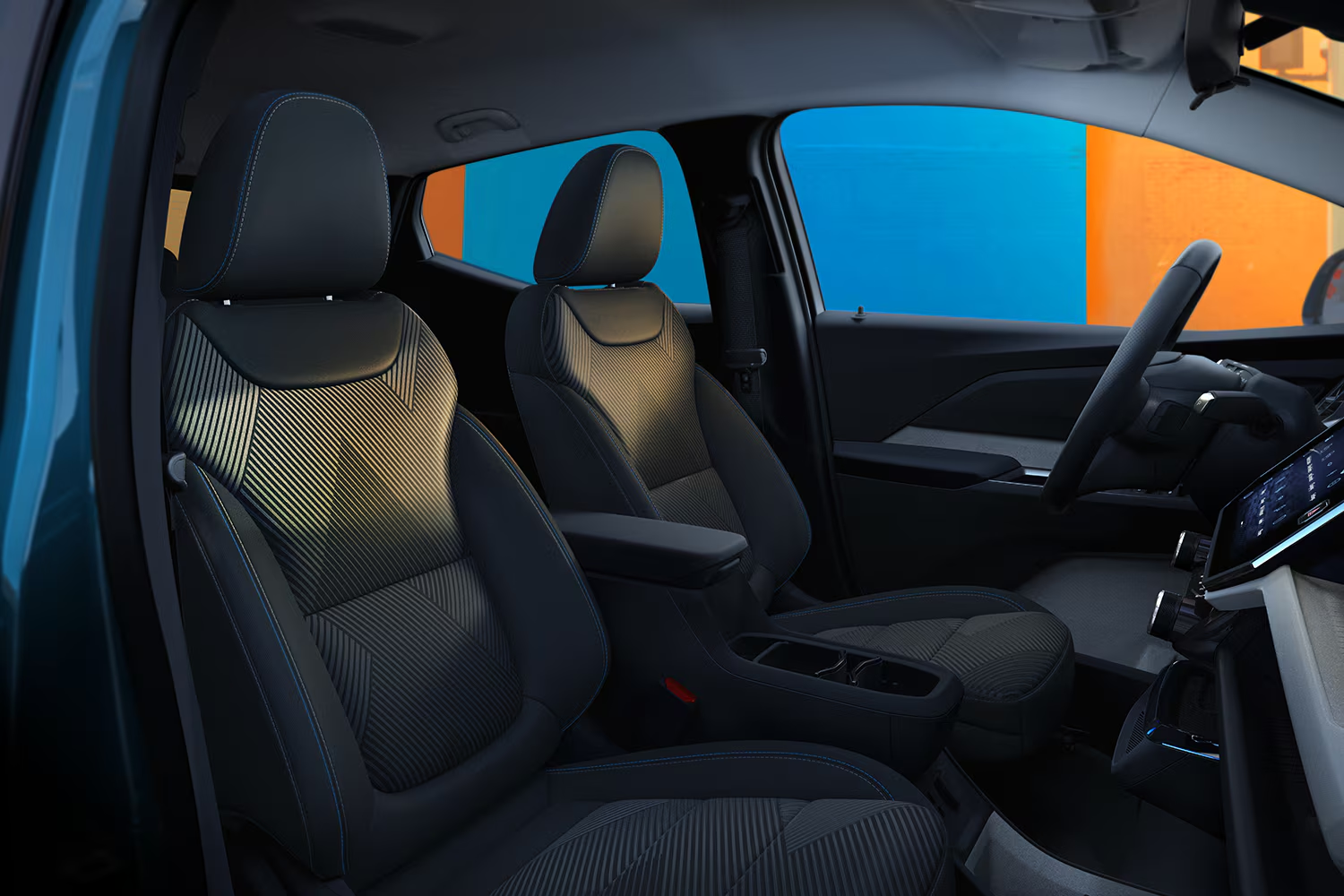
Seats and cabin space. Front seats are comfortable for drives up to two hours and have enough adjustment range for tall drivers. Rear legroom (36 inches) is generous relative to the car’s exterior footprint. The flat floor in the rear — a benefit of EV packaging with no driveshaft tunnel — makes the centre rear seat genuinely usable rather than a punishment post.
Cargo. The hatchback body delivers 16.6 cubic feet with seats up and 56.9 cubic feet with the rear seats folded. The load floor is nearly flat when folded, making the Bolt practical for furniture runs, camping gear, or anything requiring a flat surface. For a vehicle of its footprint, cargo versatility is one of its strongest relative attributes.
Driving dynamics. The Bolt drives with predictable, competent front-wheel-drive handling. It is not exciting — body roll in corners is more pronounced than a similarly sized sports-oriented hatchback. One-pedal driving via the i-Pedal mode is excellent: one of the strongest implementations of the feature available when the car was new, and it remains genuinely good in 2026. The Regen on Demand paddle on the left side of the steering wheel adds a useful intermediate option for drivers who want more granular control.
Noise and refinement. EV silence at low speed is present and appreciated. At highway speeds above 65 mph, road noise and wind noise are more noticeable than in newer, more heavily NVH-treated vehicles — the Bolt’s 2017 platform was not engineered to the same highway refinement standard as the 2022+ Ioniq 5 or Model Y. It is not unpleasant, but it is audibly older at speed.
Should You Buy the Bolt EV or a Newer Used EV?
The Bolt EV is the right used EV purchase for buyers who prioritise the lowest possible 5-year total cost and primarily use the car for home-charged commuting. For buyers with additional requirements — road trips, cold-climate range security, a more modern interior — the cost difference to a 2022 Ioniq 5 or 2022 Kia EV6 is $6,000–$10,000, and that gap buys meaningfully better fast-charging capability, a heat pump, and a more current driving environment.
Buy the Bolt EV If…
- You have home Level 2 charging and your daily commute is under 100 miles
- You want the lowest 5-year total ownership cost available in the used EV market
- You road trip rarely — once or twice a year — and can plan around 60-minute charging stops
- You live in a moderate climate where the lack of a heat pump costs you less than 20% winter range
- Your budget is firmly under $18,000 — at this price, no other EV delivers 250+ miles of range
- You verified the battery recall was completed and the state of health is above 85%
Buy a Newer Used EV Instead If…
- You road trip more than twice per year — 60-minute DC stops will frustrate you quickly
- You live in a cold climate and need consistent winter range above 200 miles
- You have no home charging and rely on public DC fast charging for routine use
- You want a modern infotainment system with OTA updates and integrated charge planning
- Your budget extends to $22,000–$28,000 — a 2022 Ioniq 5 or 2022 EV6 is reachable and the fast-charging gap alone justifies it for regular road trippers
- You need NACS native access without an adapter for Supercharger compatibility
The honest summary: the Bolt EV is the best used EV deal in the market for a specific buyer. That buyer is a home charger, suburban or urban commuter, moderate-climate driver who road trips rarely. Outside of that profile, the $6,000–$10,000 price gap to a 2022 Ioniq 5 or EV6 buys real, daily-felt improvements in charging speed, cold-weather range, and interior modernity that most buyers who leave the city regularly will notice. Match the car to the buyer, not the price tag alone.
Frequently Asked Questions
Is the Chevrolet Bolt EV a good buy in 2026?
Yes — for the right buyer. At $14,000–$20,000 used with 259 miles of EPA range and EV-level maintenance costs, the Bolt delivers better value per dollar than any comparable vehicle in the 2026 market. The condition: you need home charging access and must be comfortable with the 55 kW DC fast charging limit, which makes road trips slow but is invisible in daily commuting use. Verify battery recall completion and state of health above 85% before purchasing any pre-2023 example.
Does the Chevrolet Bolt EV hold up well used?
Yes. Consumer Reports gives the Bolt EV above-average reliability for the 2022–2023 model years, excluding the pre-recall battery issues that were resolved under warranty. The drivetrain is mechanically simple — no transmission, no engine, no exhaust — and battery degradation in real-world examples has been modest. Owners regularly report 95%+ state of health at 50,000–60,000 miles. The primary variable to check before any used purchase is the battery recall status and current SoH via OBD-II diagnostic.
What was the Chevrolet Bolt EV battery recall about?
Between 2021 and 2023, GM recalled 2017–2022 Bolt EVs due to a manufacturing defect in LG Energy Solution battery cells that created a fire risk when charged to 100%. GM’s remedy was a full battery module replacement at no cost to the owner. Most affected vehicles have had the recall completed. Before purchasing any 2017–2022 Bolt EV, verify recall completion via the NHTSA VIN lookup at nhtsa.gov/recalls. A vehicle with a completed replacement has a new battery with the 8-year / 100,000-mile warranty running from the replacement date.
How slow is the Bolt EV’s DC fast charging compared to other EVs?
Significantly slower. The Bolt peaks at 55 kW, taking approximately 60 minutes for a 10–80% charge. A Hyundai Ioniq 5 or Kia EV6 on 800V architecture peaks at 220–235 kW and completes the same 10–80% charge in approximately 18 minutes. A Tesla Model Y on a Supercharger takes approximately 25–30 minutes. In practice, this means a 400-mile road trip that takes a Model Y driver one 25-minute stop takes a Bolt driver two to three 60-minute stops. For home-charging commuters who never use DC fast charging, the limitation is completely invisible.
What is the real-world range of the Bolt EV?
In moderate temperatures (60–75°F) at 65 mph, expect approximately 215–230 miles — about 83–89% of the 259-mile EPA figure. At 75 mph, range drops to around 195–210 miles. In cold weather below 20°F, the Bolt’s lack of a heat pump means range can fall to 175–195 miles — a 25–33% EPA reduction that is larger than the 15–20% penalty seen in heat-pump-equipped EVs. In warm-weather urban driving with frequent regenerative braking, real-world range can approach or slightly exceed EPA.
How much does it cost to charge a Chevrolet Bolt EV at home?
At the US national average residential electricity rate of $0.14/kWh, a full charge (63 kWh usable) costs approximately $8.82. At 12,000 miles per year and the Bolt’s 3.7 mi/kWh average efficiency, the annual home charging cost is approximately $454–$500. This compares to approximately $1,286 for a 28 mpg gas car at $3.00/gallon — a fuel saving of approximately $786 per year, $3,930 over five years. Public DC fast charging at $0.35–$0.50/kWh raises the per-mile cost to $0.09–$0.13/mile, significantly reducing the fuel saving.
Should I buy the Bolt EV or the Chevrolet Equinox EV?
For a used purchase under $20,000: the Bolt EV is the only option — the Equinox EV is not yet widely available used at that price point. For a new or newer-used purchase in the $30,000–$38,000 range: the Equinox EV is the better buy. It offers 319 miles of EPA range (60 more than the Bolt), 150 kW DC fast charging (nearly three times the Bolt’s speed), and a modern GM Ultium platform with OTA updates. The Bolt’s advantage is price — nothing else; at $14,000–$18,000 used, the Equinox EV at $34,995 new simply cannot match the value-per-dollar calculation.