Last Updated: May 2026 — EV manufacturer maintenance schedules, DOE AFDC data, and Consumer Reports maintenance cost figures verified
Pure electric cars never need an oil change. There is no engine oil in a BEV — no sump, no filter, no drain plug. If you own a Tesla Model 3, Hyundai Ioniq 6, or Chevrolet Bolt EV, you will never book an oil change appointment for as long as you own the car. That part is not surprising once you think about it.
The part that surprises most new EV owners is this: EVs are not maintenance-free, and one service item becomes more critical in an EV than in a gas car, not less. Brake fluid. In a gas car, friction brakes generate heat repeatedly — that heat cycles through the hydraulic system and gives you early warning when the fluid is degrading. In an EV, regenerative braking handles 70–90% of all deceleration. The friction brakes sit largely idle. Idle brake fluid absorbs atmospheric moisture faster than most owners expect, quietly lowering the fluid’s boiling point. Most EV manufacturers recommend brake fluid inspection every two years. Most first-time EV buyers miss this entirely because they were busy celebrating never buying oil again. The five-year maintenance savings versus a gas car are real — approximately $1,500–$2,500 for maintenance alone — but understanding where those savings come from, and where they do not, makes for a better ownership decision.

Do Electric Cars Need Oil Changes? — Quick Answer
Pure electric vehicles (BEVs) require zero oil changes — they have no internal combustion engine and therefore no engine oil. Plug-in hybrids (PHEVs) — including the Toyota RAV4 Prime and Prius Prime — have a combustion engine and do need oil changes, though typically less often since the engine runs fewer miles. EVs still need: tire rotation every 5,000–7,500 miles, cabin air filter replacement annually, brake fluid inspection every 2 years, and wiper blades. Brake pads last 2–3 times longer than on gas cars due to regenerative braking. The estimated five-year maintenance saving versus a comparable gas car is approximately $1,500–$2,500 — less than the figure sometimes quoted in EV marketing, but real and consistent.
Why Gas Cars Need Oil — and Why EVs Don’t
Engine oil in an internal combustion engine does three things: it lubricates hundreds of metal components moving against each other at high speed, it carries heat away from those components, and it suspends combustion byproducts — carbon, fuel residue, metal particles — in a stable emulsion until the next oil change flushes them out. Over time, the oil’s additive package breaks down, the viscosity changes, and suspended contaminants accumulate to the point where the oil does more harm than good. That is why the oil change interval exists.
An electric motor has no combustion, no combustion byproducts, and far fewer moving parts. A typical BEV powertrain has a rotor that spins inside a stator — roughly equivalent to swapping a thousand-part reciprocating mechanism for a spinning top. The bearings that support the rotor are sealed and factory-lubricated for the life of the vehicle. There is nothing to drain, nothing to replace, and no degradation cycle driven by heat and chemical byproducts. The electric motor simply runs.
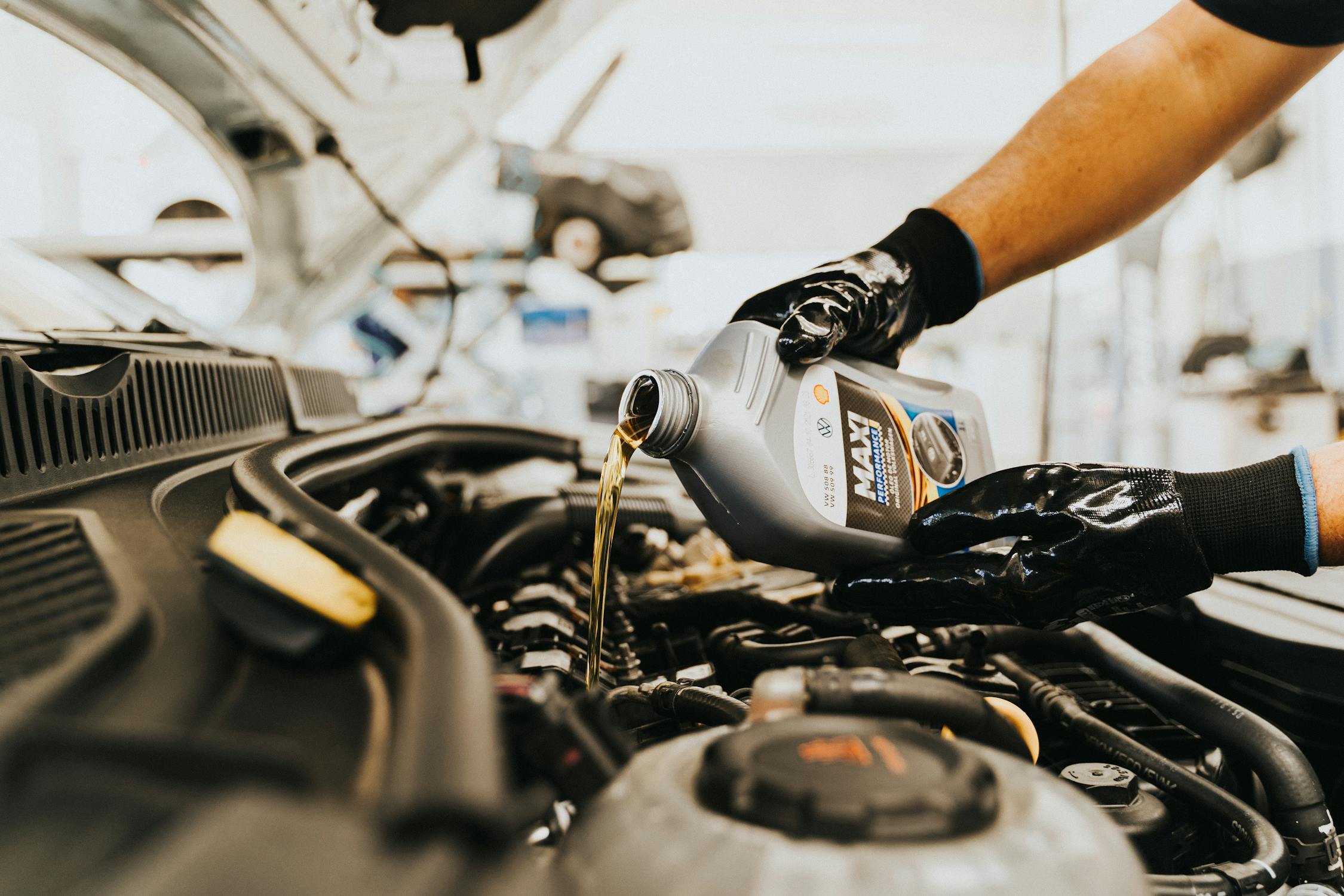
Some EVs do have a separate fluid lubricating the reduction gearbox — the single-speed unit that steps down the motor’s rotational speed to the drive wheels. The Nissan Leaf, for example, recommends inspecting the front gear reducer oil at the first service interval and replacing it around 30,000 miles. Tesla Model 3 and Model Y, by contrast, use a sealed gearbox that requires no scheduled fluid service. This variation matters: before assuming your EV has zero drivetrain fluids, check the owner’s manual for your specific vehicle. Most current EVs follow the sealed Tesla approach, but not all.
What Maintenance Does an EV Actually Need?
The absence of oil changes does not mean the absence of maintenance. EVs have a specific service schedule — it is shorter than a gas car’s, but it is not zero. Here is what stays, what goes, and what changes.
| Service Item | Gas Car | BEV (Pure Electric) | Typical Cost (BEV) | Notes |
|---|---|---|---|---|
| Engine oil change | Every 5,000–10,000 mi | Never ELIMINATED | $0 | No engine, no oil, no filter |
| Spark plugs | Every 30,000–100,000 mi | Never ELIMINATED | $0 | No combustion, no ignition system |
| Engine air filter | Every 15,000–30,000 mi | Never ELIMINATED | $0 | No engine intake; cabin filter remains |
| Transmission / gearbox fluid | Every 30,000–60,000 mi | Varies by model | $0–$150 | Tesla sealed (no service); Nissan Leaf gear reducer ~30,000 mi |
| Tire rotation | Every 5,000–7,500 mi | Every 5,000–7,500 mi SAME | $20–$50/visit | EVs are heavier — may wear front tires faster, especially RWD/AWD with strong regen |
| Brake pads | Every 25,000–60,000 mi | Every 70,000–150,000+ mi MUCH LESS OFTEN | $100–$350 | Regen braking dramatically reduces friction pad wear — Tesla recommends inspection at 150,000+ miles under normal use |
| Brake fluid | Every 2–3 years | Every 2 years MORE CRITICAL | $100–$150 | Hygroscopic fluid absorbs moisture faster when brakes are rarely heat-cycled — see section below |
| Cabin air filter | Annually or 15,000–25,000 mi | Annually or 15,000–25,000 mi SAME | $20–$50 | Same interval and cost — replace more often if you drive in heavy traffic or dusty conditions |
| Wiper blades | Annually or as needed | Annually or as needed SAME | $15–$40 | No difference from a gas car |
| Battery coolant (HV system) | N/A | Every 5–7 years (some models) | $150–$350 | Not universal — some EV battery packs are air-cooled or use sealed liquid systems. Check your owner’s manual. |
| 12V auxiliary battery | Every 3–5 years | Every 5–8 years | $150–$300 | EVs have a 12V auxiliary battery for accessories — distinct from the traction pack. Frequently overlooked by first-time EV owners. |
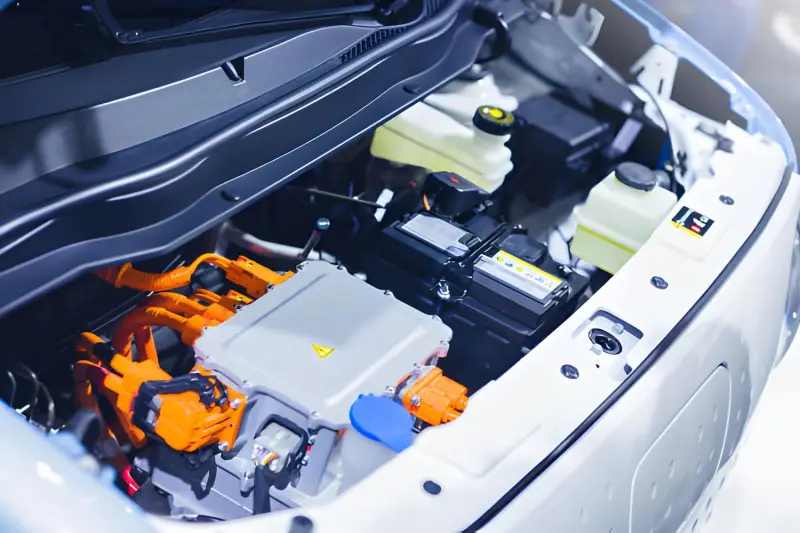
One item deserves particular attention: the 12V auxiliary battery. Every EV has one — a separate, conventional 12V lead-acid or lithium battery that powers accessories, the 12V electrical system, and the car’s main computer when the high-voltage pack is not actively engaged. It works exactly like the 12V battery in a gas car, fails in the same ways, and needs to be replaced on a similar schedule. Tesla Model 3 owners have discovered this the hard way when their cars went completely unresponsive — not because the 400V traction battery was dead, but because the $200 12V battery failed. Add it to your maintenance calendar.
PHEVs: The Exception to the Rule
Plug-in hybrid vehicles — PHEVs — are not pure electric cars. They have both an electric motor and a functioning internal combustion engine. That engine has pistons, a crankshaft, a timing belt or chain, spark plugs, an air intake, and oil. It needs oil changes on a regular schedule, and it will continue to need them for as long as you own the car.
The oil change interval for PHEVs is typically the same as for the gas version of the same vehicle. The Toyota RAV4 Prime, for example, follows Toyota’s standard synthetic oil interval: every 10,000 miles or 12 months under normal driving conditions. The Ford Escape PHEV and Hyundai Tucson PHEV follow similar schedules — annual oil changes at a minimum, regardless of how many miles the engine actually ran in electric mode.
The reason the mileage-based interval still matters even when the engine runs infrequently is that oil degrades on a time basis as well as a mileage basis. Moisture from condensation, fuel dilution from cold-start enrichment, and oxidation from temperature cycling all occur regardless of how many miles the engine turns. Toyota specifically notes that PHEV owners who drive primarily on electric power should still follow the time-based interval — annual change — rather than assuming extended intervals are safe because the odometer hasn’t moved much.
Standard non-plug-in hybrids — the Toyota Camry Hybrid, Honda Accord Hybrid, and similar — also need regular oil changes on the same schedule as their gas equivalents. The hybrid system in these vehicles extends battery life and improves fuel economy, but does not meaningfully change the engine maintenance schedule. The oil still gets dirty; the interval is still relevant.
The Service That Surprises Most EV Owners: Brake Fluid
This is the maintenance item that most EV buyers do not anticipate — and the one where assuming “EVs need less maintenance” leads to a specific, avoidable problem.
Brake fluid is hygroscopic, meaning it absorbs water from the atmosphere through microscopic permeability in rubber brake lines and caliper seals. This is true in both gas cars and EVs. The difference is what happens next. In a gas car, drivers use the friction brakes routinely — every deceleration that is not coast-down involves the pads pressing against the rotors. That friction generates heat, which in turn heats the brake fluid repeatedly. The regular heat cycling does not make the fluid better, but it does give a mechanic inspecting the fluid early warning signals: darkened color, cloudiness, copper content from corroded brake lines.
In an EV, regenerative braking handles the majority of deceleration. Under typical urban driving, friction brakes may engage for less than 20% of all braking events. The hydraulic system sits largely dormant between the occasional hard stop. Without regular heat cycling, moisture absorption continues on its own schedule — and without the discoloration and copper buildup that heat accelerates, the contamination is less visually obvious during a casual inspection.
The consequence of contaminated brake fluid is a depressed wet boiling point. Standard DOT 3 brake fluid has a dry boiling point above 400°F, but its wet boiling point — after 3.7% moisture absorption — drops to approximately 284°F. In a hard braking event from highway speed, brake fluid can momentarily exceed this threshold, converting to vapor and causing brake fade or, in severe cases, complete loss of pedal feel. This scenario is uncommon in normal driving — but it is the reason every major EV manufacturer, including Tesla, Hyundai, and Chevrolet, recommends brake fluid inspection every two years regardless of mileage.

The practical implication: set a calendar reminder for brake fluid inspection at the 2-year mark regardless of mileage. The inspection itself is inexpensive — a mechanic checks the fluid’s moisture content with a test strip or refractometer, typically for $20–$50. If contamination is found, a full flush runs $100–$150. Budget for one flush every four years as a baseline, with the possibility of skipping it if the inspection comes back clean.
5-Year Maintenance Cost: EV vs Gas Car
The DOE’s Alternative Fuels Data Center estimates that gas car owners spend approximately $0.061 per mile on maintenance, while BEV owners spend approximately $0.030 per mile — roughly half. Applied to 12,000 miles per year over five years, that gap translates to approximately $1,860 in maintenance savings over the ownership period. That figure is consistent with what detailed cost breakdowns produce when you itemize the services.
| Service | Gas Car — 5-Year Cost | BEV — 5-Year Cost | EV Saves |
|---|---|---|---|
| Oil changes | $640–$960 8 changes × $80–$120 synthetic |
$0 | $640–$960 |
| Engine air filter | $60–$100 2 replacements |
$0 | $60–$100 |
| Spark plugs | $150–$350 1 set iridium/platinum at ~60k mi |
$0 | $150–$350 |
| Transmission service | $150–$250 1 service at ~60k mi |
$0–$100 Sealed (Tesla) or one gear reducer service (Leaf) |
$50–$250 |
| Brake pads (front + rear) | $300–$600 1–2 sets in 60k miles |
$0–$150 Often not needed in first 60k miles; prorated to first replacement at 100k+ |
$150–$600 |
| Brake fluid | $200–$300 2 flushes over 5 years |
$200–$300 Same interval — 2 flushes |
$0 (same cost) |
| Cabin air filter | $100–$200 4–5 replacements |
$100–$200 Same interval |
$0 (same cost) |
| Tire rotation | $240–$320 8 rotations at $30–$40 |
$240–$400 Same or slightly more — heavier vehicle weight accelerates wear on some models |
$0 (same or slightly more) |
| 12V auxiliary battery | $150–$200 Likely 1 replacement |
$150–$300 Similar — may be lithium (more expensive) in newer models |
$0 (similar cost) |
| 5-Year Total | $1,990–$2,930 | $690–$1,450 | $1,300–$2,500 |
The honest read of this table: the savings are front-loaded in the services that disappear entirely — oil changes, spark plugs, air filter, and transmission. These account for the bulk of the $1,300–$2,500 range. The services that remain — brake fluid, cabin filter, tire rotation, 12V battery — cost nearly the same in both vehicles. EV ownership reduces your total maintenance spend meaningfully, but it does not eliminate it.
If you drive 20,000 miles per year rather than 12,000, the savings scale up roughly in proportion. If you drive 6,000 miles per year, the fixed-cost services (brake fluid, 12V battery) become a higher proportion of your total spend, and the per-mile cost advantage narrows. High-mileage drivers gain the most from eliminating oil changes on a cost-per-mile basis.
When EV Maintenance Savings Are — and Aren’t — Worth the Switch
Maintenance savings alone are rarely the primary justification for buying an EV over a gas car. But they are a consistent, predictable component of the total ownership calculation. Here is where they are most meaningful and where they are overstated.
Where EV Maintenance Savings Are Real and Predictable
- You drive 15,000+ miles per year — eliminated oil changes compound faster at higher mileage
- You currently pay for synthetic oil changes at $100–$120 per service — the savings per change are higher at the top of the market
- Your gas car has a transmission that requires periodic fluid service — this entire cost category disappears with most BEVs
- You drive hard — EVs are less susceptible to “spirited driving” maintenance penalties (no oil heat stress, no transmission wear)
- You plan to keep the car 7–10 years — the eliminated services accumulate meaningfully over a long ownership period
Where Maintenance Savings Are Overstated or Don’t Apply
- You buy a PHEV — oil changes continue on a standard schedule; savings are reduced compared to a BEV
- You drive under 8,000 miles per year — oil change frequency is limited by the time-based interval anyway; the mileage savings are smaller
- You need to replace EV-specific components (traction battery, DC-DC converter, onboard charger) — these costs have no gas car equivalent and can exceed years of oil change savings in one event
- You expect zero maintenance — tire rotation, brake fluid, and the 12V battery remain on the schedule
- You are comparing a BEV to a reliability-optimized gas car like a Toyota Camry Hybrid — the maintenance gap narrows versus cars with known long-term durability records
Frequently Asked Questions
Do electric cars ever need oil changes?
Pure battery electric vehicles (BEVs) never need engine oil changes. There is no internal combustion engine, no engine oil, and no oil filter. This applies for the full ownership life of the vehicle at any mileage. The only EV-adjacent vehicles that need oil changes are plug-in hybrids (PHEVs) and standard hybrids, both of which have a functioning combustion engine that requires normal oil maintenance.
Does a Tesla need an oil change?
No. Tesla vehicles — Model 3, Model Y, Model S, Model X, and Cybertruck — are pure battery electric vehicles. They have no engine oil, no oil filter, and no oil change requirement at any point in the ownership life. Tesla’s published maintenance schedule covers brake fluid inspection every 2 years, cabin air filter replacement every 2 years (or annually for HEPA-equipped models), tire rotation every 6,250 miles, and periodic inspection of the brake calipers. No oil change is listed anywhere in that schedule.
Do hybrid cars need oil changes?
Yes. Standard hybrids (Toyota Camry Hybrid, Honda Accord Hybrid, etc.) need oil changes on the same schedule as comparable gas vehicles — typically every 7,500–10,000 miles with synthetic oil. Plug-in hybrids (Toyota RAV4 Prime, Hyundai Tucson PHEV) follow the same logic: the combustion engine requires regular oil maintenance regardless of how many miles it ran in electric mode. Annual oil changes are the practical minimum for most PHEV owners.
How much money does an EV save on maintenance over 5 years?
Approximately $1,300–$2,500 in maintenance costs over five years at 12,000 miles per year, compared to a comparable mid-size gas car. This estimate excludes fuel savings, which add a separate $500–$800 per year at average US electricity and gas prices. The DOE’s Alternative Fuels Data Center estimates gas car maintenance at $0.061 per mile versus $0.030 per mile for BEVs — roughly half. The services eliminated entirely are oil changes, spark plugs, engine air filter, and in most cases, transmission fluid service.
Does an EV need brake fluid changes?
Yes, and this is the maintenance item most EV owners underestimate. Brake fluid is hygroscopic — it absorbs moisture over time regardless of how often the brakes are used. Because regenerative braking handles most deceleration in an EV, the hydraulic friction brakes see less use and less heat cycling than in a gas car. This means moisture absorption continues on its own schedule without the visual cues that routine brake use provides. Most EV manufacturers — including Tesla, Hyundai, and Chevrolet — recommend brake fluid inspection every 2 years and replacement when contamination is found.
How long do EV brake pads last compared to gas cars?
EV brake pads typically last two to three times longer than gas car brake pads under normal driving conditions. Regenerative braking handles 70–90% of deceleration force in most EVs, meaning the friction pads rarely engage except during hard stops. Tesla recommends brake pad inspection at 150,000 miles or more under typical driving conditions. Gas car owners generally replace brake pads every 25,000–50,000 miles depending on driving style. Over a 150,000-mile ownership period, an EV owner might replace pads once versus three to five times for a comparable gas car.
What is the most overlooked EV maintenance item?
The 12V auxiliary battery. Every EV has a standard 12V battery — separate from the high-voltage traction pack — that powers accessories, the car’s computers, and the control systems when the main pack is not engaged. It works exactly like a 12V battery in a gas car, fails in the same ways, and costs $150–$300 to replace. Tesla Model 3 and Model Y owners have experienced cars that were completely unresponsive because this battery failed, despite a fully charged traction pack. It typically lasts 5–8 years and should be included in your long-term maintenance budget.